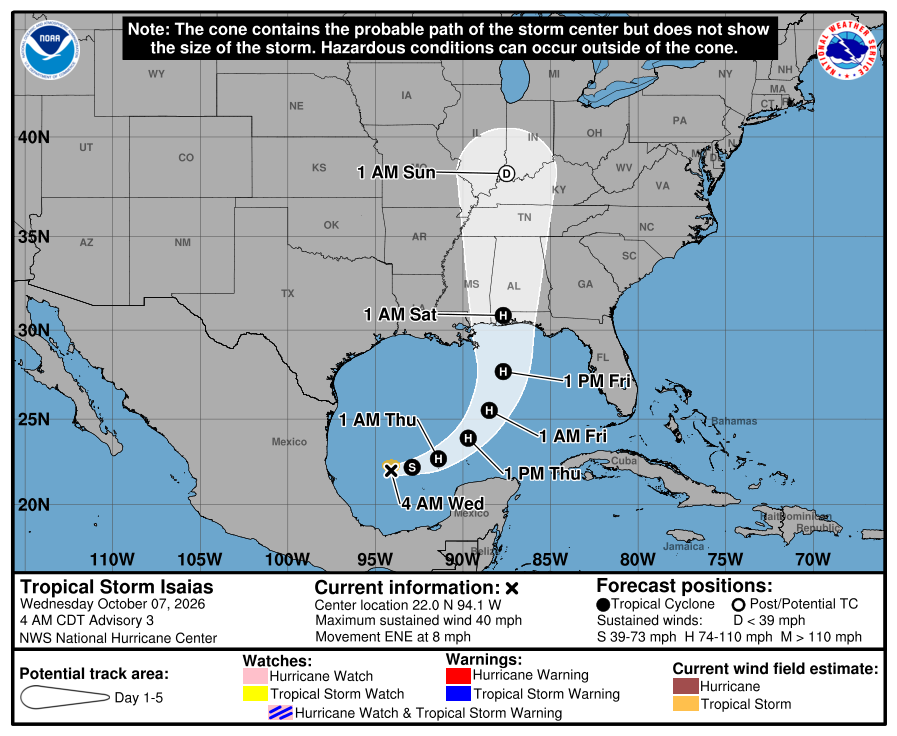
Since my previous update, Tropical Depression 9 has become Tropical Storm Isaias, with maximum sustained winds of 40 mph in the National Hurricane Center’s 4 a.m. CDT Wednesday advisory. NHC now forecasts strengthening to a hurricane before the system reaches the northern Gulf Coast, replacing the earlier range of model possibilities with an official hurricane forecast. The projected coastal approach remains late Friday into early Saturday, with southern Alabama and the western Florida Panhandle near the forecast centerline. I am also tracking the rainfall outlook, which now includes a Moderate Risk of flash flooding near Mobile and adjacent coastal areas.
The NHC forecast cone places Isaias near 22.0°N, 94.1°W, moving east-northeast at 8 mph. The forecast takes the storm east-northeast today before turning northeastward and then northward through the central Gulf. Hurricane symbols begin early Thursday and continue through the coastal approach late Friday into early Saturday, followed by weakening inland. I would interpret the cone as uncertainty in the center’s path; it does not represent the storm’s size or the full area that could experience wind, rainfall, or coastal impacts.
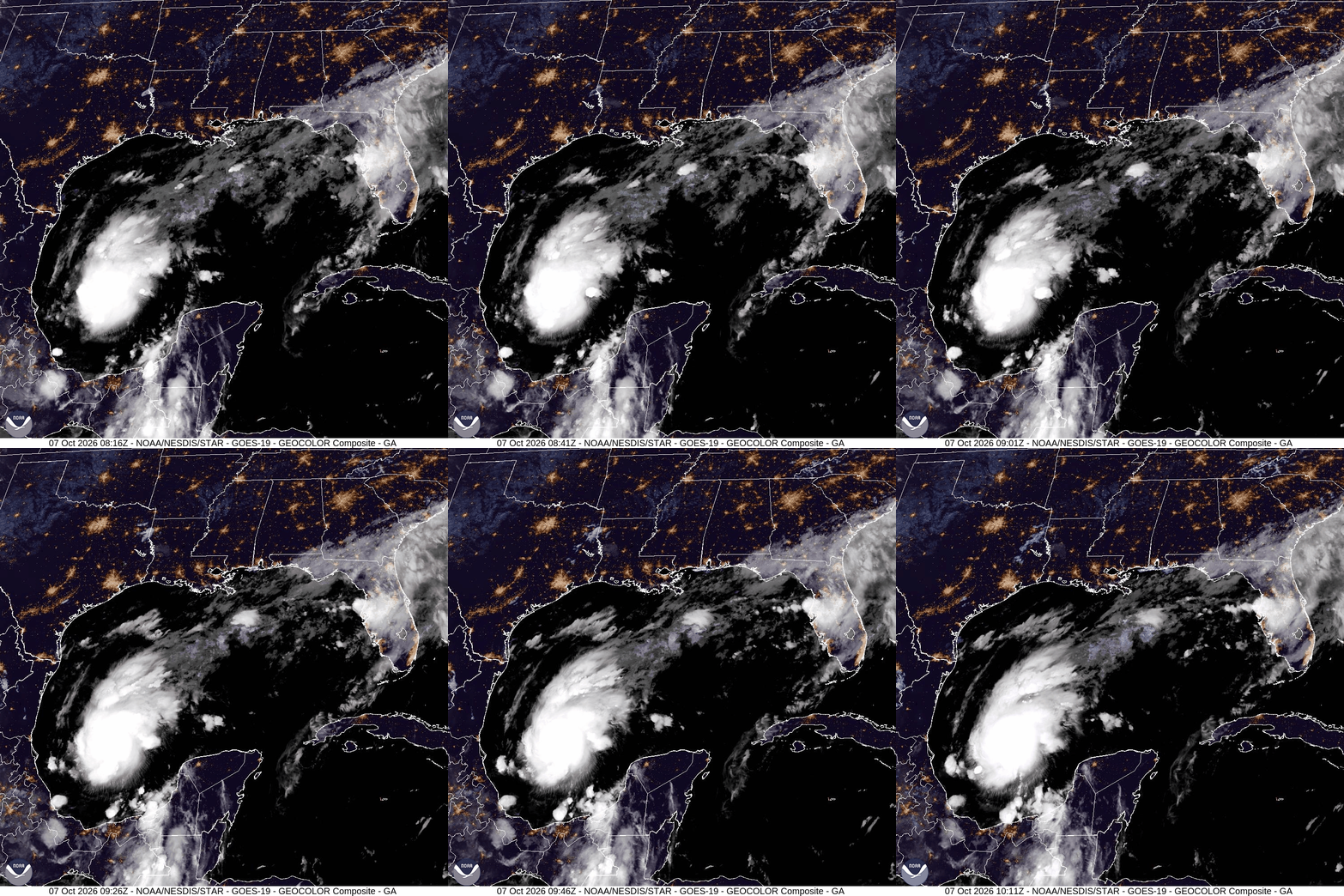
The early-morning GOES-19 satellite image shows a more concentrated area of thunderstorms over the southwestern Gulf than in the previous update, with cloudiness extending northeastward. The storm remains asymmetric, and no eye is apparent in this image. This presentation is consistent with an organizing tropical storm, although satellite appearance alone does not establish its surface wind strength. I will be watching whether convection remains concentrated near the center as Isaias moves away from the Mexican coast.
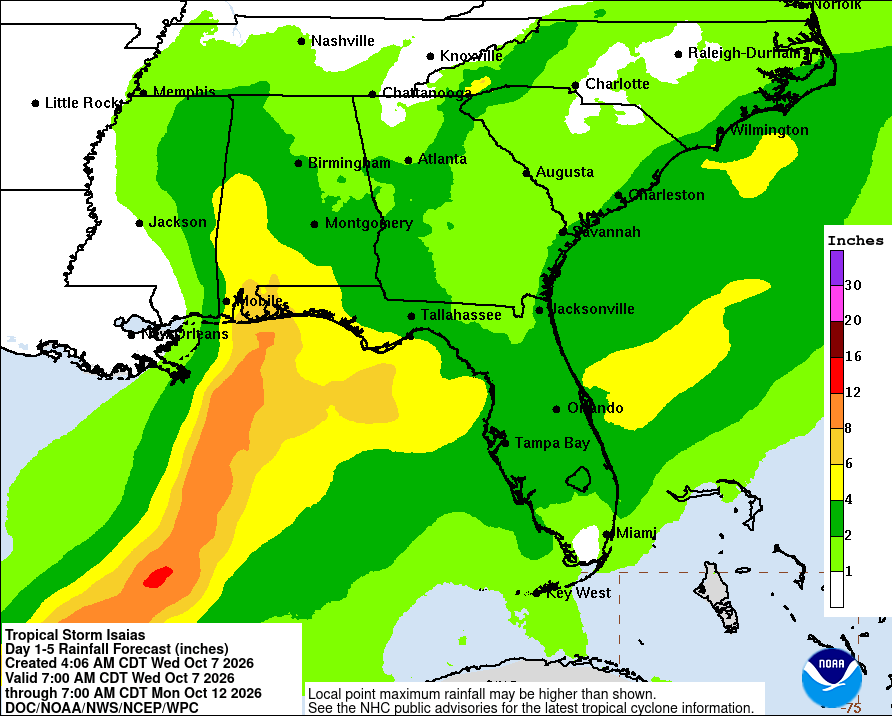
The WPC five-day rainfall forecast, valid Wednesday morning through Monday morning, depicts approximately 4–6 inches across portions of coastal Mississippi, southern Alabama, and the western Florida Panhandle, with locally higher amounts possible. Much of the surrounding Southeast is forecast to receive roughly 1–4 inches, while the largest totals shown remain offshore. I am watching the coastal rainfall corridor and its inland extension through Mississippi and Alabama, where repeated rain bands could produce totals above the mapped averages. The placement of these amounts remains dependent on the track and distribution of thunderstorms.
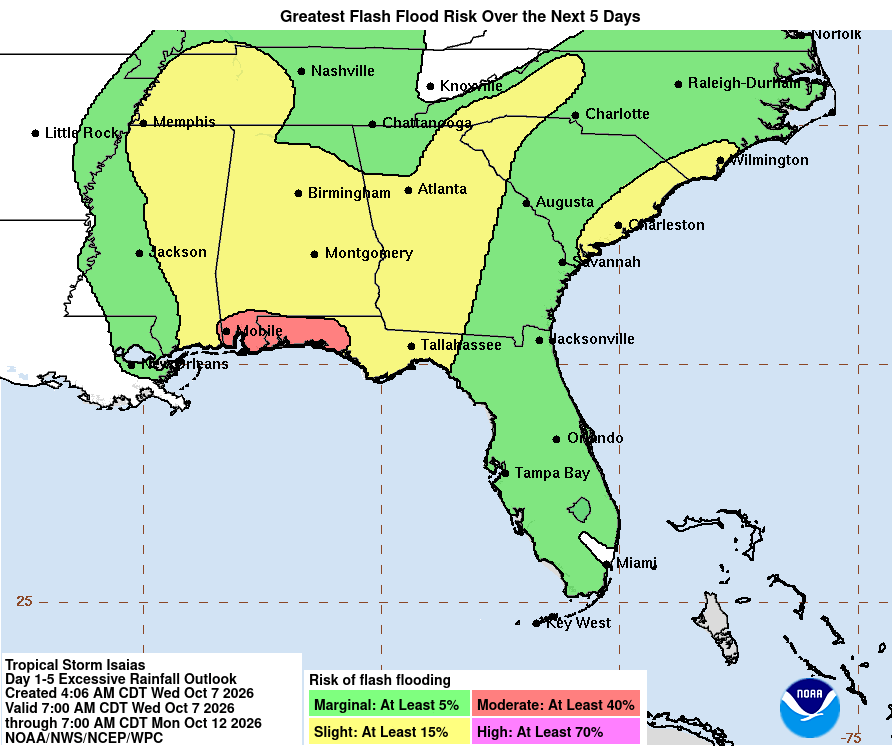
The five-day excessive rainfall outlook identifies a Moderate Risk of flash flooding near Mobile, extending into nearby coastal Mississippi and the western Florida Panhandle. A broader Slight Risk covers much of Mississippi and Alabama, portions of Tennessee and Georgia, the Florida Panhandle, and parts of the Carolinas. The graphic defines these categories as at least a 40% and 15% probability, respectively, within the product’s assessment framework. I view the coastal Moderate Risk area as the current focus for flooding potential, while recognizing that localized flooding could also occur elsewhere within the broader outlook.
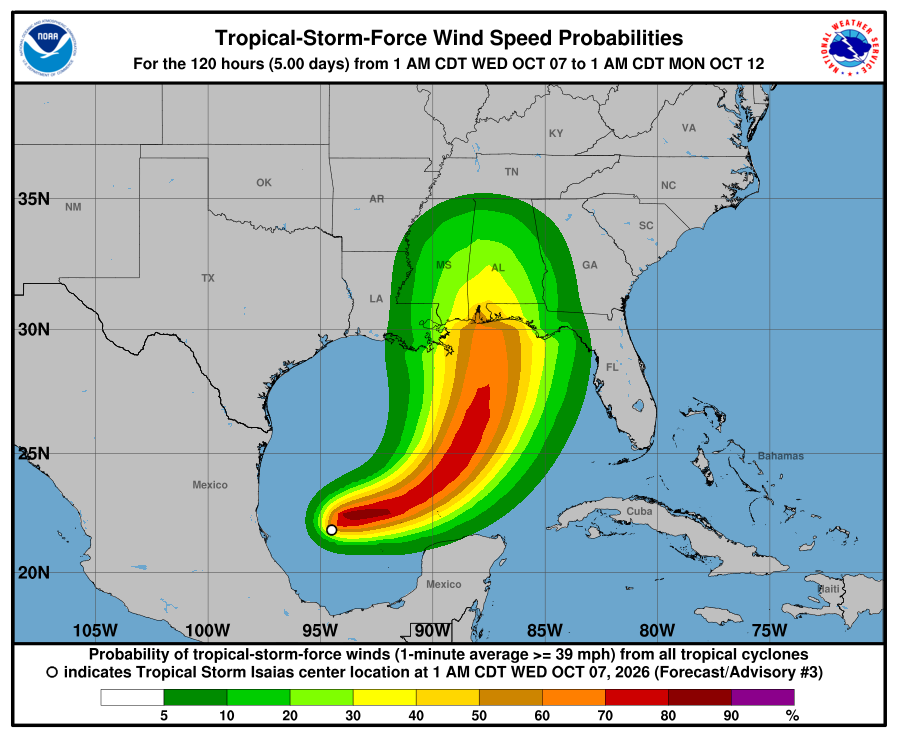
The tropical-storm-force wind probability graphic shows the highest likelihood along the projected path across the Gulf, with probabilities decreasing outward and inland. Portions of the north-central Gulf Coast are within approximately the 40–60% bands for sustained winds of at least 39 mph during the five-day period, with lower probabilities extending farther into Mississippi, Alabama, Georgia, and Florida. I use this graphic to assess the chance of wind reaching that threshold at a location; it does not show the expected maximum wind speed or guarantee that those winds will occur.
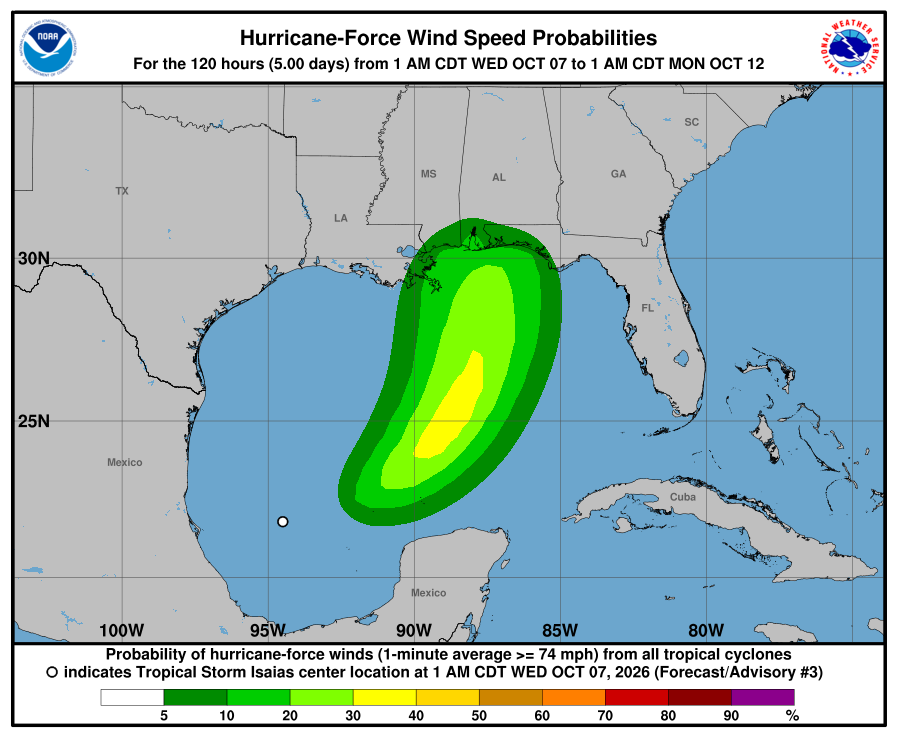
The hurricane-force wind probability graphic shows a narrower area of potential sustained winds of at least 74 mph, centered mainly over the Gulf with lower probabilities reaching the north-central Gulf Coast. This is consistent with an official forecast of hurricane strength while allowing for uncertainty in the track, intensity, and size of the hurricane wind field. I would not interpret the lower probability at an individual coastal location as contradicting the hurricane forecast, because the strongest winds may affect a relatively limited area.
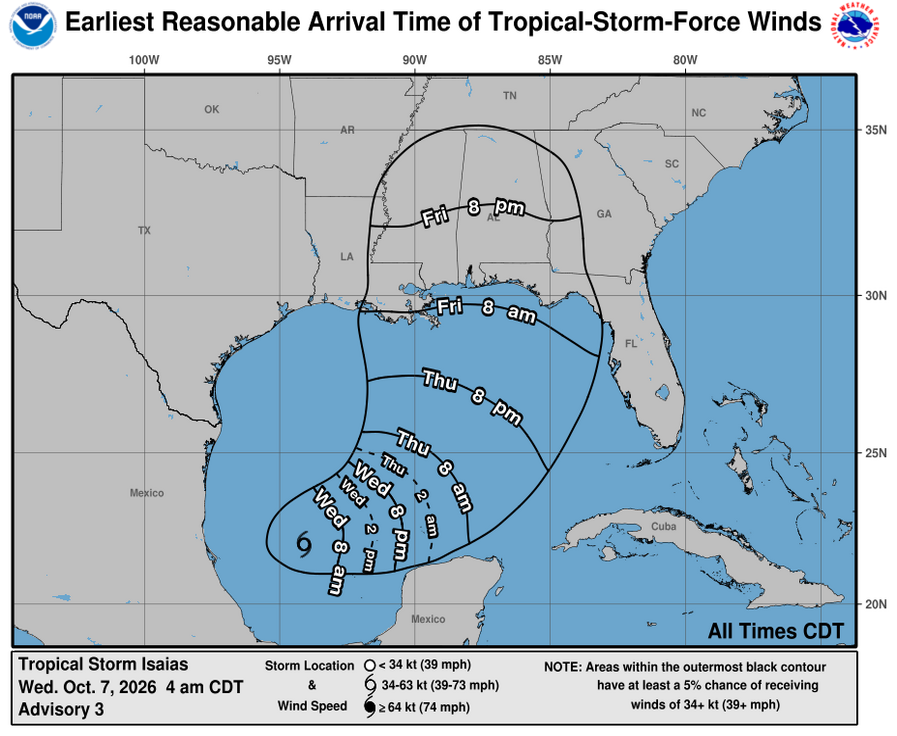
The earliest reasonable arrival-time graphic indicates that tropical-storm-force winds could reach portions of the northern Gulf Coast as early as Friday morning, with an earlier arrival over offshore waters during Thursday. The potential arrival progresses inland across Mississippi and Alabama during Friday, and all times shown are CDT. I would use these times as an early planning boundary rather than the most likely onset time. They describe the possible arrival of sustained winds of at least 39 mph, not the arrival of the center or the beginning of rainfall.
My assessment has shifted from monitoring formation to evaluating an established tropical storm that NHC forecasts to become a hurricane. The main forecast questions are the degree of strengthening, the precise coastal crossing, and the distribution of rainfall and wind on either side of the track. The current graphics support attention to the north-central Gulf Coast late this week, with rainfall and flooding potential extending inland into the weekend. I will provide follow-up updates as observations and subsequent advisories refine those details.
Some precipitation on the way, W’wards initially, then E’wards by days 11-15 is forecast away from ridging conditions moving E to W through period. Confidence lowers on long-range detail, while more meaningful rain is thought to be needed for significant recovery, especially in the Alps as for extreme river stress.
A quick blog just to offer a high level view on precipitation through early October.
- We’re opening the month with wetter conditions in the W, driven by a low deepening over the near Atlantic, while much drier weather is ensured further E by strong ridging.
- Through next week, we forecast a re-organization of higher pressure to the W-NW of Europe, as heights drop across Scandinavia.
- The prelude to troughing sagging into E Europe by late W41 into early W42. Cooler and unsettled conditions over C-E Europe will foster higher precipitation than recently seen.
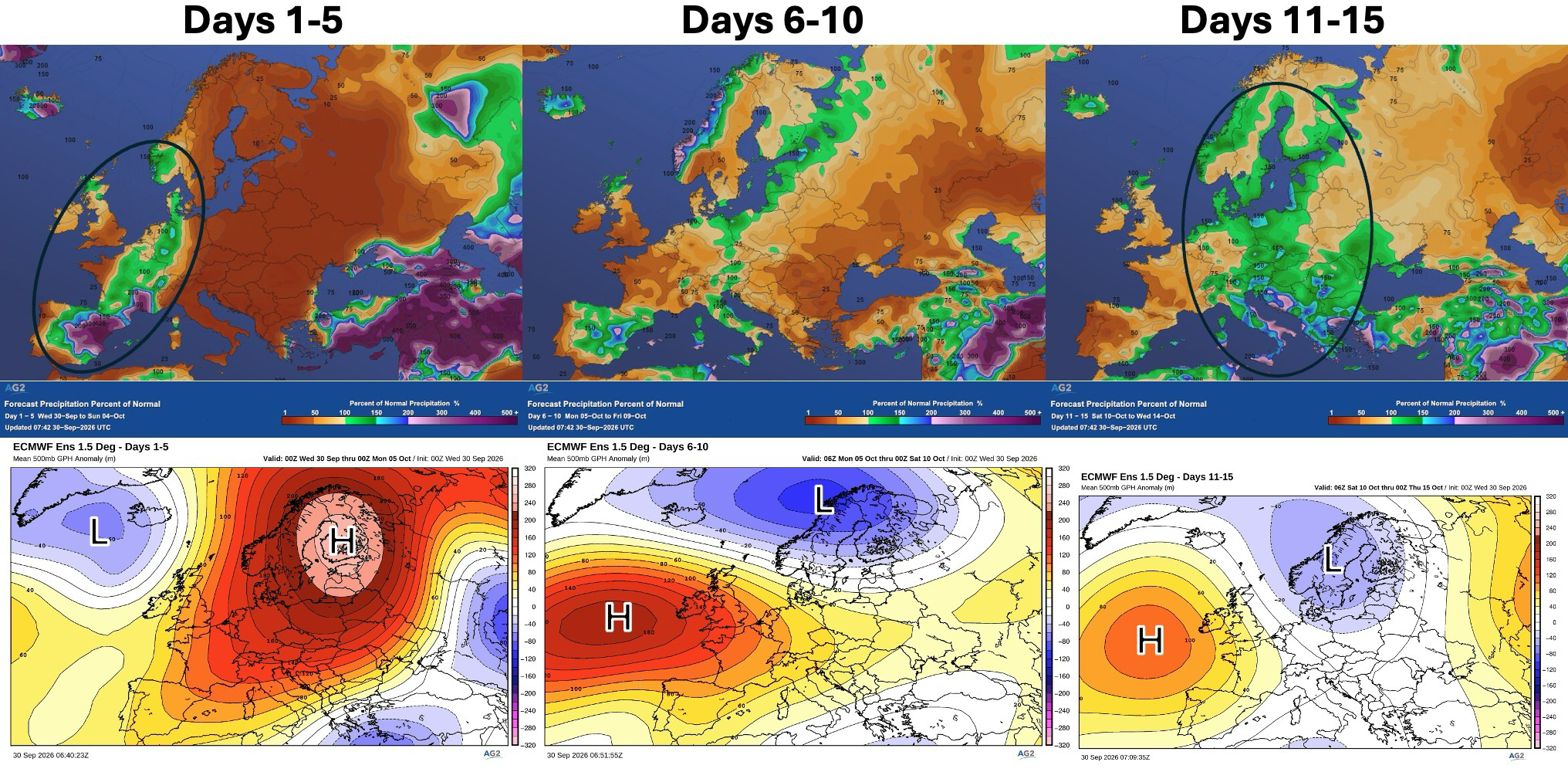
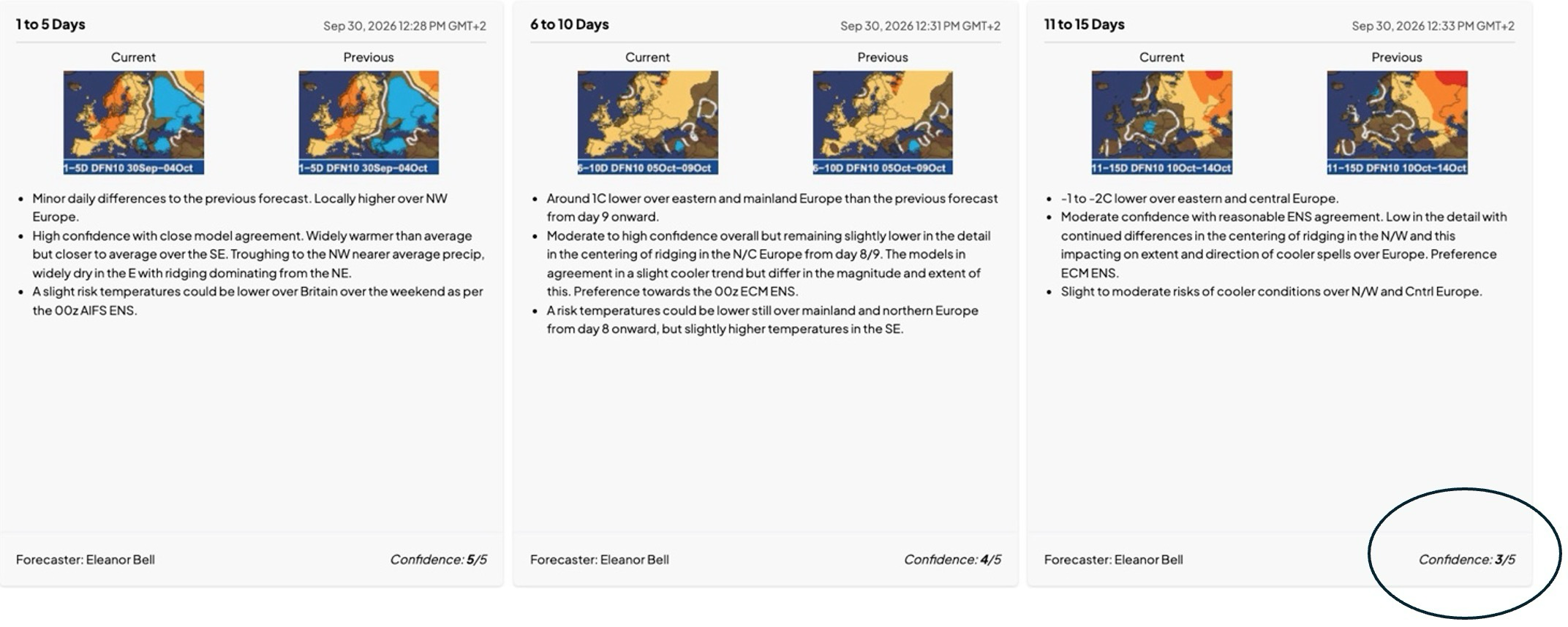
The exact 11-15 day pattern, however, comes with moderate confidence – slightly lower than earlier periods. This translates into lower confidence on the exact amounts of precipitation through C-E Europe towards mid-month, while the broader trend looks sensible and higher confidence overall.
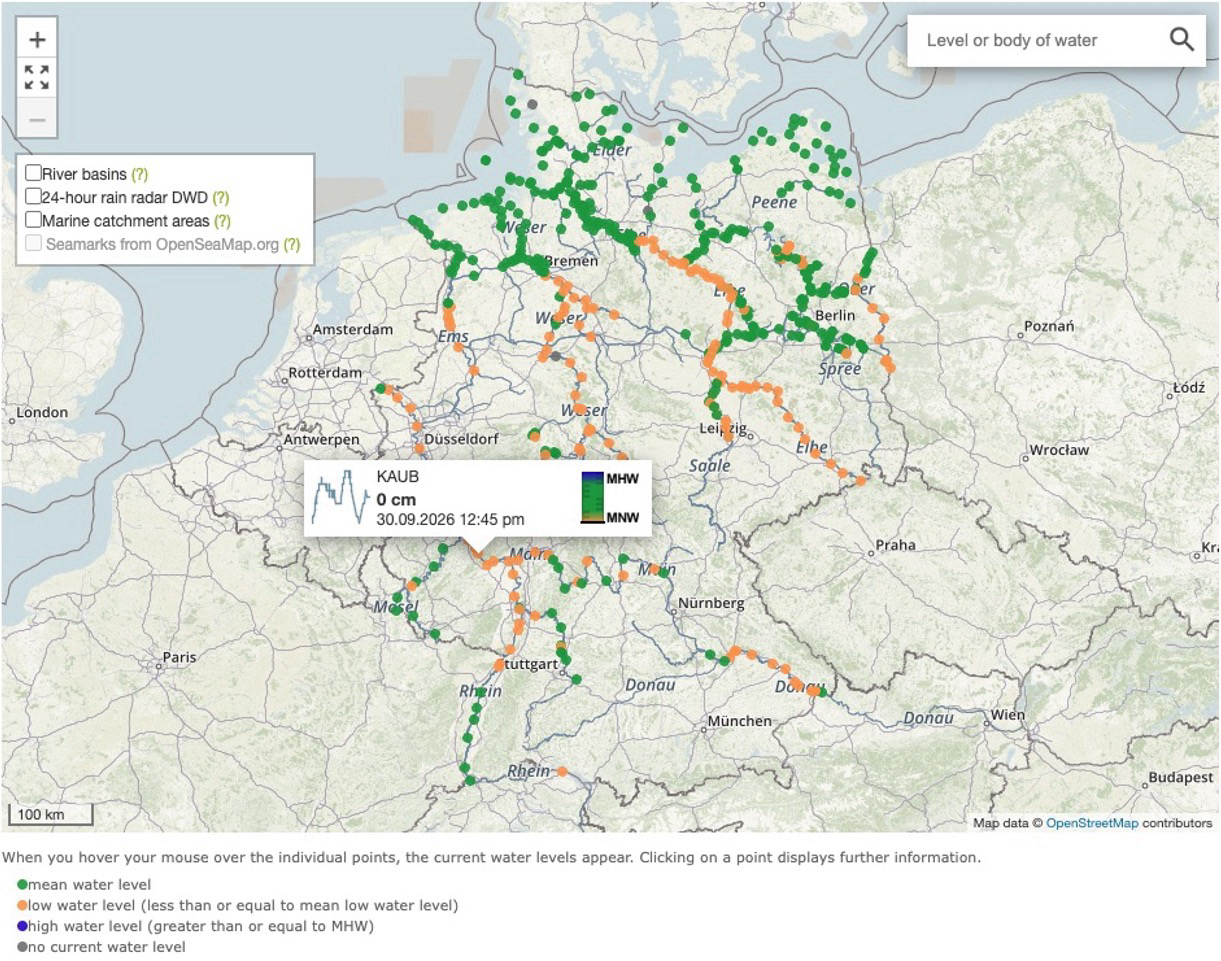
Rivers – central European rivers are still facing high stress conditions. Low flow and persistently high water temperatures. Some relief is expected in the W this week, while more to the E and Danube catchments towards mid-month. Much more rainfall than the one we see in the cards, especially in the Alps, is thought to be needed before we see a more meaningful recovery from the legacy of an extremely dry and hot summer.
Bottom line: Precipitation focuses on W Europe initially, before shifting back toward C-E Europe by late W41 into W42 as higher pressure reorganizes itself to the W-NW and troughing gains influence in the E. This should offer some relief to stressed river catchments, especially the Danube towards mid-month, but current rainfall signals still look insufficient for a meaningful recovery from the summer drought, especially across the Alps.
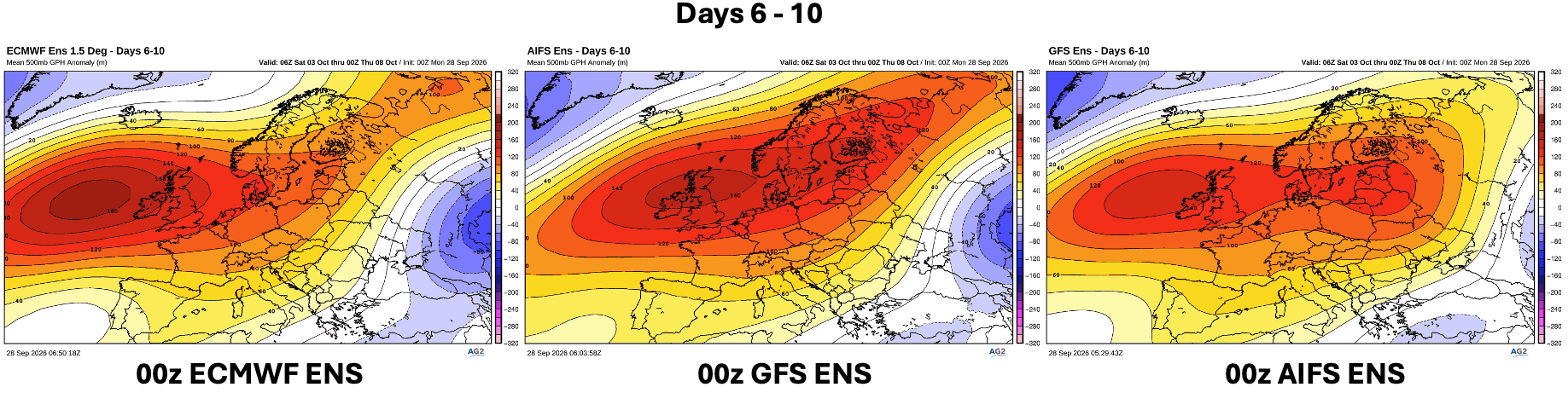
Confidence in the temperature details starts to lower as we move through next week related to the exact details of the movement and placement of higher pressure across Europe.
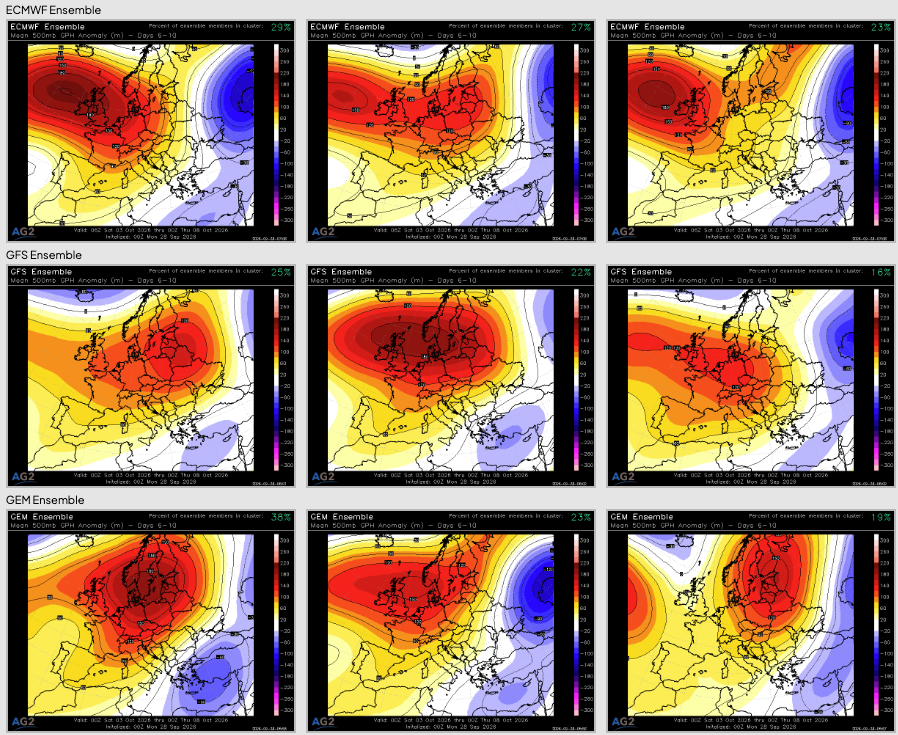
The 6-10 ensemble means from the 00z ECMWF ENS, AIFS ENS and GFS ENS are shown below. High pressure is generally forecast to dominate, centered to the north-west, but slight detail differences appear in the movement and exact positioning of the high.
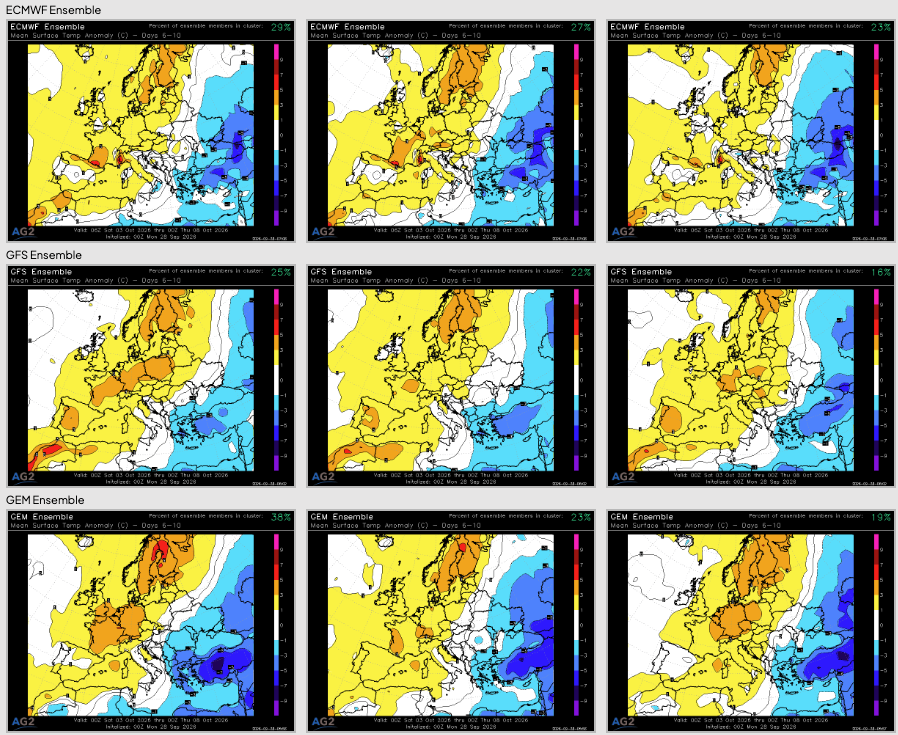
The top 3 clusters from the ECMWF, GFS and GEM below show these slight detail differences. There are cooler risks to the south-east as per some clusters with stronger ridging to the north-west, with troughing towards the south-east, which would bring a cooler airflow to the south-east. While northern Europe could be warmer under stronger ridging here.
500mb height anomalies:
Temperature anomalies:
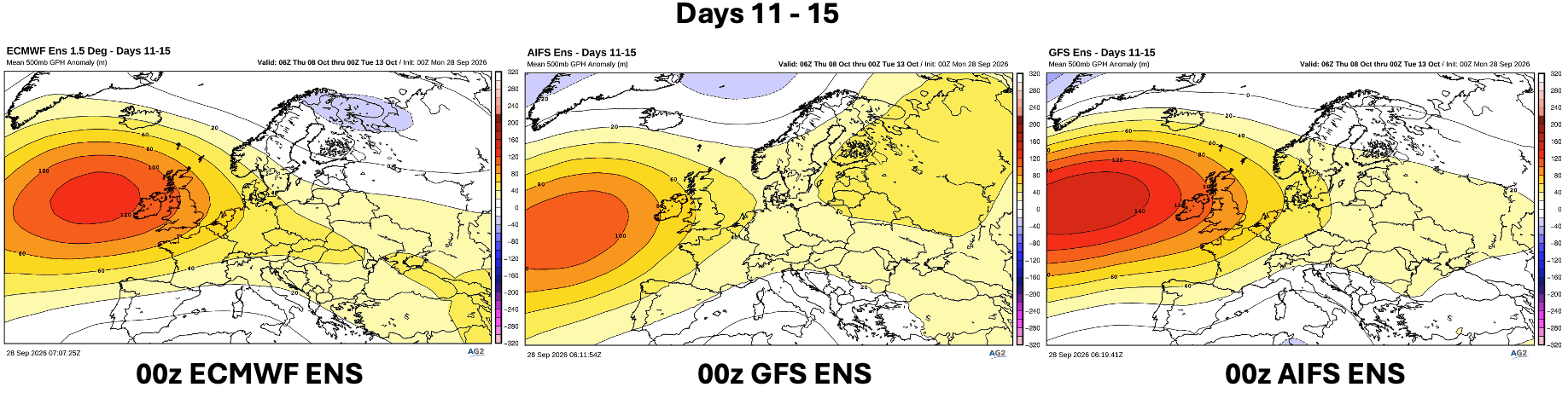
Into days 11-15, higher pressure is forecast to centre to the north-west of Europe, but there are uncertainties in the eastwards extent.
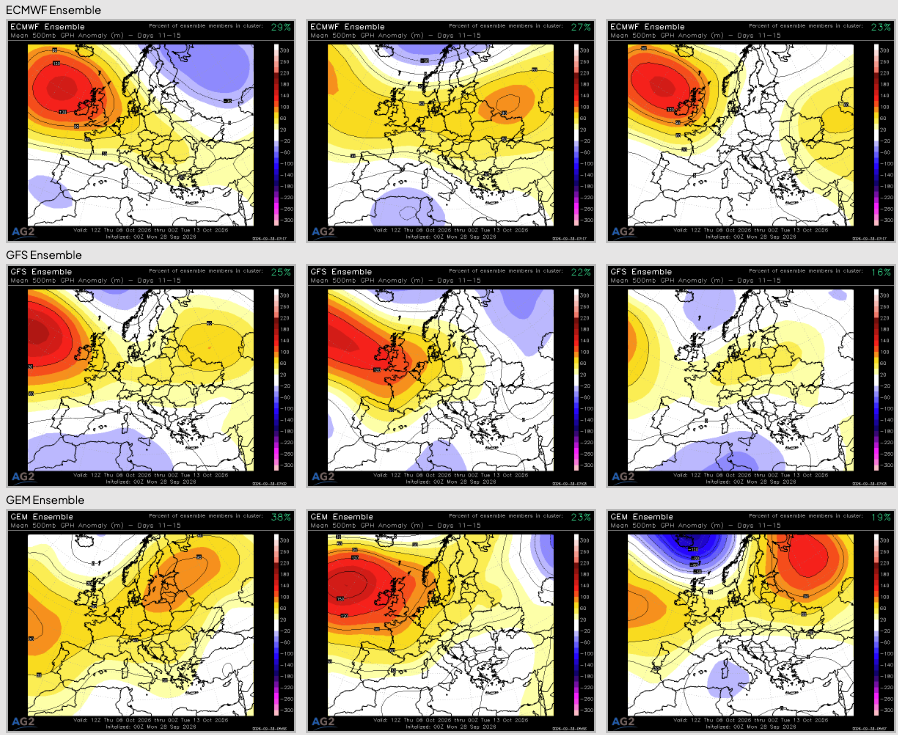
The 11-15 day clusters below show variations in the placement and extension of the high. South-eastern Europe risks cooler if a strong north/north-easterly airflow around the eastern flank of the high, while north-western Europe risks warmer under stronger higher pressure here.
500mb height anomalies:
Temperature anomalies:
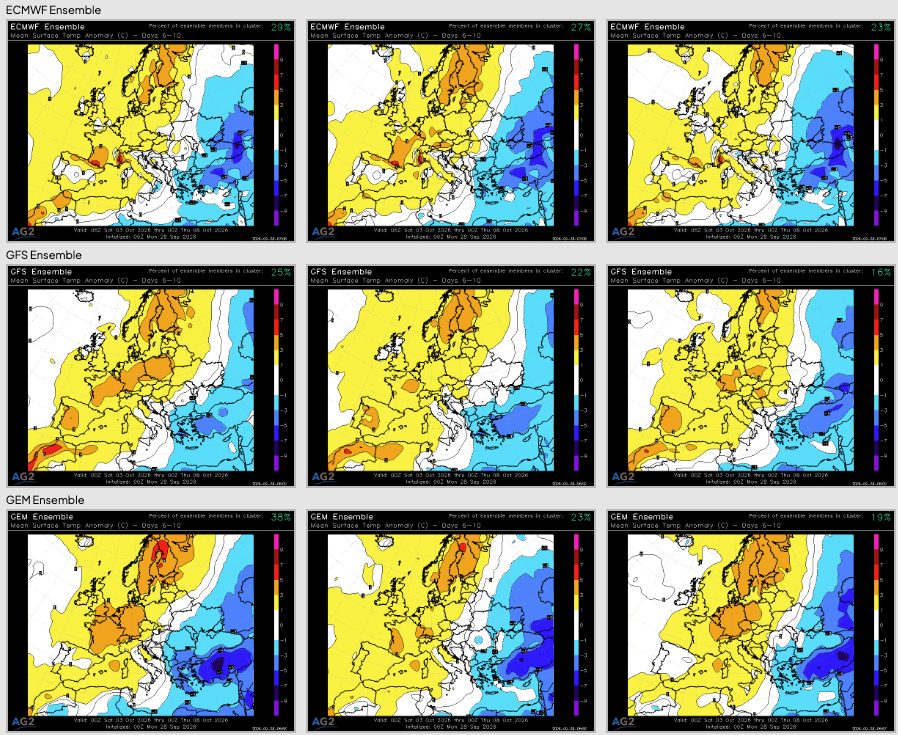
Bottom line: There are uncertainties in the exact placement and details of higher pressure across northern and north-western Europe through days 6-10 and 11-15. Risks appear greater to the cooler side across south-eastern Europe under a strong north/north-easterly airflow here. While to the north and north-west, stronger ridging here gives the risk of higher temperatures. The models are in broad agreement in the general pattern, but slight detail differences could impact temperatures.
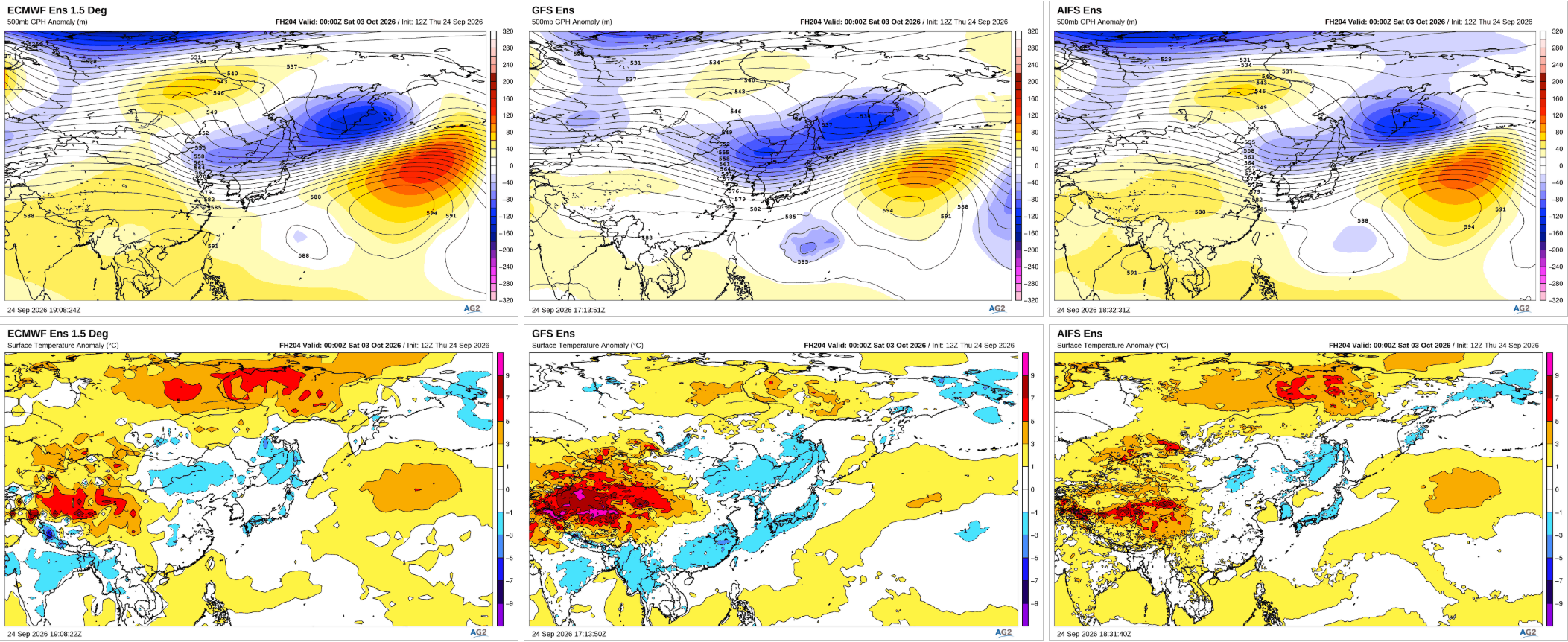
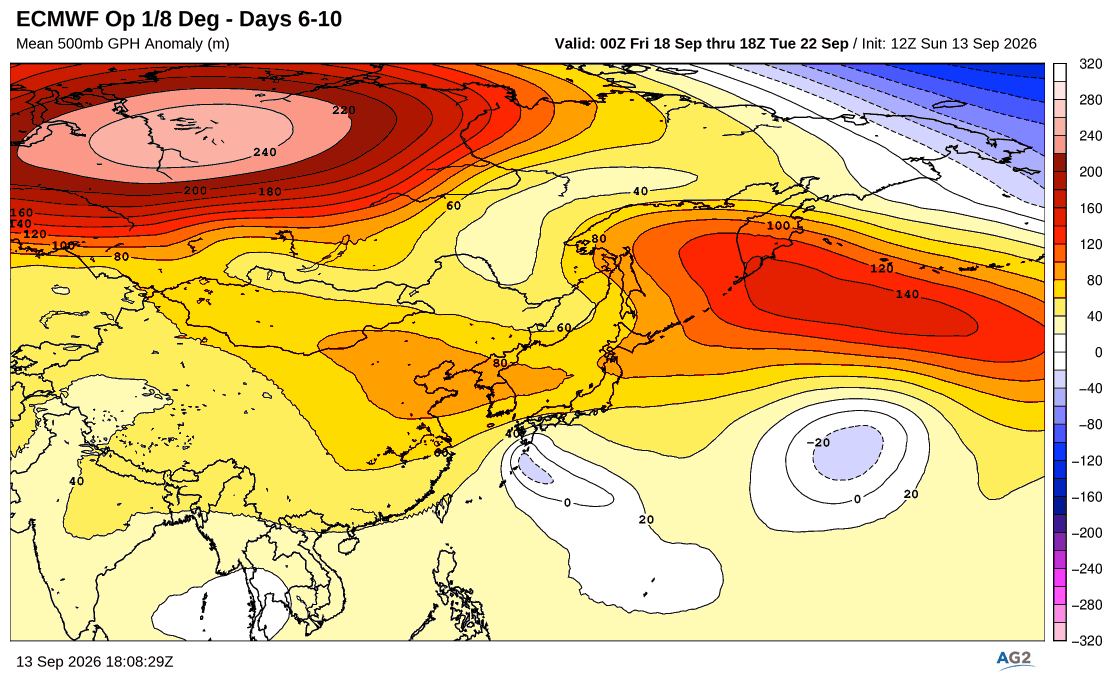
In Japan, the temperature forecast for East Asia from the 2nd onward could shift significantly depending on the positional relationship between the trough passing through the Sea of Okhotsk and the tropical disturbance located over the ocean south of Japan.
For example, as shown in the ECMWF, GFS, and AIFS model charts, when the trough sits to the northwest of the tropical disturbance, this can favor a tendency toward below-current-forecast temperatures across northern China, South Korea, and Japan.
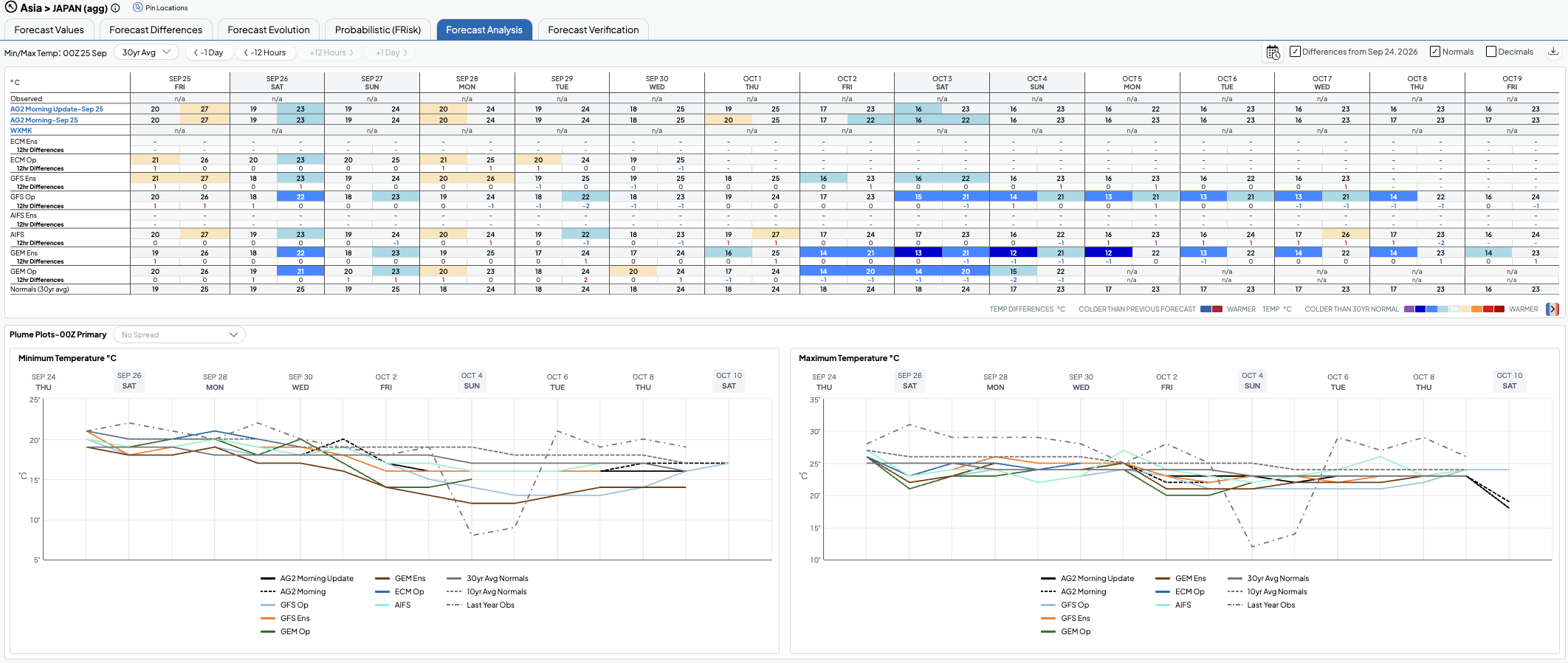
AG2’s forecast for Japan (agg) currently shows near-normal temperatures from the 2nd onward, but other models suggest below-normal temperatures, indicating the current forecast could be revised 1–2°C lower.
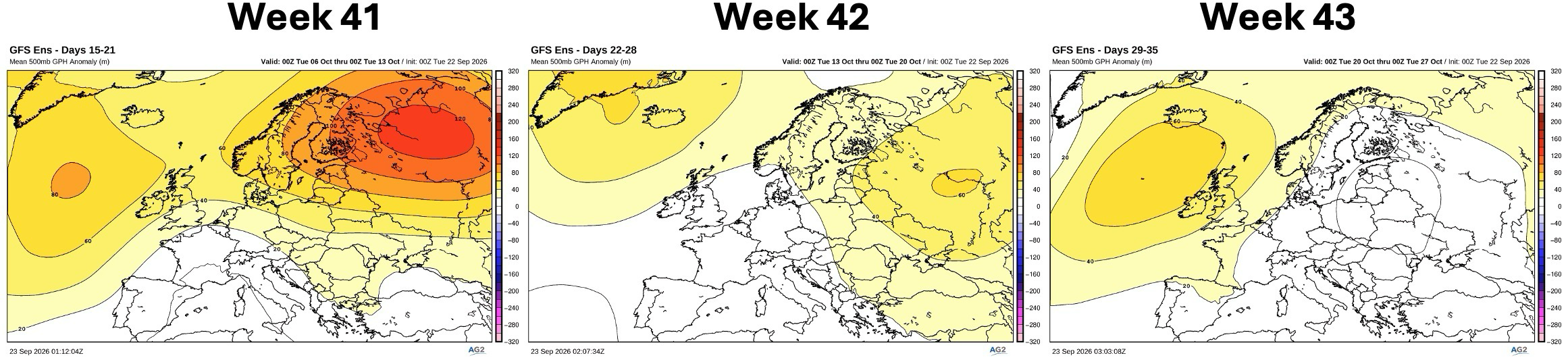
The latest EC46 guidance continues to point to N-NE ridging prevailing through October. While this is thought to combine with lower NAOs initially and then higher NAO values later in the month, the main concerns come from lower wind through N farms (risks of persistent Dunkelflaute) and a S’ward-shifted storm track (risks of flooding S Europe, among high SSTs). GFS continues to offer the main alternative scenario focusing higher pressure more to the NW of Europe, with cooler implications for the continent.
The latest EC46 run revised overall cooler than its previous release, especially for weeks 41 and 43, as per the graphics below.
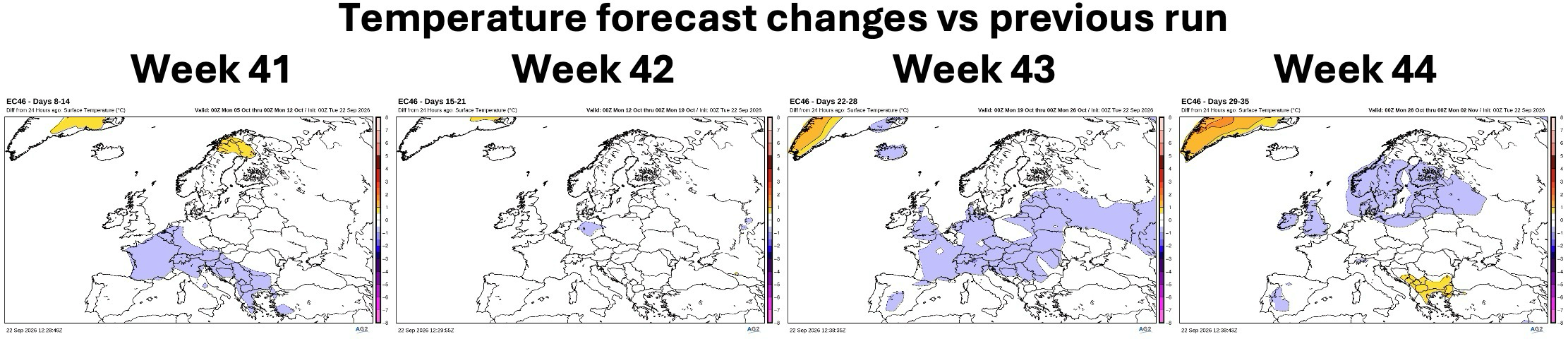
Let us look at a weekly breakdown now of this latest solution.
Week 41
Pattern: Higher pressure focused over NE quadrant of Europe stretches towards Greenland/Iceland to open SW-S areas to troughing.
Temperatures: Widely above normal, with larger departures S-SE among more SE’ly advection, and far SE under higher heights.
Precipitation: Lower than normal NE under ridging, wetter Mediterranean regions through Black Sea.
Wind: Mostly below normal, if not nearer normal locally through S farms.
Solar: Above normal W through NE mainland, lower elsewhere, especially far SE.
Confidence/risk: The idea of an overall –NAO period is gaining confidence, following MJO passage over Atlantic and Africa. The idea of higher heights focusing NW also remains in place, but the main risk highlighted by some lower clusters and GFS weekly is that higher pressure could also build NW of Europe, forcing troughing further into the SW/W Med. Some risks of flooding should be considered for the S, especially linked to magnitude of Med warm anomalies.
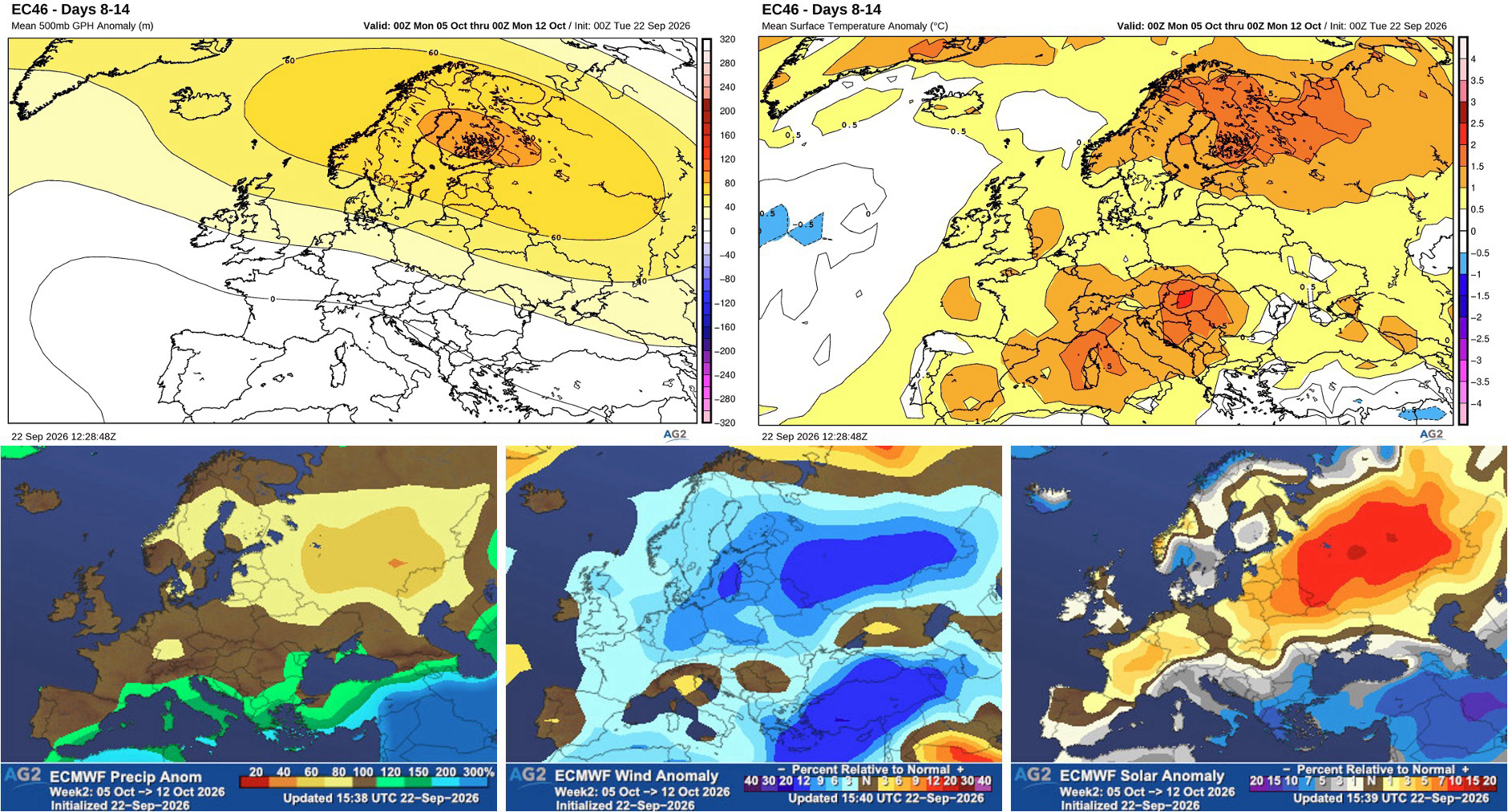
Week 42
Pattern: –NAO regime with higher heights stretching from Greenland/Iceland through NE sectors of Europe.
Temperatures: Nearer normal across parts of the NE, otherwise widely above, with larger departures through the S.
Precipitation: Near to drier than normal N, wetter S.
Wind: Lower over higher than normal.
Solar: Above normal C-NE, lower elsewhere, especially S among wetter weather.
Confidence/risk: Decent confidence on broader pattern, with fairly good agreement on placement of main ridge between EC and GFS, but lower on how influential troughing could be towards C areas. GFS as well as some lower clusters show risks of more troughing penetration into C Europe. Based on pattern though, the forecast risks drier NE under ridging. Risks of flooding through S Europe persist.
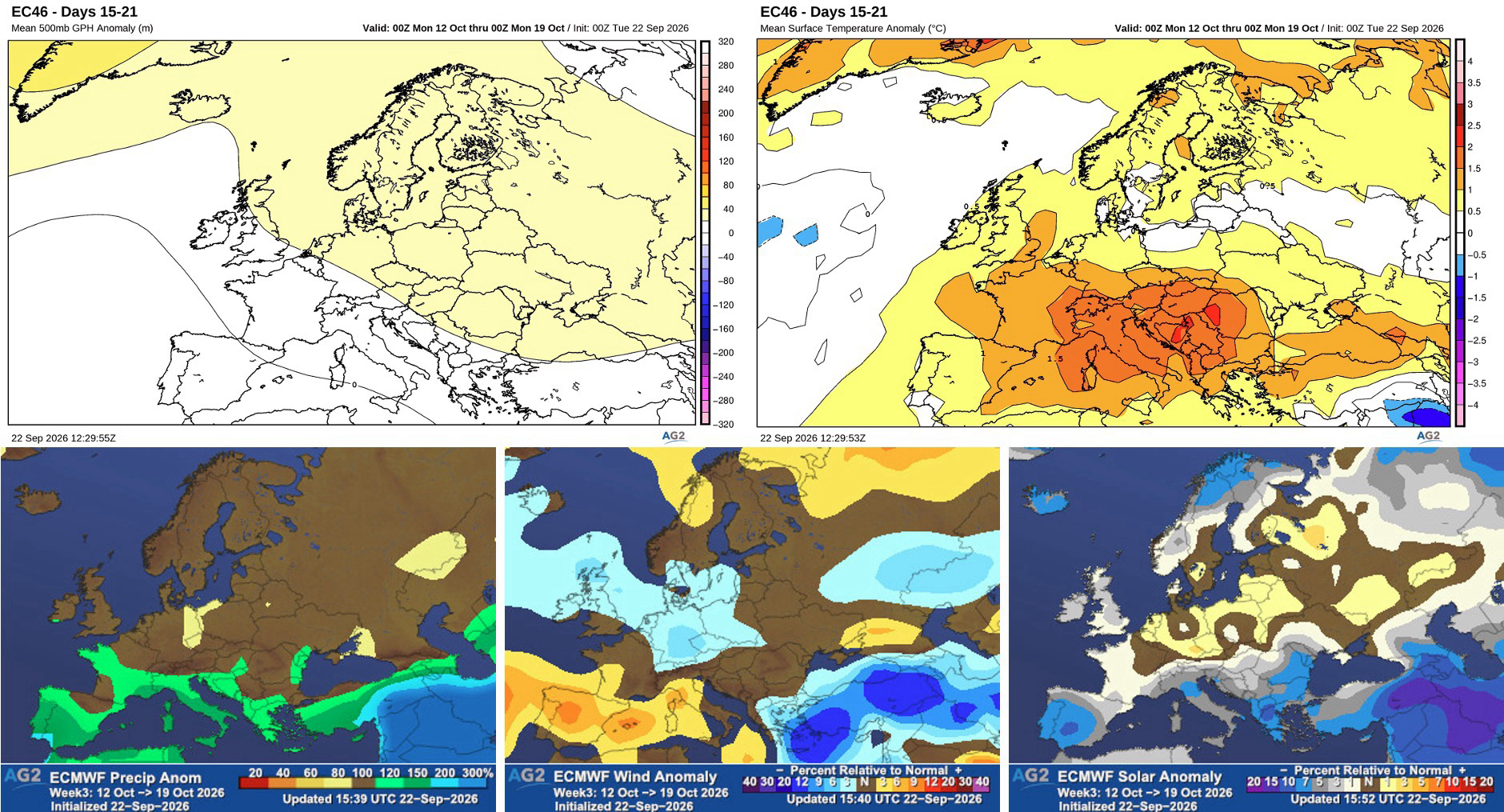
Week 43
Pattern: Higher heights persist through N -NE Europe, while troughing penetrates towards C areas from the SW.
Temperatures: Nearer normal locally through the N, otherwise warmer than normal, especially S-SE
Precipitation: Above normal through S-E mainland Europe.
Wind: Leaning below normal through N farms, higher S.
Solar: Near to locally above normal N, if not slightly higher NW, while much lower S among more unsettled weather.
Confidence/risk: While GFS continues to point to NW ridging as the main risk of cooler NE intrusions, there could actually be a push from the MJO to higher NAO values by then if the MJO reaches the Indian Ocean and Maritime Continent. So lower confidence on the exact placement of ridging through N Europe, but overall higher confidence in finding a wetter S-SE with persistent risks of flooding there.
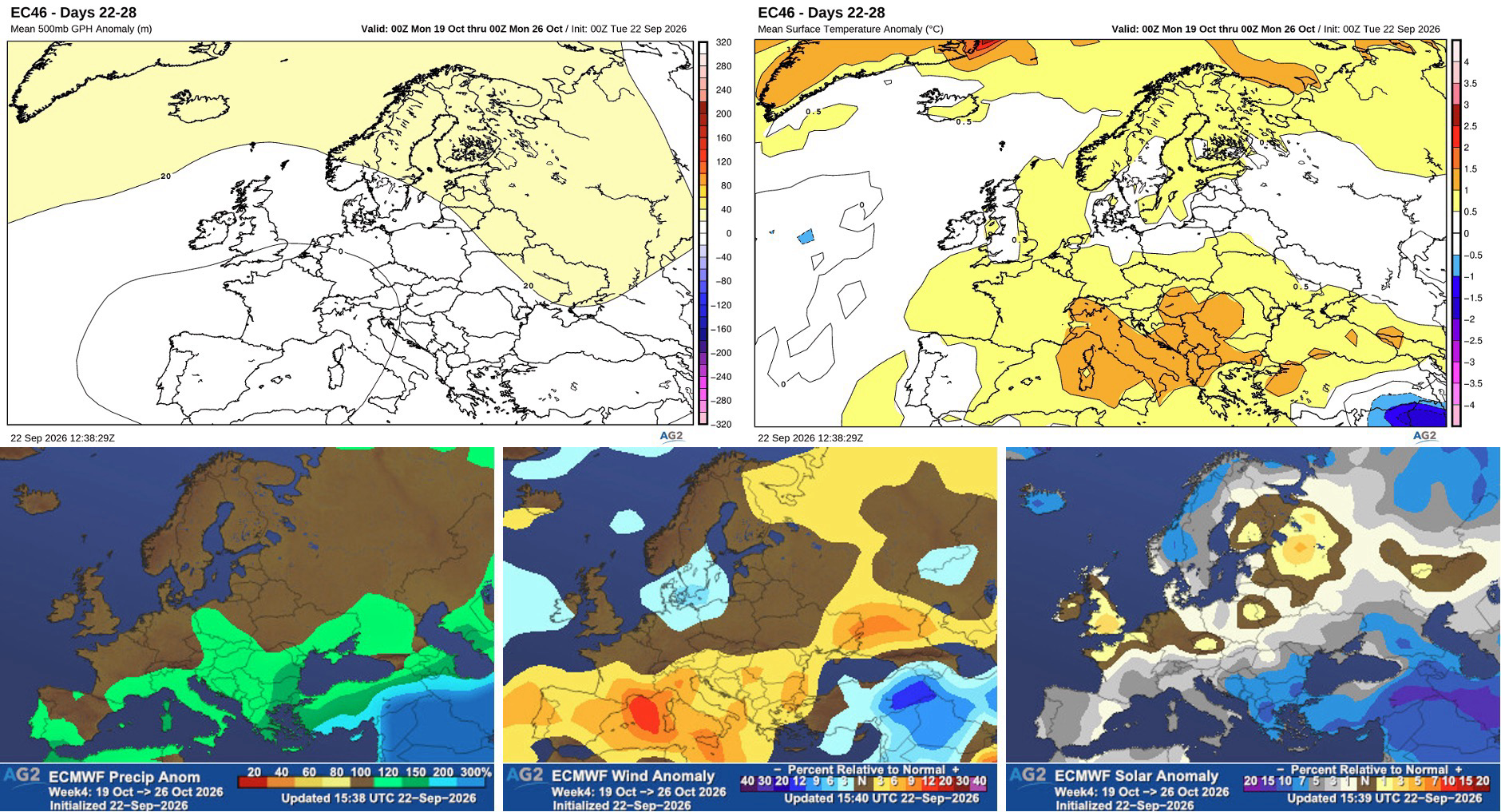
Week 44
Pattern: Higher heights retreat far N and E, leaving C-W Europe to troughing.
Temperatures: Near normal W and N, warmer moving SE.
Precipitation: Widely wetter than normal mainland.
Wind: Lower over higher.
Solar: Nearer normal far N, subdued throughout mainland.
Confidence/risk: Expectations of wetter progression towards the heart of fall are met, with a possible increase in the NAO also possible per MJO progression, but confidence in forecast detail is overall limited by uncertainty in the exact placement of N ridging and space for troughing.
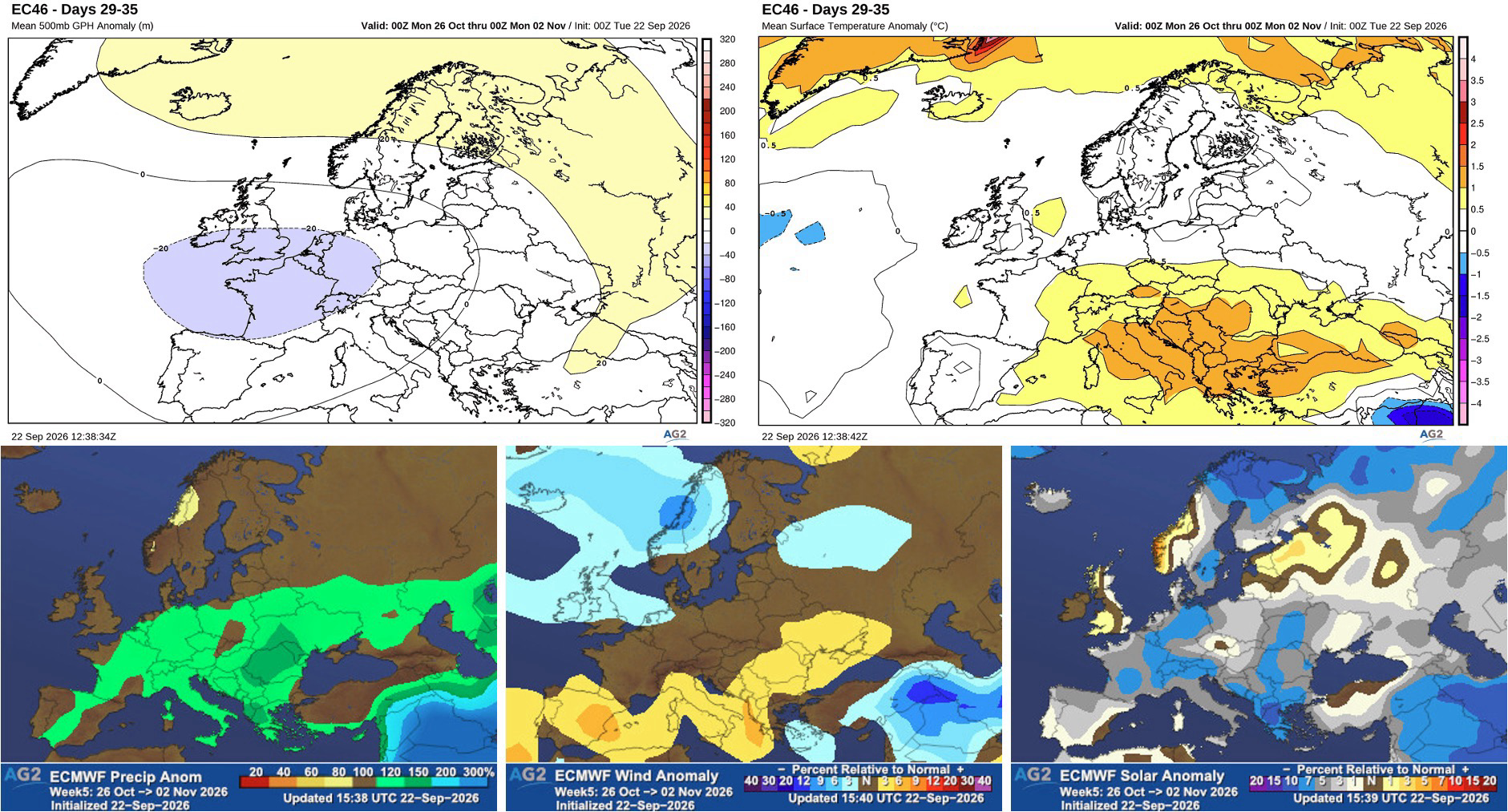
GFS Weekly
GFS continues to resolve a risk of finding higher pressure W of the British Isles coming at the same or even replacing NE Europe ridging through much of October. This suggests cooler risks through an increase NE components in the flows.
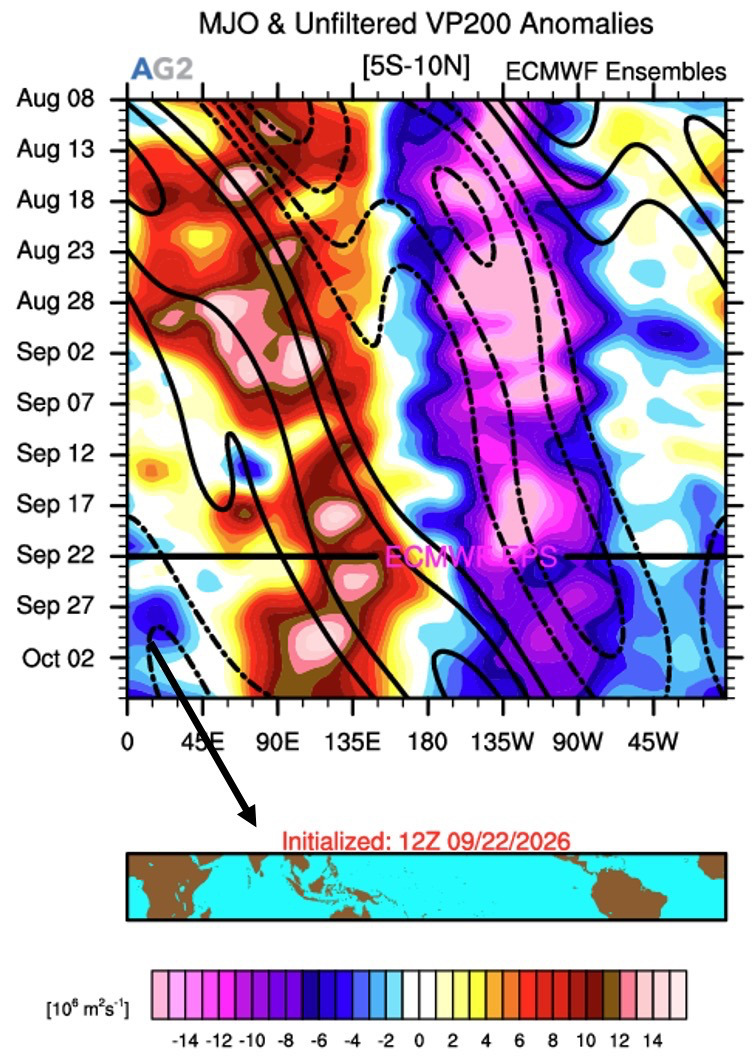
MJO
The MJO currently crossing the Atlantic and Africa over the next couple of weeks is thought to advance E towards the Indian Ocean and Maritime Continent by late October, possibly driving an increase in NAO values later in the month.
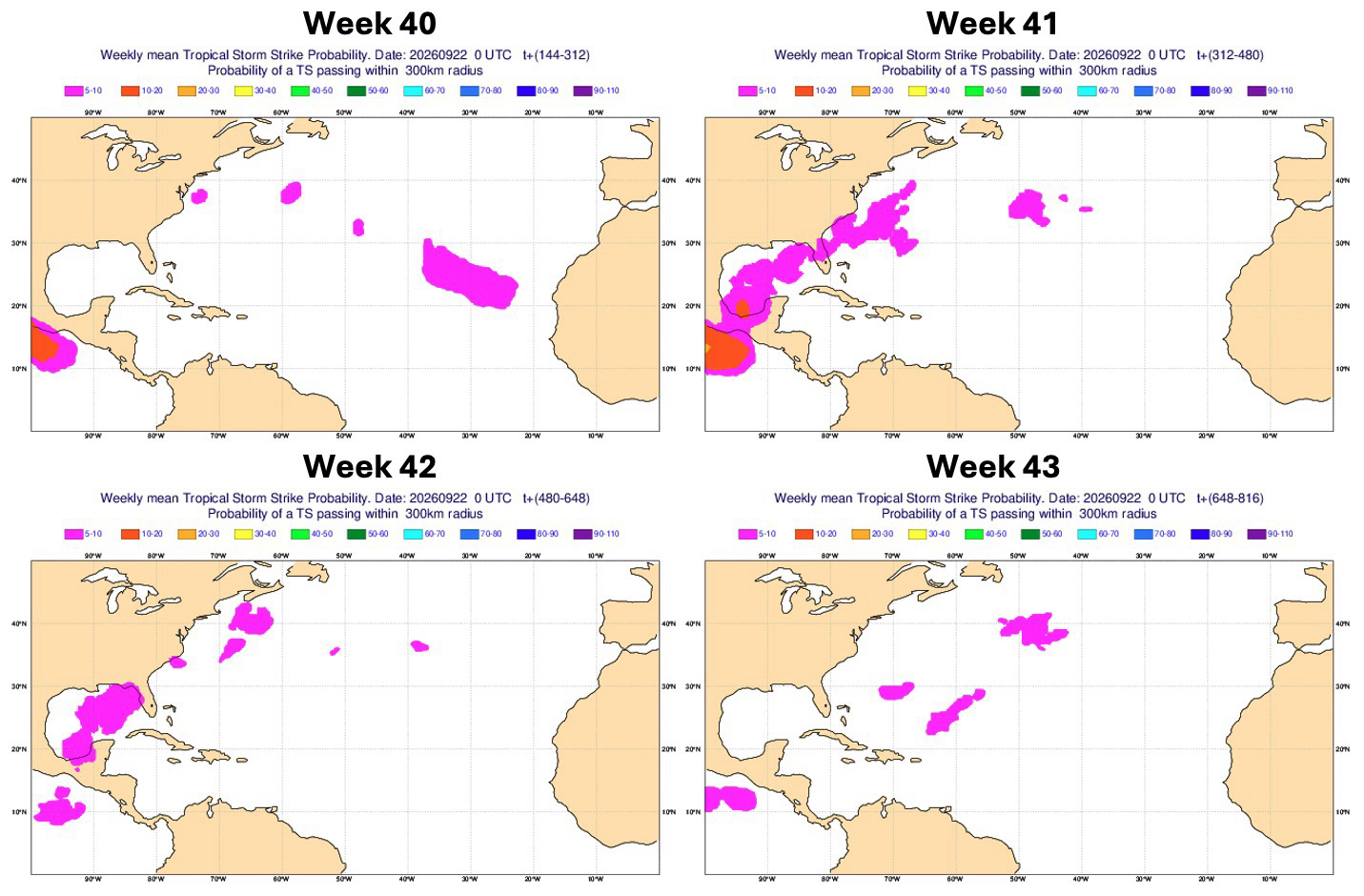
Tropics
The tropical Atlantic is still forecast to remain anomalously quiet for the time of year, due to high shear over the Atlantic linked to strengthening El Nino conditions. Risks of tropical impacts to Europe remain very limited, while some storms across the US eastern seaboard and mid-Atlantic could gain some sub-tropical characteristics.
Bottom line: EC46 October guidance continues to lean toward higher-latitude N-NE ridging, keeping mostly warmer conditions broadly in place but shifting the main storm track further S than normal. That raises a couple of key energy risks: persistently lower wind across N farms and greater Dunkelflaute potential, while repeated stormy troughing into S Europe/Med raises heavy-rain and flooding risks over very warm seas/Med. Confidence is especially limited by GFS favoring more NW-based ridging with cooler NE’ly components in the flow and by uncertainty around the exact MJO-driven NAO evolution later in the month.
This blog takes a look at the latest drought monitor, which was issued on September 17th…
The latest drought monitor is below, noting drought coverage is down ever-so-slightly to 80.97% (down from 81.05% last week).
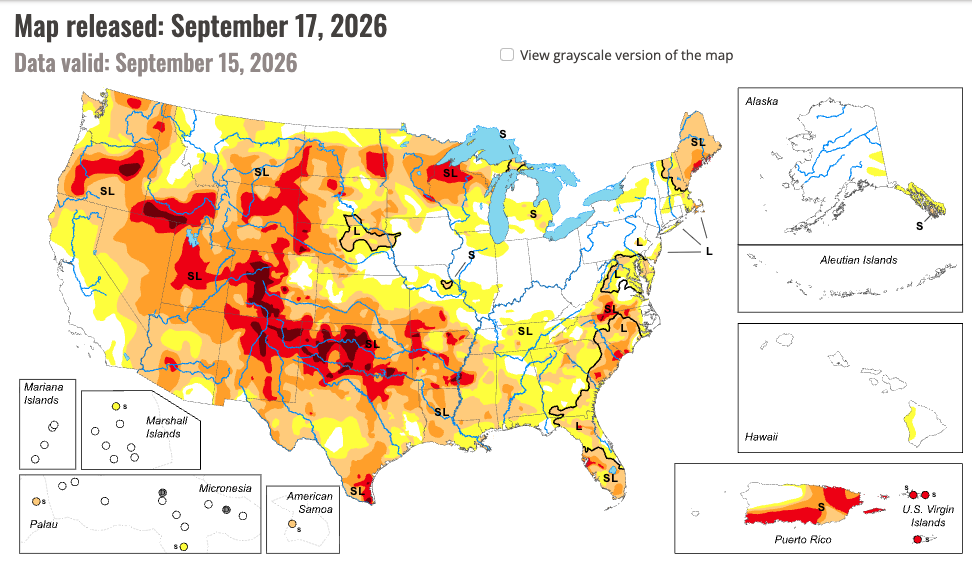
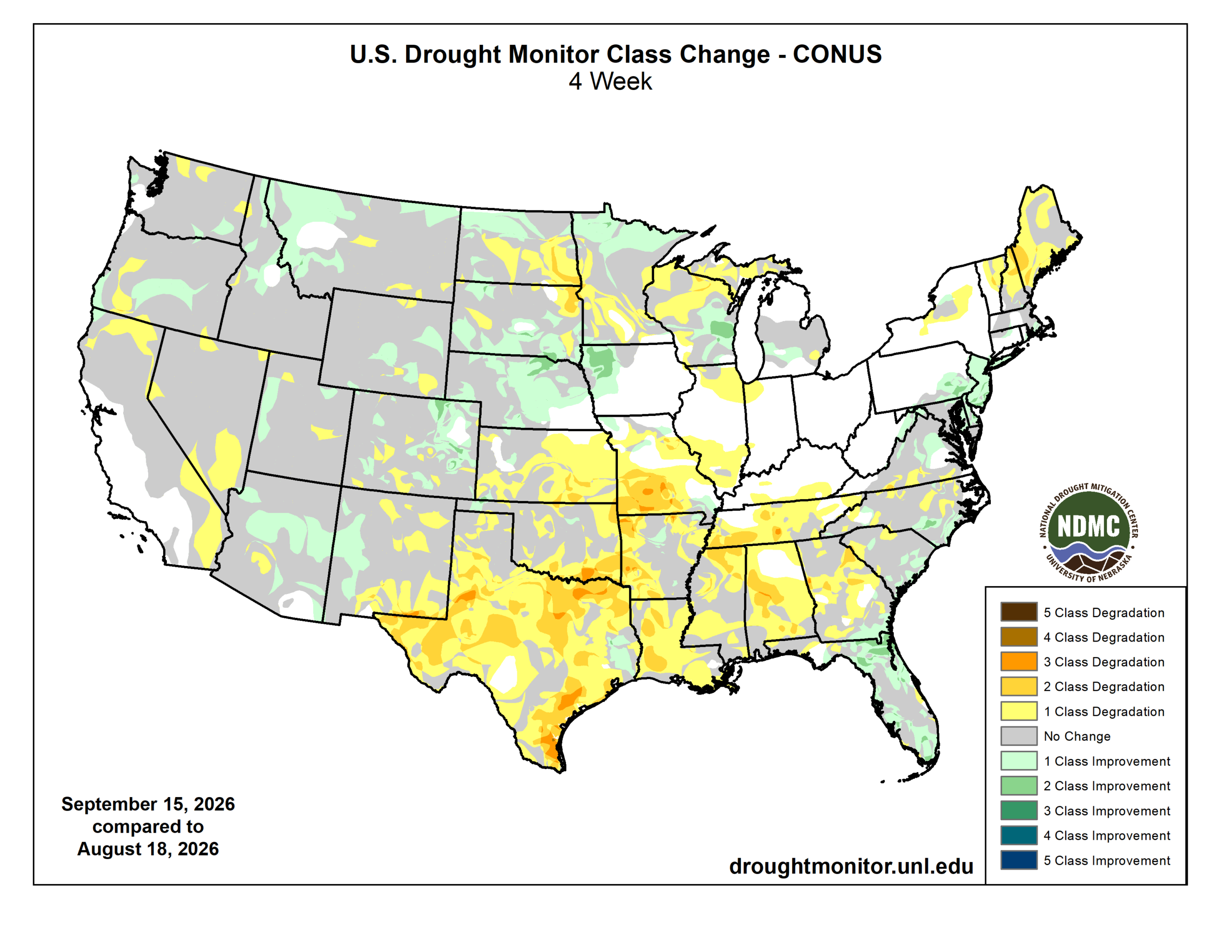
Month over month change maps are below. The most notable trends in the last month are wetter in parts of the East, northern Plains, and Interior West, but drier across the southern Plains, Upper Midwest, and PNW, most notably in Texas.
We can see last 7 days of rains across the country from 10-16 September below.

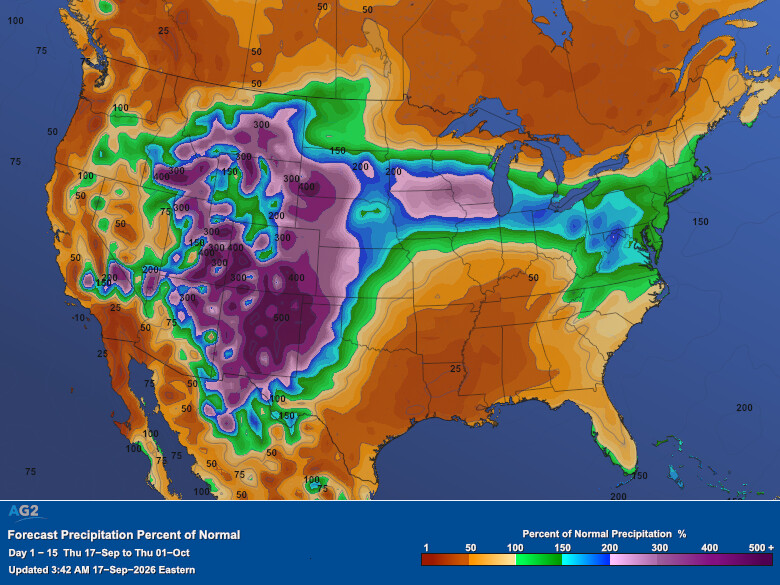
The forecast over the next 15 days continues to look very wet across the West and northern tier. It does look drier in Texas and the southern tier…
Today’s AG2 forecast shows temperatures running 2–3°C higher than Friday’s forecast from Sunday the 20th through Tuesday the 22nd, with the outlook running as much as 3°C above the 30-year average. This warmer-than-current-forecast trend is expected to persist over the coming two weeks.

The main drivers are a well-defined ridge sitting over Japan, which limits the influence of cold air, and moist, warm airflow from the tropical disturbance forecast over the ocean south of Japan, which is increasingly likely to flow into mainland Japan.
Western Japan, however, tells a different story. GFS shows temperatures running below the current forecast from the 23rd through the 25th.
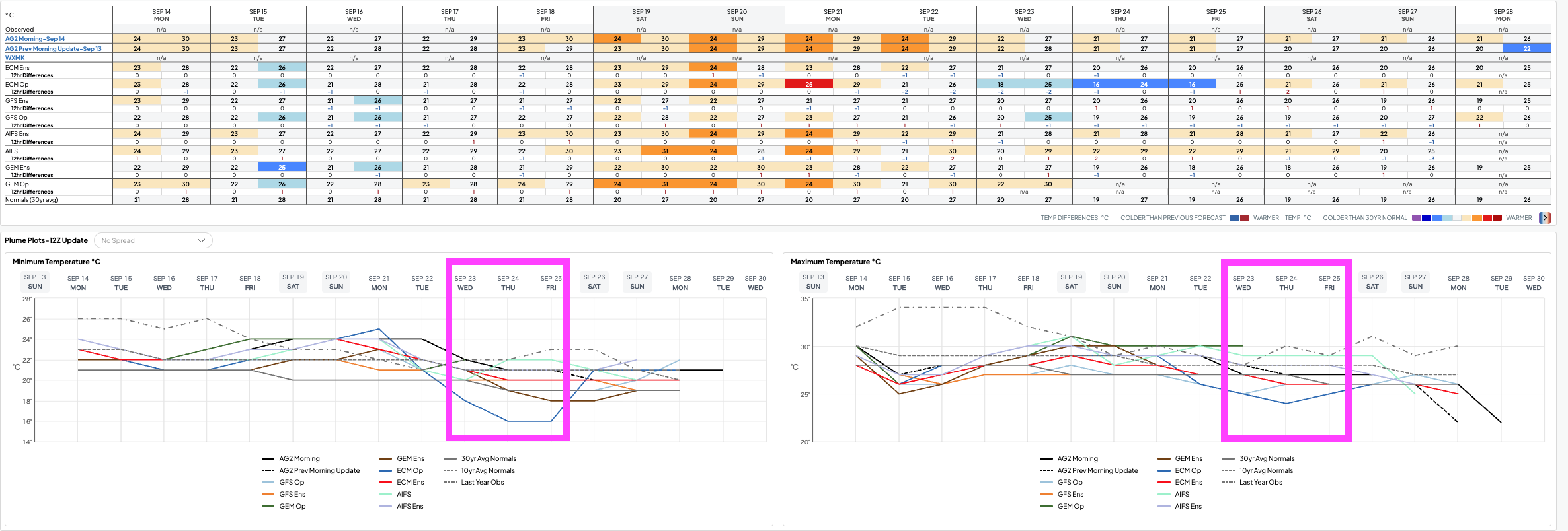
This appears to reflect ongoing spread in the track of the tropical disturbance passing near Japan, with different models showing different timing for when the region moves into the system’s rear flank. AG2’s latest forecast currently has the 23rd (Wednesday) through the 25th (Friday) tracking near the current forecast level, but a downside risk remains, which could ease cooling demand.
Summary
- JTWC has issued its Final Warning on TD Krovahn and is not currently monitoring any disturbances, but a separate tropical disturbance continues to show rising development confidence for a possible approach to Japan from the 19th.
- Model guidance has shifted: ECMWF now shows the closest approach, tracking toward Kanto on the night of the 21st (versus only AIFS showing landfall yesterday), while AIFS and GFS now both point toward the Nansei Islands followed by a path through Kyushu/Korea into the Sea of Japan.
- The ECMWF scenario would bring upward temperature revisions, more rain, less solar, and stronger winds to eastern/northern Japan on the 21st–22nd, while the AIFS/GFS scenario would instead bring these impacts to western Japan and Korea from the 23rd — both the timing and the potential impact area have shifted later and broader compared to yesterday.
As of 09 UTC on the 9th, the JTWC has issued its Final Warning on Tropical Depression Krovahn, and no disturbances are currently being monitored.
Next, let’s look at a tropical disturbance that may go on to affect Japan.
Continuing from yesterday’s update, ECMWF, GFS, AIFS, and GEM all continue to suggest that a tropical disturbance will be present over the ocean south of Japan from Saturday the 19th onward. ECMWF and GFS ensemble guidance now show closed circular isobars more clearly than yesterday, indicating rising confidence in this system’s development.
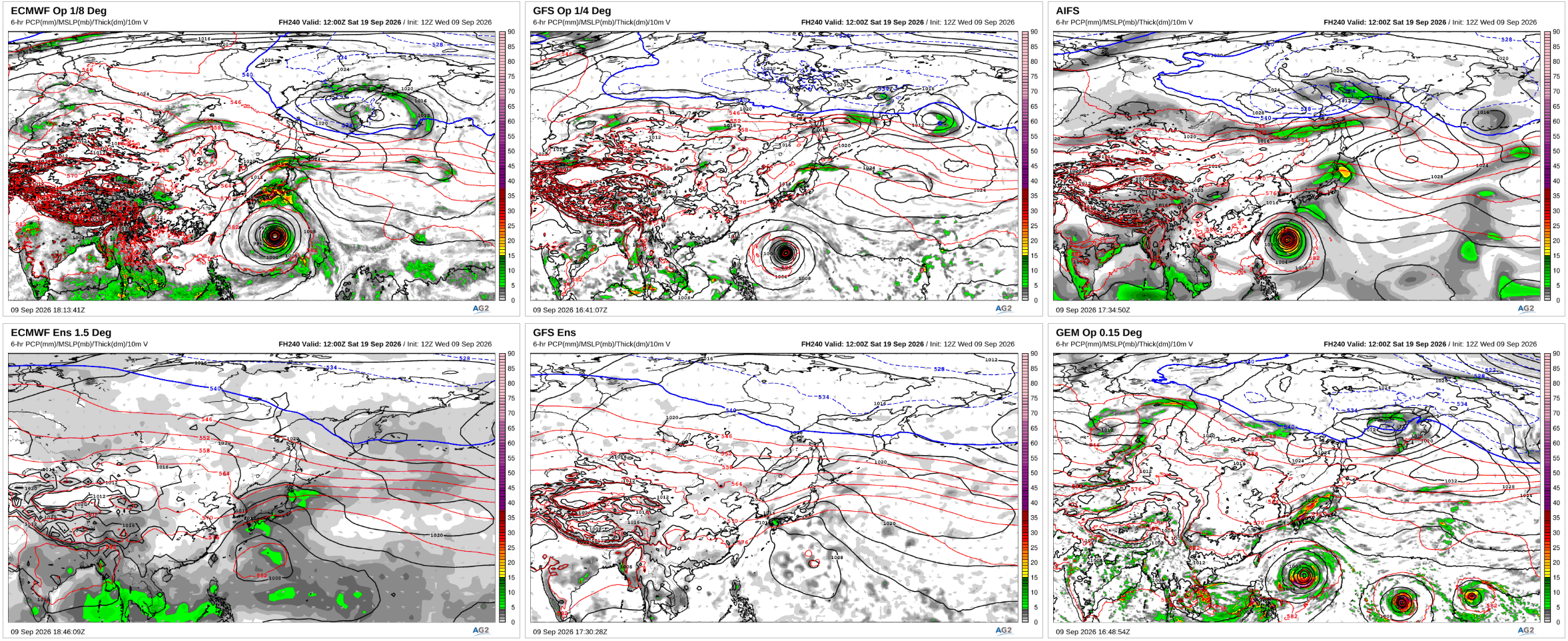
Of these, ECMWF shows the closest approach to Japan.
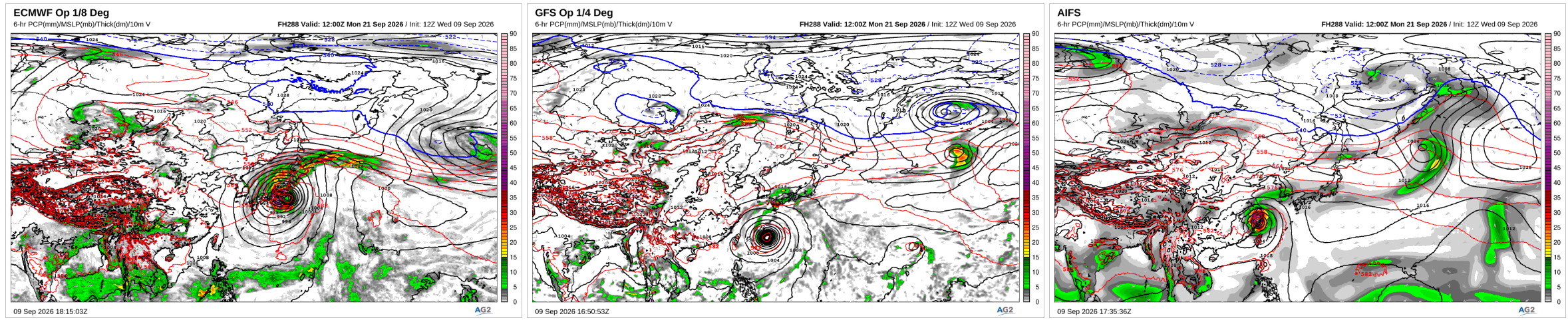
Yesterday’s models had only AIFS forecasting landfall in the Tokai or Kanto region on Saturday the 19th, Japan time. In the latest models, however, ECMWF now shows the system tracking toward the Kanto region on the night of Monday the 21st. AIFS and GFS, meanwhile, continue to show a track toward the Nansei Islands, followed by a path through Kyushu or Korea and into the Sea of Japan.
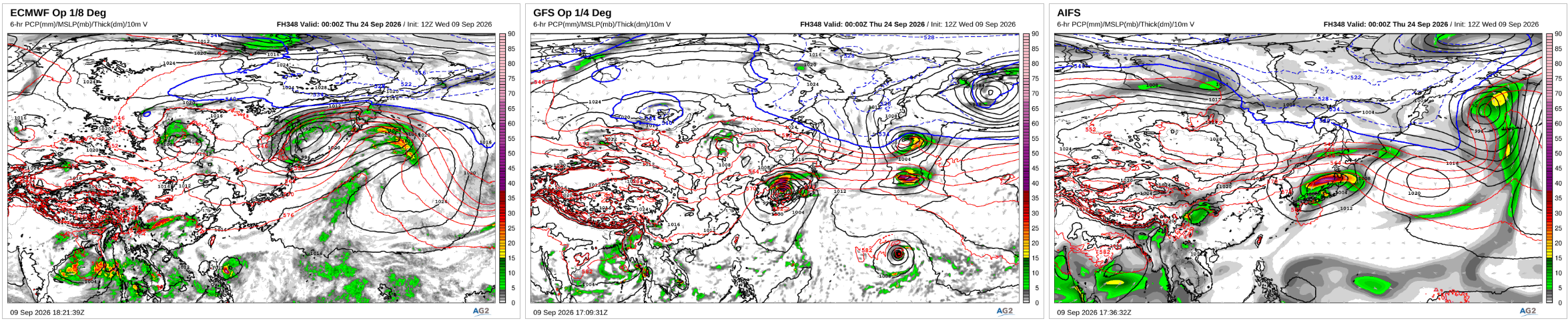
Should the ECMWF scenario verify, a broad area of Japan — particularly eastern and northern Japan on the 21st–22nd — would see upward revisions to the temperature forecast, increased precipitation, suppressed solar output, and stronger winds.
If instead the system tracks toward the Nansei Islands, as shown by AIFS and GFS, the direct impact would instead appear from the 23rd onward as increased precipitation, suppressed solar output, and stronger winds across western Japan and South Korea.
Compared to yesterday, the timing of the system’s approach has shifted later, and the potential area of impact has broadened to include western Japan and South Korea. We will continue to provide blog updates on this system’s track through next weekend.
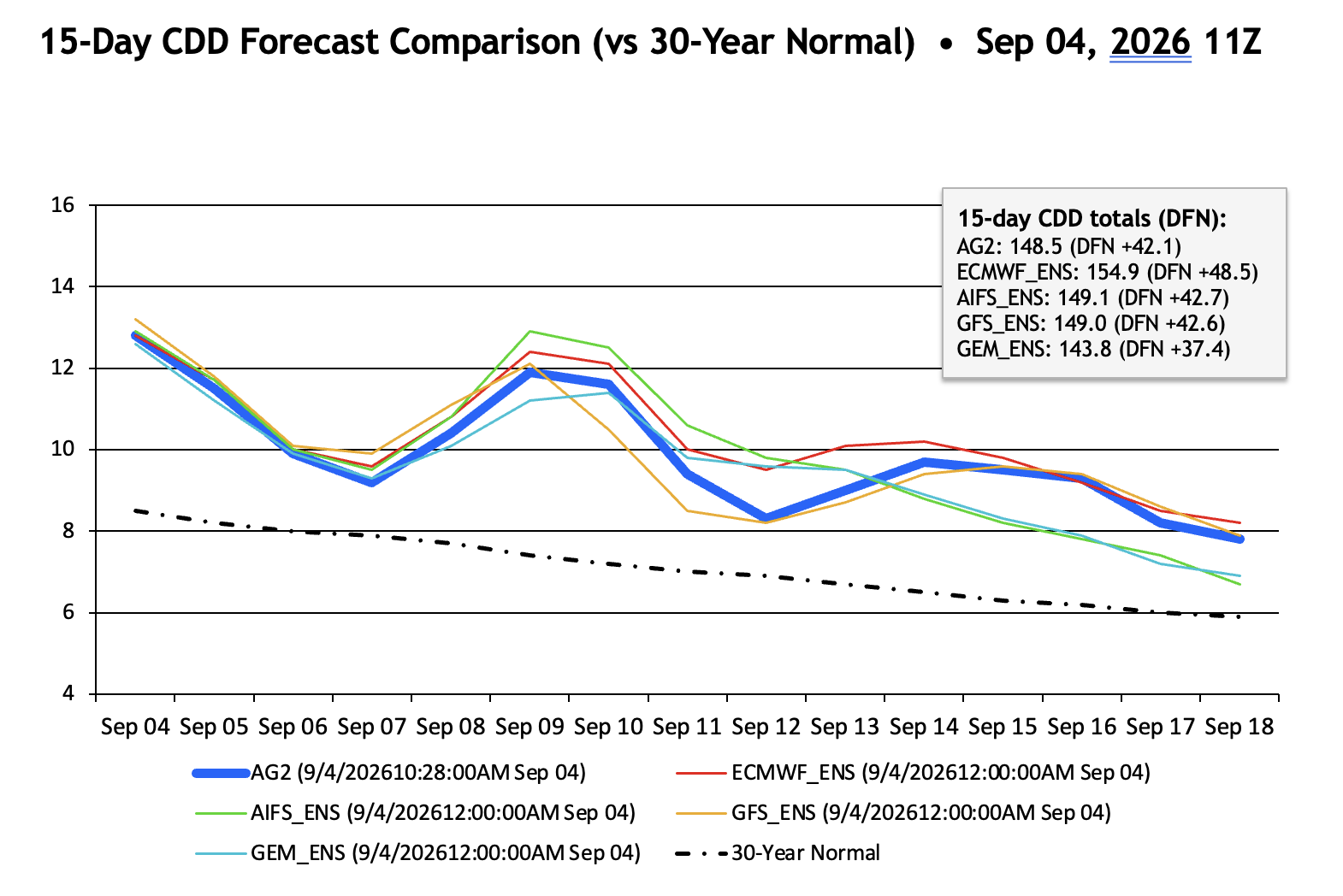
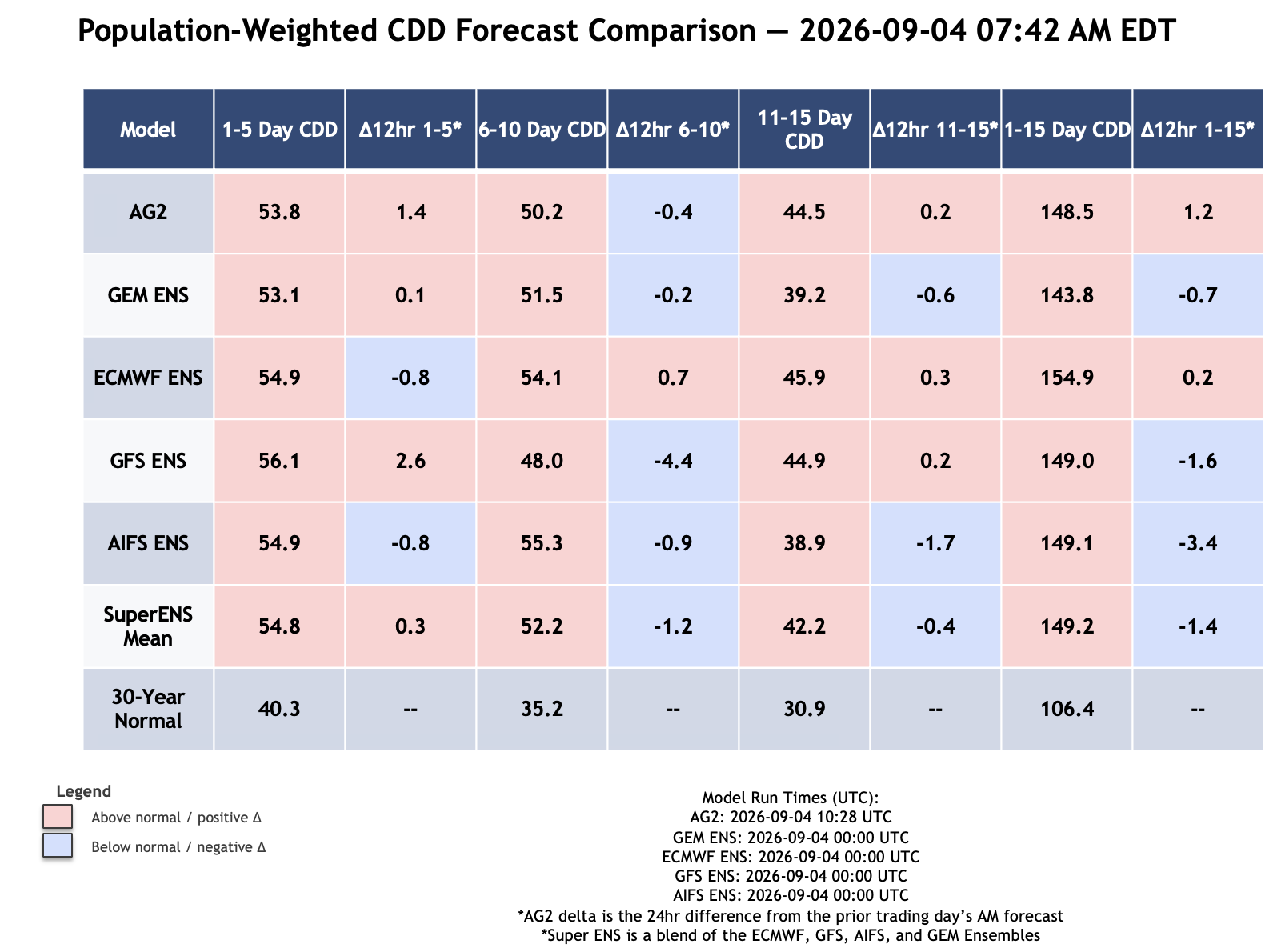
The 14 day national demand change since yesterday is +1.5 CDDs…
Modeled temperatures next 15 days:
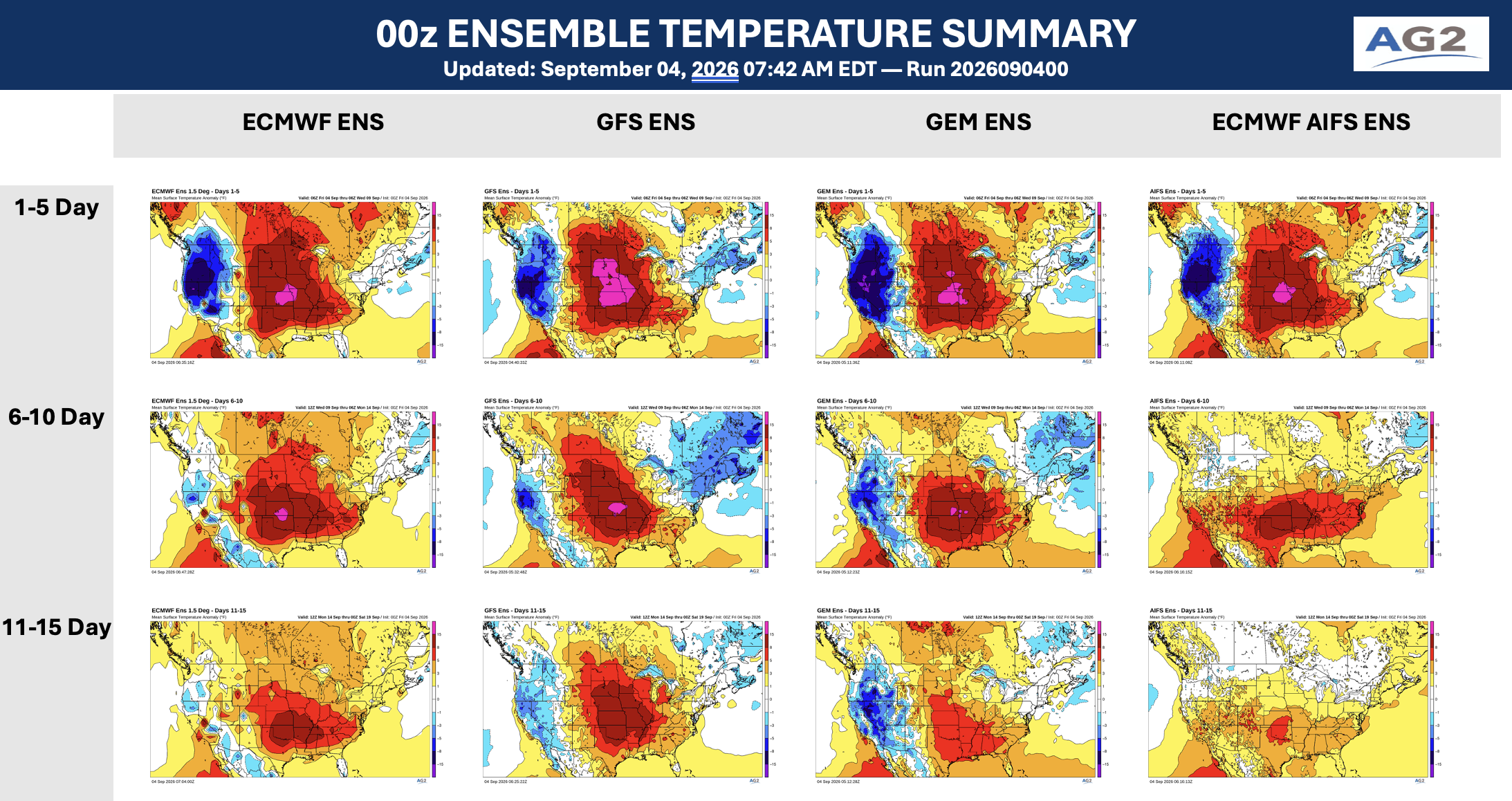
Our forecast in terms CDDs with changes since yesterday:
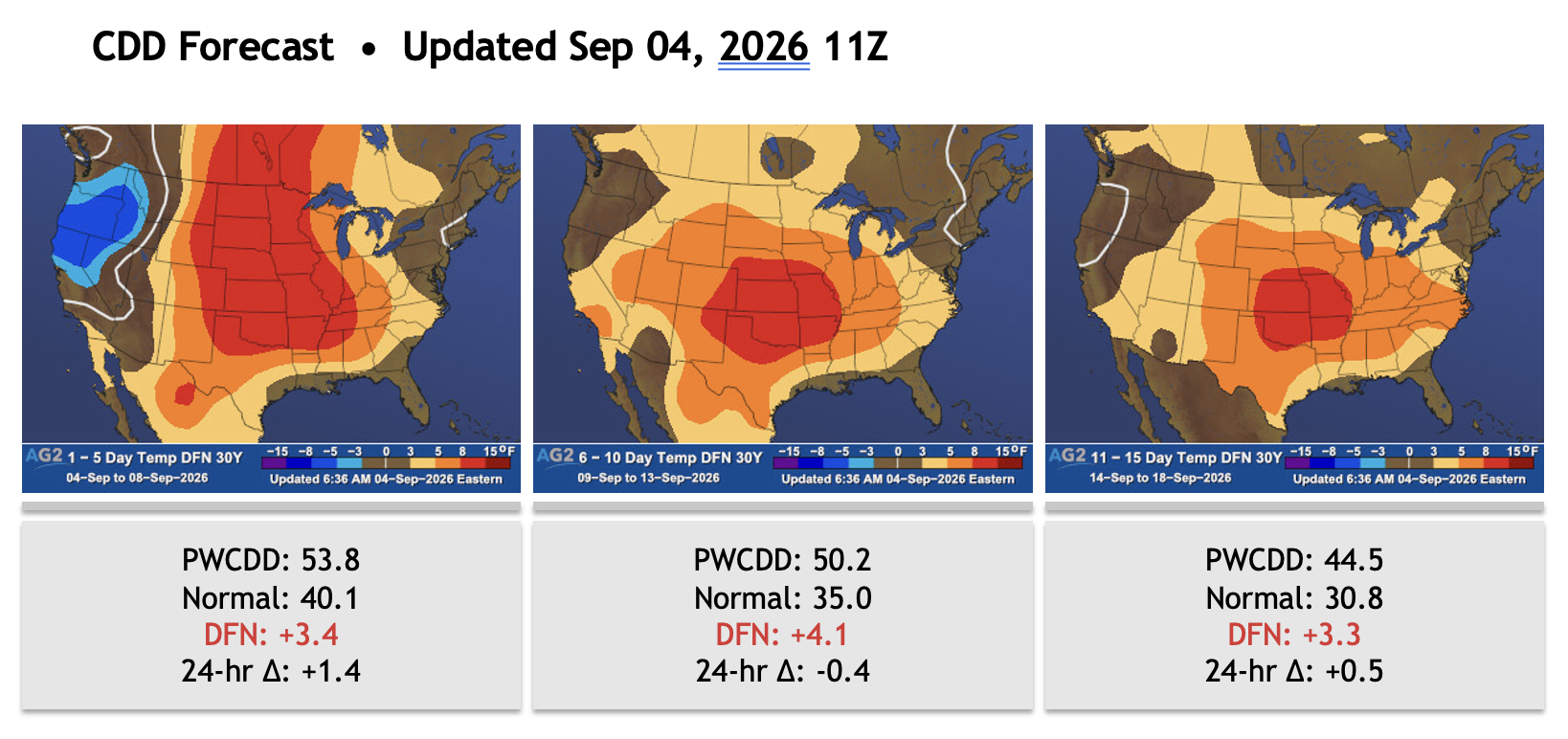
Degree day info for the next 15 days:
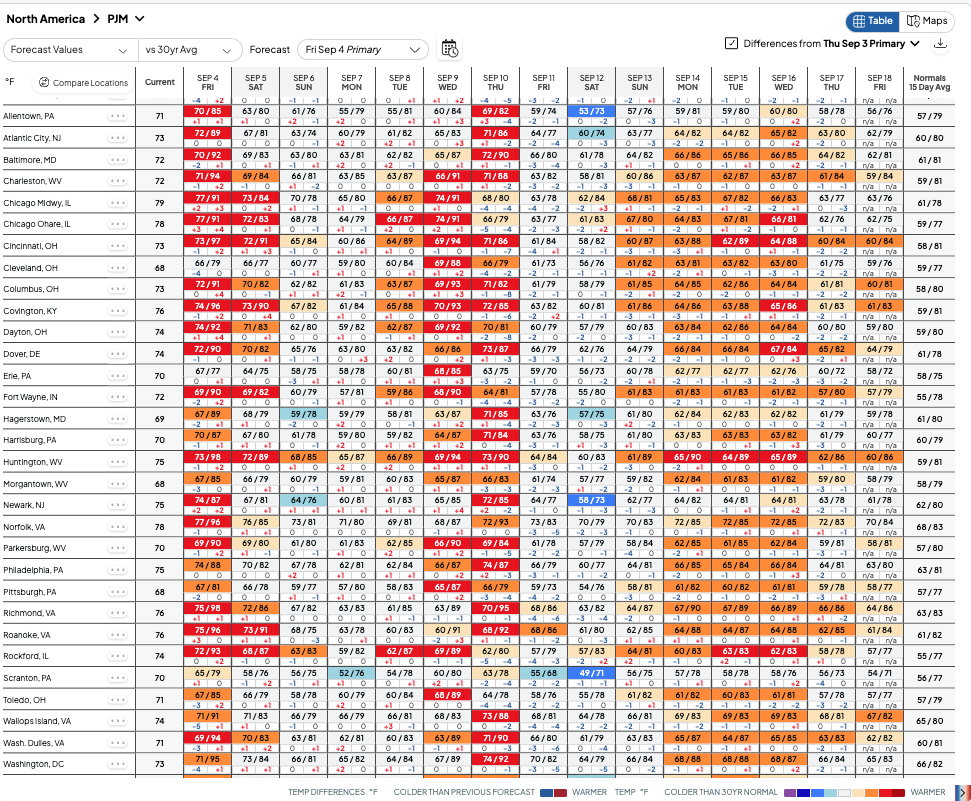
The PJM pattern will cool off this coming weekend into the first day or two of the week of the 7th, but likely turn hotter again for the middle of that week. Right now, we are cooler than the temperatures we are seeing this week with a cooler trend to end that week. We do turn warmer again into the week of the 14th, but it looks cooler than the week of the 7th.
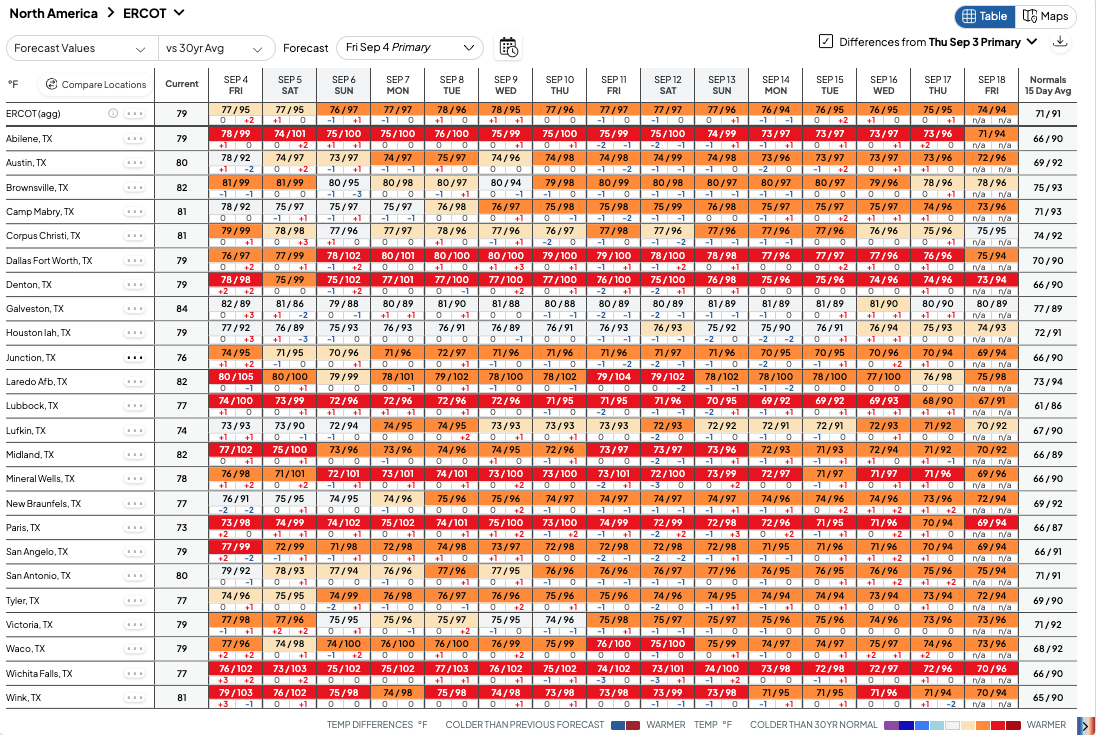
ERCOT maintains its hot look through mid-September, with upper 90s and some 100s expected – trends are mixed since yesterday.
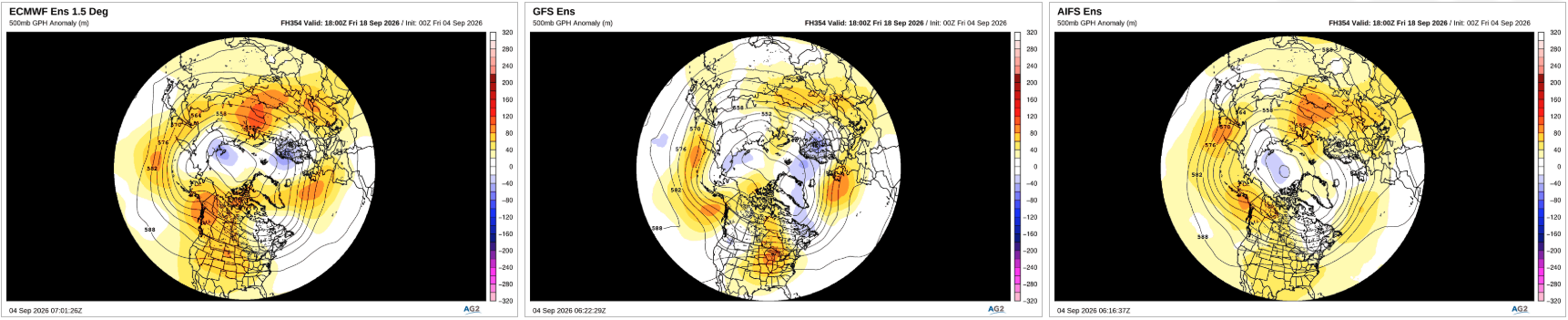
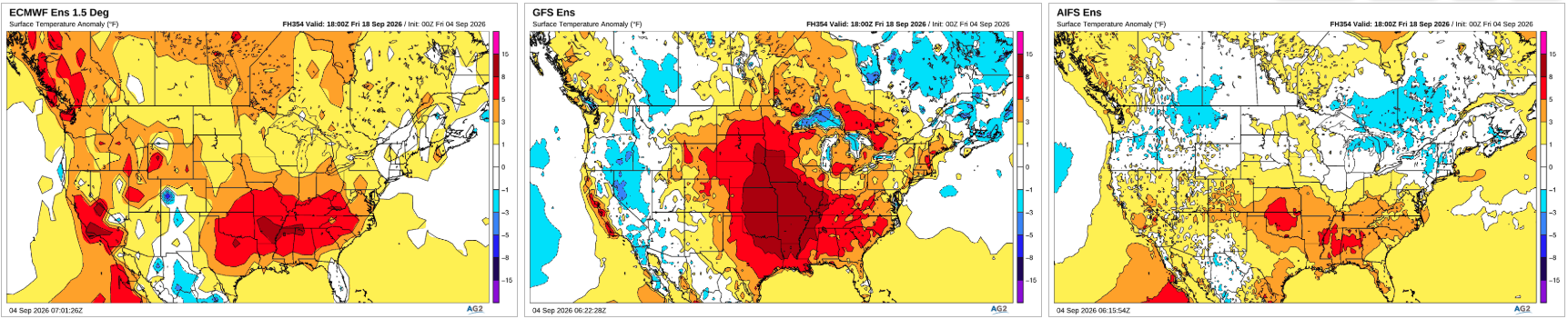
Looking at day 15, September 18th, we can see the ridge centered over the MidCon. We can see broader warmth continue in the East, but it appears the core of the durable heat is centered MidCon through the middle of September, including parts of Texas.
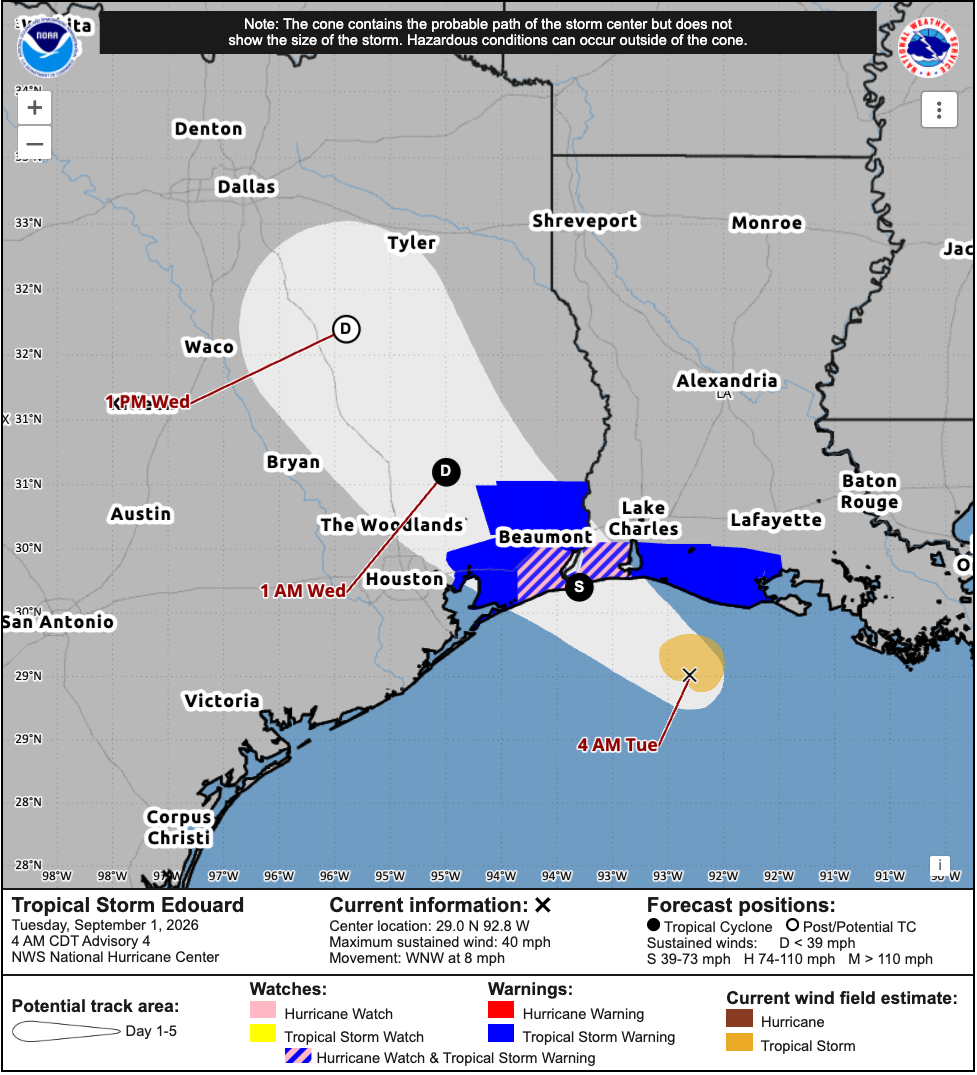
Tropical Storm Edouard remains the main weather story along the Upper Texas and Louisiana coast, and the overall setup continues to suggest that rain is a bigger risk than wind for Houston. While Edouard is maintaining tropical-storm strength near the coast, the strongest winds should remain closer to the center and immediate coastal areas. For the Houston metro, the more meaningful concern is the potential for repeated bands of heavy rain, localized flash flooding, and travel disruptions as Edouard moves inland through Tuesday into Wednesday.
Changes From the Previous Forecast: Compared with the previous forecast, the latest guidance has nudged Edouard and its expected inland track somewhat farther west toward Southeast Texas, while the storm itself has not strengthened beyond a minimal tropical storm. The center has also continued moving west-northwest and is now closer to the Upper Texas coast. This subtle westward adjustment is important for Houston because it increases the potential for the storm’s deeper tropical moisture and heavier rain bands to spread farther into the metro area. At the same time, there has been no corresponding increase in the wind threat, so the primary forecast change is an increased emphasis on Houston’s rainfall and localized flooding risk rather than stronger winds.
Satellite and Storm Track: The first image shows Edouard as a 40 mph tropical storm approaching the Upper Texas coast, with the projected track carrying the circulation inland across Southeast Texas. The broad cloud and precipitation shield extends well away from the center, meaning meaningful impacts do not depend on the exact location of landfall. Houston remains close enough to the track for periods of tropical downpours, but the current structure continues to favor rainfall as the dominant concern rather than widespread damaging winds.
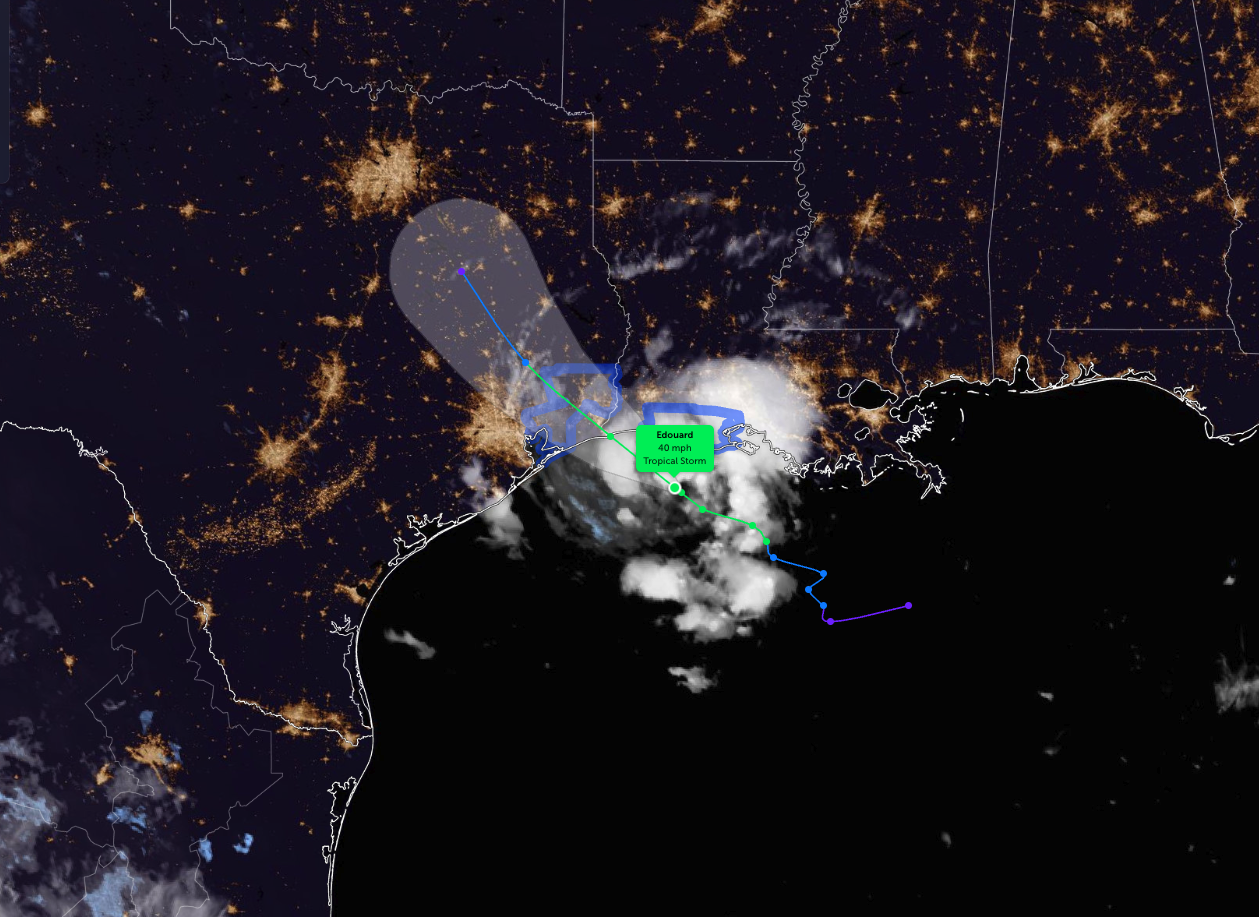
Latest NHC Forecast: The latest National Hurricane Center advisory places Edouard near 29.0°N, 92.8°W, with maximum sustained winds of 40 mph and movement west-northwest at around 8 mph. The forecast takes Edouard inland across the Upper Texas coast before weakening to a tropical depression over Southeast Texas. Houston is close to the western portion of the track corridor, while Tropical Storm Warnings cover portions of the Upper Texas and southwestern Louisiana coast. Despite the storm’s proximity, Edouard remains relatively weak, so the Houston impact continues to be much more about rain than wind.
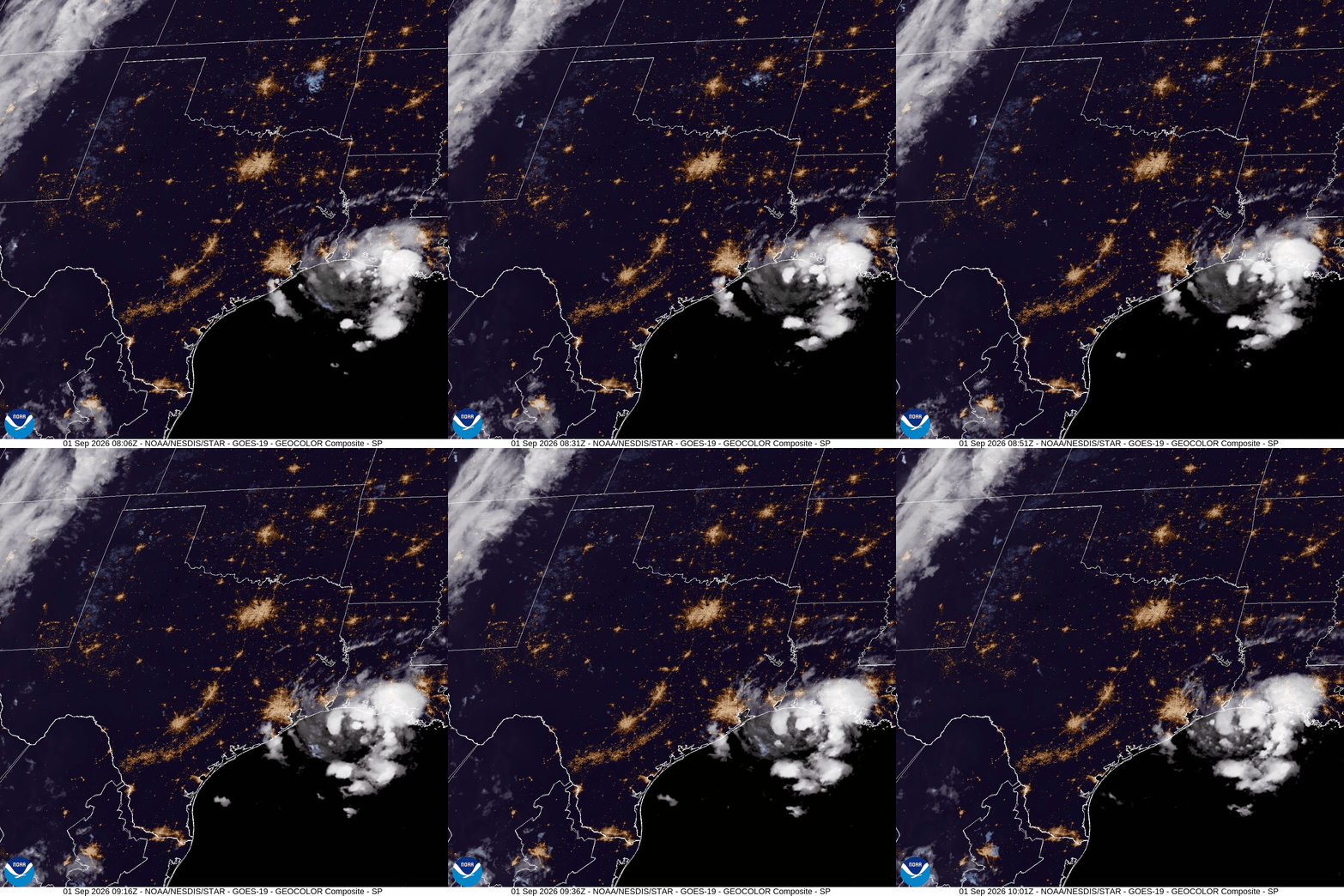
GOES Satellite: The latest nighttime satellite imagery shows Edouard’s main convective area approaching the coast, with the circulation and strongest thunderstorms concentrated southeast of the Houston metro. The storm remains somewhat asymmetric rather than having a compact, powerful tropical structure. That is good news from a wind standpoint, but the large moisture envelope can still deliver repeated tropical rain bands across Southeast Texas. Houston does not need to take a direct hit from the center to experience locally heavy rainfall.
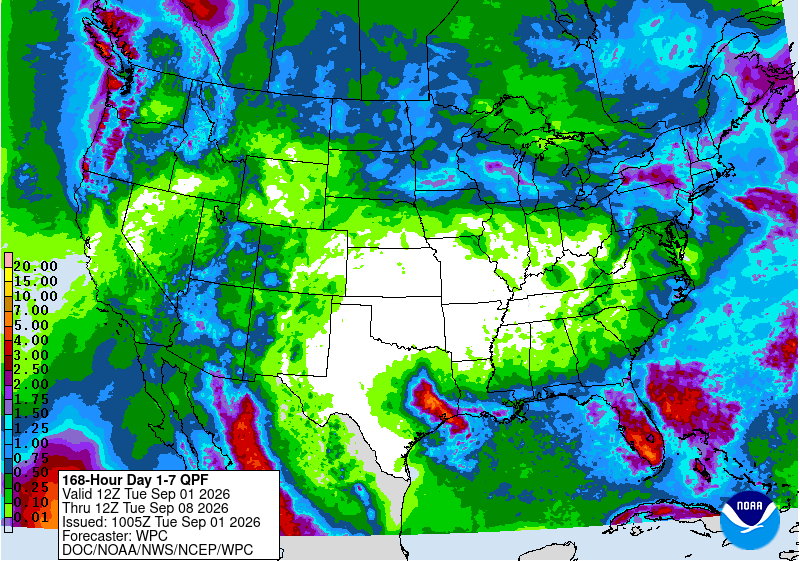
Seven-Day Rainfall Outlook: The broader precipitation forecast reinforces the rainfall concern, showing a pronounced precipitation maximum along the Upper Texas and southwestern Louisiana coast with moisture extending inland across Southeast Texas. The heaviest totals will be localized and highly dependent on where individual rain bands train, but several inches could fall in portions of the region. For Houston, that creates a greater threat of street flooding, poor-drainage flooding, and isolated flash flooding than meaningful wind damage.
Overall, Edouard remains a relatively weak tropical storm, but its westward adjustment makes rainfall increasingly relevant for Houston. I do not expect wind to be the primary problem for the metro, with widespread damaging winds looking unlikely based on the current forecast. Instead, the focus should be on periods of heavy rain Tuesday into Wednesday and the potential for localized flooding where bands repeatedly move across the same areas. The latest forecast therefore represents somewhat greater rainfall concern for Houston, even as the overall wind threat remains relatively limited.
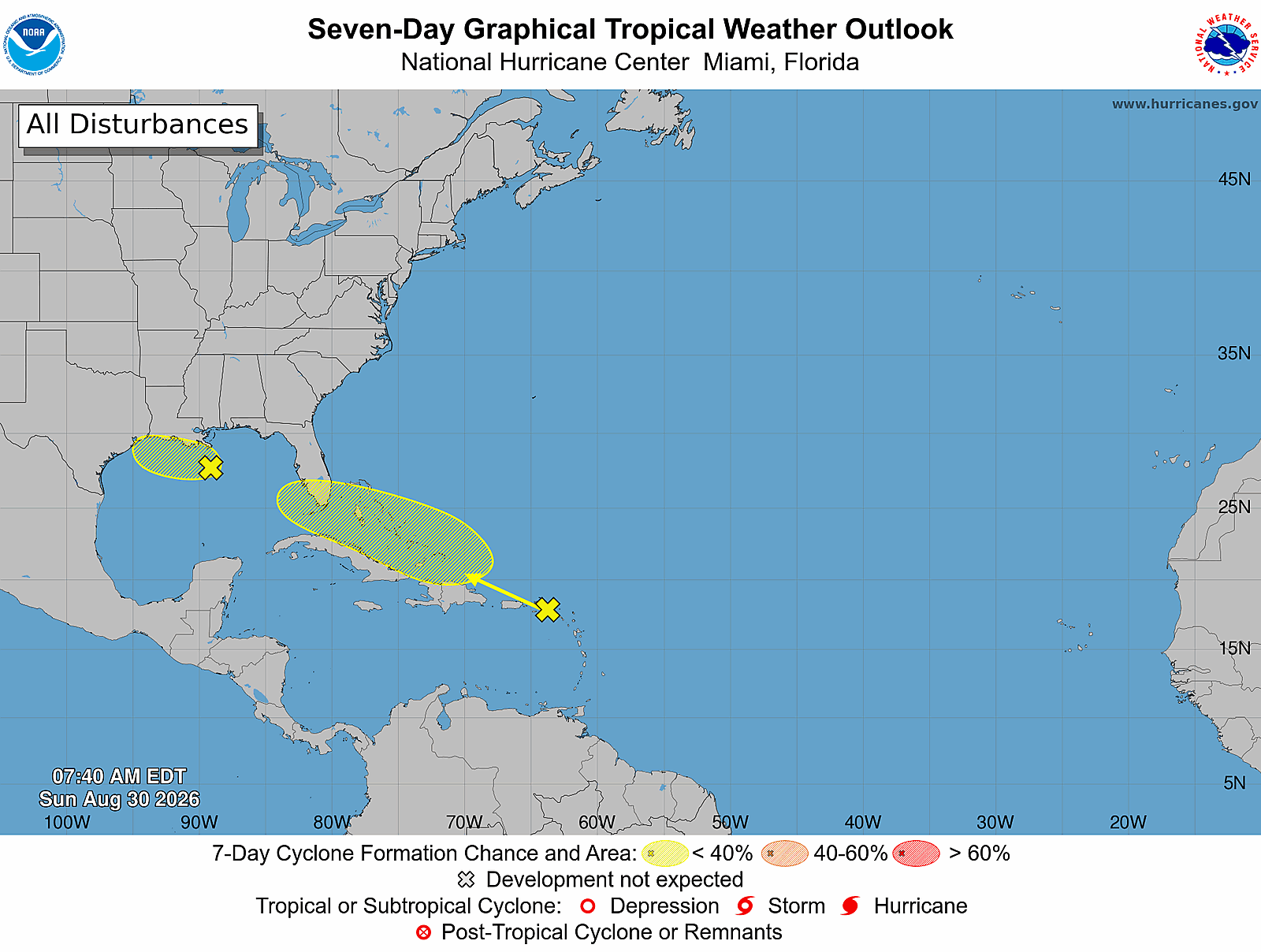
The Atlantic basin remains active heading into the new week, with two areas of tropical interest being monitored. The northern Gulf disturbance remains the primary near-term concern for the U.S., while the tropical wave moving westward through the Caribbean/Atlantic corridor also continues to show a meaningful development signal in the ensemble guidance. I still view the Gulf system primarily as a heavy-rain threat rather than a significant wind event, although some gradual tropical organization remains possible as the disturbance moves westward.
NHC Tropical Outlook: The National Hurricane Center continues to highlight both the northern Gulf disturbance and the tropical wave moving westward toward the Caribbean, with both remaining in the low-probability development category. The Gulf disturbance is already close to land, so its impacts will be driven much more by rainfall and its eventual track than by whether it receives a tropical designation. The eastern system has considerably more time over water and will need to be monitored as it progresses westward during the coming days.
ECMWF Full Atlantic Ensemble: The ECMWF ensemble continues to show two distinct areas of potential development. The stronger longer-range signal is associated with the tropical Atlantic wave, with a concentrated probability corridor extending westward toward the northeastern Caribbean before many ensemble members eventually turn the system northward. Meanwhile, there remains a separate development signal over the northern Gulf. The broader ensemble pattern suggests the Atlantic is becoming more favorable for tropical activity as we move into early September.
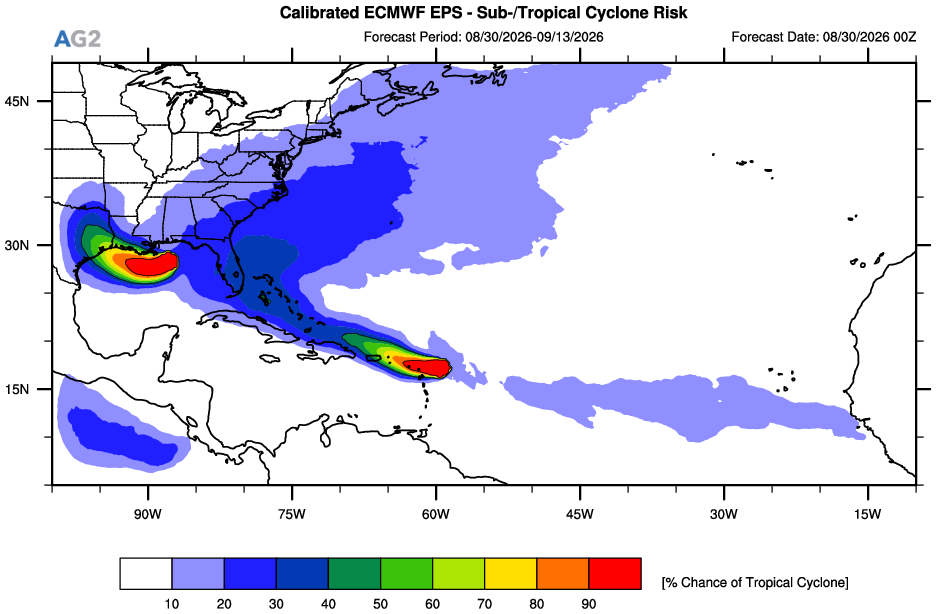
ECMWF Gulf Ensemble: For the northern Gulf disturbance, the latest ECMWF guidance continues to support a westward to west-northwestward movement across the northern Gulf, followed by a turn toward the Louisiana or upper Texas coast. The ensemble probability signal for reaching at least tropical-depression strength remains fairly concentrated, although the spread in tracks is still considerable. I remain more focused on exactly how far west the circulation gets before turning inland, because a farther-west solution would increase the heavy-rain threat across western Louisiana and Southeast Texas.
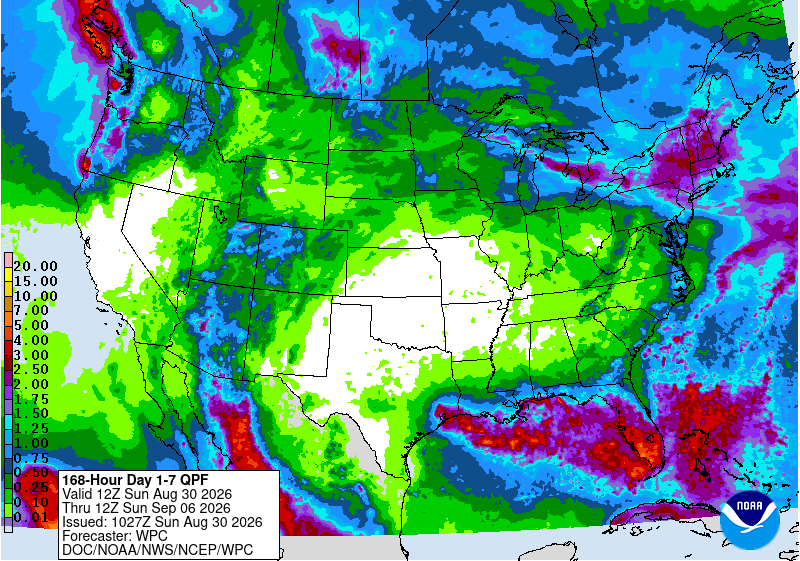
Seven-Day Rainfall Outlook: The WPC rainfall forecast shows a very moisture-rich pattern across the Gulf, with a broad area of several inches of rainfall over the north-central and northeastern Gulf and locally much higher totals offshore. The heaviest rainfall axis remains concentrated from the central Gulf toward Florida, but significant moisture extends west toward Louisiana. With a slow-moving circulation, repeated convective bands could produce locally excessive rainfall even if the system never becomes a strong tropical cyclone.
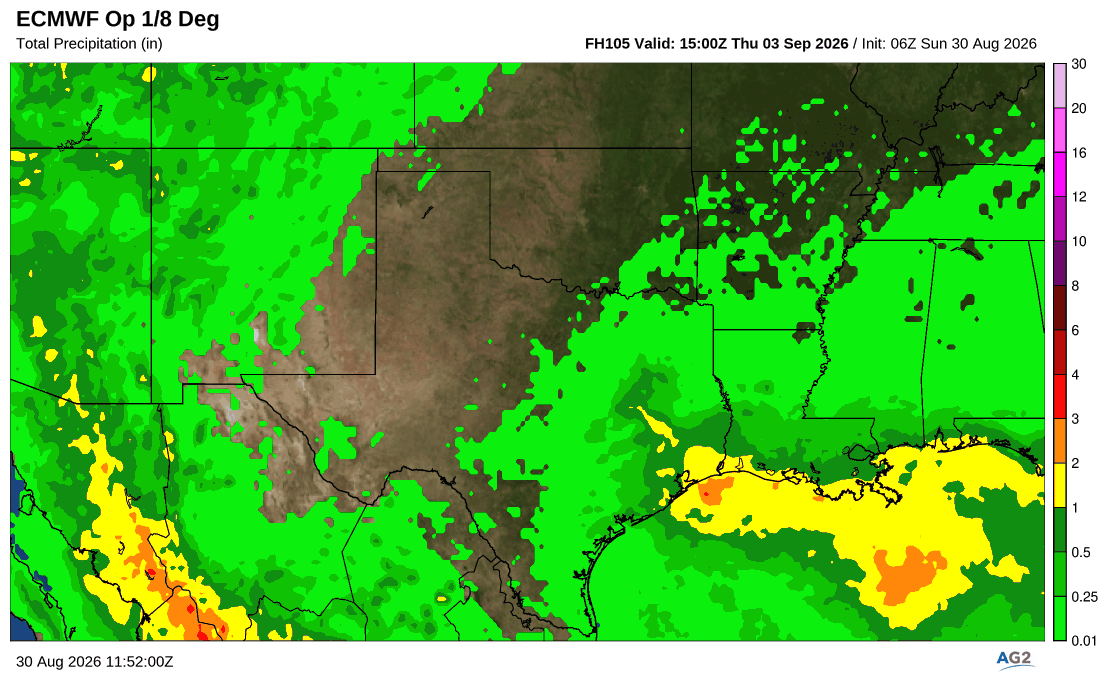
ECMWF Rainfall Forecast: The operational ECMWF is somewhat less aggressive with rainfall over Southeast Texas, keeping the more substantial totals focused closer to the Louisiana coast and offshore waters through Thursday. However, this remains highly sensitive to the eventual track. If the low drifts farther west before coming north, the rainfall shield would likely follow it, bringing a greater risk of 2+ inch totals and locally heavier amounts into western Louisiana and portions of Southeast Texas. A quicker northward turn would keep the most significant rainfall farther east.
Overall, I continue to see the northern Gulf disturbance as mainly a heavy-rain event through the first half of the week, with tropical development a secondary concern. The ECMWF still supports some organization, but the most important forecast variable remains the eventual track. A Louisiana-focused solution keeps the heaviest rainfall farther east, while any additional westward shift would increase the concern for heavier rainfall and localized flooding across Southeast Texas and western Louisiana. Farther east, the tropical Atlantic wave also deserves increasing attention as ensemble guidance continues to show a stronger development signal heading into early September.
The Panama Canal is a major global shipping route, shortening transit times between the east and west coasts of the Americas. Severe drought in 2023 and into 2024 reduced Panama Canal transits by around 30% as low water levels limited canal operations. The main reservoir feeding the canal is Gatun Lake which has strong seasonal variability. The plot below shows the monthly average water levels over the past five years. Lowest levels are during late spring and early summer, with highest levels through the winter.
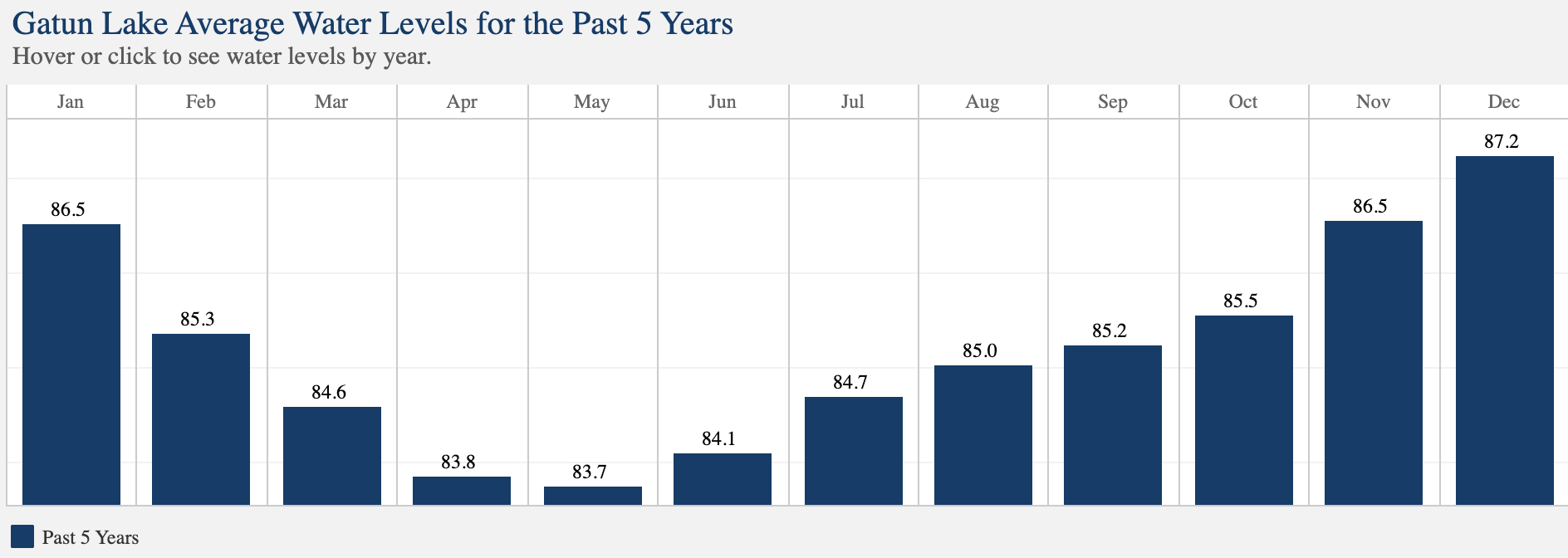
Taking a closer look at the yearly levels for September and December below, clearly shows the extremely low levels during the El Nino of 2023.
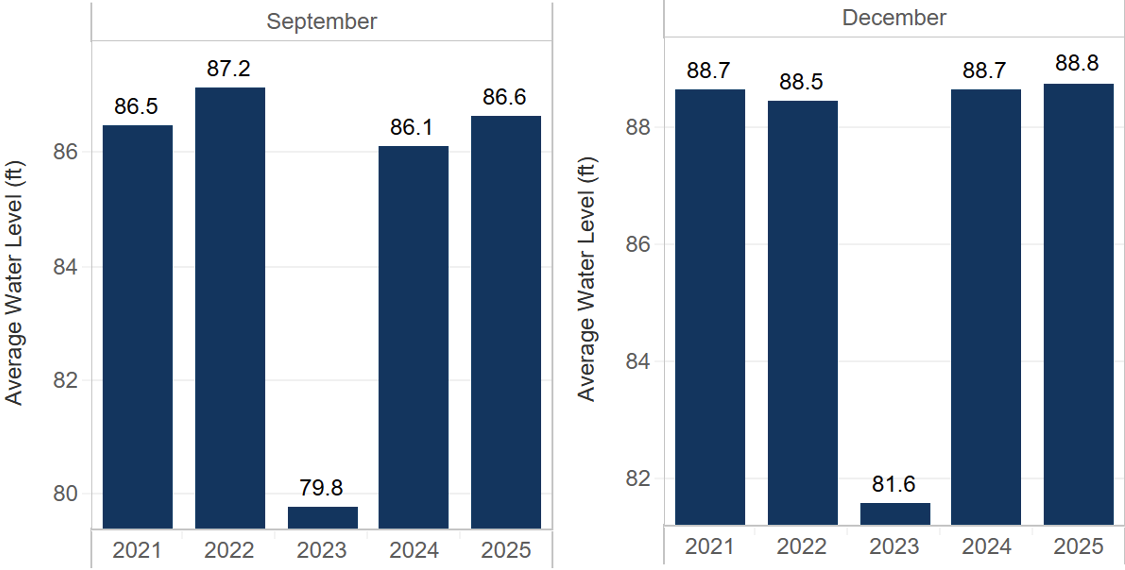
The strong El Nino through 2023-2024 is considered to have played a significant role in these drought conditions leading to the canal operating well below capacity. Daily transits dropped to as low as 24 vessels and maximum drafts fell below 44 feet. By later 2024 and through 2025, a change to La Nina conditions led to an increase in rains across the region and hence the canal returned to normal operations.
So, what is the current situation and the outlook through the rest of 2026?
Local observations show water levels in Gatun Lake of 83.8cm on 27th August, which has lowered from 84.1cm on 20th August. Comparing this latest water level of 83.8cm at the end of August, these levels are currently higher than the low level of 79.6cm which was recorded in August 2023. So we are currently remaining above the 2023 levels.
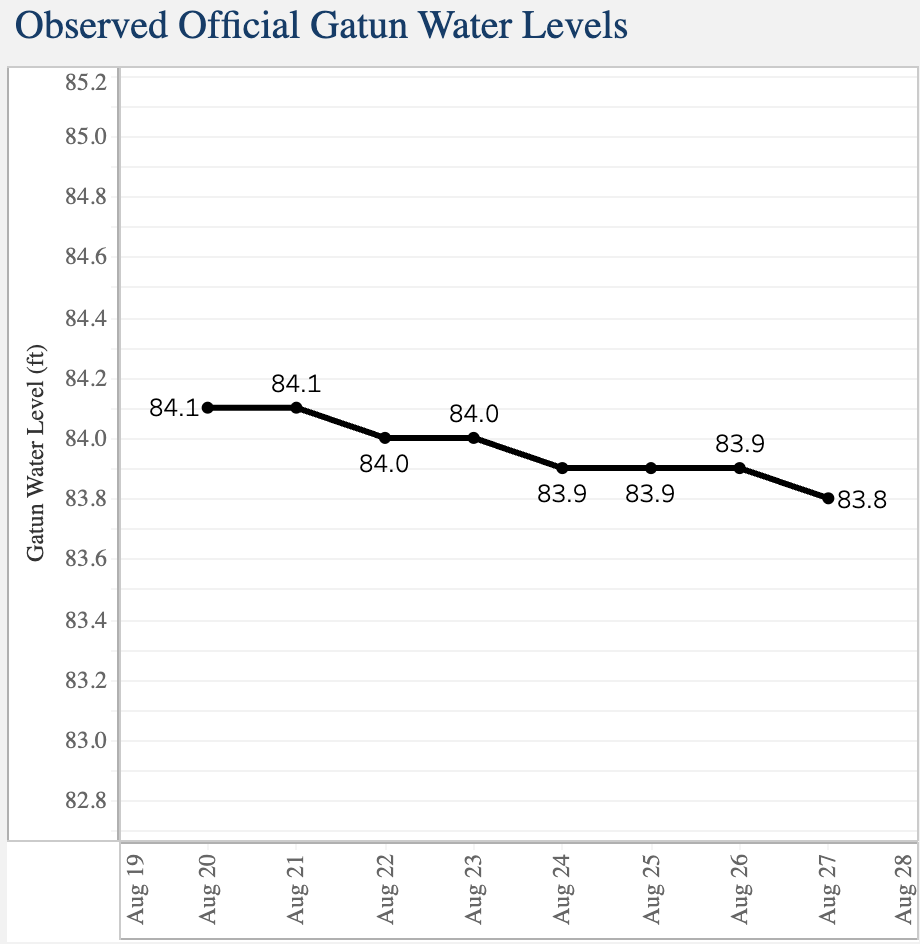
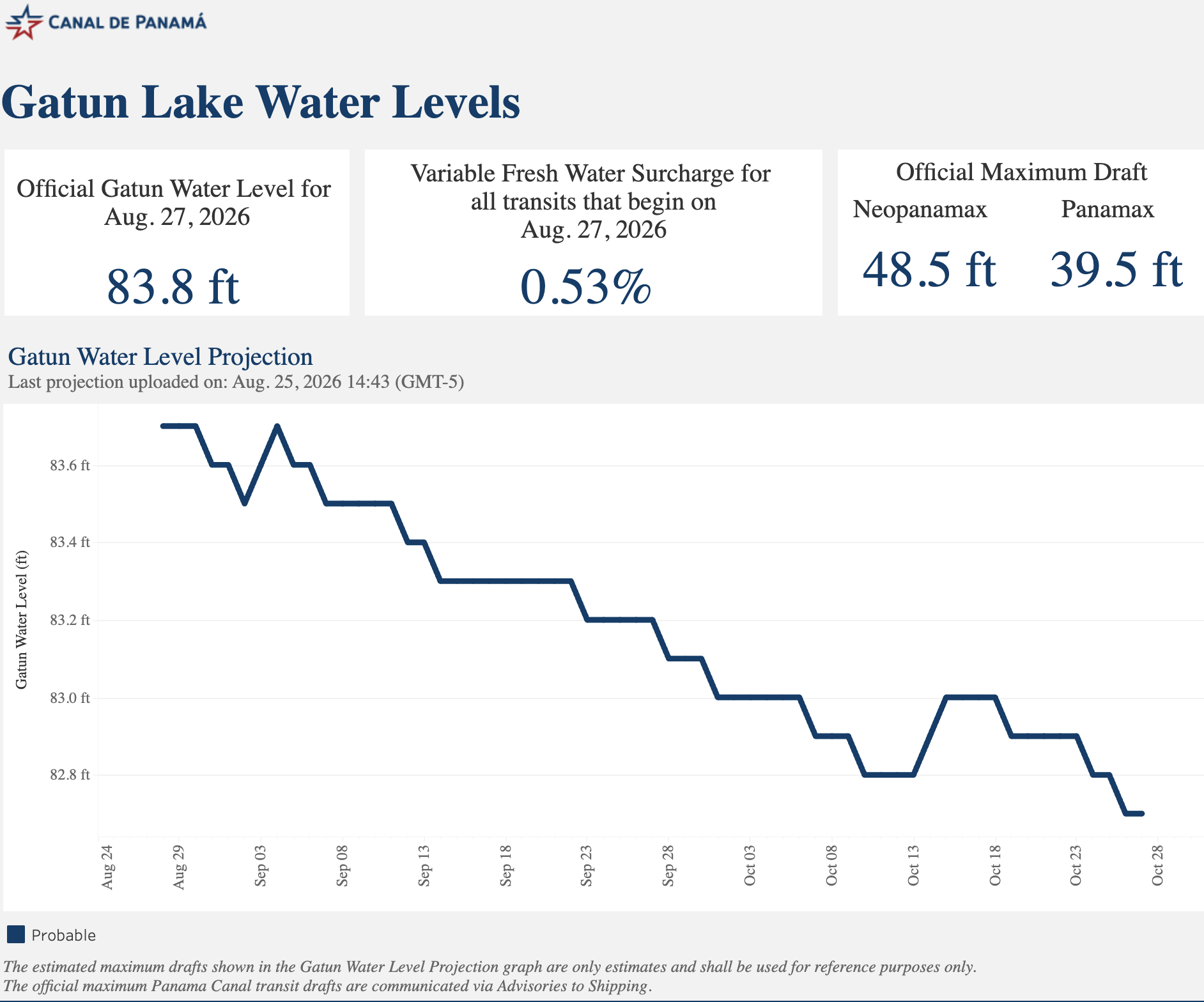
The water level projection plot below does forecast a further drop in levels over the next two months as El Nino strengthens. The Panama Canal Authority (ACP) has lowered draft levels from the beginning of July due to El Nino. While last week the ACP told shipping firms that 32 vessels a day will be able to pass through it from 15th September, compared to 36 currently.
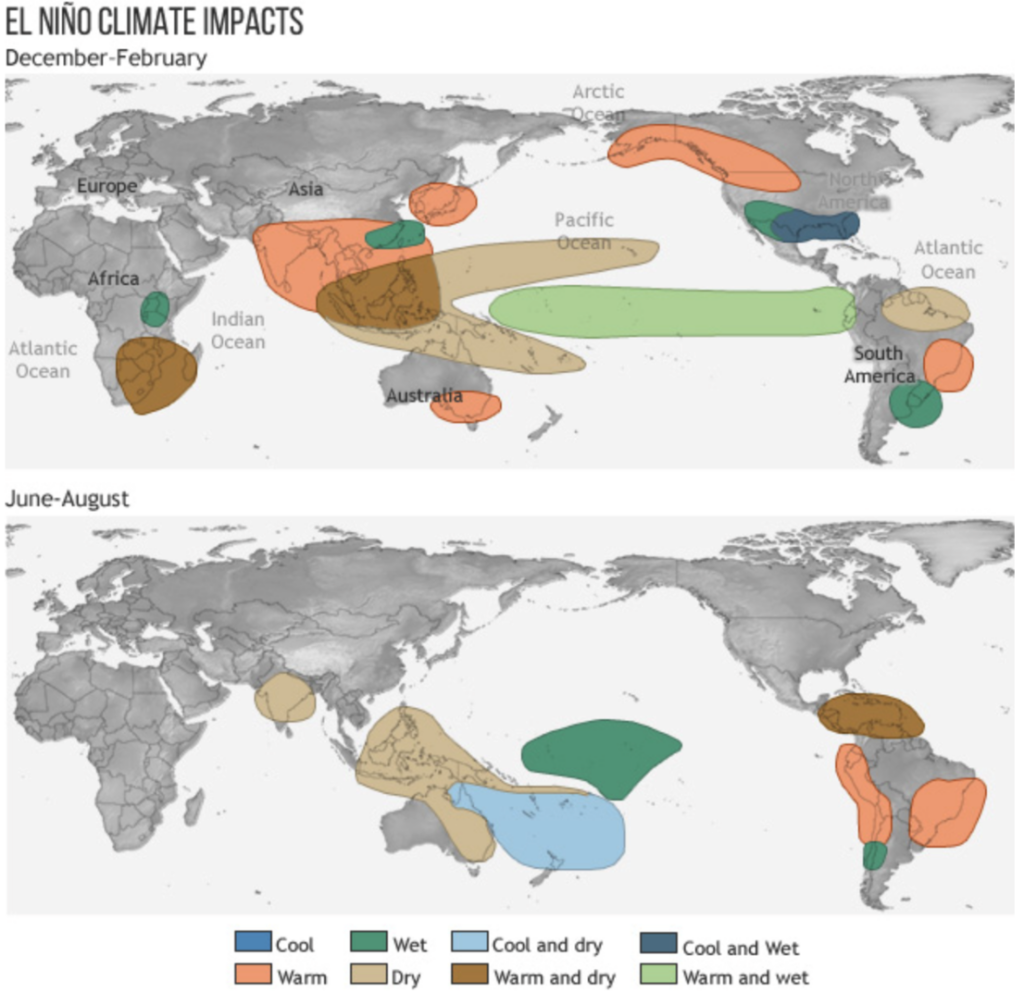
The latest ENSO guidance from the ECMWF below continues to forecast a historically strong El Nino as we move through the rest of this year, peaking November and December.
El Nino generally brings drier conditions across the Caribbean, including the Panama Canal region through summer. The signal is then weaker through the winter across Panama.
The C3S seasonal guidance for September through to January is shown below. Drier than normal conditions are forecast across Panama through the end of this year and into January. So although moving through winter is the wetter season for the region, conditions are forecast to remain drier than normal. This would therefore limit precipitation input into Lake Gatun and have implications on water levels in the Panama Canal through autumn and winter.
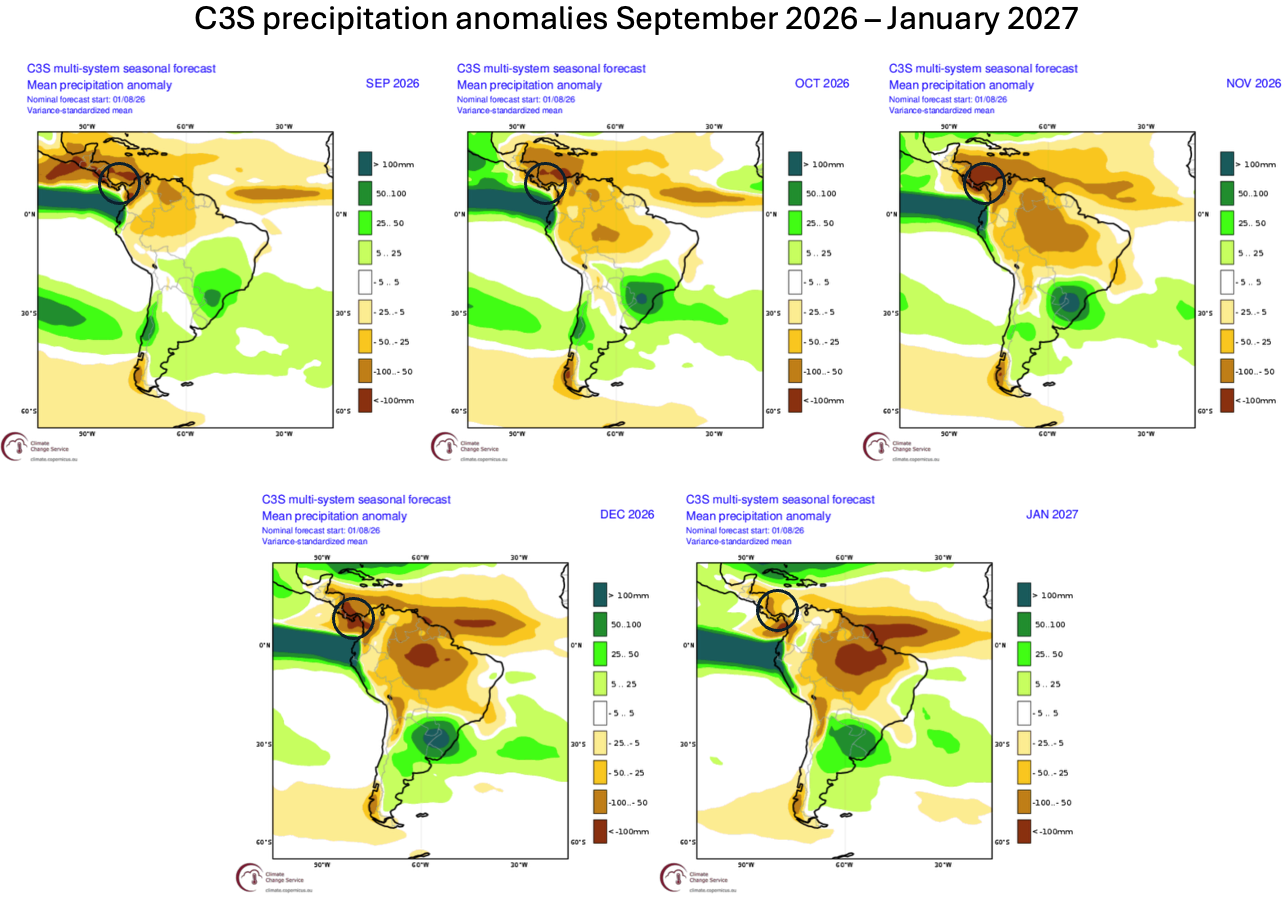
Bottom line: Drier than normal conditions across the Panama Canal region through summer have lowered water levels at Lake Gatun to 83.8cm. This however isn’t as low as the 79.6cm which was recorded in August 2023 during the severe drought. As we move through autumn and into winter, a historically strong El Nino is forecast. Drier than normal conditions are forecast to persist across the region as per the latest C3S from September to January. The Panama Canal Authority have just last week announced further vessel restrictions from September lowering vessel numbers down to 32 from mid September due to the drier than normal forecast.
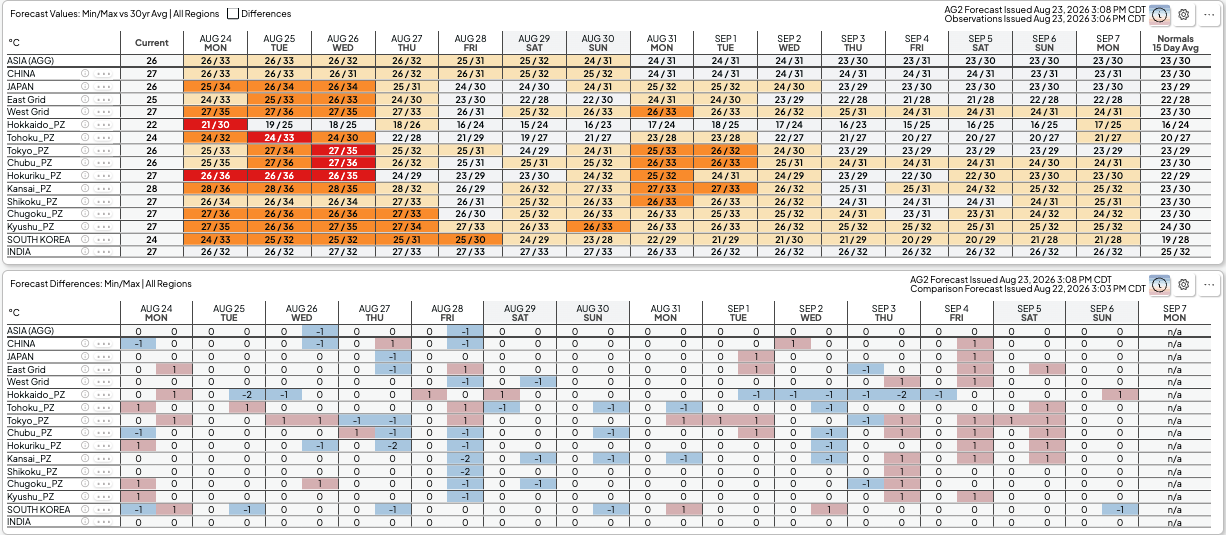
Japan begins the new forecast period with another stretch of above-normal late-August heat before temperatures gradually ease later this week. The hottest conditions remain concentrated across central and western Japan through Wednesday, followed by increasing cloud cover, precipitation and somewhat lower daytime temperatures from Thursday into the weekend. Tokyo and Kansai both remain quite humid, so apparent temperatures will continue to run well above actual air temperatures during the hottest periods. Model spread increases later in the forecast, with tropical activity across the western Pacific adding another source of uncertainty for temperatures, rainfall and solar generation.
For Japan overall, the AG2 forecast continues to show highs near 34°C from August 24-26, compared with a 30-year normal high near 29°C. Temperatures then step down to around 31°C Thursday, 30°C Friday and Saturday, and generally 30-32°C through the first part of September before settling closer to seasonal levels. Changes from yesterday are very small, reinforcing good continuity in the forecast. The national forecast is unchanged through Wednesday, with Thursday’s August 27 maximum lowered by 1°C, while September 1 and September 4 were each raised by 1°C. Overall, the message remains the same: significant heat early in the period followed by gradual moderation rather than an abrupt end to summer warmth.
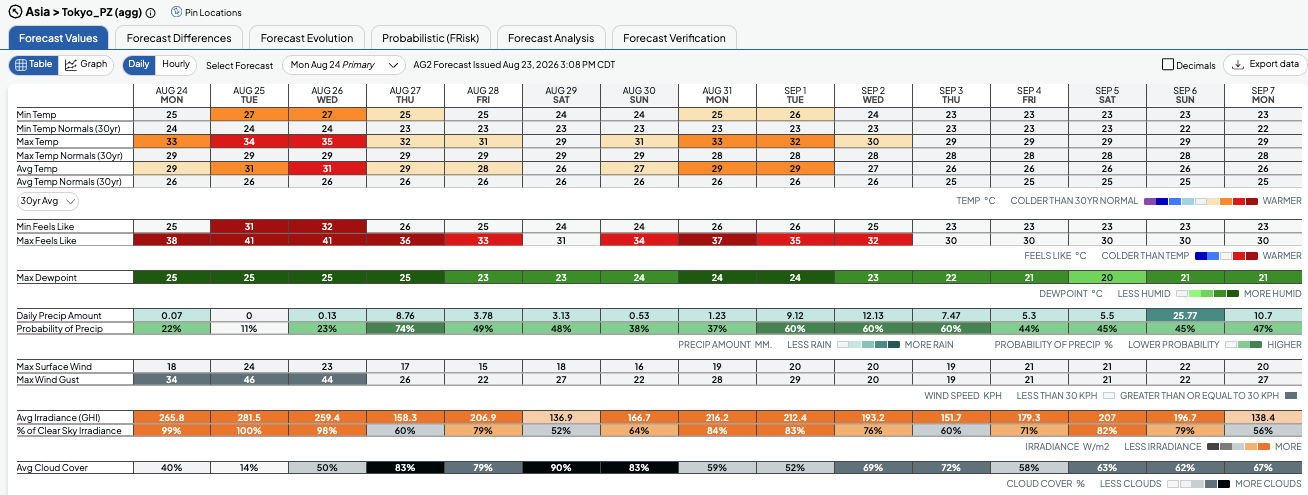
For Tokyo PZ, the hottest stretch remains Monday through Wednesday with forecast highs of 33°C, 34°C and 35°C, respectively, versus normals near 29°C. Humidity remains substantial with dewpoints around 25°C, pushing maximum feels-like temperatures to approximately 38°C Monday and 41°C Tuesday and Wednesday. Solar generation conditions are very favorable during this period, with average irradiance near 266-282 W/m² Monday and Tuesday and 259 W/m² Wednesday, representing roughly 98-100% of clear-sky irradiance. Conditions deteriorate Thursday as precipitation and cloud cover increase, with the high falling to 32°C and irradiance dropping to approximately 158 W/m², followed by an even lower 137 W/m² Saturday under very cloudy conditions. Temperatures briefly rebound to 33°C on August 31 before becoming closer to seasonal levels during early September.
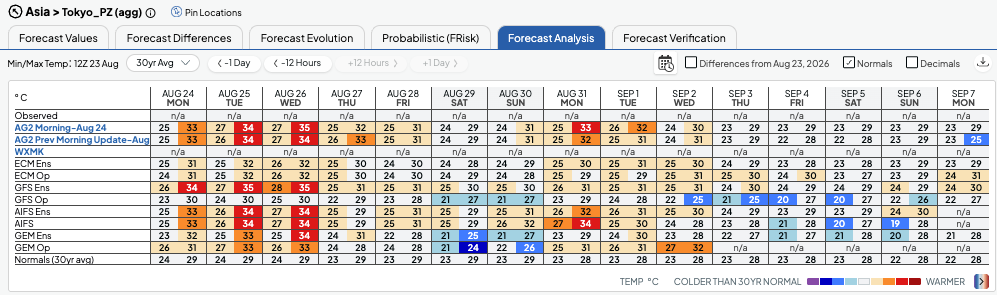
There remains meaningful model spread for Tokyo, particularly beginning Thursday, and I continue to favor the AIFS ensemble over the other model guidance. The AIFS ensemble supports the current heat through the first half of the week but is noticeably more aggressive with the cooling thereafter. Most importantly, it has a Tokyo high near 29°C Thursday versus the AG2 forecast of 32°C, and it is also cooler than AG2 around August 31 and September 1. Therefore, while confidence remains relatively high in the Monday-Wednesday heat, the primary risk to the AG2 forecast is that Tokyo daytime temperatures could cool faster and remain somewhat lower than currently forecast during the late-week and August 31-September 1 periods. The operational GFS is an even cooler outlier at times, but I would not favor that solution over the more stable AIFS ensemble.
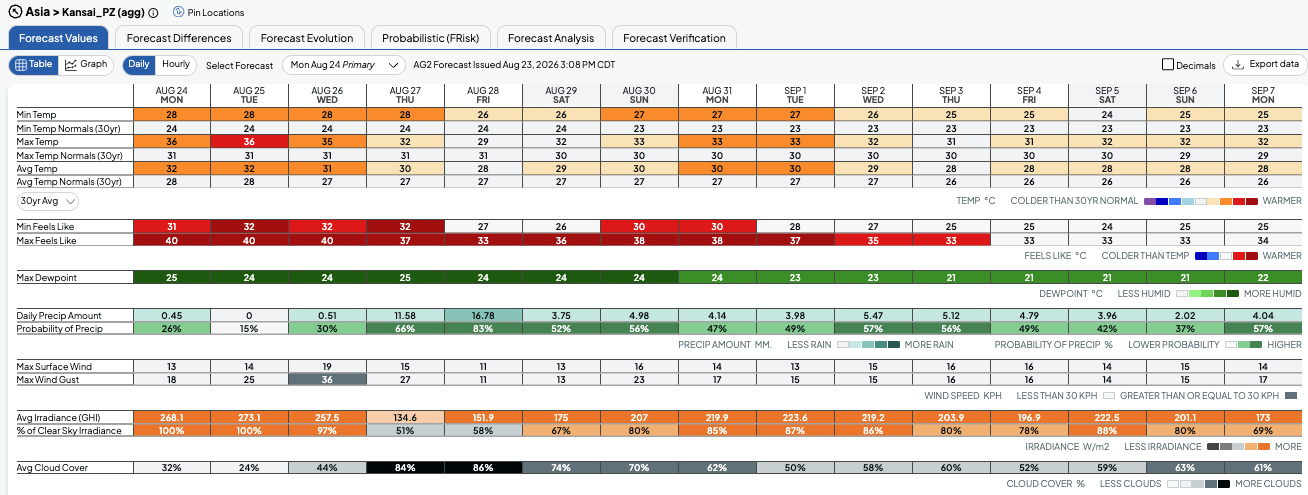
For Kansai PZ, the heat signal is even stronger. AG2 forecasts highs of 36°C Monday and Tuesday and 35°C Wednesday, with minimum temperatures holding near 28°C. Maximum feels-like temperatures reach approximately 40°C each day, creating continued significant heat stress. Solar conditions are also excellent early in the week, with average irradiance around 268 W/m² Monday, 273 W/m² Tuesday and 258 W/m² Wednesday, or roughly 97-100% of clear-sky potential. Cloud and rainfall increase substantially Thursday and Friday, lowering highs to 32°C and 29°C and reducing irradiance to approximately 135 and 152 W/m², respectively. Temperatures then recover into the 32-33°C range from the weekend into early September, with solar generation also rebounding as cloud coverage becomes less extensive.
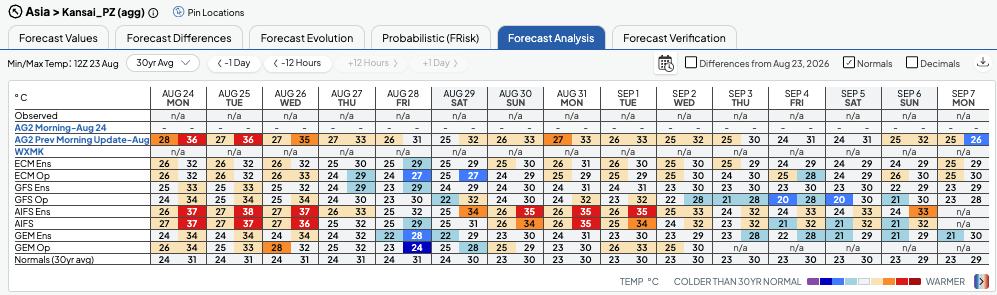
The model spread across Kansai is especially important because the AIFS ensemble is consistently hotter during the daytime than the current AG2 forecast, and I again favor the AIFS ensemble over the other guidance. AIFS ensemble highs reach approximately 37-38°C early this week and remain several degrees warmer than AG2 during portions of the late-week and early-September period. For example, AIFS has highs around 32°C Friday versus AG2’s 29°C, followed by approximately 34-35°C from Saturday through September 1 versus AG2’s 32-33°C. The AIFS ensemble even maintains highs near 32-33°C farther into early September. This creates a clear upside temperature risk for Kansai, particularly for daytime highs, while AIFS overnight lows are occasionally slightly cooler than AG2. If the AIFS ensemble verifies, the late-week cooling would be less pronounced and the subsequent return of heat would be stronger than currently indicated in the AG2 forecast.
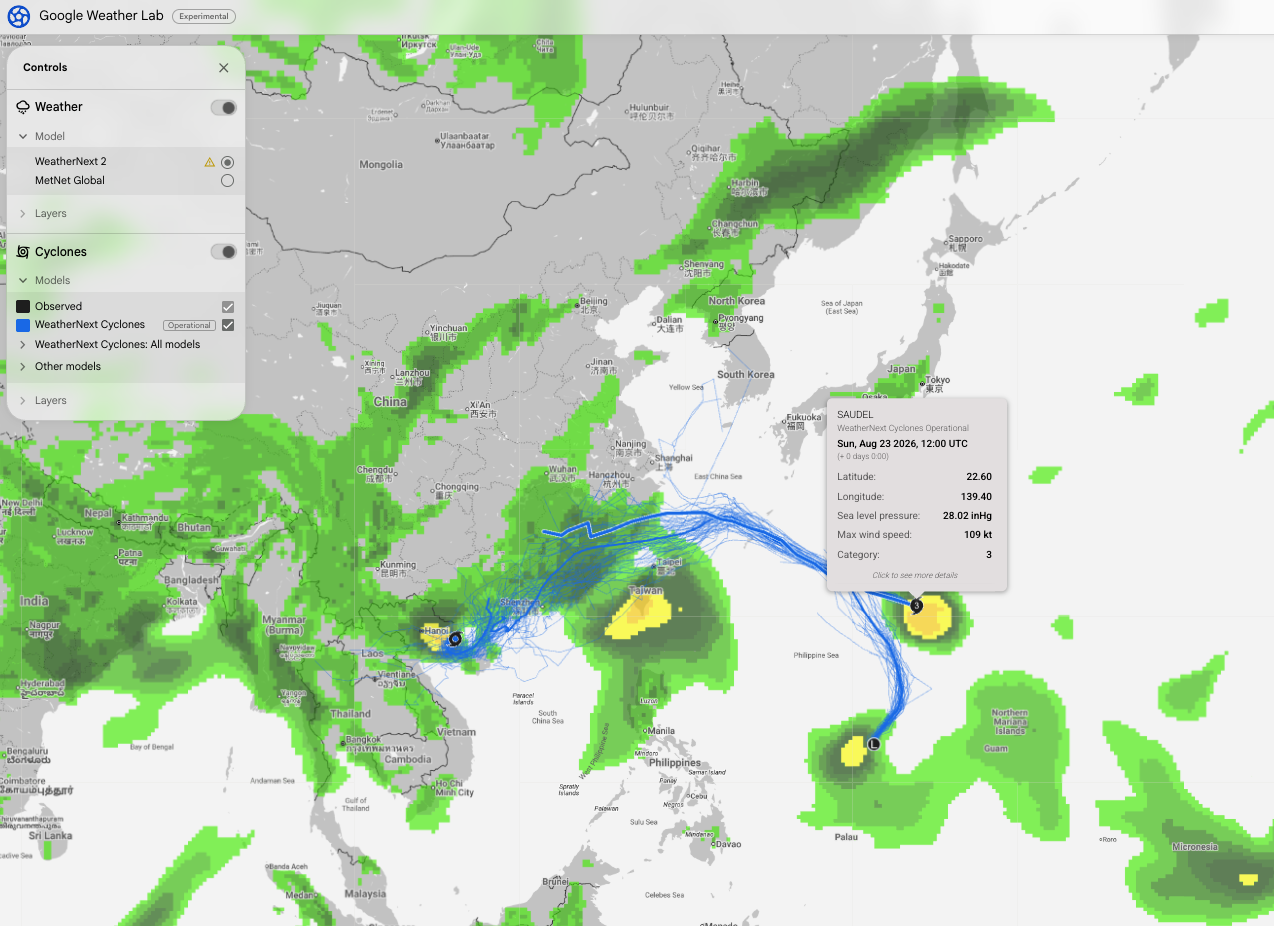
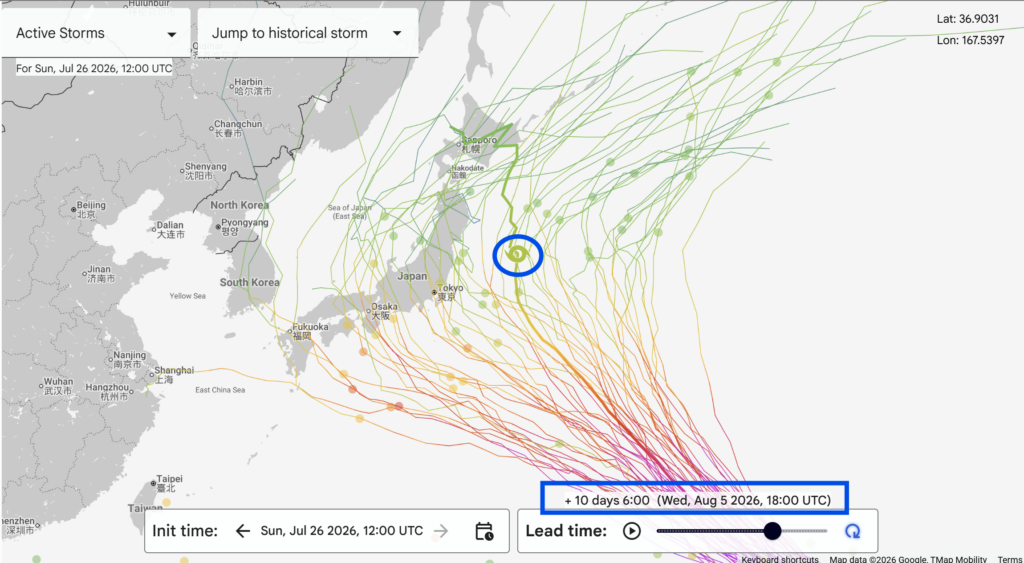
Tropical activity remains an important wildcard late in the forecast. Google WeatherNext cyclone guidance depicts a strong tropical system east-southeast of Japan, with the model showing a broad track envelope generally progressing westward toward Taiwan and eastern China. The majority of the guidance currently keeps the core of the system south of the main Japanese islands, but track spread remains substantial enough that changes in tropical moisture, cloud cover, rainfall and regional wind flow could influence Japan even without a direct landfall. Western and southern Japan, including Kansai, would be particularly sensitive to any northward adjustment in the track, with corresponding downside risk to solar generation and increased precipitation potential. The broader western Pacific pattern therefore needs to be monitored closely over the next several days.
Overall, the forecast continues to favor significant early-week heat across Japan, with Tokyo reaching the mid-30s and Kansai potentially approaching the upper 30s before increasing clouds and rainfall bring some relief later in the week. Confidence is highest through Wednesday, while model and tropical uncertainty grow thereafter. I continue to place the greatest weight on the AIFS ensemble, which argues for somewhat quicker cooling in Tokyo but a hotter and more persistent temperature pattern in Kansai relative to the current AG2 forecast. Tropical evolution will be an increasingly important factor in determining late-week precipitation, solar generation and the magnitude of any temperature moderation.
India’s monsoon is improving. The national rainfall deficit has narrowed to roughly 11 percent below normal, and reservoir storage climbed from 44.4 percent of capacity on 30 July to 52.8 percent by 6 August.
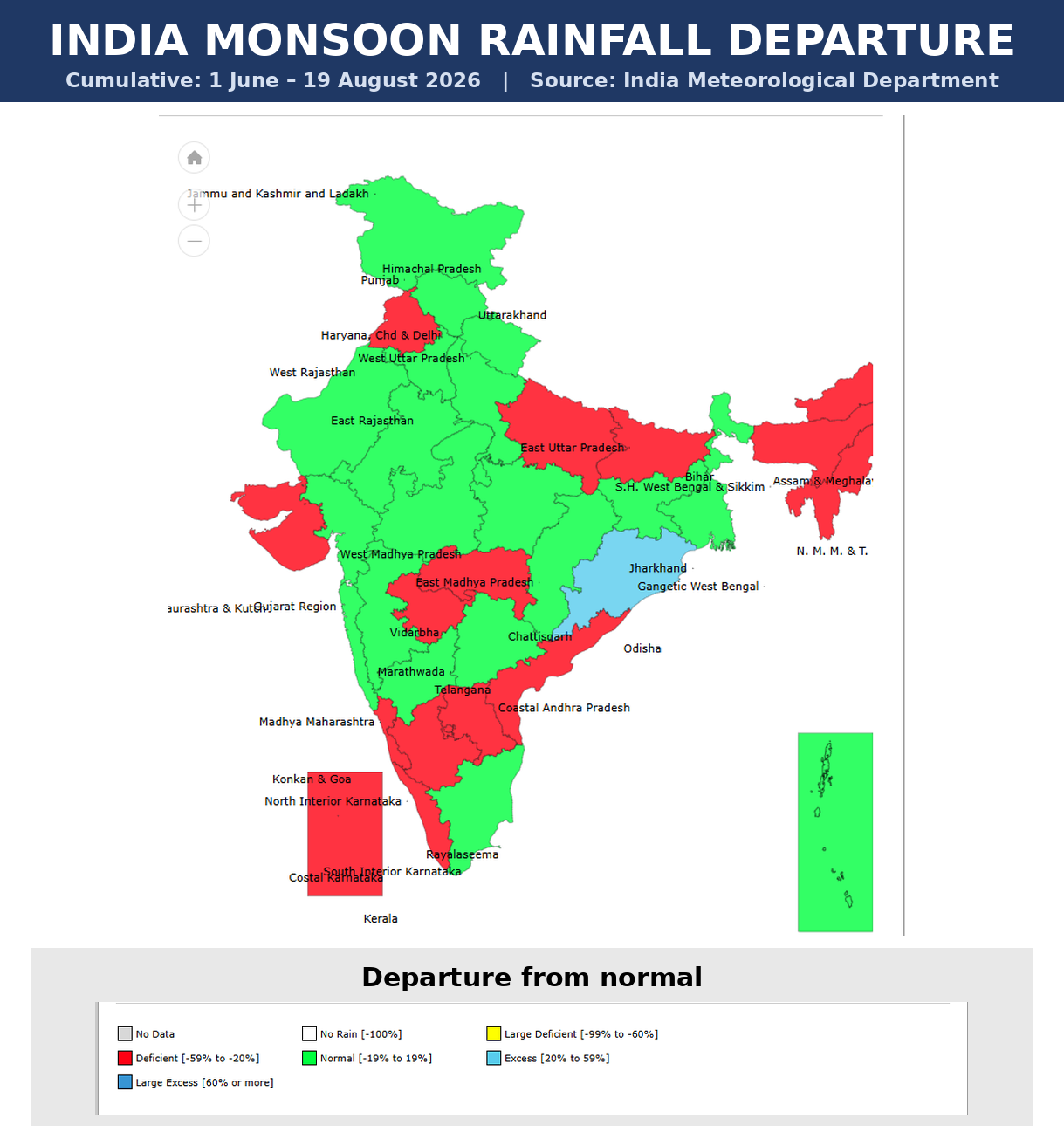
The deficit is regional. India’s 166 monitored reservoirs hold about 97 billion cubic meters against 132 billion this time last year. Western India is fine, ahead of last year at 75.9% of capacity. But Central sits at 47.4%, Northern at 45.8%, and Southern at 46.5%. Three of five regions are 25 to 32 points below where they were a year ago. IMD’s (India Meteorological Department) cumulative departure map says the same thing in geography: deficient subdivisions cluster through Konkan and Goa, all three Karnataka divisions, Telangana, coastal Andhra, Rayalaseema, Vidarbha, East Madhya Pradesh and Gujarat Region, with Jharkhand the lone area in excess.
Which makes the current EC46 run interesting. It spans 24 August to 28 September, The final five weeks of a season that closes on 30 September, with withdrawal normally beginning around 17 September from the northwest. This is the last refill window.
The precipitation anomaly panels are departures from climatology, so the seasonal decline is already subtracted out; a dry anomaly holding through CW38 and CW39 is a real signal. The probability of 10mm panels are absolute, so their collapse from over the Western Ghats in CW35 to almost nothing by CW39 is just the monsoon ending on schedule. The first says drier than it should be.

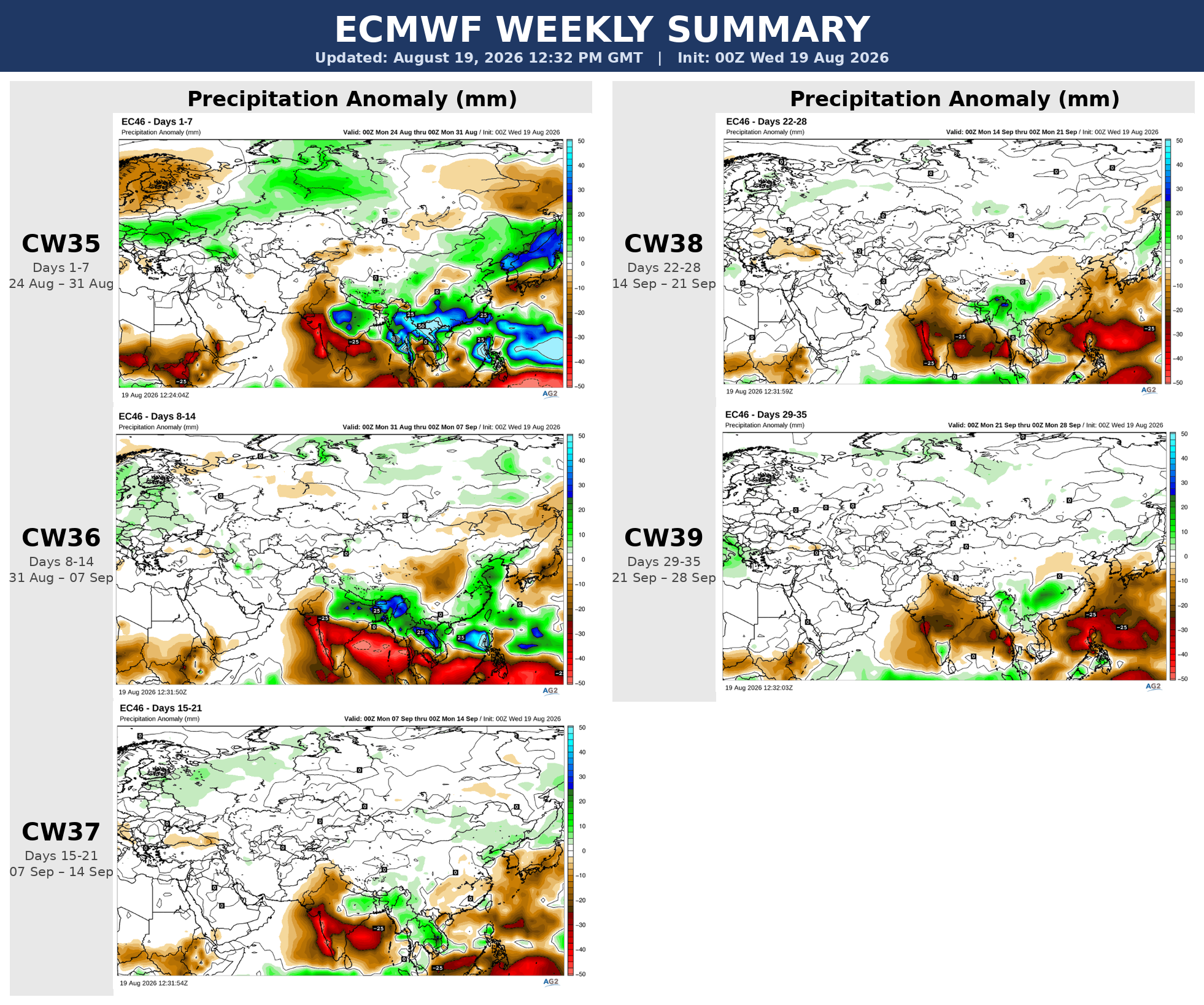
On that measure, the signal is unambiguous and it is dry. Negative anomalies cover most of the subcontinent from CW36 onward, with minus 25 millimeter cores parked over Maharashtra, Gujarat and west central India continuously from CW36 through CW38 before the amplitude relaxes in CW39. There are positive anomalies too. Almost every week puts wet departures along the Himalayan arc, Nepal and northeast India, strongest at plus 25 to 50 millimeters in CW36. That is physically sensible, the trough shifts north as orographic lift keeps the foothills wet. But that water feeds the northern and eastern river systems. The dry cores sit over the peninsular catchments, which is exactly where Southern and Central storage is 25 to 32 points short. The rain is falling where the storage problem isn’t.
One region does have a second chance: Southeast India. Tamil Nadu, coastal Andhra, Rayalaseema, south interior Karnataka draws most of its annual rainfall from the October-to-December northeast monsoon rather than the southwest. Published work on northeast monsoon variability finds the positive phase of ENSO favors that rainfall to be normal or above normal over the southern peninsula, and positive IOD does the same. With El Niño strengthening toward a possible record and IOD guidance leaning positive by September, both drivers point the same way. Strength alone guarantees nothing. But, southern India’s deficit has a recovery path that Central and Northern India do not once September ends.
Published by James Caron
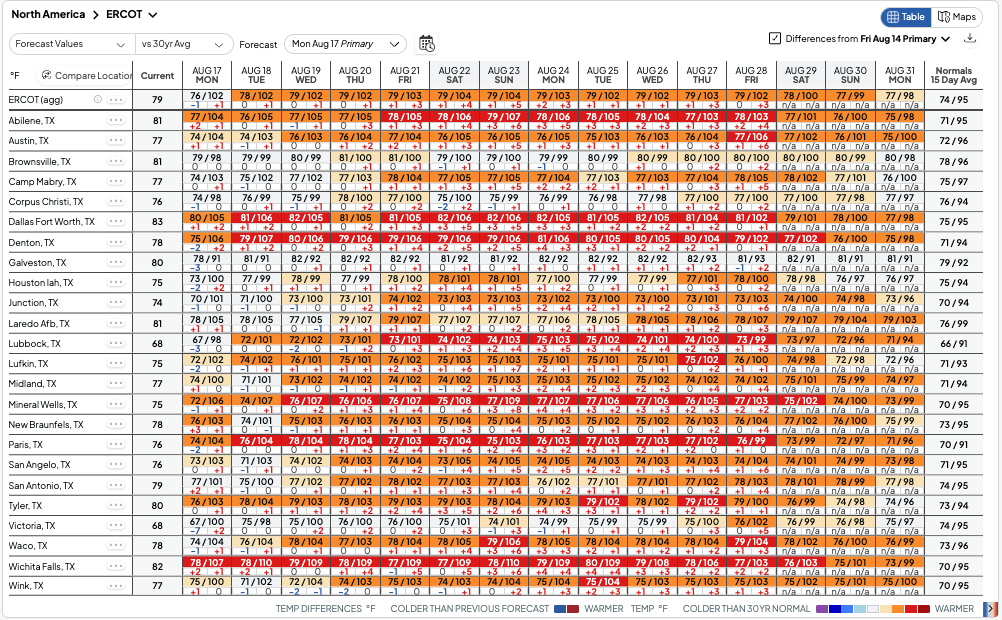
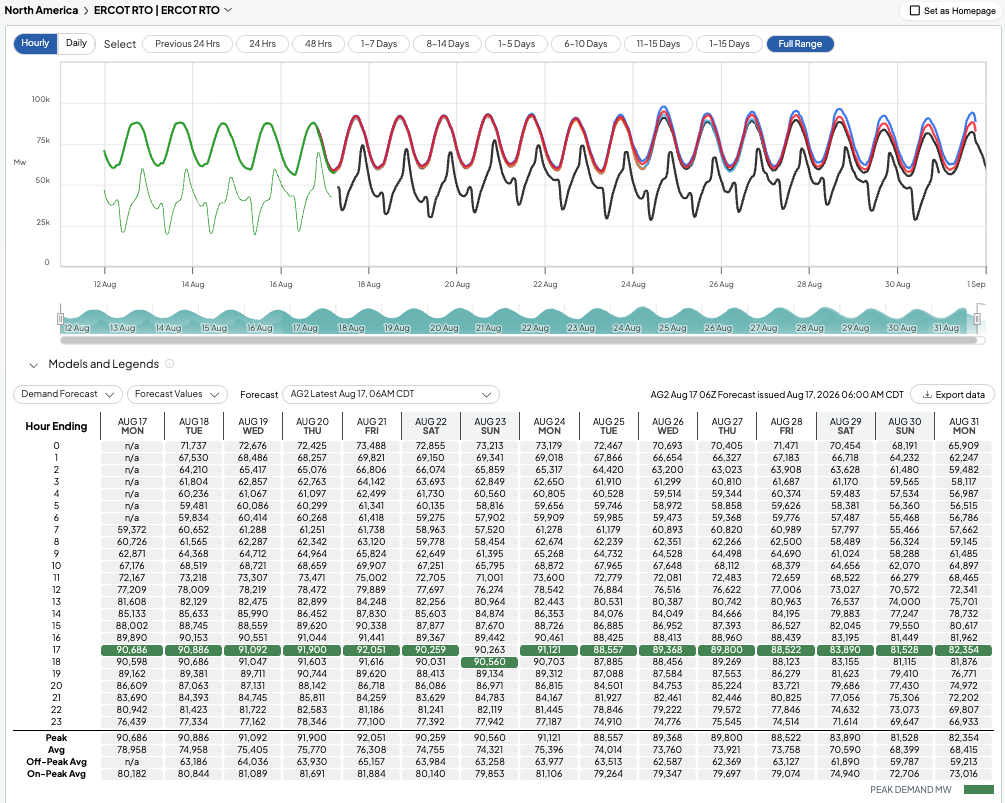
Temperature: ERCOT temperatures are forecast to remain well above normal through the upcoming two weeks, with the aggregate forecast showing highs generally in the upper 90s to around 104°F. The hottest stretch arrives late this week into the weekend, with ERCOT-wide highs near 103–104°F, while North Texas locations such as Dallas and Denton reach roughly 104–106°F. Compared with the Aug. 14 forecast, the latest outlook has trended warmer by several degrees across much of the period, particularly from Aug. 21–23, keeping temperatures roughly 7–9°F above the 30-year normal high near 95°F.
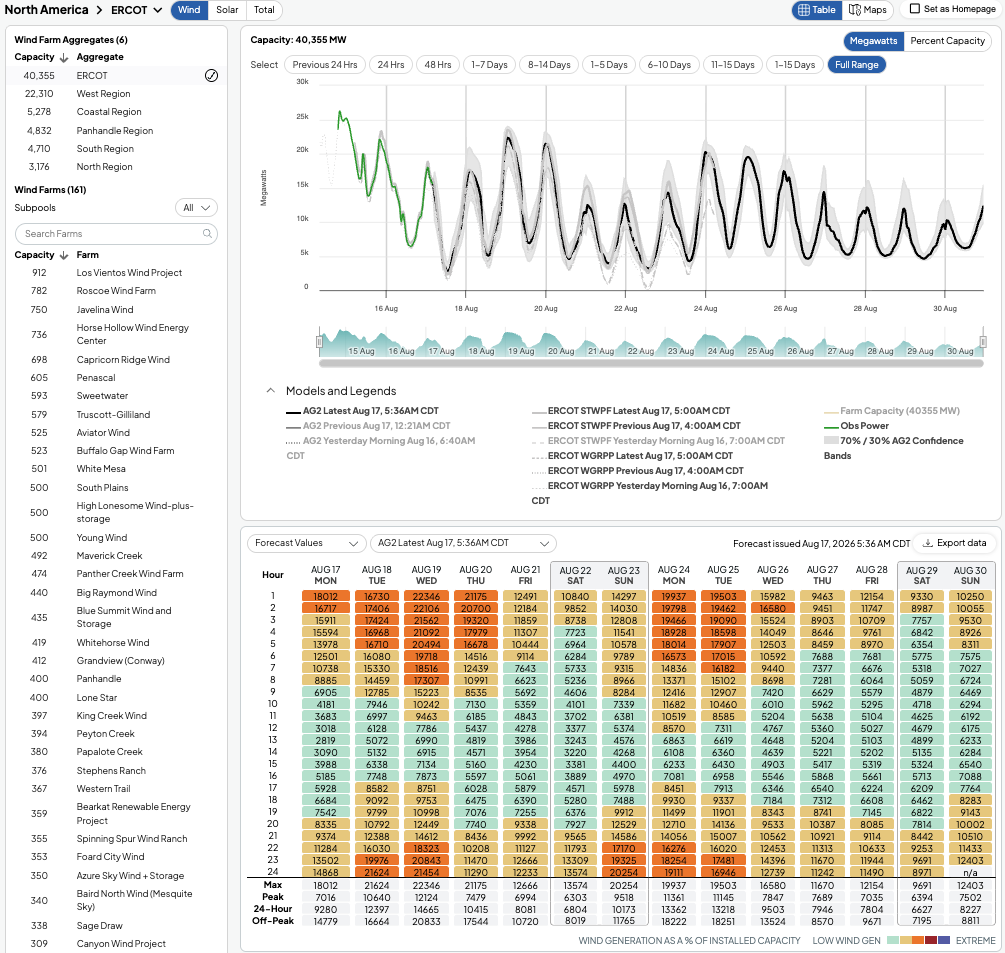
Wind Generation: ERCOT wind generation remains relatively weak compared with the system’s more than 40 GW of installed wind capacity. While overnight and early-morning production periodically rises into the upper teens or low 20 GW range, output falls sharply during many of the higher-demand daytime and evening hours, frequently dropping into the 5–10 GW range. The forecast shows particularly soft wind production late this week and into the weekend, limiting wind’s contribution during some of the periods when heat-driven demand will be strongest.
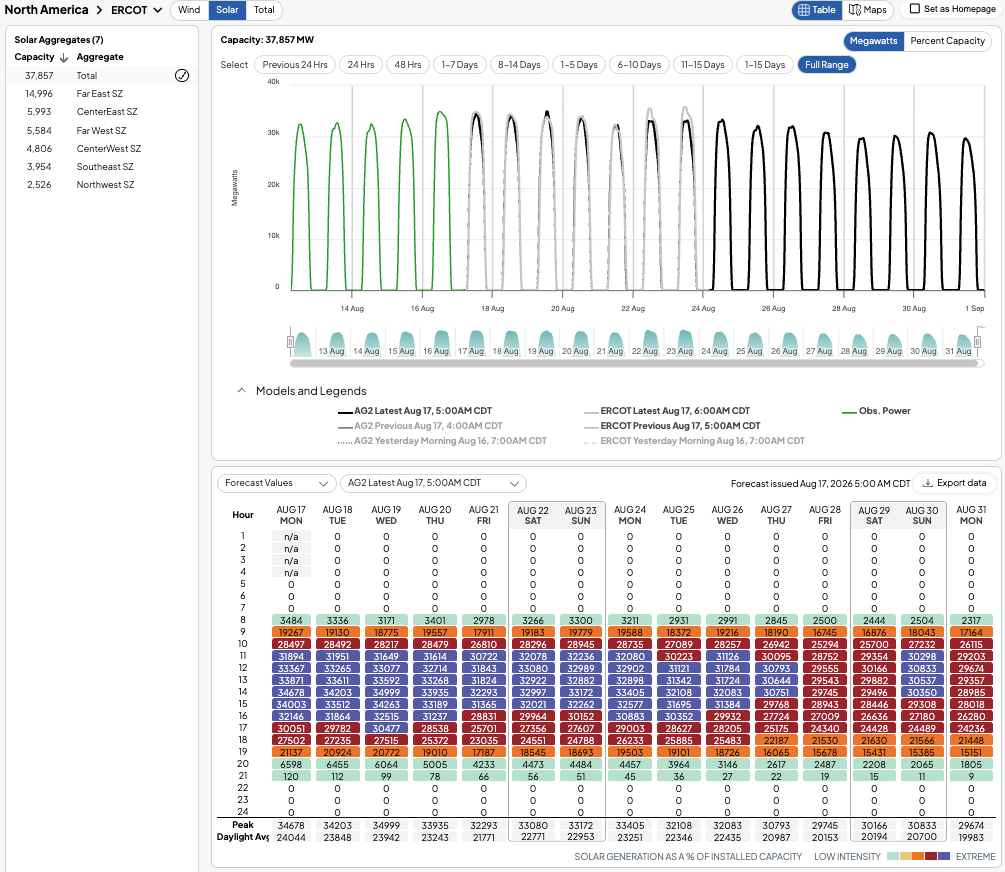
Solar Generation: Solar continues to provide a strong daytime contribution to the ERCOT generation stack, with forecast midday output generally reaching about 30–35 GW against roughly 37.9 GW of installed solar capacity. Peak production approaches 35 GW early this week, representing very high utilization during the strongest daylight hours, and remains near or above 30 GW on many subsequent days. That strong solar output should provide meaningful support during the afternoon, although generation declines rapidly toward sunset and offers little assistance during the later evening demand peak.
Demand Forecast: ERCOT demand is expected to remain elevated as the hotter weather persists, with daily peak demand generally near or above 90 GW through the first part of the forecast period. The latest outlook climbs from roughly 90.7 GW Monday to around 92.1 GW Friday, Aug. 21, before remaining near 90 GW through the weekend and early next week. Demand then gradually moderates during the final week of August, falling into the upper 80s and eventually low 80 GW range, making the combination of high temperatures, weak wind output, and the evening loss of solar generation the primary near-term conditions to watch.
Published by Andrew Pedrini
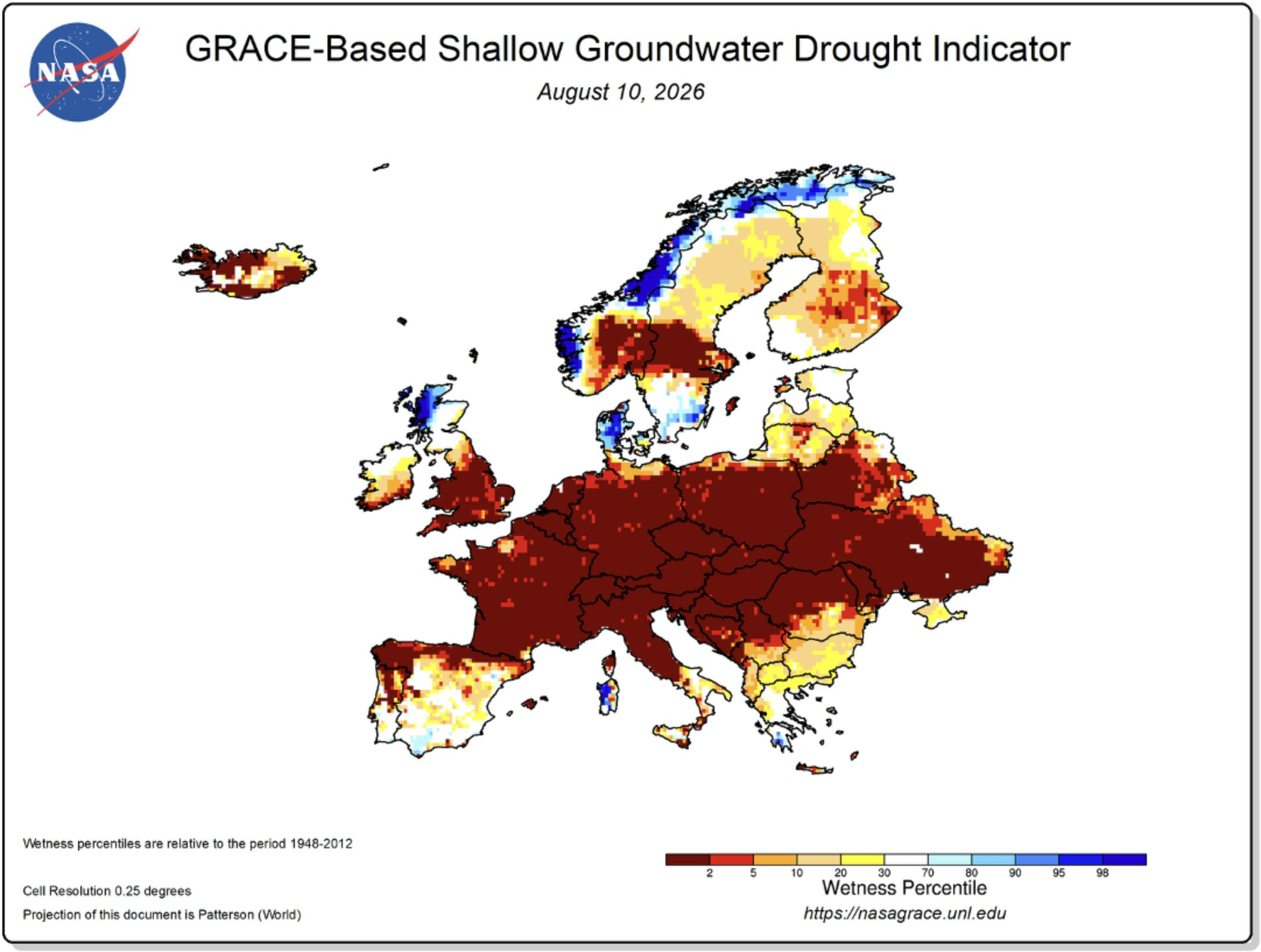
Short answer is: partially – we don’t think the upcoming precipitation is enough to dramatically move the needle to offset and completely resolve the current drought conditions across Europe. While there could be a slightly healthier relief across W Europe in the next 2-3 weeks, higher concerns remain towards the E-SE mainland, where forecast rainfalls are very limited.
Extremely dry soil cover much of Europe, as result of an intense summer, with numerous heatwaves and extensively dry weather.
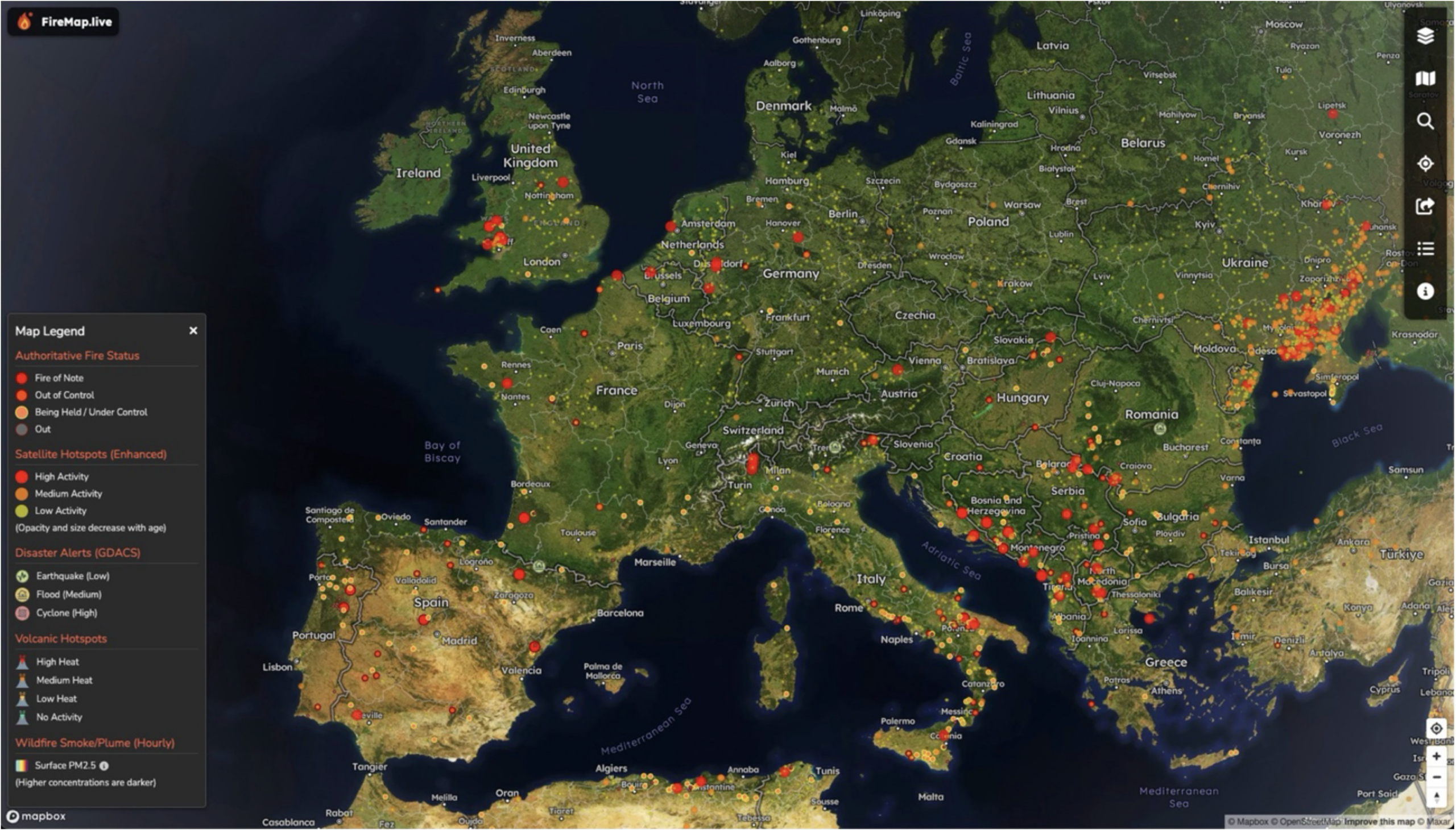
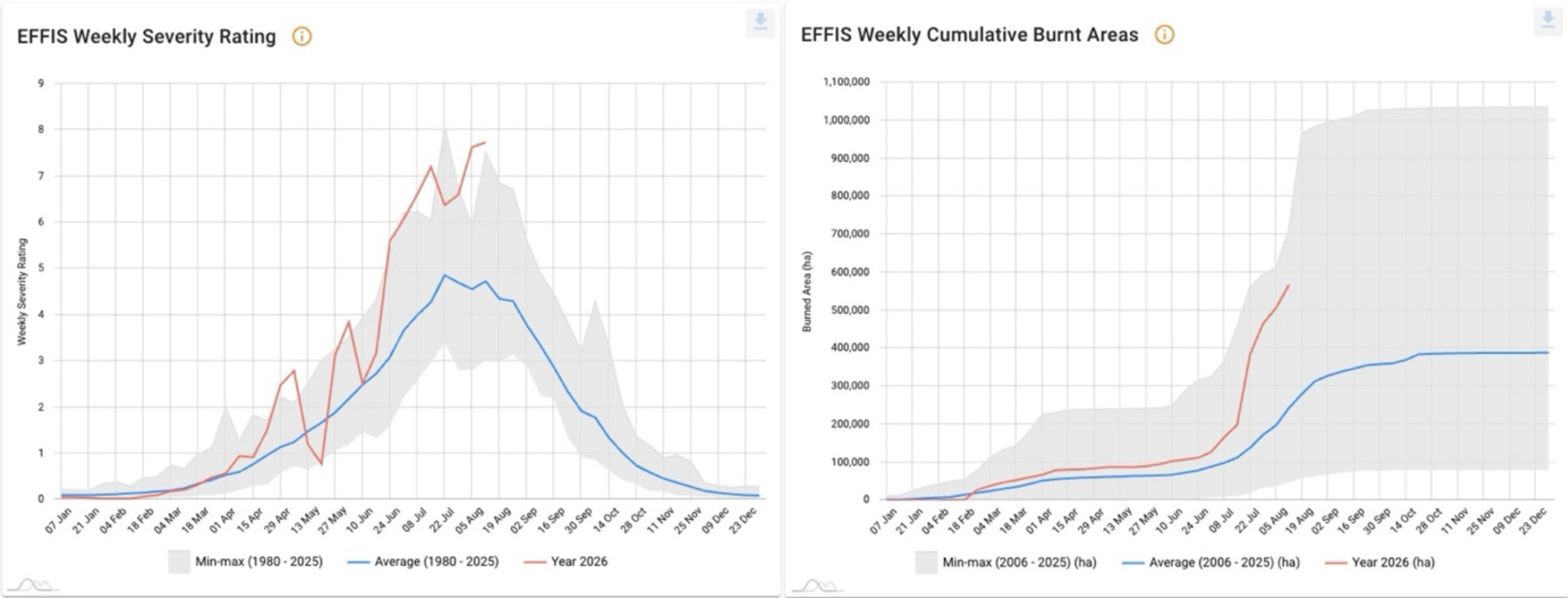
Wildfires are copious, severe, and devastating large areas throughout the continent.
River stress is extremely high, largely impacting various markets and industries.
Almost unprecedented French river temperatures are forecast to moderate through late August, thanks to a less hot/less dry pattern emerging W34-35. This is likely to increase river flows somewhat as well, offering *some* relief to the French river systems.
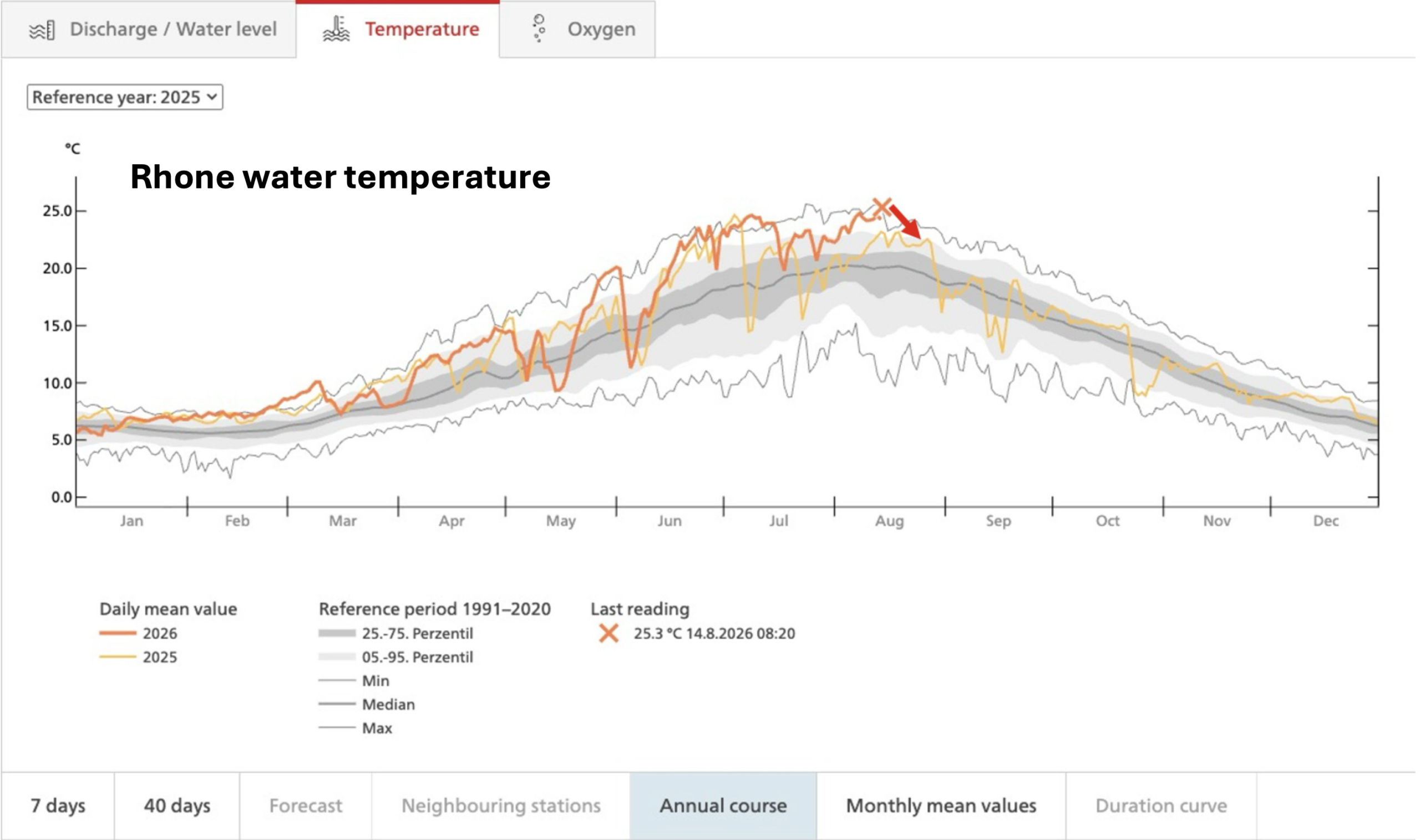
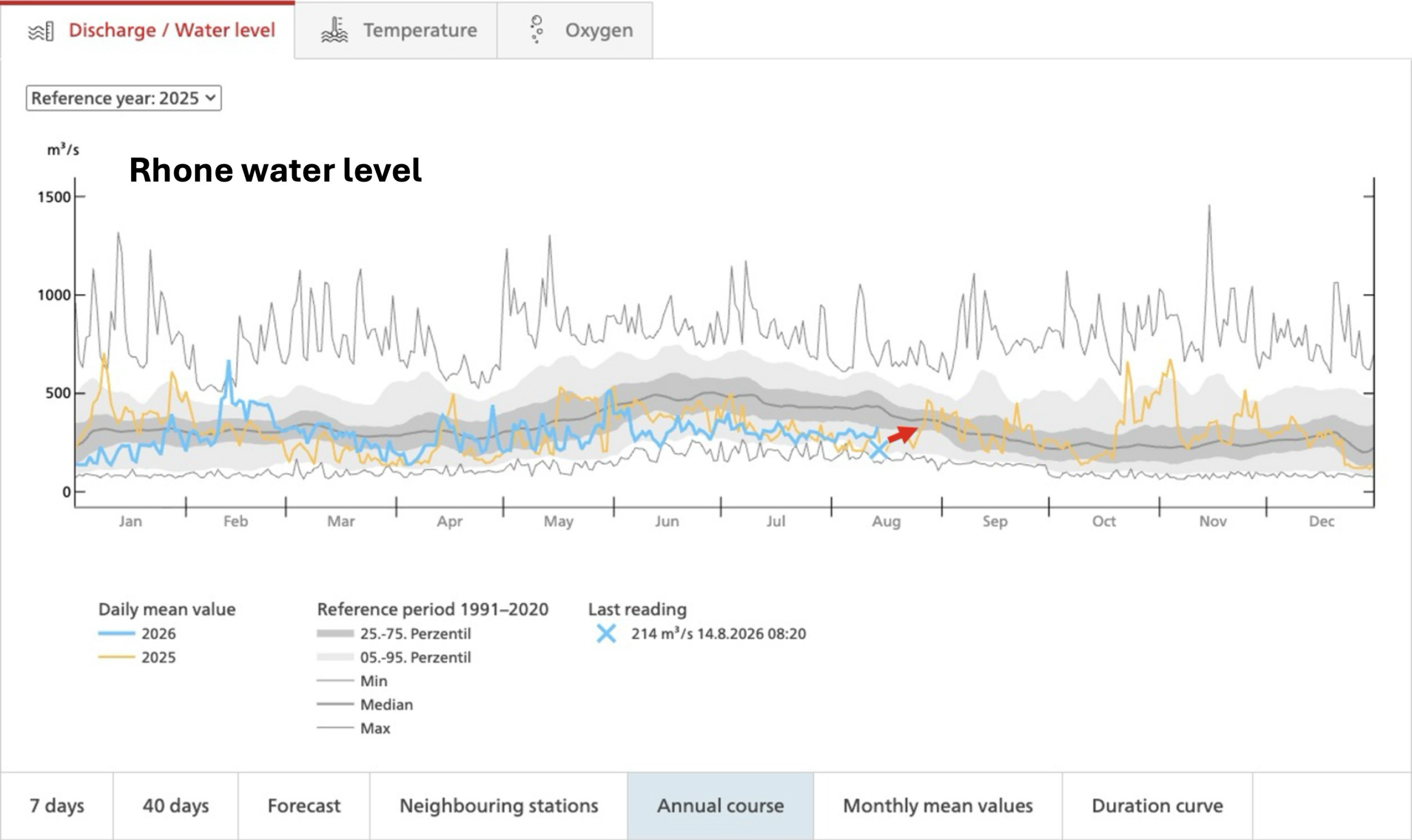
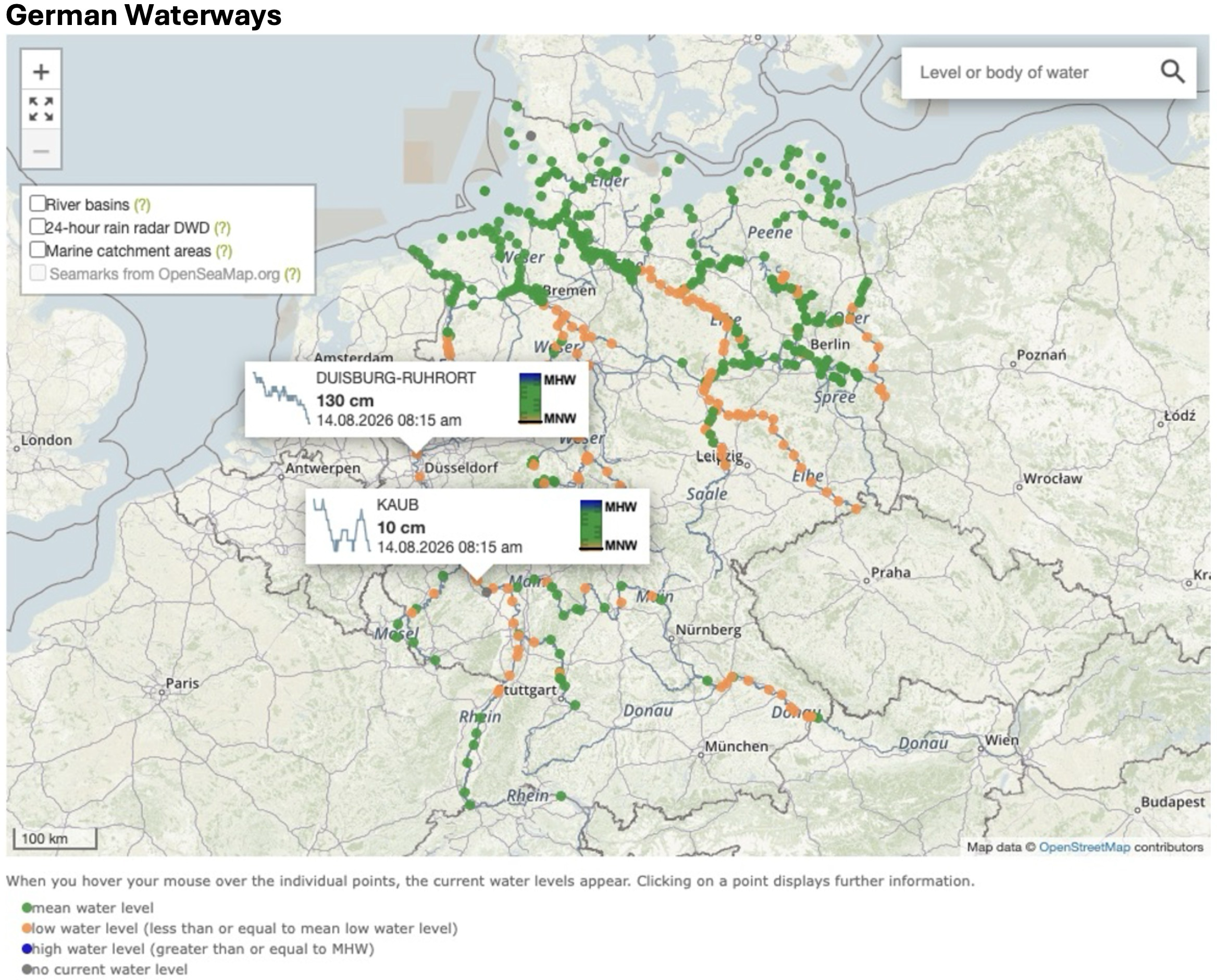
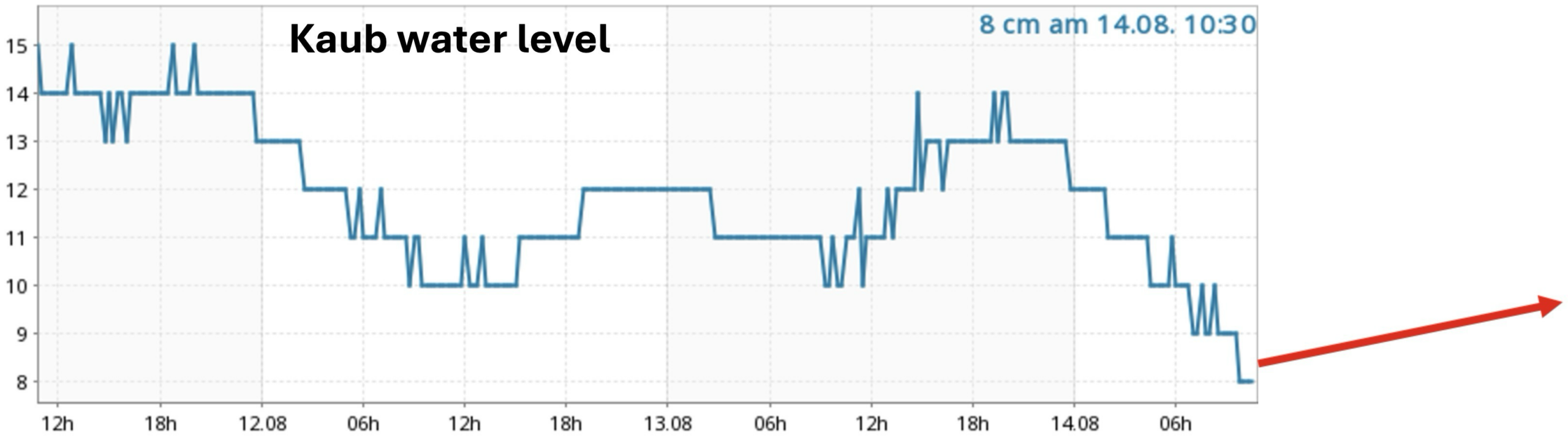
Meanwhile, the Rhine continues to abate and break low flow records, with Kaub around the 10cm mark this morning. There is some scope for some fresher input in the next couple of weeks, but could be less than on the way for French rivers, so recovery, again, could be quite limited.
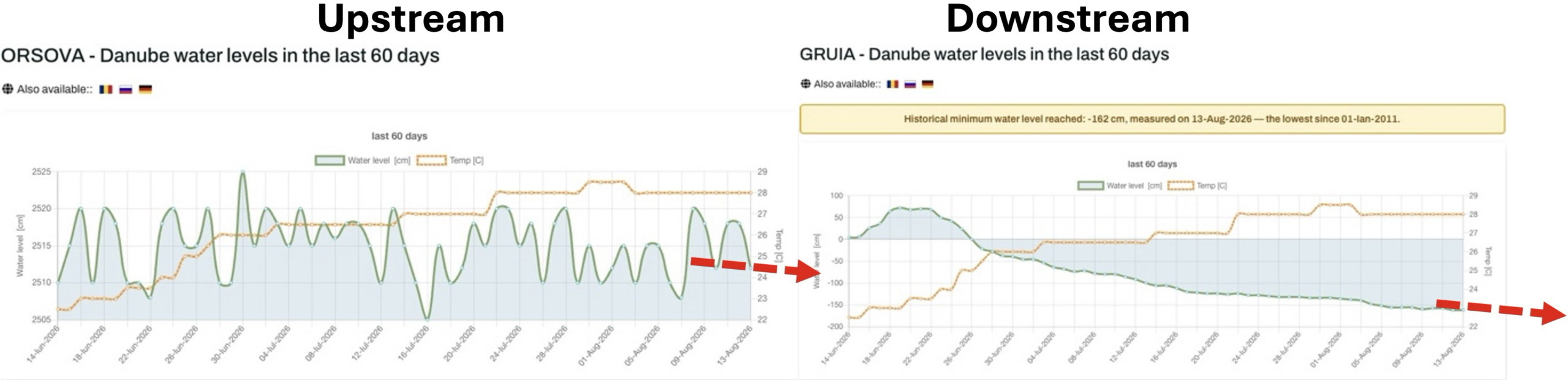
Looking at the Danube, we also find very critical conditions, with low volumes of water forcing nukes to be curbed across the SE one after another, while constraining hydro availability. Little to no recovery is expected for the Danube later this month though, with further low flow risks downstream.
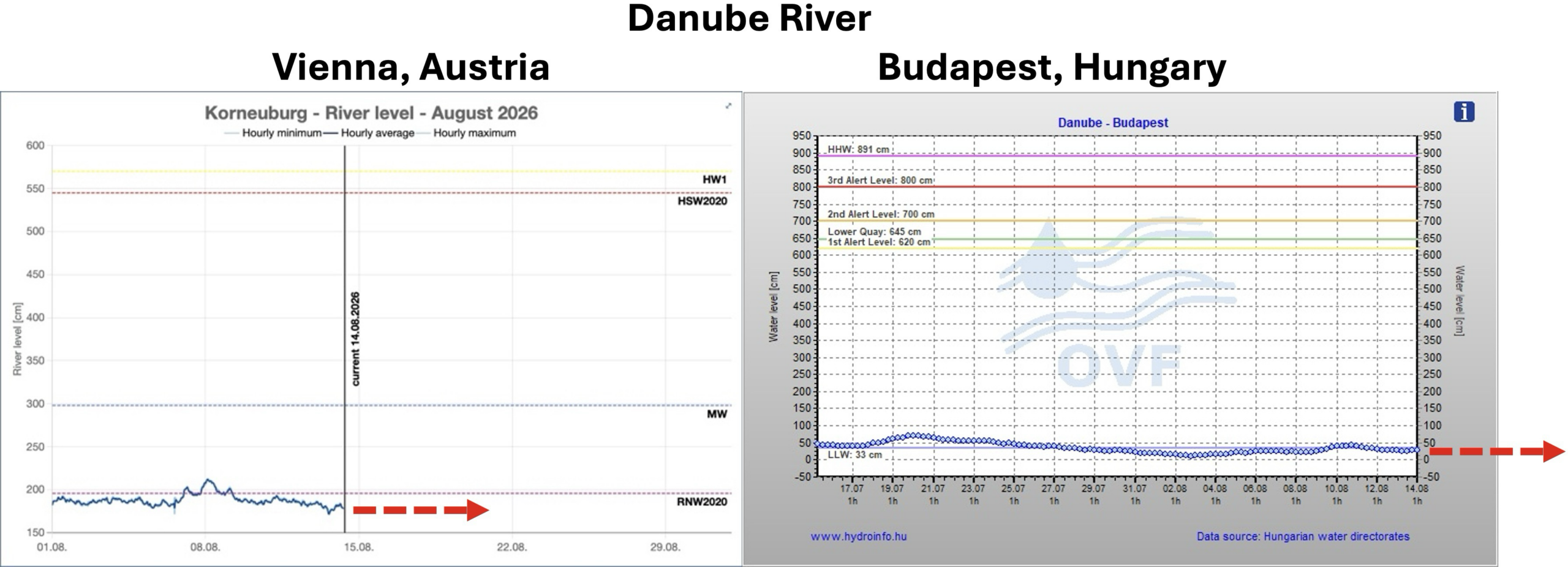
Specifically, downstream of the Iron Gates facility historical minimum water levels are being recorded.
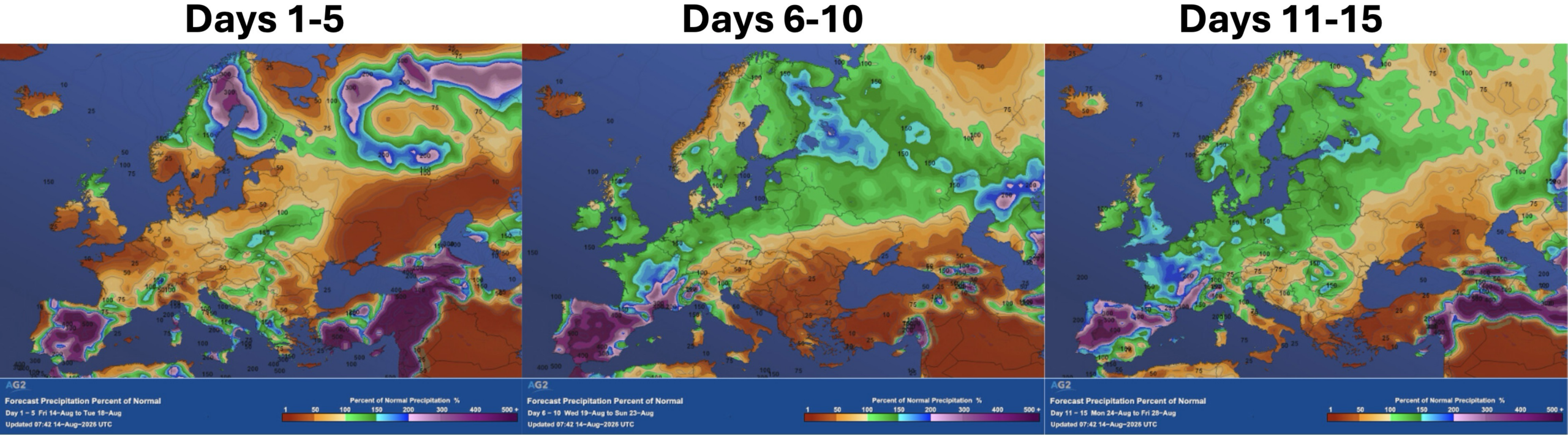
We’re in the process of seeing a pattern shift, with higher pressure starting to break down across W Europe and rearrange itself more towards the SE for this second half of August. This is forecast to maintain drier-leaning conditions in the SE over the next couple of weeks, while W and N tiers of Europe turn wetter than normal. Higher amounts of precip are projected for the far W, decreasing as we move E-SE.

Meanwhile, temperatures are forecast to mitigate in the W heading into late August, supporting, along with more active weather, a somewhat healthier recovery than further E-SE, where overall drier/less wet but also hotter than normal conditions are expected.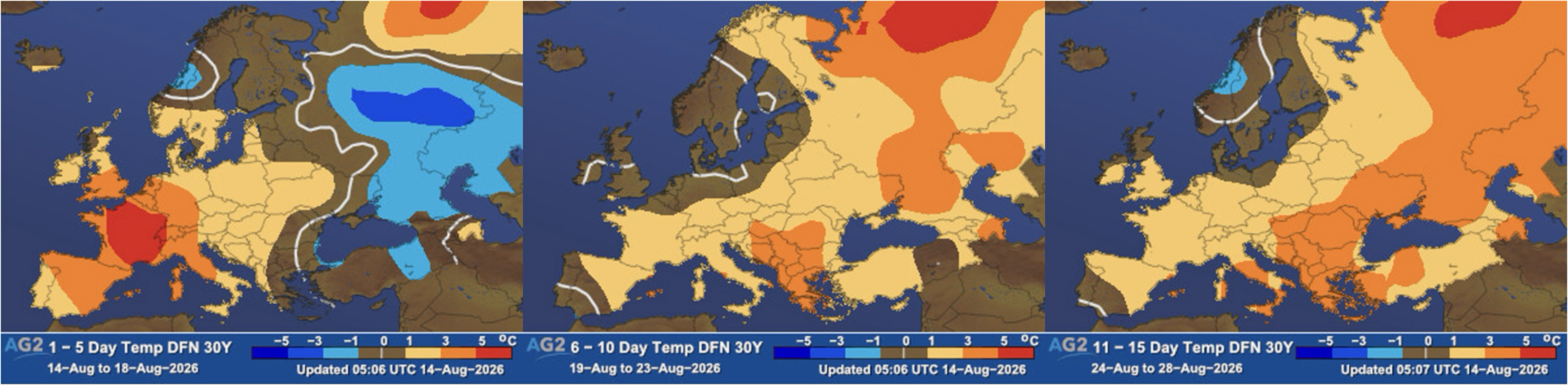
The barrier to a final resolution of drought conditions is September, where model signal a rebound in heat and dryness, ahead of a widely wetter turn later this fall.
Bottom line: Upcoming rainfall is thought to offer Europe a partial breather, especially across W/N areas where wetter and less hot conditions in W34-35. However, this does not look sufficient to fully offset Europe’s severe drought, with Rhine recovery likely limited and the Danube/SE Europe remaining highly exposed as rainfall deficit and hotter temps. With September still carrying renewed hotter/drier risks ahead of a more meaningful wet turn later this fall, any near-term relief may be uneven and far from a full reset.
Published by James Caron
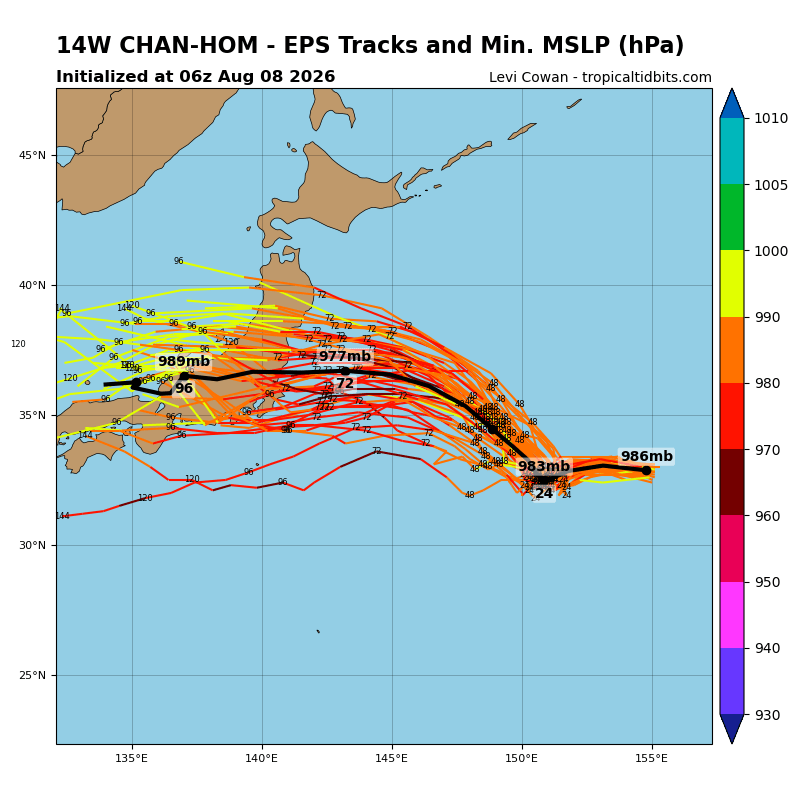
EPS track guidance:
The latest 06z ECMWF ensemble guidance continues to show a fairly consistent west to west-northwest track for Chan-hom from its current position east of Japan toward Honshu, followed by a continued westward movement into the Sea of Japan. Track spread increases materially after roughly 48–72 hours, with solutions ranging from central/northern Honshu to farther north across the Sea of Japan. The pressure guidance generally supports Chan-hom remaining a meaningful tropical cyclone during the approach, with many members in roughly the 970s–990s hPa range. The ensemble therefore continues to support impacts to Japan, but there is still uncertainty regarding the exact corridor of strongest winds and heaviest rainfall.
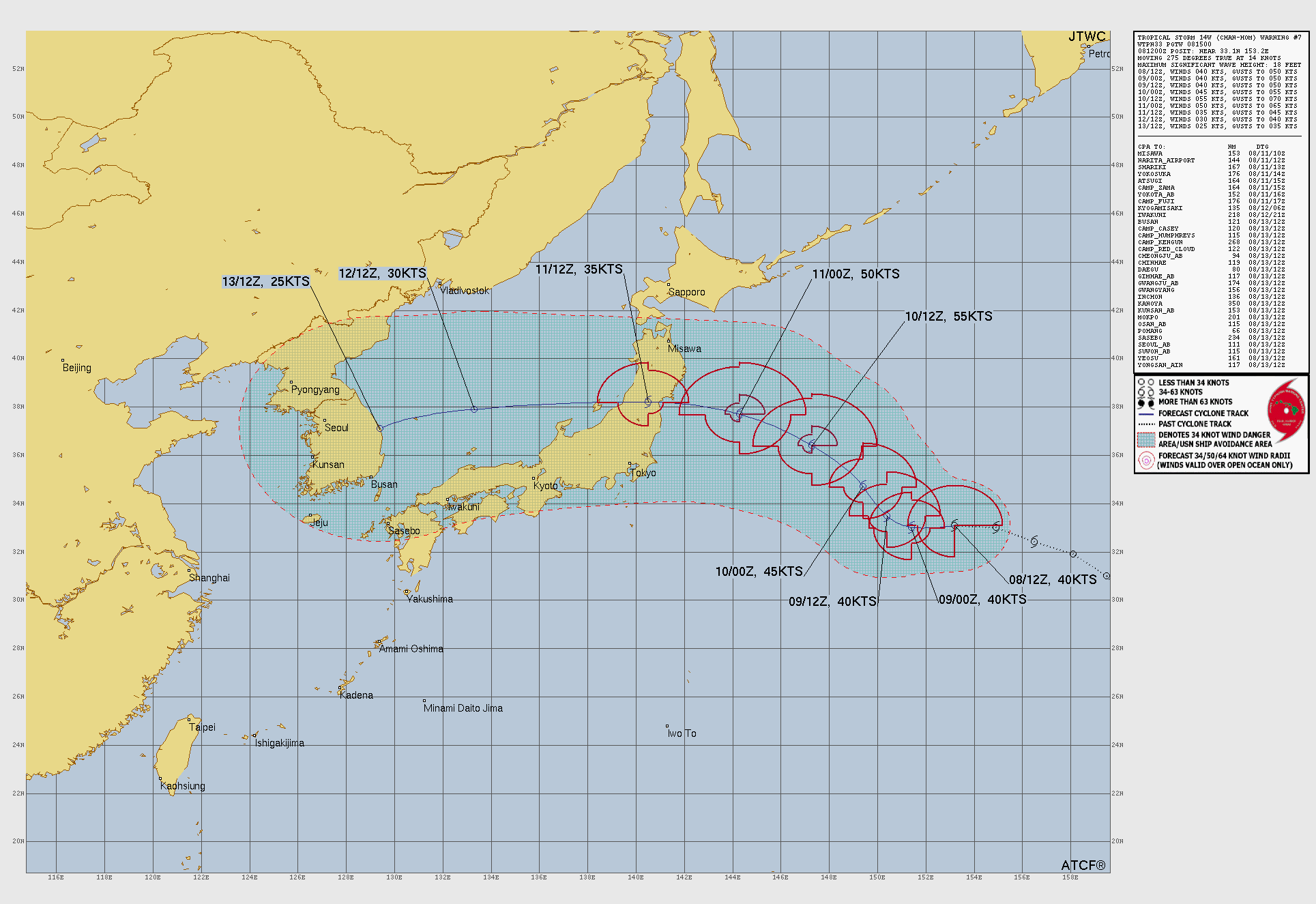
JTWC forecast:
The latest JTWC graphic shows Chan-hom as a 40-kt tropical storm near 33.1°N/153.2°E, moving nearly due west at about 14 kt. JTWC maintains the system near 40 kt through August 9, followed by strengthening to 45 kt by August 10 00z and a peak near 55 kt on August 10 12z, before weakening to 50 kt on August 11 and then more rapidly as the storm interacts with Japan and moves west. The projected track takes the center toward eastern/northern Honshu before continuing into the Sea of Japan, with the Tokyo-area installations generally south of the centerline.
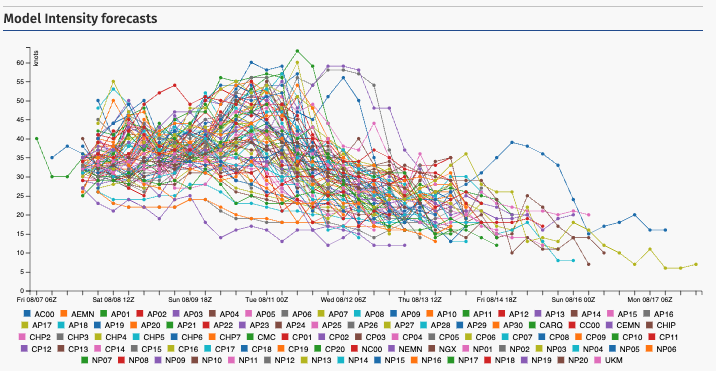
Model intensity guidance:
The multi-model intensity forecast continues to show a fairly wide range of outcomes, but the central tendency favors a moderate tropical storm rather than a major typhoon. Most solutions are concentrated around 30–50 kt through August 9–11, with a subset of members reaching roughly 50–60+ kt. After August 11–12, nearly all of the guidance trends downward, with most members falling into the 15–30 kt range later in the week. Overall, the intensity envelope supports some additional strengthening before the closest approach to Japan, followed by fairly rapid weakening as the circulation moves over or interacts with the Japanese islands.
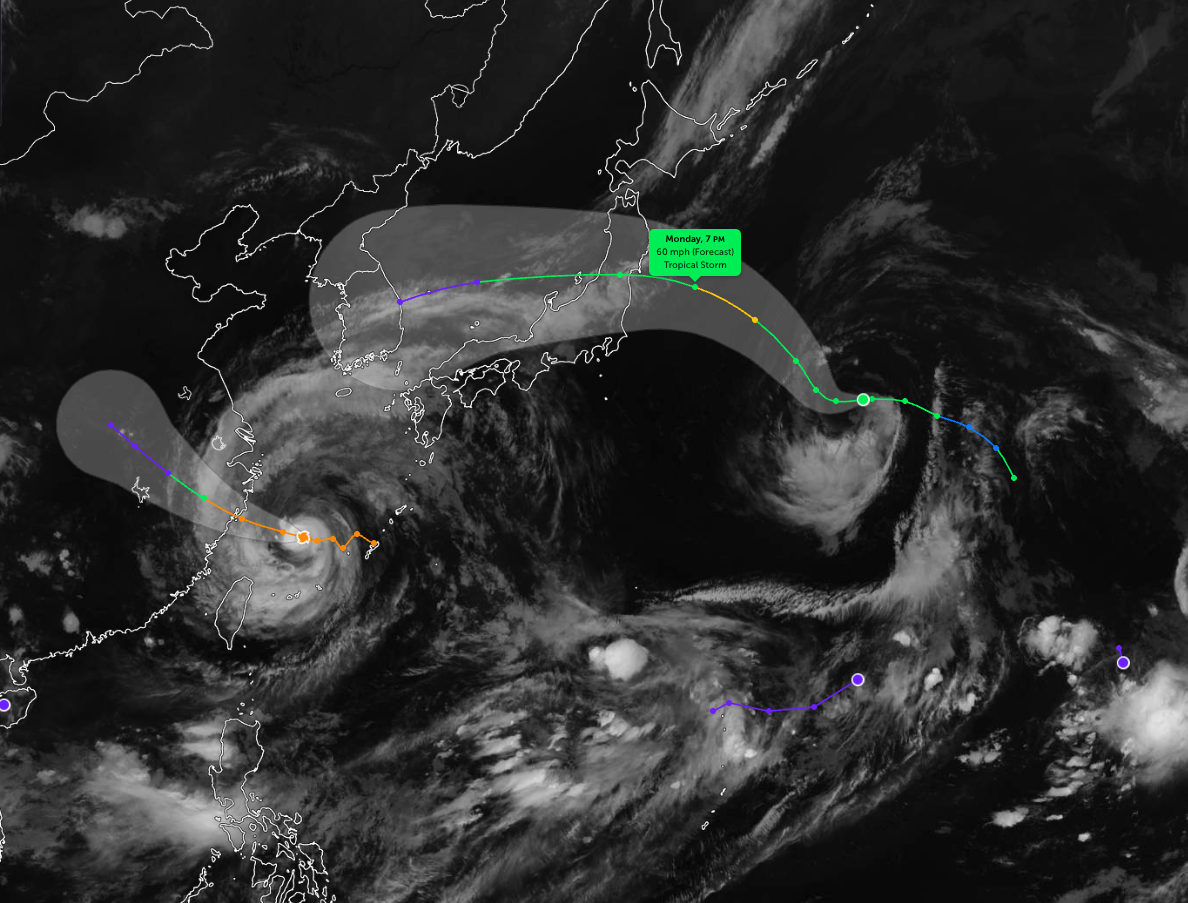
Satellite/forecast cone:
The satellite presentation shows a large circulation east of Japan with a broad cloud shield, while the forecast cone continues westward toward Honshu and eventually the Korean Peninsula/Sea of Japan region. The forecast shown on the map maintains Chan-hom as a tropical storm near Japan, including a roughly 60-mph forecast Monday evening. The large circulation is important from an energy perspective because cloud, precipitation, and wind impacts can extend well away from the exact center track; therefore, even areas south of the primary track, including Tokyo, can see significant solar suppression without experiencing the storm’s strongest winds.
Tokyo outlook:
For next week, August 9–15, Tokyo cools noticeably as cloud and rainfall associated with the Chan-hom pattern increase. Daily highs average about 30°C, with the coolest period Tuesday through Thursday when highs are only around 28–30°C. Solar conditions weaken sharply around the middle of the week: GHI falls to approximately 173 W/m² Tuesday and 190 W/m² Wednesday, compared with 270+ W/m² Sunday and Monday. Average GHI for August 9–15 is about 225 W/m². During the following week, August 16–22, temperatures recover slightly, with highs averaging about 31°C, but solar remains variable. Irradiance is particularly weak August 17–18 before improving strongly August 19–21. The second-week average is around 220 W/m², so there is not much week-over-week improvement in total Tokyo solar potential despite the warmer temperatures.
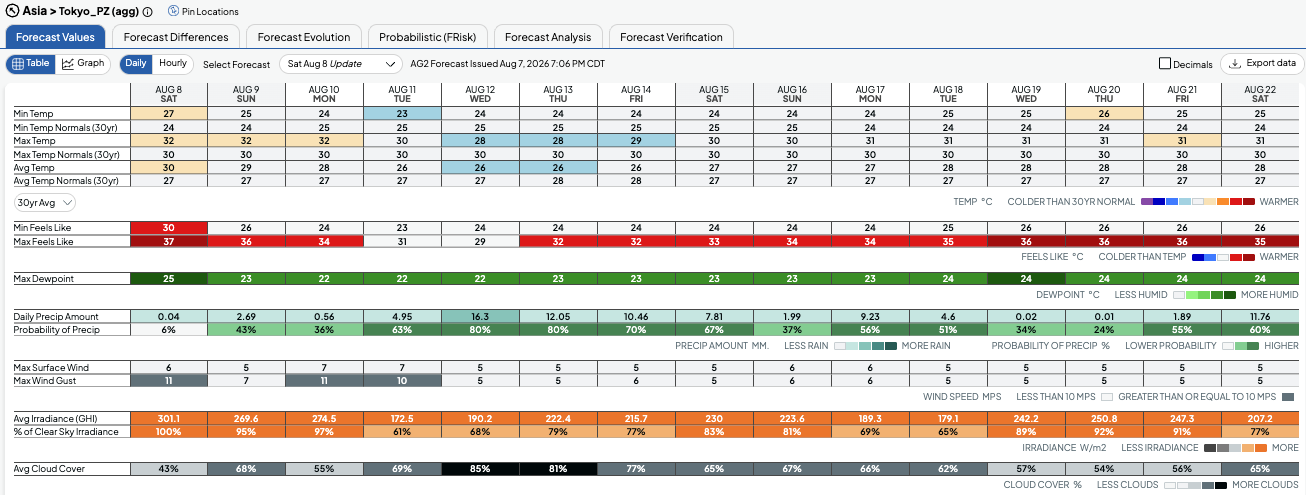
Kansai outlook:
Kansai remains both warmer and substantially better for solar generation than Tokyo. During August 9–15, highs average about 32°C, roughly 2°C warmer than Tokyo, while GHI averages around 247 W/m². Although Sunday and Monday are somewhat cloudier, solar conditions improve sharply Tuesday and remain relatively healthy through the end of the week. During August 16–22, Kansai becomes even hotter, with average highs close to 34°C and overnight lows approaching 27°C. Solar generation potential also remains robust, averaging approximately 250 W/m², with clear-sky irradiance percentages generally near 85–97%. Unlike Tokyo, there is no prolonged period of heavily suppressed irradiance in the second week.
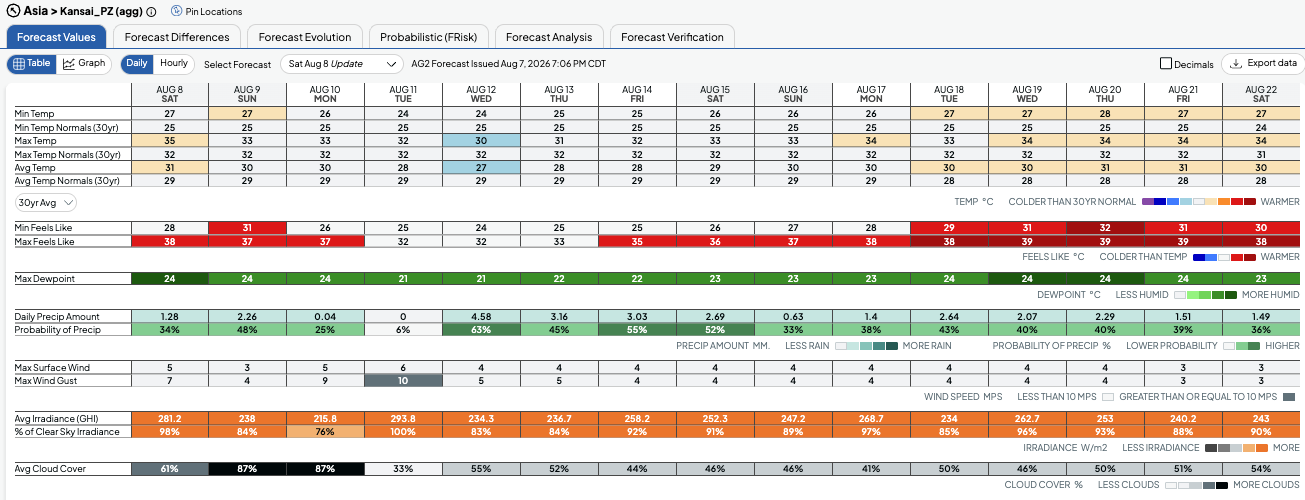
Bottom line:
The current guidance favors a tropical-storm-strength Chan-hom passing across or near northern/eastern Honshu before weakening westward into the Sea of Japan. For power markets, the more notable regional distinction is that Tokyo carries the larger cloud/solar downside, particularly around August 11–12 and again August 17–18, while Kansai stays hotter and has stronger, more consistent solar availability. On a weekly-average basis, Kansai GHI is roughly 10% higher than Tokyo next week and about 14% higher the following week, while the temperature differential also expands in Kansai’s favor during week two.
Published by Andrew Pedrini
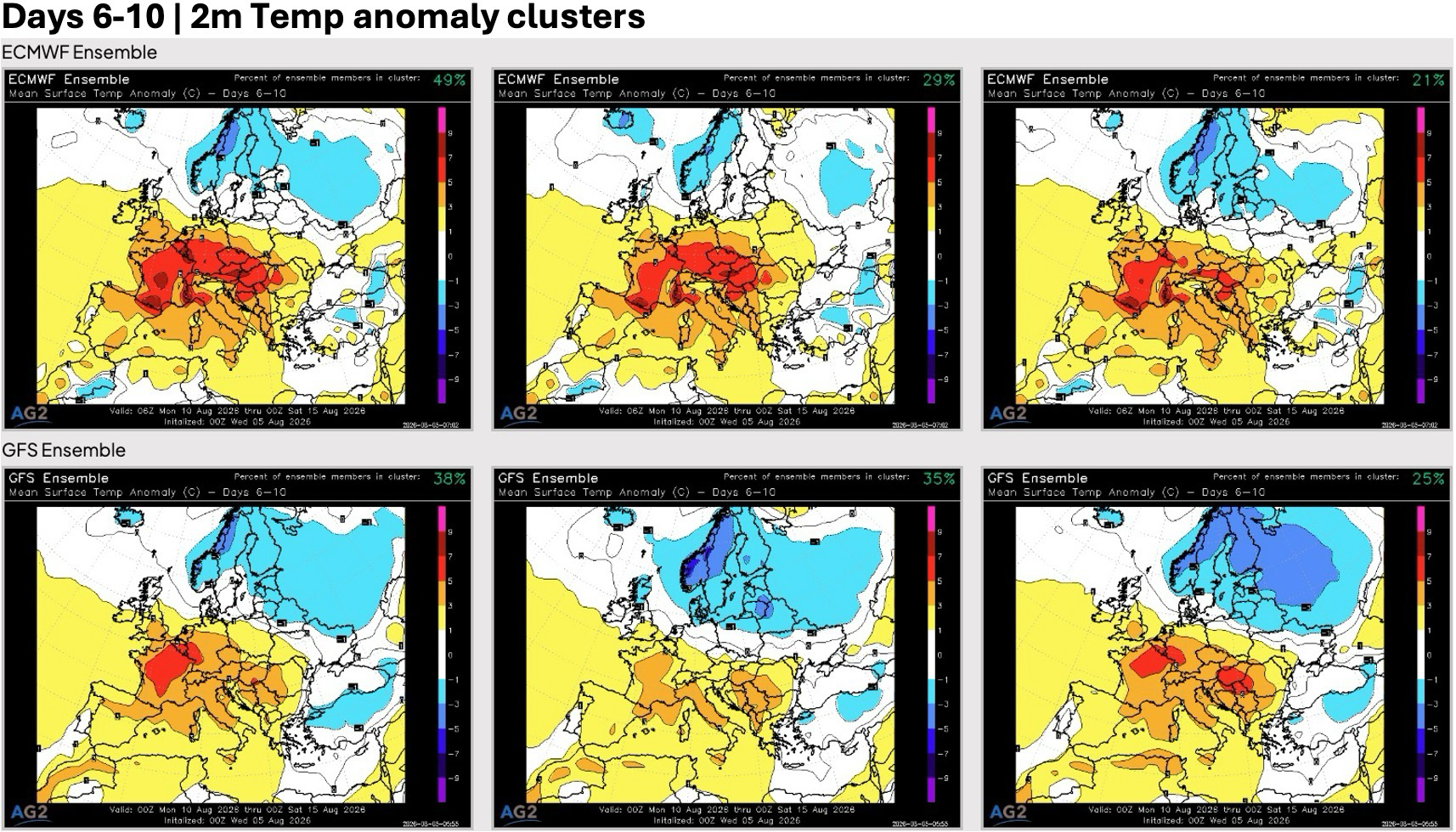
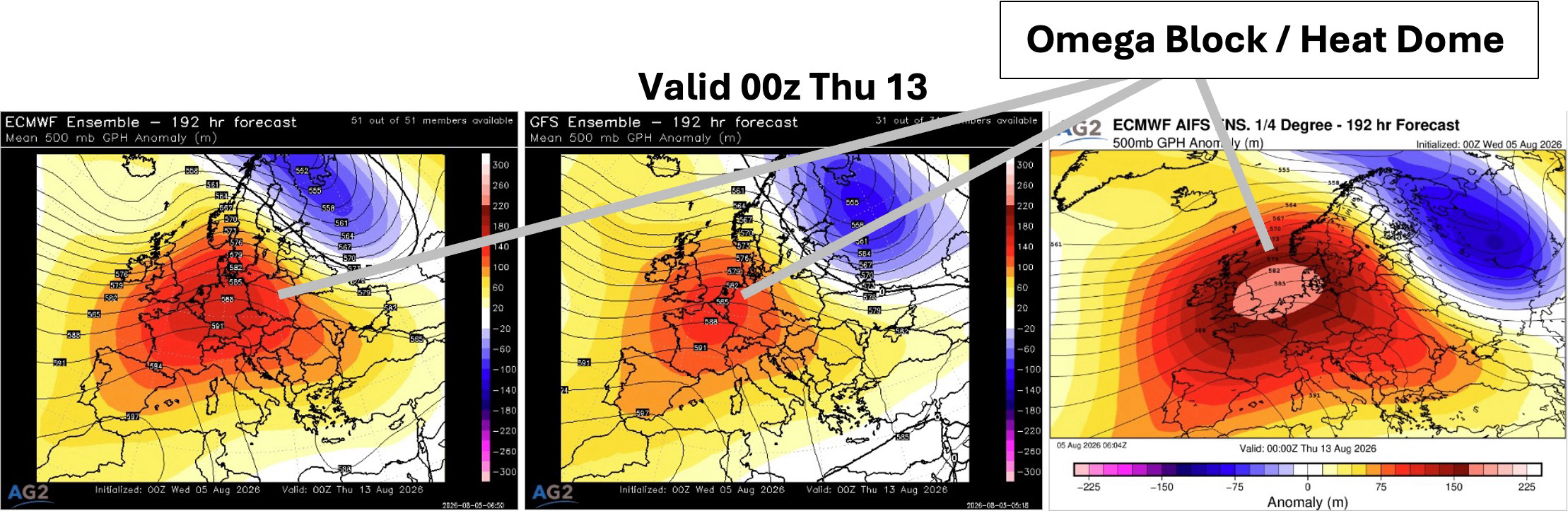
A new, nasty heat dome is forecast to build over Europe next week (W33). Through indications of a new potential Omega Block type pattern, expect hotter, dry, calm and sunny conditions to dominate the scene once again. With recent trends, more extreme heat risks are monitored, as well as all the implications trickling from that with regards to higher cooling demand, persistently elevated hydro/river stress, and downside to solar in peak heat.
Projections for next week are trending increasingly hot and dry day-on-day. This is an evident signal shaping up a new peak in extreme heat and dryness across much of Europe next week (week 33), as per the graphics below. Well above normal temperatures focus over C-W Europe once again.
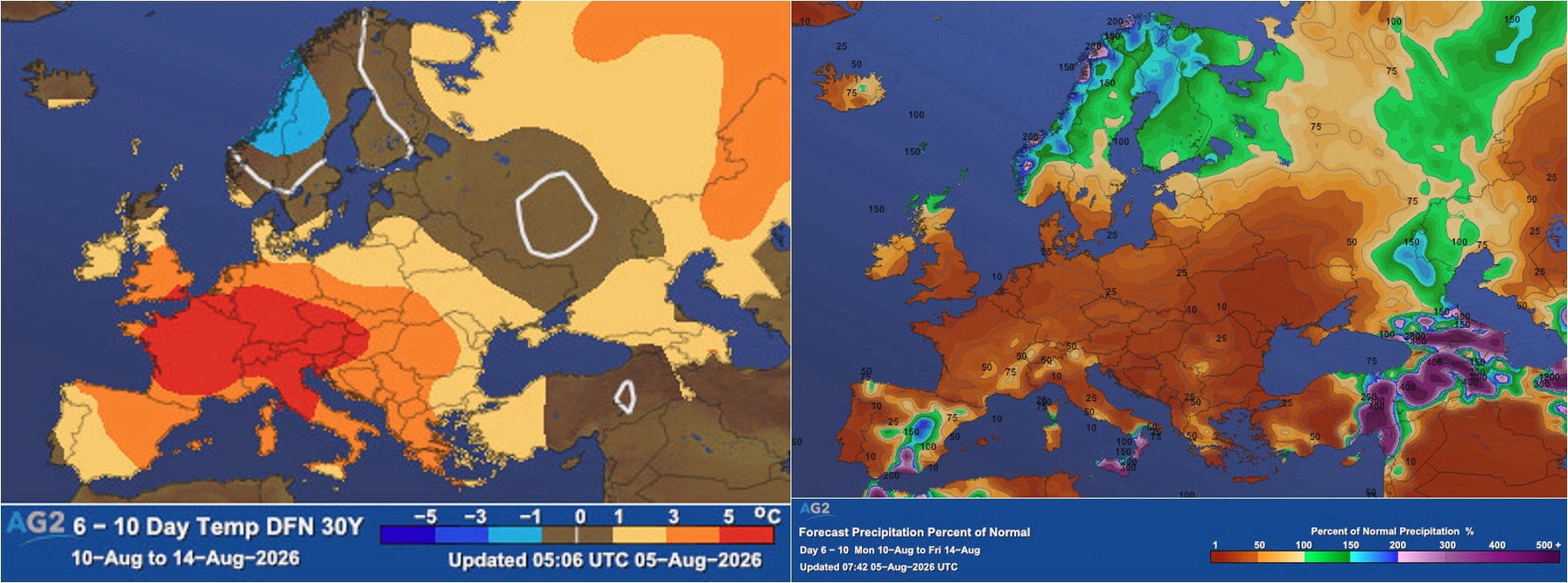
Model guidance is on a roll, keeping on revising hotter and hotter for next week.
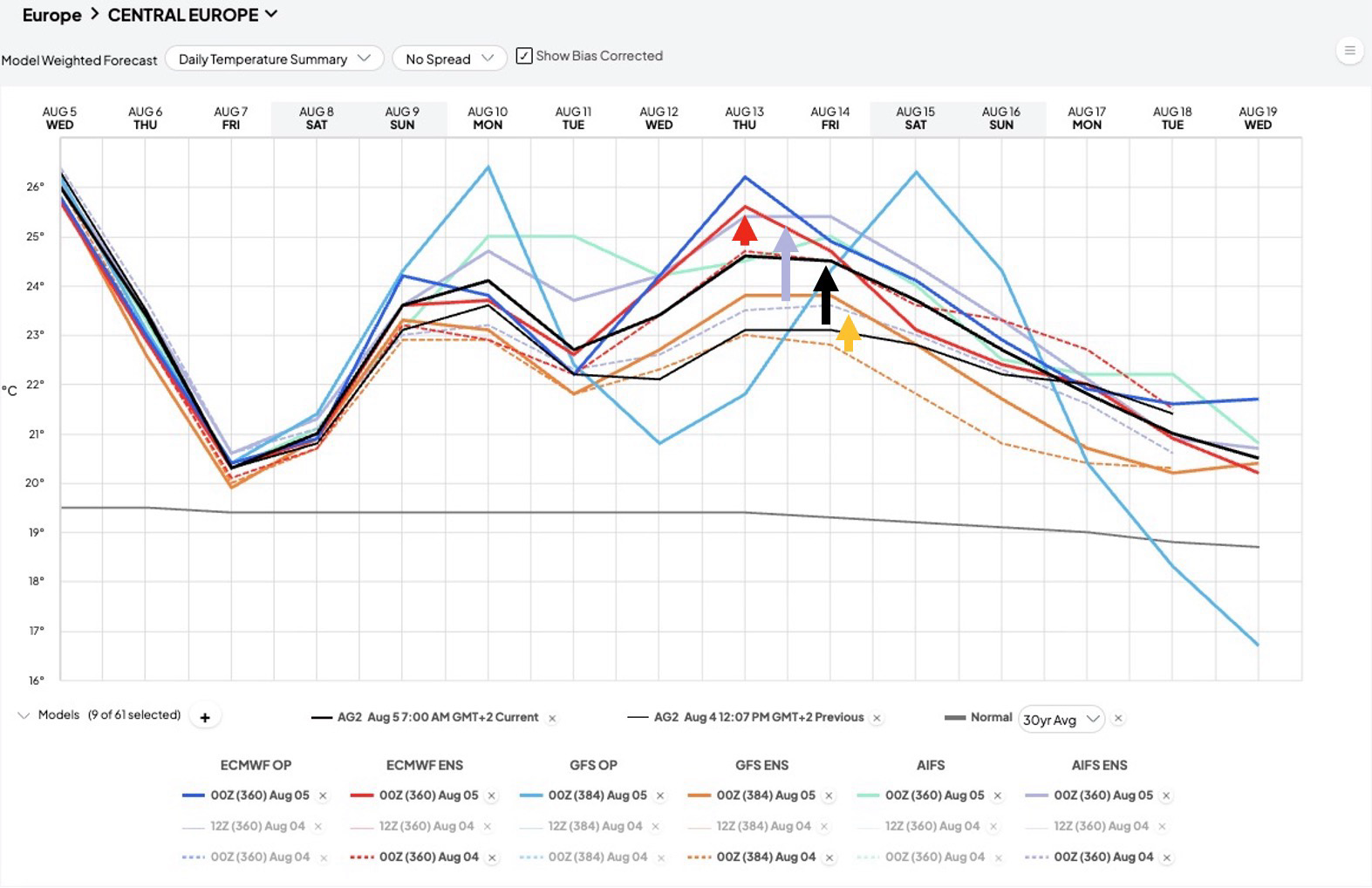
There begins to be closer model convergence on the dominance of higher pressure, with some GFS clusters also improving their alignment with the hotter view next week.

Those are GFS clusters 1 and 3 specifically closing the gap with the already scorching temp signal offered by EC scenarios.
AIFS ENS had a better handle of W33 heat dome all the way through and led the way to this new Omega Block of next week, especially towards Thu 13. Legacy EC and GFS progressively converged towards AIFS there with time. And we all know what that mean by now – a pattern we saw multiple repetitions of this summer: hot, dry, plenty of sunshine and slack winds.
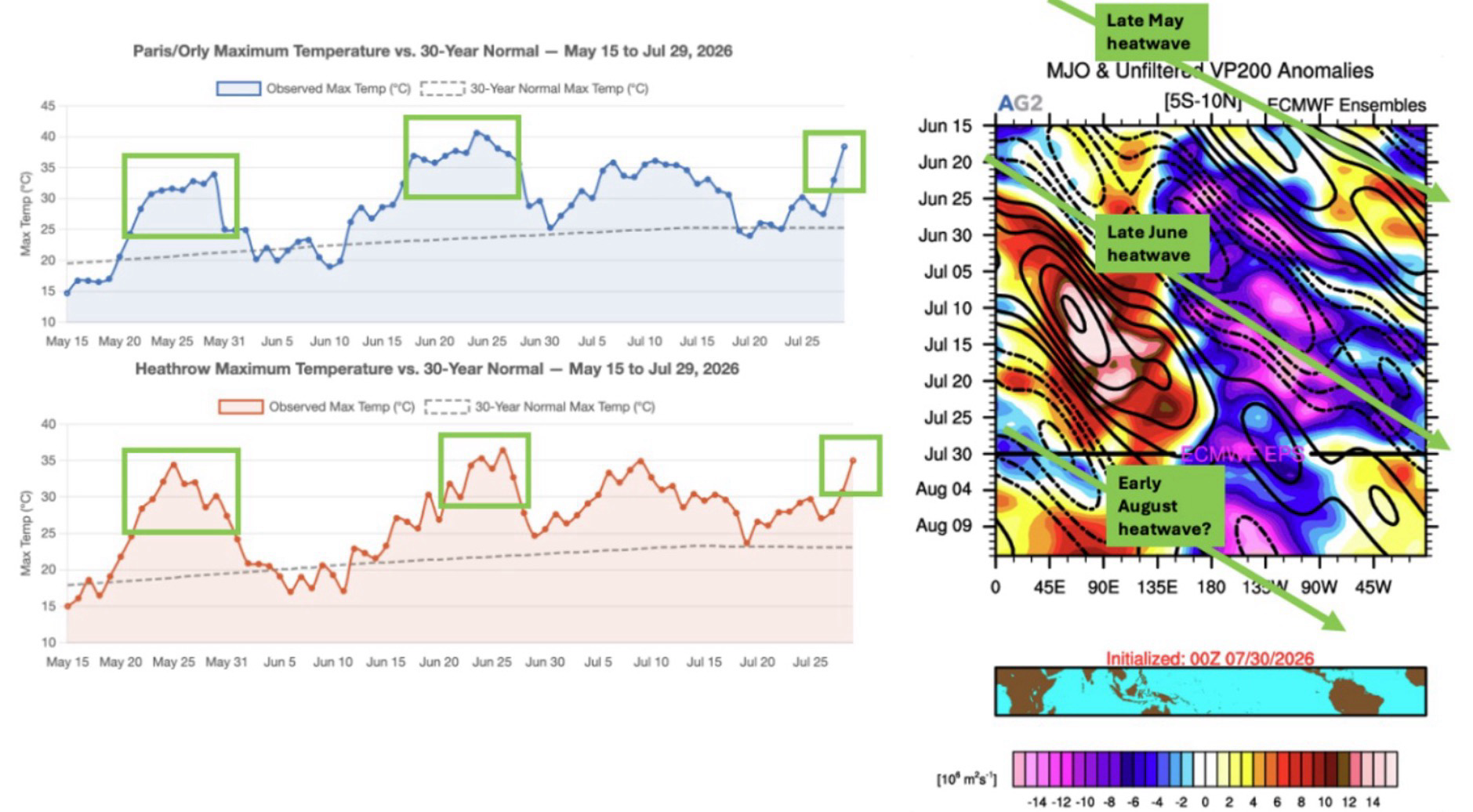
As anticipated in our seasonal reports, this early August heat is correlating very well with the MJO’s passages over the Indian Ocean and Maritime continent.
Bottom line: Europe faces its 5th heatwave of the season, as guidance converges onto a new heat dome / Omega Block next week, with higher pressure rebuilding over the continent and driving another round of hot, dry, sunny and mostly calm conditions. Recent trends continue to push hotter, with C-W Europe once again in the core of the strongest anomalies and AIFS having led the way toward this now better-supported extreme scenario. This renews now familiar summer risks around surging cooling demand, persistent hydro/river stress, nuclear constraints, lower wind and downside to PV efficiency in peak heat.
Published by Ed Vallee
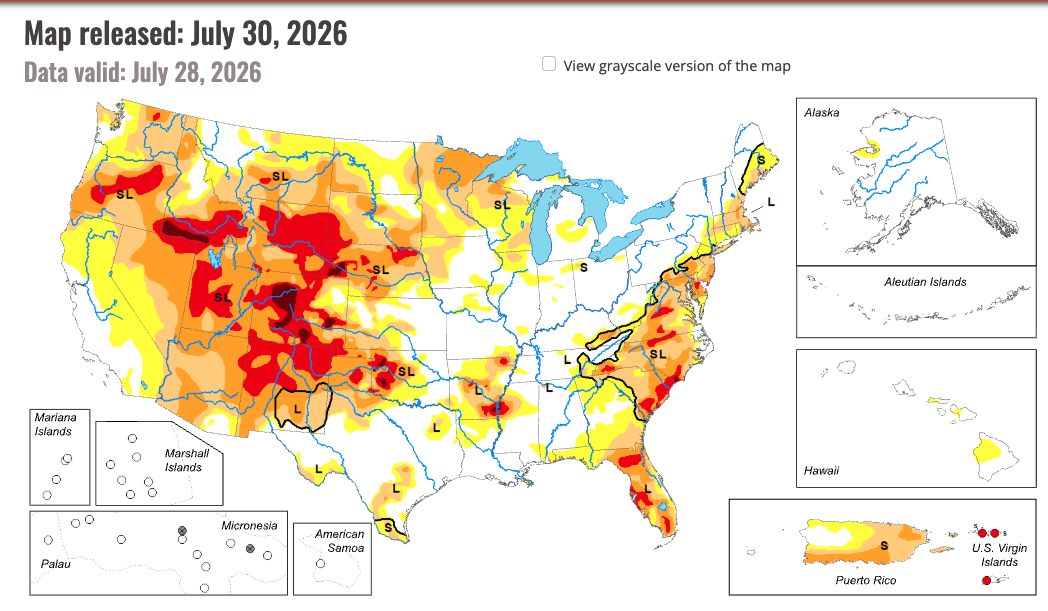
This blog takes a look at the latest drought monitor, which was issued on July 30th.
The latest drought monitor is below, noting drought coverage is up to 67.92% (up from 65.24% last week).
Month over month change maps are below. The most notable trends in the last month are wetter in parts of the Ohio River Valley, southern Plains, and Southeast, but drier in parts of the northern Plains and Upper Midwest.
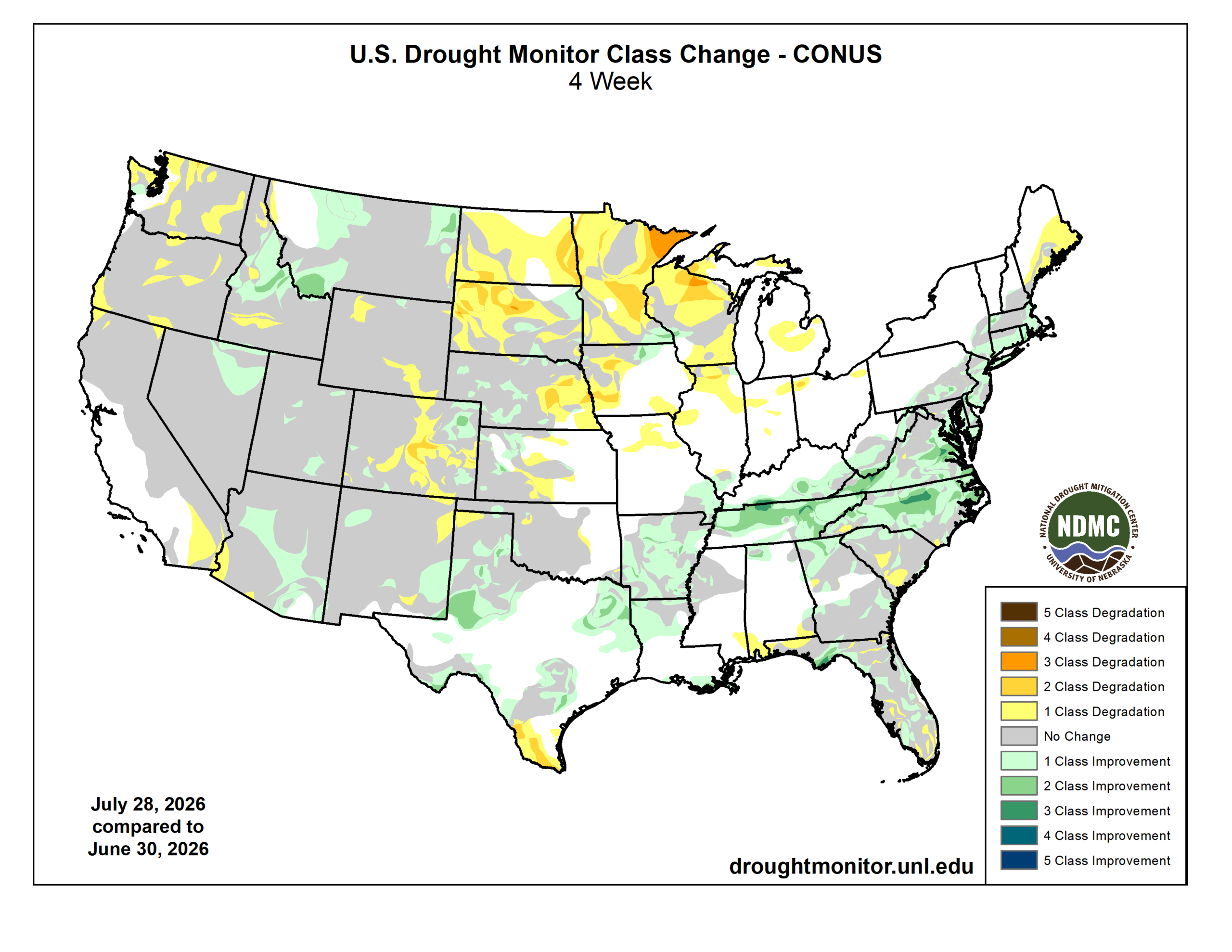
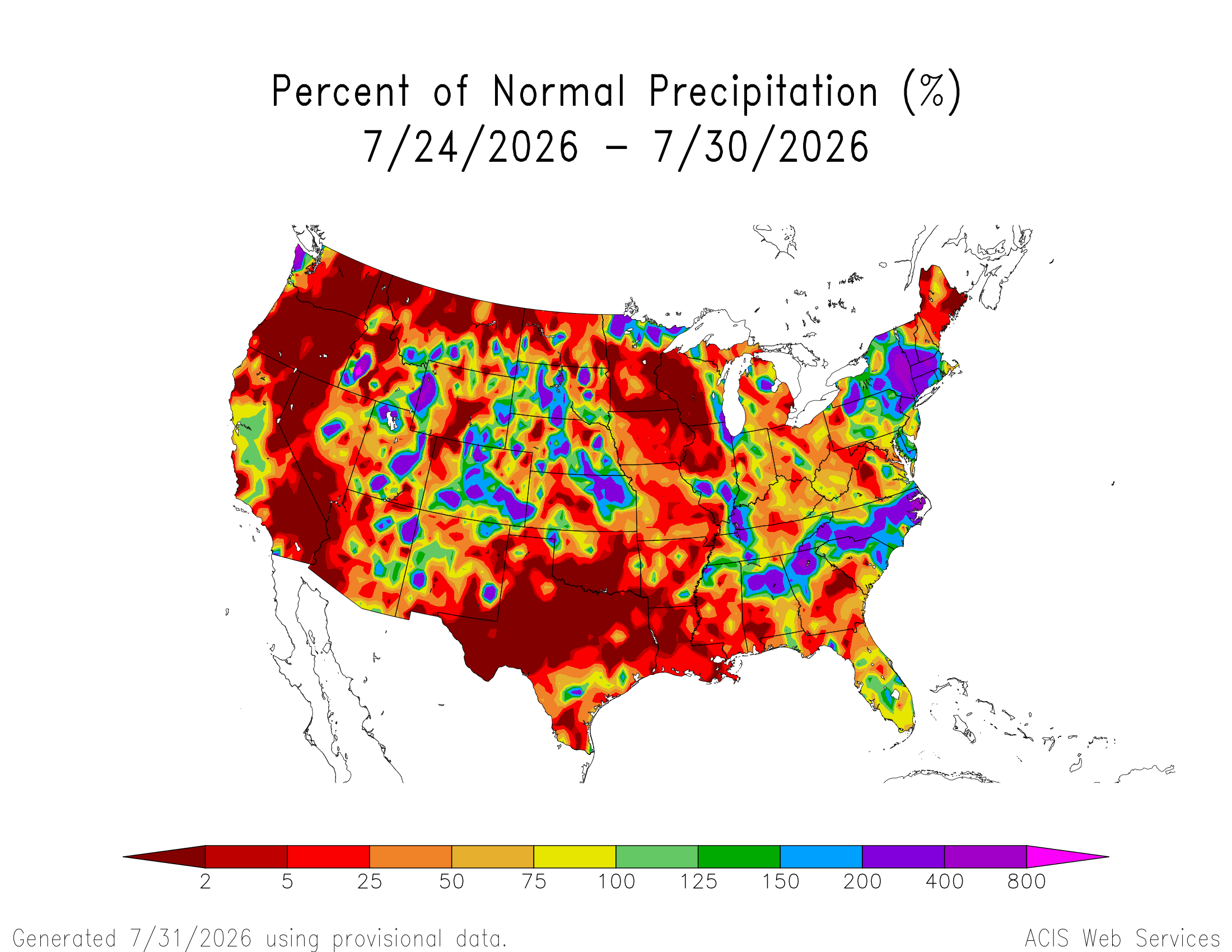
We can see the recent rains across the East, from 24-30 July, which helped drought coverage lower in that particular this week.
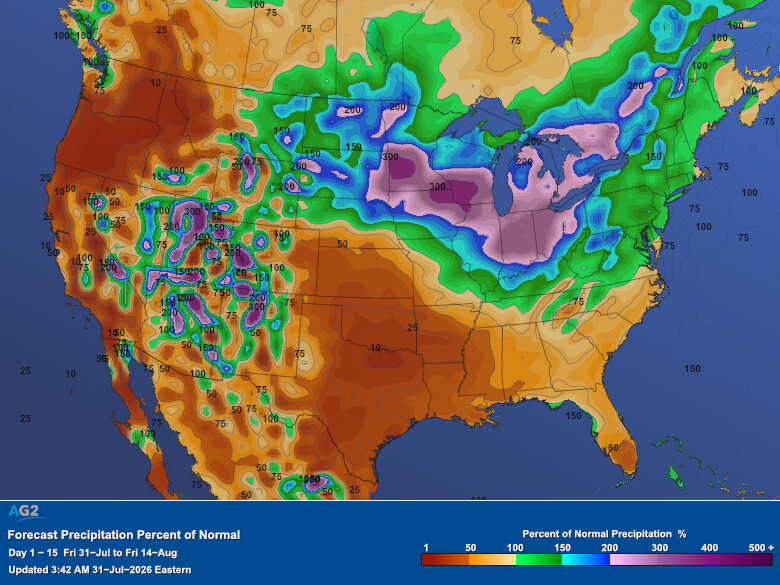
The forecast over the next 15 days looks very wet across the Upper Midwest, Great Lakes, and Northeast. It does look drier in Texas as that region turns hotter.
Published by Andrew Pedrini
River conditions proved extremely impactful this summer so far in Europe, due to hot and dry summer weather patterns renewing themselves. As we head into the next (4th of the season) heatwave, already critical river conditions are expected to deteriorate further, continuing to make the news and impact various industries, including energy trading mostly through French nuclear curtailment risks and Rhine navigability restrictions, agriculture, hydro generation and transportation to name a few.
As a follow up to our river update from Friday, here is a rundown through the latest obs and outlook for Europe with focus on hydro and river expectations.
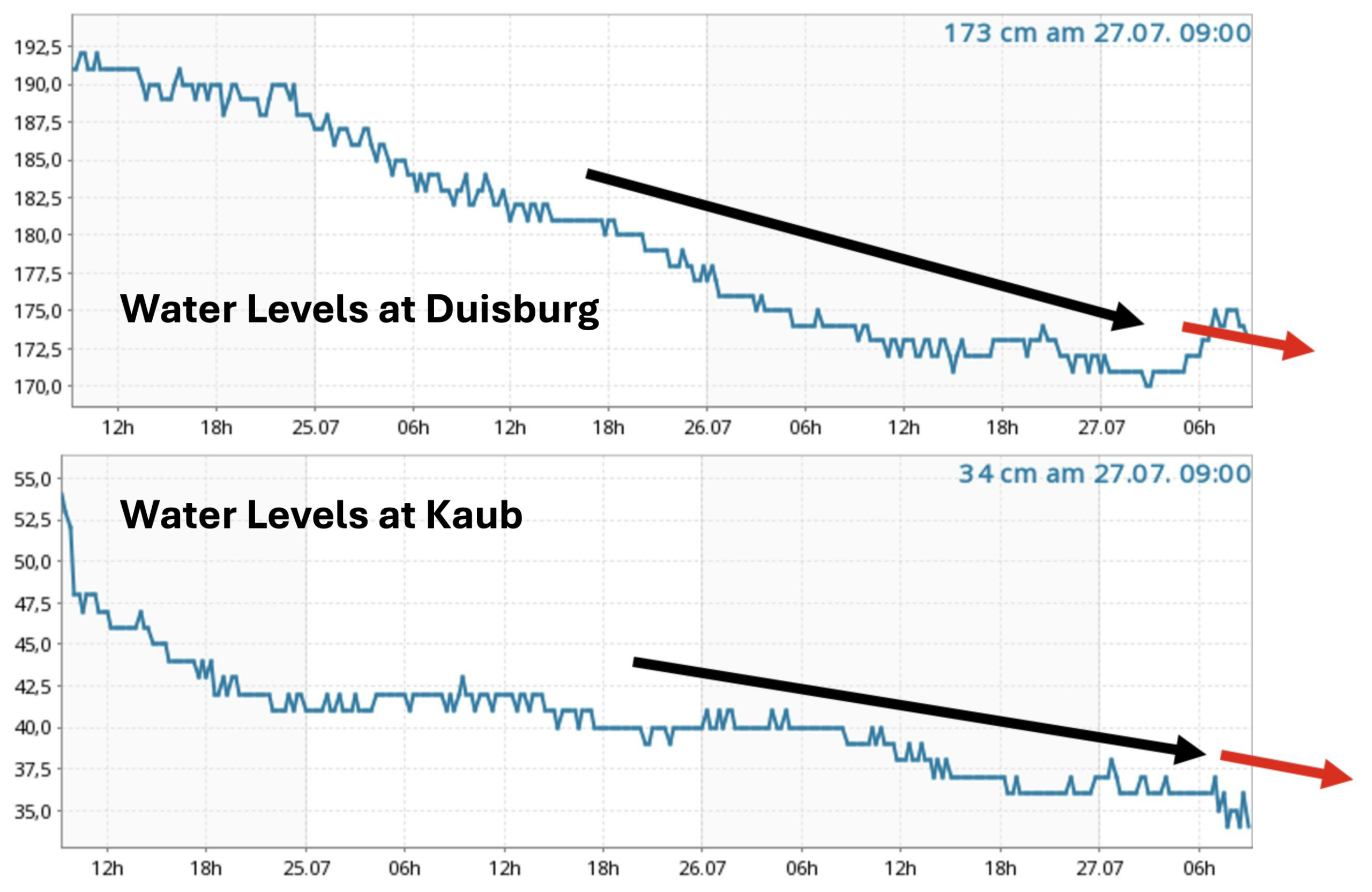
The Rhine River continues to abate, with Ruhr’s Duisburg port at just 175cm of water level, and Kaube choke point at 35cm!
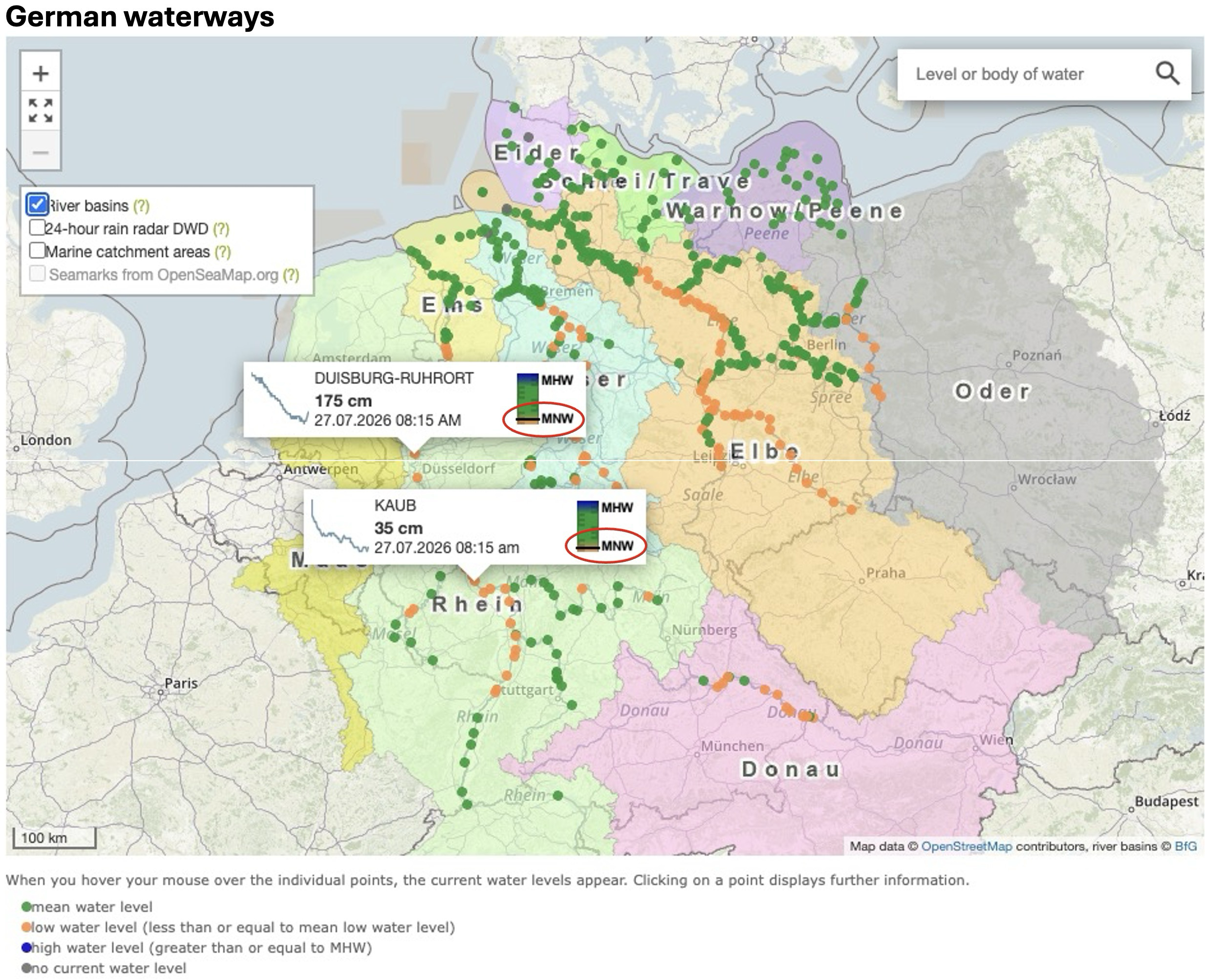
We expect water levels to decrease further through both locations in the next week or 10 day period.
Meanwhile, French river temperatures found slight mitigation in less hot and more unsettled conditions last week. But hotter and drier conditions renovating themselves through early August suggest a new ramp up towards hotter and lower flow conditions soon, impacting French nuclear more heavily once again, unless EDF is allowed a higher discharge temperature thresholds for their nukes.
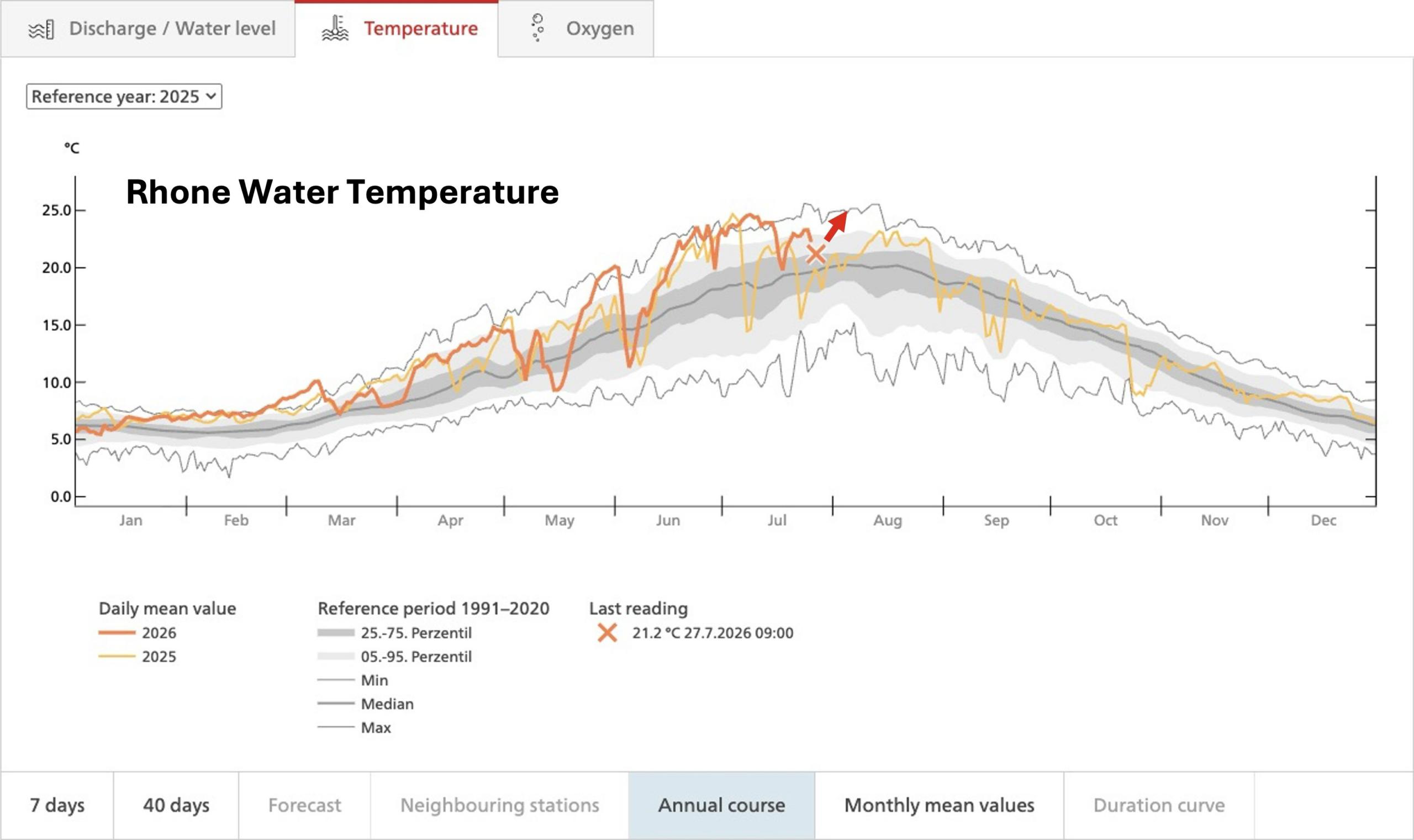
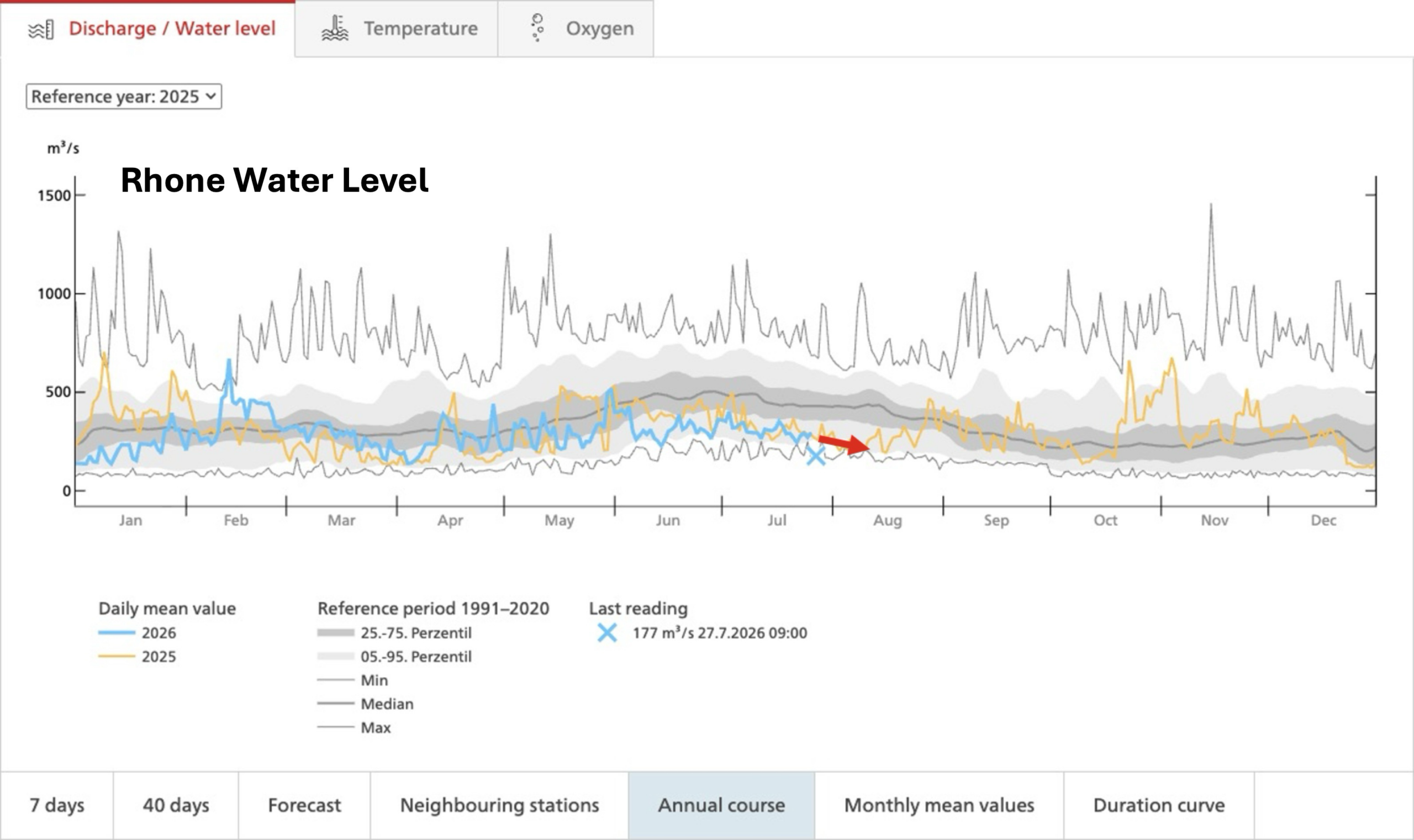
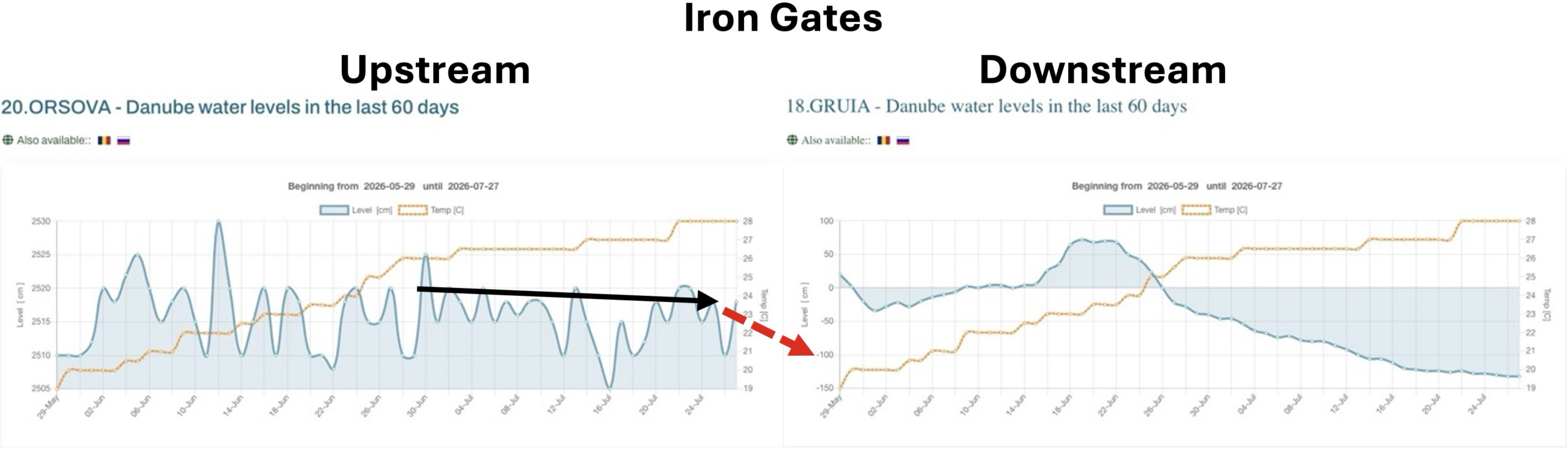
The Danube is also running significantly low, with also little relief ahead, and expectations of further drop-off’s. In particular, the Iron Gates could struggle to be held in the overall steady levels we’ve seen of late, threatening hydro generation in the SE.

Latest outlook
The 4th heat dome of the season is forecast to build in this week into at least early W32. Capping ridging will ensure hotter/drier conditions, favoring evapotranspiration, adiabatic warming of the air, very limited fresh hydro input over the next week or 10 day period. Bad news for rivers, in a period that will demand higher cooling continent wide. The ridge is then projected to weaken later next week, with lower heights over Scandi, re-introducing a N’ly component to incoming flows, opening to less hot and less settled risks only then.
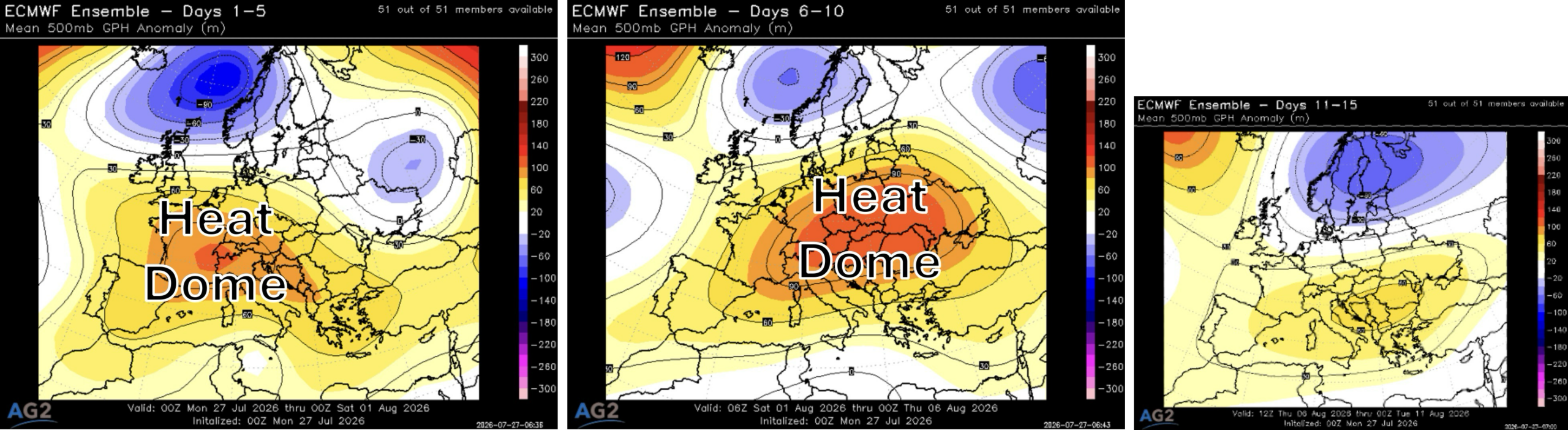
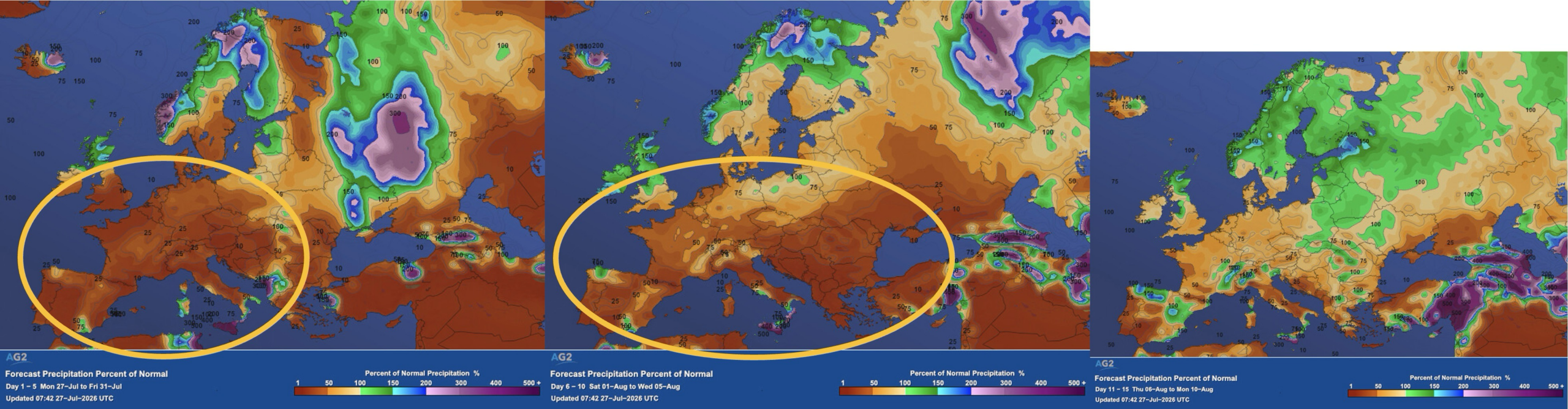
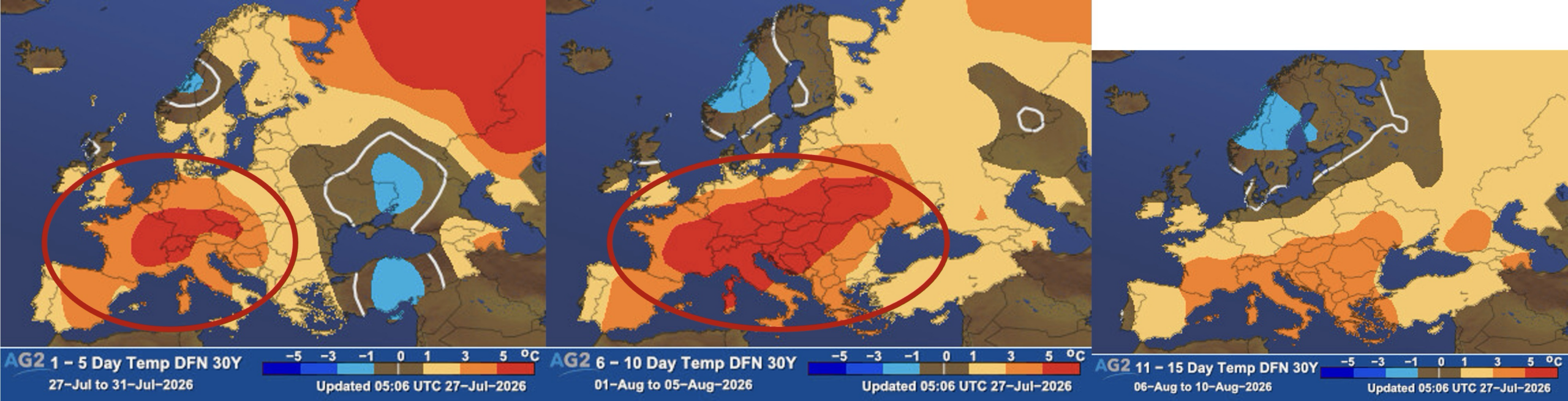
Bottom line: European river systems are heading into another highly stressful stretch as the 4th heat dome of the season hits, bringing renewed hot, dry and high-evapotranspiration conditions with very limited fresh hydro input over the next 7-10 days. Already critical Rhine, Rhone and Danube conditions are expected to deteriorate further, keeping risks elevated around French nuclear curtailment, Rhine navigability restrictions, SE hydro generation and broader energy-market and agriculture disruption. Some less hot and less settled relief may emerge later next week as the ridge weakens, but the near-term setup remains firmly adverse for river recovery.
Published by Julian Longoria
Synopsis:
Last week’s tropical wildcard for Japan is no longer a single run curiosity. The signal has now held up across multiple runs through the weekend and into this week, and today’s guidance sharpens the picture in several important ways. The approach window has slipped a few days later, now centered closer to August 5th rather than August 3rd-4th. Ensemble tracks have also tightened meaningfully toward Japan, raising confidence that some impact occurs, even though exactly where remains an open question. At the same time, projected intensity has scaled back, with ensemble clustering now favoring a weak Category 1 or strong tropical storm rather than the stronger system implied last week. The 500-mb pattern shows early evidence that the ridge, rather than holding its ground against the storm, has been the feature giving way. And in the 15-day temperature data itself, a real, whole number 1C of cooling has already shown up across the storm’s approach window compared to a week ago, even as feels like values stay stubbornly elevated for a separate and important reason.
The Signal, Confirmed and Refined
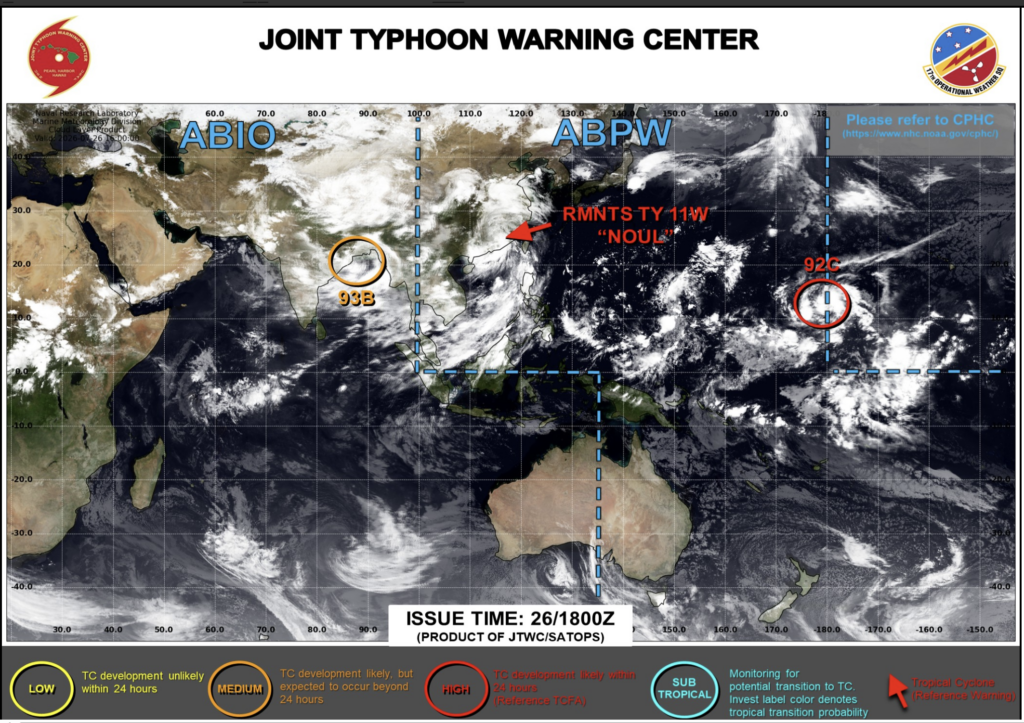
The system in question is Invest 92C, currently a formative tropical disturbance sitting far out in the open Pacific, well east of Japan, with the Joint Typhoon Warning Center assessing a high probability of tropical cyclone development within 24 hours. That’s still an early stage feature at this point, days away in both time and distance from any approach to Japan. What’s changed since last week is how the ensemble guidance handles that system’s evolution. Tracks that were previously scattered across an enormous range, from near Hokkaido to as far southwest as Vietnam, have now clustered far more tightly into a corridor converging on Japan by around August 5th. That’s a meaningful gain in confidence that this system does approach the country in some form. It is not, however, a gain in confidence about precise landfall location or which power zones see the most direct impact; that piece of the forecast remains unresolved and shouldn’t be priced as settled. Alongside the tighter track clustering, the ensemble has also converged on a softer intensity outcome than what last week’s guidance implied, with a weak Category 1 or strong tropical storm now the most probable scenario rather than a more powerful system.
The Ridge Gave Ground, As the Setup Suggested It Might
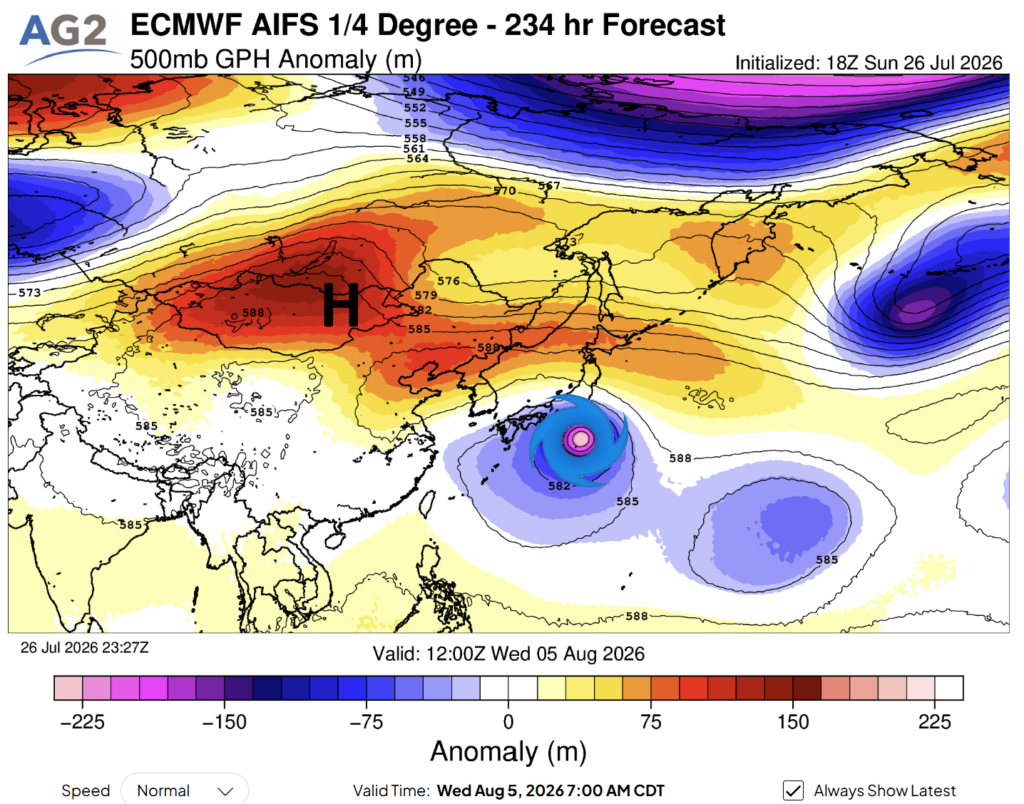
Last week’s post laid out the basic mechanics: a ridge and a typhoon that strong can’t sit on top of each other at close range, and one side of that argument was always going to give first. Today’s 500-mb data offers an early, credible look at which side that’s been. The ridge‘s core, which last week sat close to Japan itself, has since retreated west, now centered well inland over Mongolia and central Asia. The ridge is still a real, extensive feature stretching east across the region, but by the time it reaches Japan and Korea it’s noticeably weaker than its core farther west, and the approaching system now sits within a well defined trough just south of the country. This is consistent with, though not conclusive proof of, the dynamic flagged last week: the storm appears to be winning enough of that argument to organize and approach more directly, while the ridge cedes position rather than holding firm on top of it. It’s one data point worth watching rather than a settled resolution, but it lines up with the physical reasoning laid out at the time.
Temperatures Have Already Moderated in the Approach Window
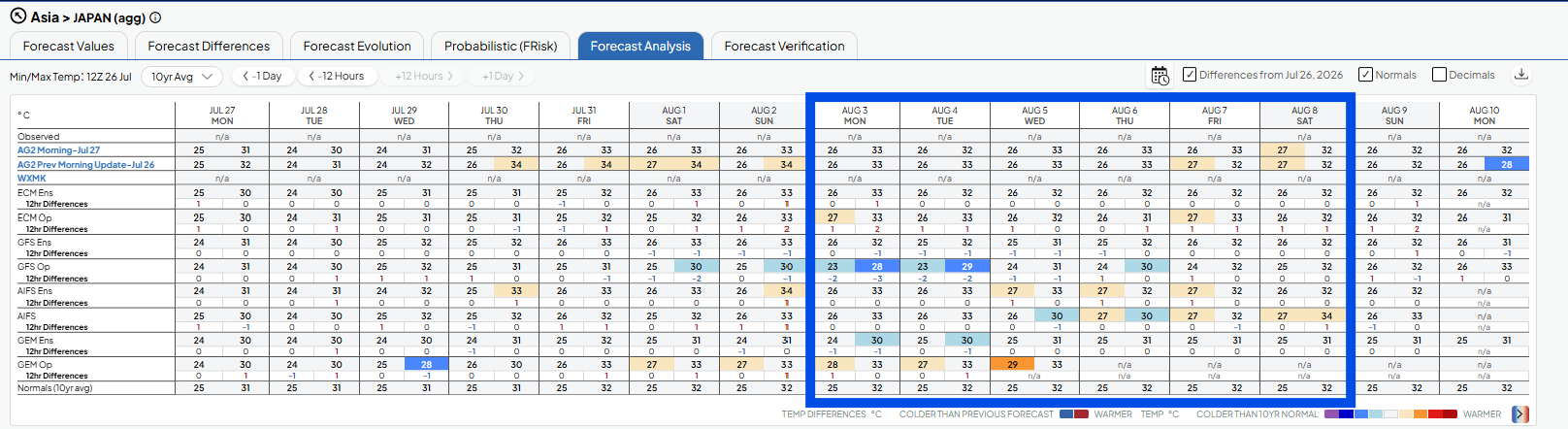
The 15-day forecast itself shows this playing out in real numbers. Maximum temperatures across the August 3rd through 7th stretch, the storm’s approach window, are now running roughly one to two degrees Celsius cooler than they were modeled just a week ago. Today’s model comparison also shows this cooling isn’t evenly distributed. GFS Op in particular is running noticeably cooler than the broader guidance specifically across the early days of that window. An isolated cool outlier like that is worth watching rather than trusting outright, but it’s a useful early signal for where the broader ensemble could still be headed if the tropical system continues to organize and the ridge keeps losing ground.
The Real Risk Sits in Feels Like Temperatures, and It’s a Downside One
Here’s the part of the data that deserves the most attention from a demand standpoint. Despite that real cooling in raw surface temperatures, feels like values across the same window are staying stubbornly high, still running in the high 30s Celsius. The reason isn’t that heat index has more room to climb, it’s closer to the opposite. Dewpoint values across the entire 15-day forecast, including the storm’s approach window, have held almost perfectly flat in the mid-20s Celsius, essentially unmoved regardless of what happens to temperature run over run. That’s consistent with an air mass that’s already sitting close to its practical moisture ceiling for this time of year. With the ridge ceding ground, feels like values look more likely to drift lower alongside them than to climb any further. There simply isn’t much more humidity available to load on top of what’s already there. The elevated feels like numbers are being sustained almost entirely by that already saturated moisture load rather than by any further room to climb, and without a strong, intact ridge behind them, there isn’t a clear driver left to push feels like values any higher from here. Practically, that means the risk to this outlook sits on the downside of the current feels like numbers, not the upside.

Bottom Line
The near term signal has shifted meaningfully since last week, even if the underlying uncertainty hasn’t fully resolved. Confidence that some tropical impact reaches Japan around the turn of the first week of August is now real and building, arriving a few days later and considerably weaker than initially modeled. Surface temperatures in that window have already moderated by a whole degree or two, and the more durable direction from here for feels like values is neutral to lower rather than higher, given how little room the current moisture profile leaves to add further heat stress. The piece of this forecast still genuinely unresolved, and the one worth tracking most closely on subsequent runs, is exactly where within Japan any impact concentrates.
Published by Amy Hodgson
The latest models are continuing to indicate another hot spell of weather building across mainland Europe as we move into the beginning of August due to higher pressure building across the continent once more.
The 11-15 day ensemble means from the ECMWF, GFS and AIFS ensembles are shown below. All show a high pressure dominant pattern across mainland Europe – above to well above normal temperatures here with mostly dry and settled conditions. While to the north and west, there are differences in the details of lower pressure here, hence lower confidence across the British Isles to Scandinavia which could be cooler and more unsettled.
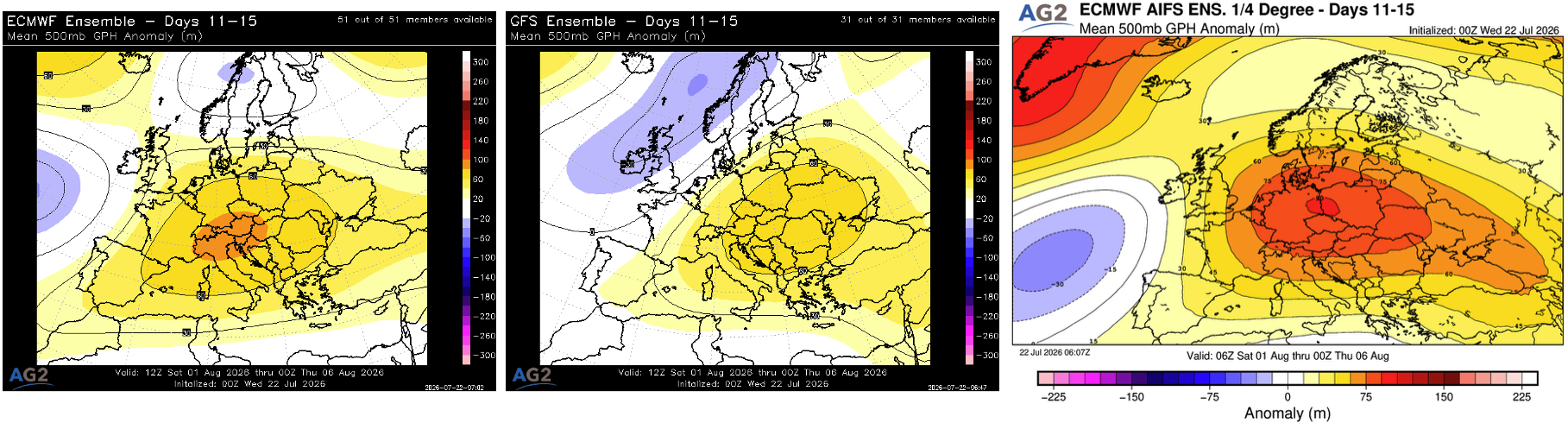
The cluster graphics for the 11-15 day period below show the differences in the details of lower pressure to the north and west, where there’s lower confidence. Higher confidence across the mainland that higher pressure will dominate.
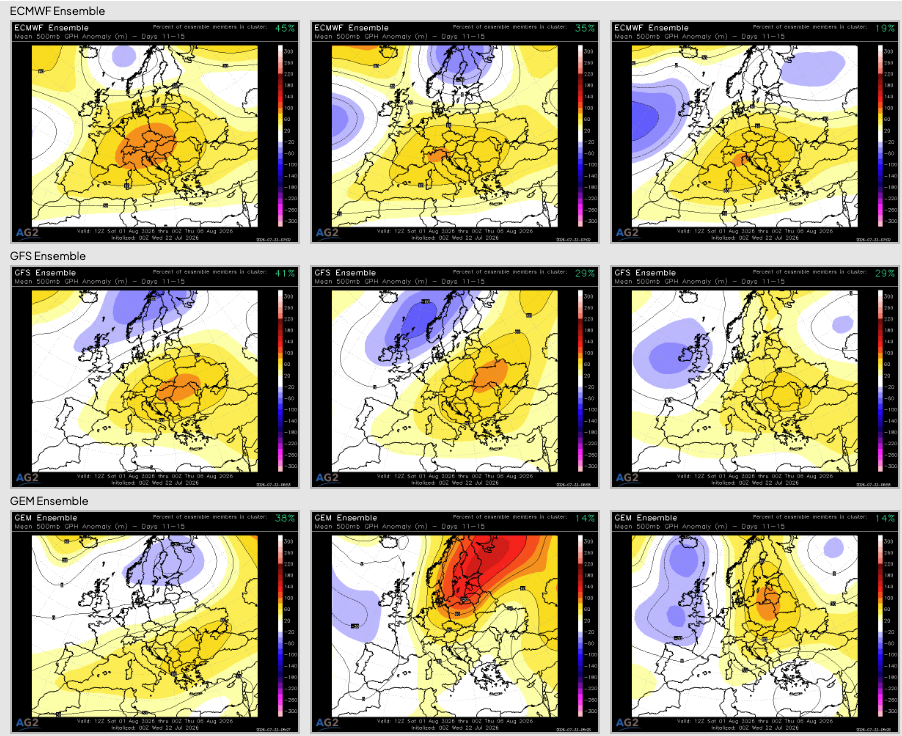
The latest AG2 temperature anomaly forecast for the 11-15 day period is shown below. Heat is forecast to return across mainland Europe. The exact details of the most anomalous heat is lower confidence. While to the far north, nearer normal temperatures are forecast across the north of the British Isles to Scandinavia more under the influence of lower pressure.
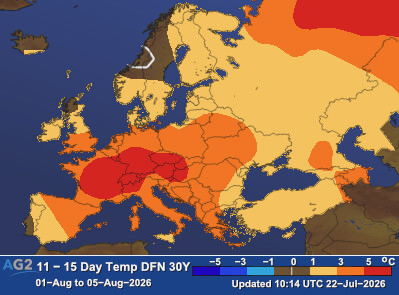
Bottom line: Another period of anomalous warm is forecast across mainland Europe as we move into the beginning of August as higher pressure is forecast to become dominant across the continent once again. This is forecast to bring potentially another heatwave event with strong sunshine, dry conditions and low winds. To the far north however, the British Isles and Scandinavia are at greater risk of being under the influence of lower pressure and hence nearer normal temperatures, and wetter conditions.
Published by Ed Vallee
This blog takes a look at the latest drought monitor, which was issued on July 16th.
The latest drought monitor is below, noting drought coverage is down to 69.95% (down from 72.84% last week).
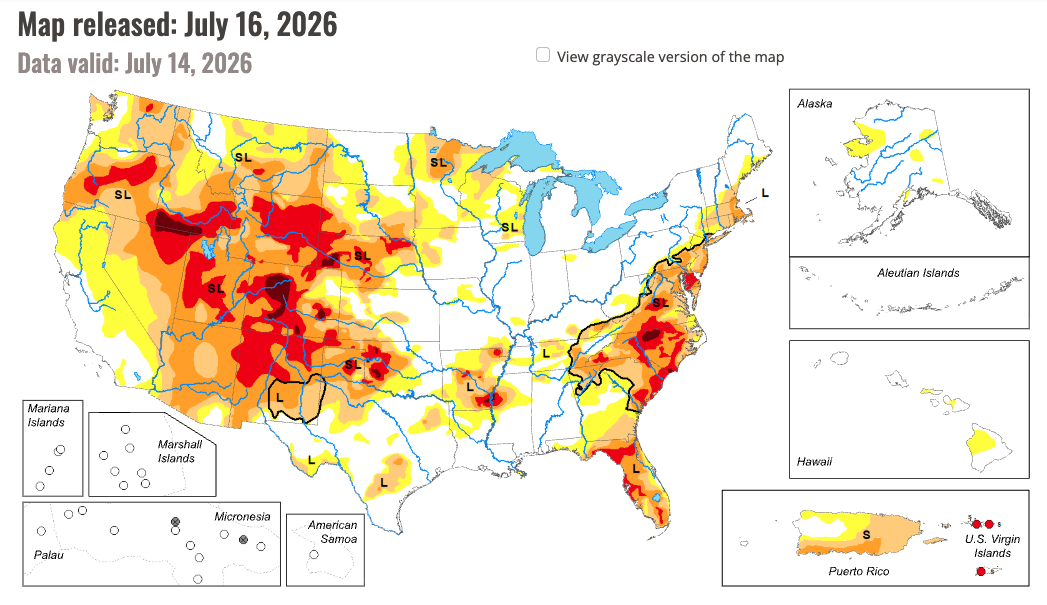
Month over month change maps are below. The most notable trends in the last month are wetter in parts of the Midwest, Ohio River Valley, Plains, and Southeast, but drier in parts of the Rockies and West. 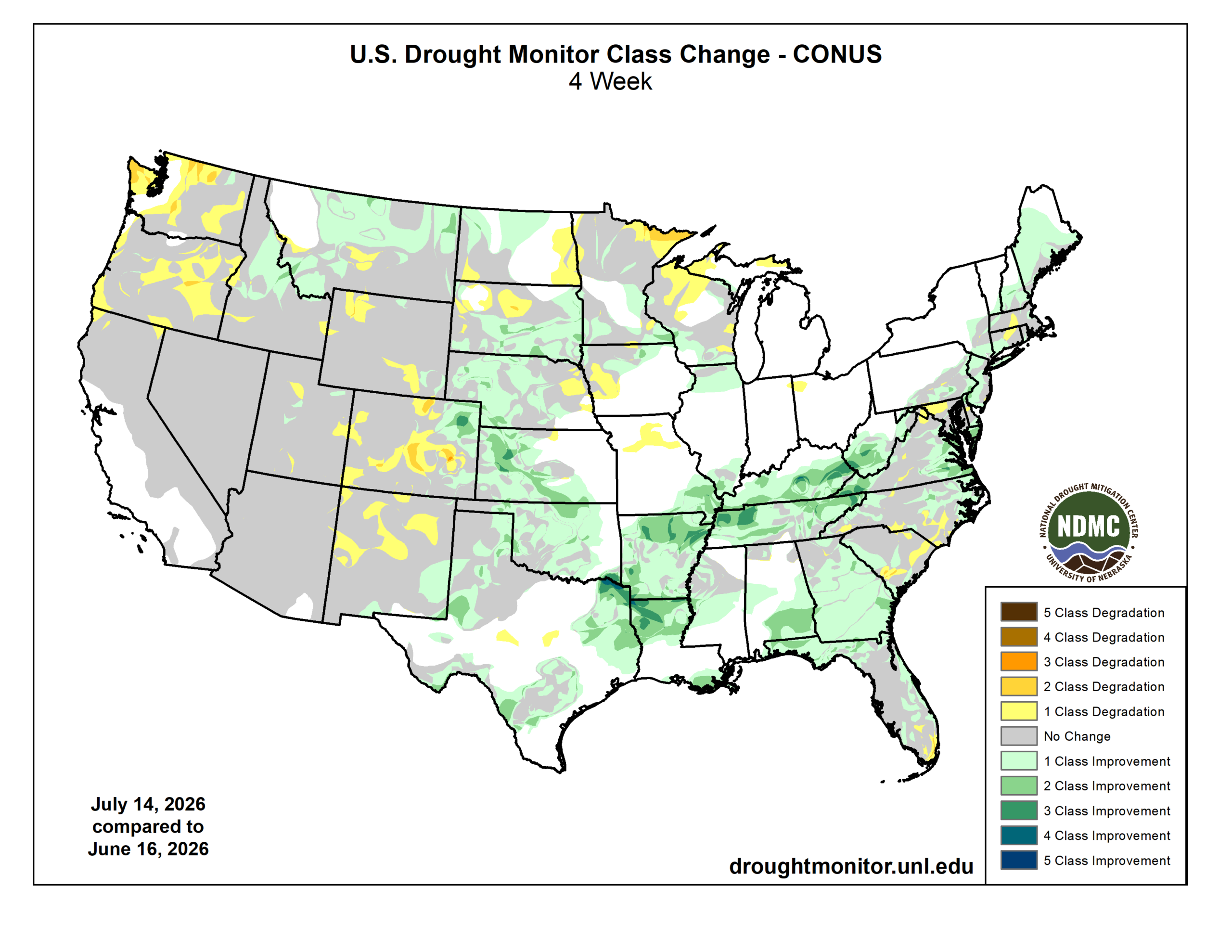
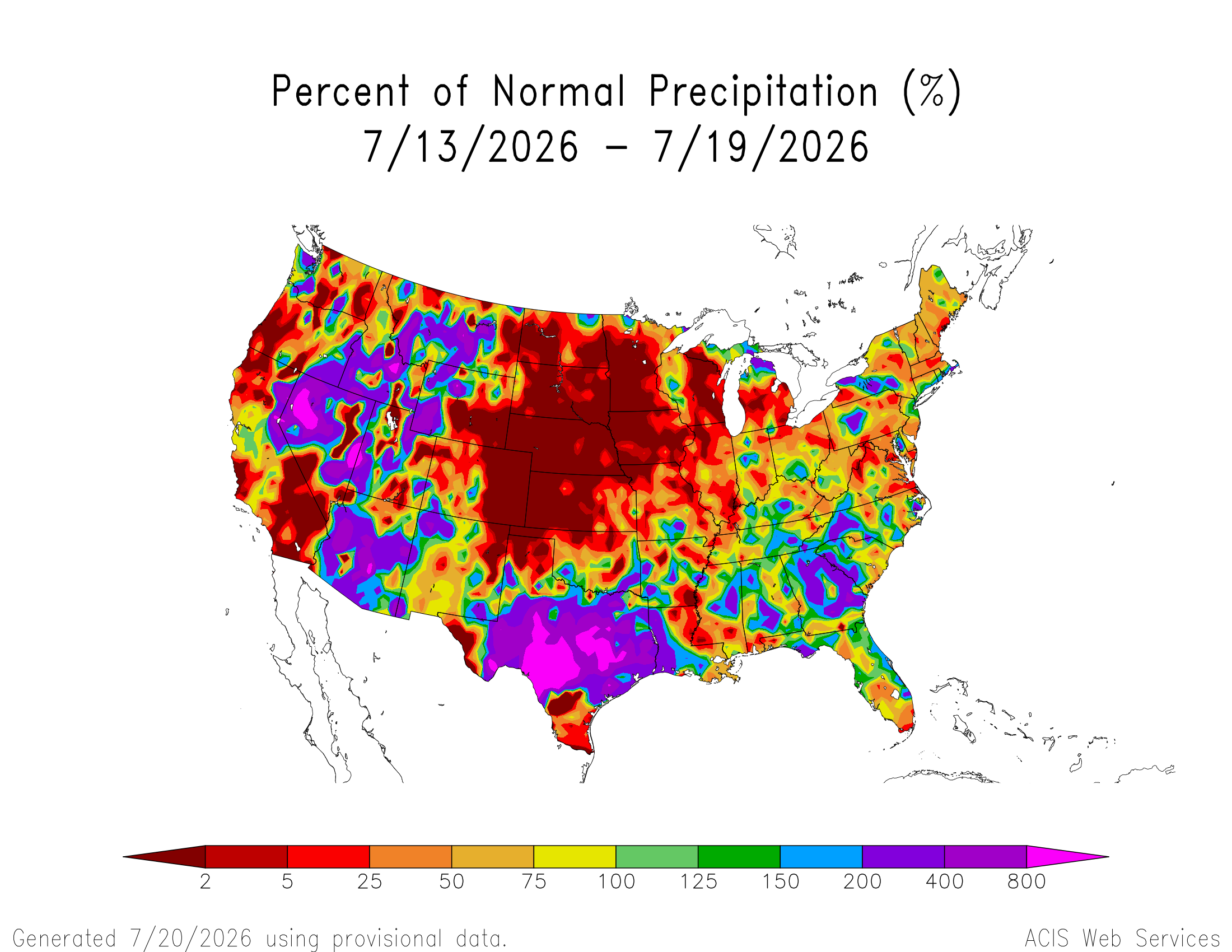
We can see the recent rains across the West and South, from 13-19 July, which helped drought coverage lower this week.
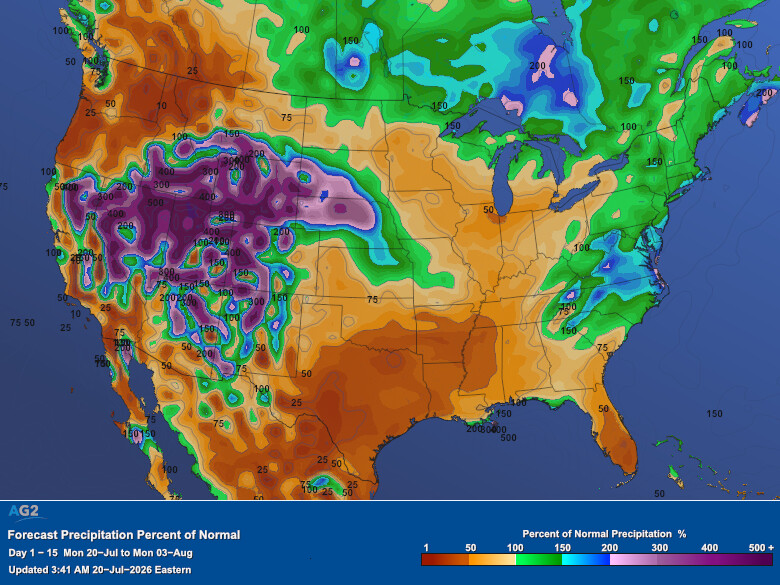
The forecast over the next 15 days continues to look very wet across the Interior West and along the East Coast. It does look drier in Texas as that region turns hotter.
Published by James Caron
The latest tropical outlook continues to highlight a low-probability development threat over the northeastern Gulf this weekend into early next week. An area of low pressure is expected to form and could gradually organize while meandering over the northeastern Gulf before moving slowly toward the southeastern United States. Development is far from certain, but the system may produce locally heavy rainfall and flooding even if it never becomes a named tropical storm.
The National Hurricane Center assigns the northeastern Gulf disturbance a near-zero chance of formation during the next 48 hours and a 20% chance through seven days. This supports a slow-development scenario, with environmental conditions potentially becoming more favorable after the low forms this weekend. The NHC is also monitoring a tropical wave southeast of the Cabo Verde Islands, but its formation probability remains only 10% as it moves into a less favorable environment.
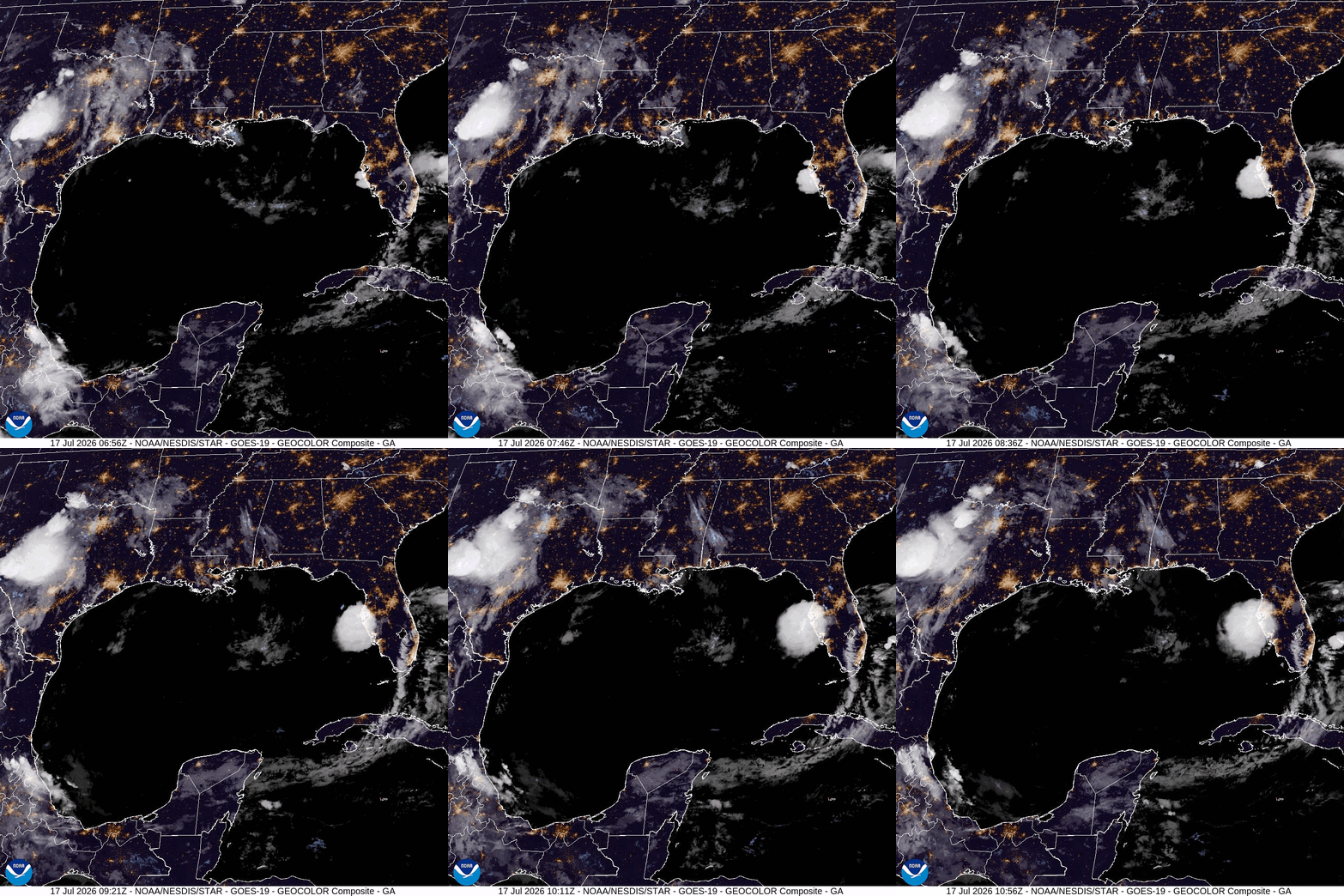
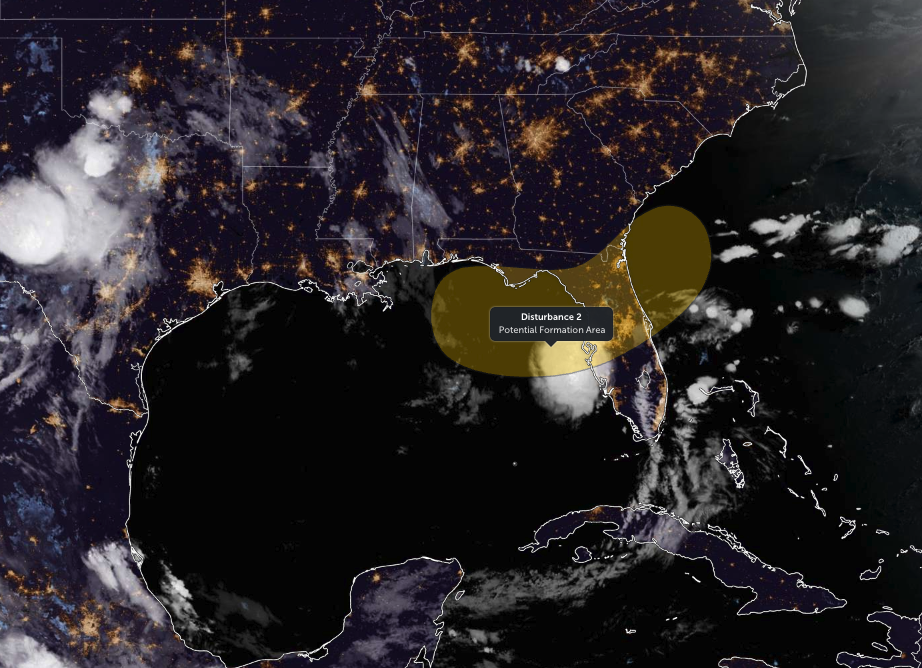 The satellite image shows an area of convection near southern Florida and the eastern Gulf, within the broader region where the low could eventually consolidate. Thunderstorm activity remains disorganized, without a well-defined circulation. The broad potential formation area extends from the northeastern Gulf across Florida and offshore of the southeastern United States, reflecting considerable uncertainty regarding where the low will form and how it will move.
The ECMWF ensemble presents a relatively weak development signal. Its tropical-depression probability is confined mainly to the northeastern Gulf and the waters west of Florida, generally within the lowest probability range. Most ensemble tracks keep any developing circulation near Florida or move it inland across the southeastern United States, with limited support for meaningful intensification over the Gulf.
The GEFS ensemble is considerably more aggressive, showing the strongest probability of tropical-depression formation over the northeastern Gulf and immediately south of the Florida Panhandle. It also has greater track dispersion, with some members moving inland across Florida or the Southeast and others tracking westward along the northern Gulf Coast. A small number of members indicate tropical-storm or hurricane intensity, but those stronger outcomes remain outliers rather than the most likely scenario.
Published by Takahisa Nishikawa
Forecast Changes from the previous run:
1-5 Day: Warmer moves over Northern Japan, South Korea, and Northern China
6-10 Day: Warmer moves over Eastern Japan, Eastern/Southern China, cooler moves over Northern Japan and Northern China
11-15 Day: Warmer moves over Eastern China
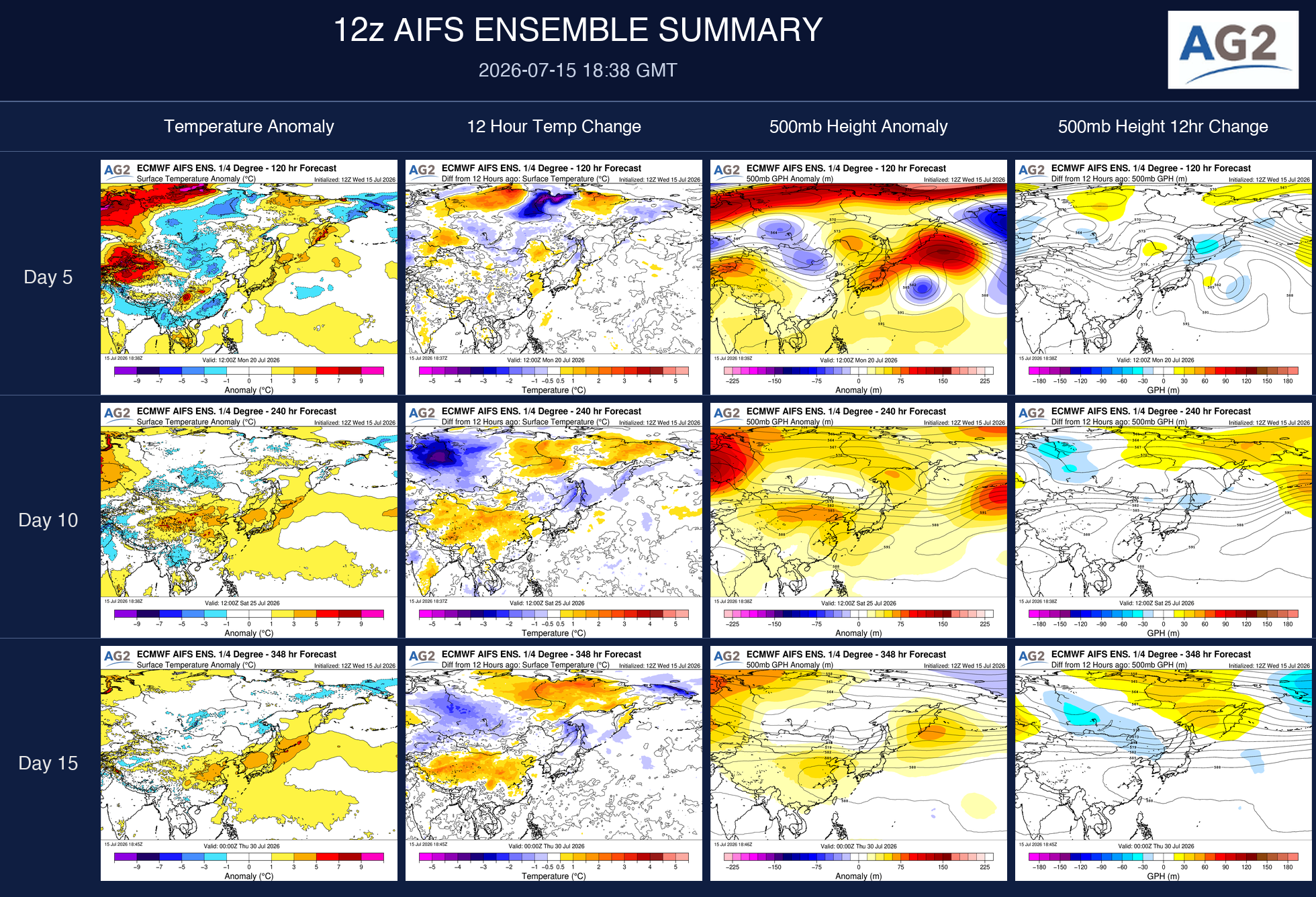
Compared to the previous run, the latest AIFS ENS shows a weaker trough over northern China in the first half of the period, driving temperature forecasts higher there. In addition, a well-defined ridge is forecast over Japan on the 21st–22nd, a tendency also confirmed by other models, raising the risk of temperatures running 5°C or more above normal across western and eastern Japan. From the 23rd onward, the forecast now shows the Pacific High extending further west, with temperature forecasts for eastern China revised 1–2°C higher compared to the previous run.
Published by James Caron
Strong El Niño winters are usually associated with reduced U.S. heating demand, but that seasonal expectation can conceal meaningful short-duration cold risk. Historical data show that even when the November–March period finishes substantially warmer than normal, one well-timed Arctic outbreak can produce the winter’s largest gas-demand revision, stress regional power systems and create freeze-off risk in producing regions.
The central takeaway for natural gas and power traders is straightforward: El Niño establishes the seasonal backdrop. The EPO, AO and evolving North American ridge–trough pattern determine whether a cold outbreak is actually developing. The MJO can provide earlier notice.
The analysis covers U.S. population-weighted heating degree days, ENSO strength, MJO behavior and major circulation indices from 1950 through the 2025–26 winter.
How Frequently Do Cold Spikes Occur During Strong El Niño Winters?
Seven winters since 1950 met the study’s strong or very strong El Niño threshold based on the December–February Oceanic Niño Index. Six of those seven winters experienced at least one national cold spike exceeding the historical 90th-percentile threshold.
Across those seven winters, the analysis detected ten qualifying cold spikes, or approximately 1.4 events per winter. That does not mean traders should expect exactly one or two events every strong El Niño winter. The sample is small, and the 2015–16 super El Niño produced no national-scale spike at all.
The more useful conclusion is that strong El Niño does not remove cold-tail risk:
- Six of seven strong or very strong El Niño winters had at least one qualifying event.
- The cold spikes generally lasted several days to approximately two weeks.
- Strong El Niño winters still averaged fewer spikes than some colder background states, but the difference was not statistically decisive.
- The event often appeared as an abrupt reversal inside an otherwise bearish heating-demand season.
That last point matters most to markets. A seven-day cold anomaly during an already cold winter may be anticipated and partially embedded in balances. The same anomaly arriving during a winter running 10% to 15% below normal in HDDs can force much larger revisions because storage, production and forward expectations have adjusted to warmth.
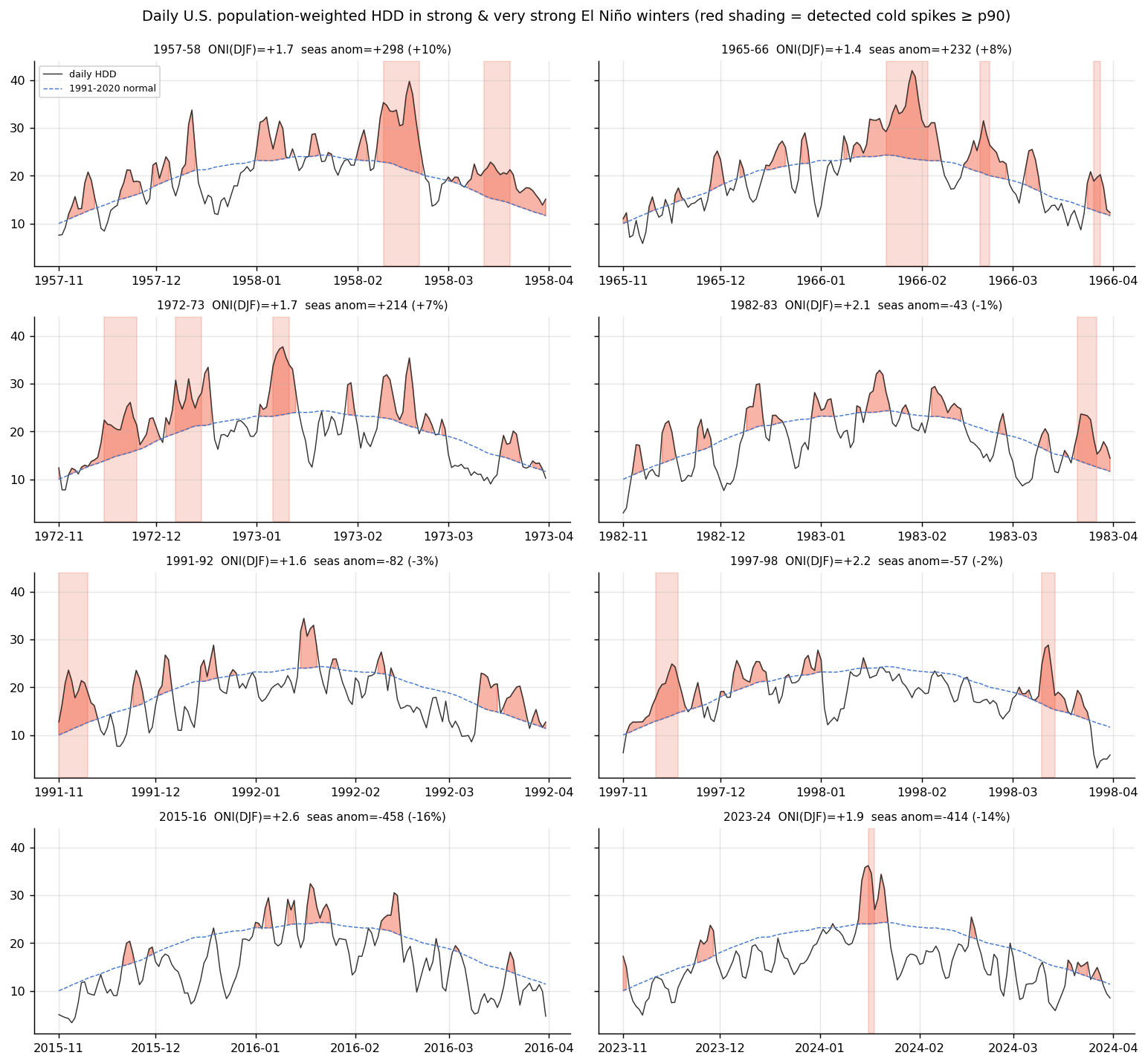
Daily population-weighted U.S. HDD in strong and very strong El Niño winters. Red shading identifies detected 90th-percentile cold spikes. The 2015–16 super El Niño is the major no-spike exception.
When During the Winter Do the Cold Spikes Occur?
The historical events were not confined to January. Strong-El Niño cold spikes occurred from November through March.
The broad timing distribution was approximately:
- November: several important early-season outbreaks, including 1991 and 1997.
- December: fewer detected strong-El Niño events, although December produced the clearest statistical MJO signal.
- January: the most commercially important recent example was the January 2024 Arctic outbreak.
- February: events can occur, but the strong-El Niño background can also overwhelm an otherwise favorable MJO signal, as happened in 2016.
- March: several historical events occurred late in the season, although their gas-market impact is usually smaller and the historical MJO relationship weakens or reverses.
For trading purposes, the most actionable window is December through February. November cold can be significant, particularly when the market has entered winter with a warm consensus, but the early events often developed without a clean MJO precursor. March outbreaks remain possible, but shrinking seasonal demand and lower daily burn reduce their national gas-market influence.
The January 2024 event demonstrates the core risk. The 2023–24 winter finished approximately 14% below normal in population-weighted HDDs, yet its largest national HDD surge arrived in mid-January and affected both demand and South Central production.
The Precursors, Ranked in Order of Importance
1. A Falling and Eventually Negative EPO
The East Pacific Oscillation is the strongest precursor in the study.
Approximately 72% of all detected cold spikes were preceded or accompanied by an EPO at or below minus one standard deviation, compared with a background occurrence rate of 44%. The composite EPO began deteriorating roughly five to seven days before cold-spike onset and bottomed near the beginning of the event.
For traders, the practical interpretation is:
- Look for persistent height rises over Alaska and the Gulf of Alaska.
- Monitor whether ensemble guidance is strengthening, maintaining and retrograding that ridge.
- Watch the five-day EPO tendency, not merely the current EPO value.
- Require downstream trough development into the central or eastern United States.
A negative EPO does not guarantee severe cold in every population center, but it is the most reliable indication that Arctic air has a viable delivery route into the Lower 48.
Typical useful lead: approximately 5–10 days.
2. A Negative AO, Often Accompanied by a Negative NAO
The Arctic Oscillation provides the next-most-important confirmation.
In the composite, the AO declined before the event and reached approximately minus 1.3 standard deviations near onset. A negative AO indicates that Arctic air is becoming less confined to the polar region. A negative NAO can reinforce the pattern by slowing the flow and sustaining downstream cold over eastern North America.
The highest-confidence cold setup occurs when:
- The EPO is falling or already negative.
- The AO is trending negative.
- Greenland or North Atlantic blocking is appearing.
- Ensemble members increasingly agree on high-latitude blocking rather than showing a brief, progressive ridge.
The EPO helps open the Pacific-side pathway. The AO and NAO help determine how much Arctic air is available and whether the cold is transient or persistent.
Typical useful lead: approximately 5–12 days, depending on the evolution of the blocking pattern.
3. Coherent MJO Movement Through Phases 6, 7, 8 and 1
The MJO can provide the earliest alert, but its predictive value is much weaker than that of the EPO or AO.
Historically:
- MJO phases 6 and 7 showed their best relationship to cold-spike onset approximately 11–30 days later.
- Phases 8 and 1 showed their best relationship approximately 0–10 days later.
- The relationship was strongest in December.
- It remained directionally useful in January and February.
- It weakened or reversed in March.
The MJO should therefore be considered a background risk conditioner, not a trade trigger. An active MJO moving eastward through phases 6→7→8→1 should cause traders to pay closer attention to North Pacific changes. It should not, by itself, justify adding HDDs or buying cold exposure.
Only 28% of persistent, high-amplitude phase 7/8/1 episodes were followed by a qualifying national cold spike within 21 days. Several strong-El Niño outbreaks also developed with no phase 7/8/1 precursor at all.
The MJO becomes more meaningful when it is:
- Coherently propagating rather than stalled.
- At an amplitude of at least one.
- Occurring from December through February.
- Followed by actual Alaska/Gulf-of-Alaska ridging in the models.
- Supported by a falling EPO and AO.
Typical useful lead: approximately 2–4 weeks, but with a high false-alarm rate.
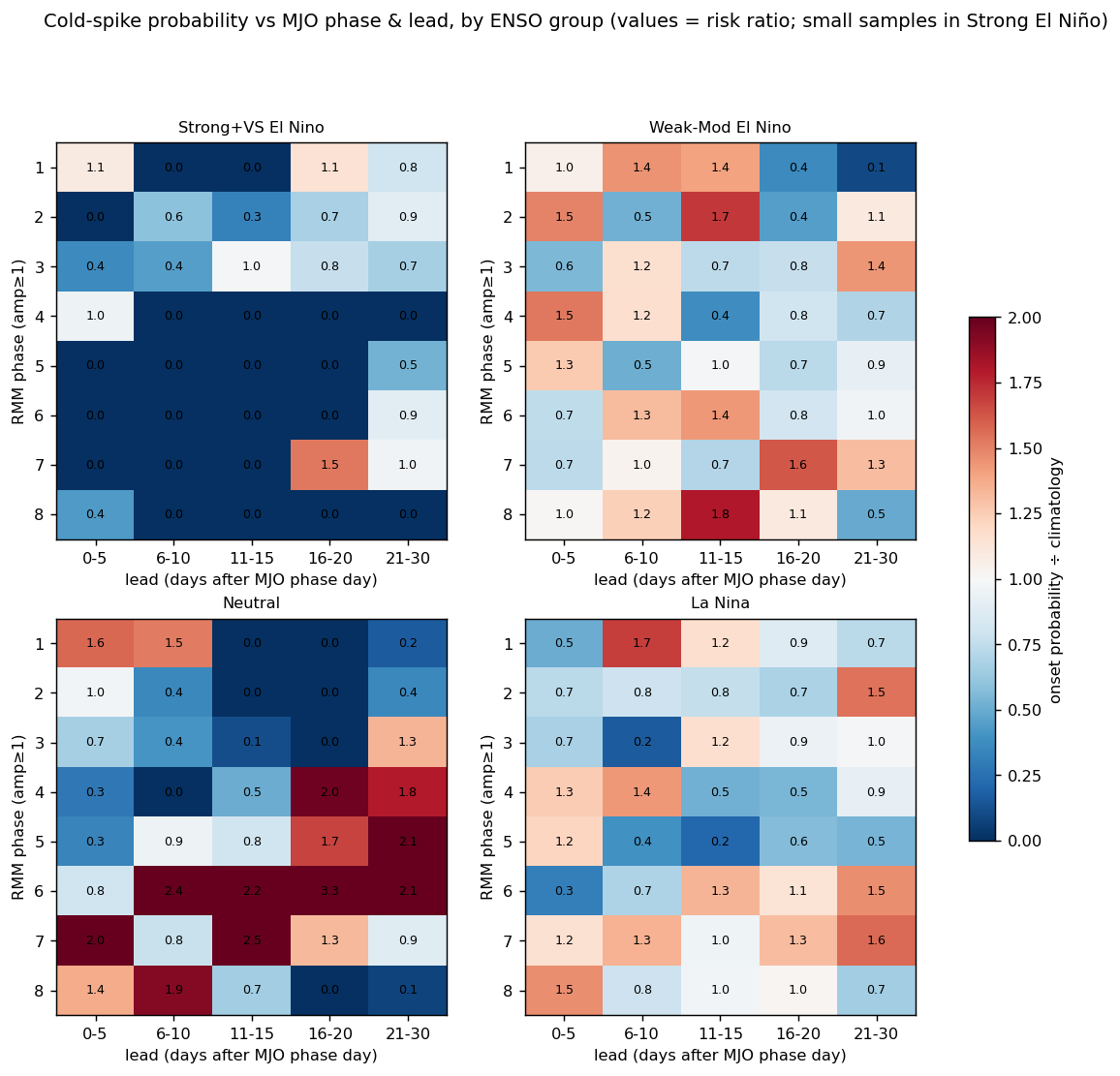
Cold-spike risk ratios by MJO phase and lead time. The strong and very strong El Niño panel is based on only five post-1974 events and should be viewed as anecdotal rather than statistically conclusive.
4. Positive PNA and the Western-Ridge/Eastern-Trough Configuration
A positive Pacific–North American pattern supports the familiar western North American ridge and central or eastern U.S. trough configuration.
The PNA signal was weaker and generally developed with, or slightly after, the EPO decline. It is therefore more useful as pattern confirmation than as an early precursor.
For traders, the important question is not simply whether the PNA index is positive. It is whether the ridge and trough are positioned correctly to direct cold toward major demand centers.
The highest-impact national pattern generally connects:
- A western Canada or Alaska ridge.
- A central or eastern U.S. trough.
- Arctic source air.
- A delivery path through the Midwest.
- Expansion into the South Central or Northeast markets.
5. Calendar and Background-State Filters
The same atmospheric signal should not receive equal weight throughout the winter.
Increase confidence when:
- The setup occurs from December through February.
- The MJO is progressing rather than stationary.
- The EPO and AO are falling simultaneously.
- The cold footprint includes the Midwest plus either the South Central or Northeast.
- Ensemble spread is narrowing around the blocking pattern.
Reduce confidence when:
- The event is occurring in March.
- MJO phases 4 or 5 are dominant.
- The EPO and AO remain positive.
- Strong El Niño convection is overwhelming the downstream response.
- The MJO is high-amplitude but stalled over the Indian Ocean or Maritime Continent.
Phases 4–5 produced the clearest statistically supported MJO result in the study: they suppressed near-term cold-spike probability. In other words, the MJO may be more useful for identifying a temporary mild window than for independently predicting a cold outbreak.
What the Composite Says About Warning Time
The circulation composite provides a useful sequence for trading desks:
- Two to four weeks ahead: The MJO may enter phases 6 or 7, raising background awareness.
- One to two weeks ahead: The MJO may progress toward phases 8 or 1 while ensemble guidance begins building Alaska or Gulf-of-Alaska heights.
- Five to ten days ahead: The EPO deteriorates rapidly, the AO falls and the North American trough becomes better defined.
- At onset: The AO is near its composite minimum, the EPO is deeply negative and national HDD anomalies accelerate.
- One week later: The EPO and HDD anomaly often begin recovering, indicating that many events are short-lived spikes rather than permanent winter regime changes.
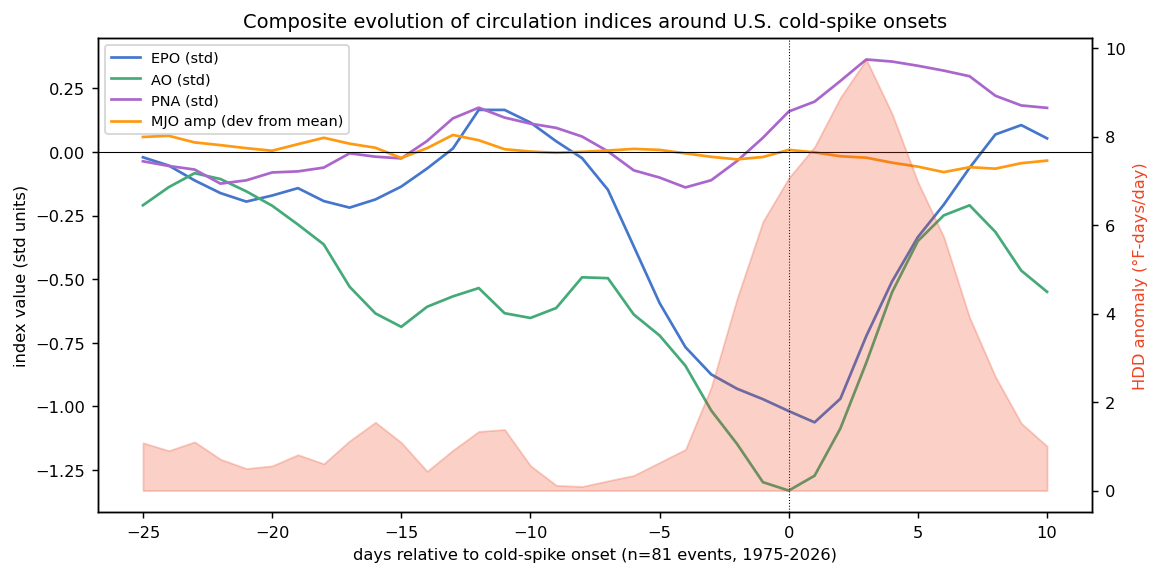
Composite circulation evolution around U.S. cold-spike onsets. The AO declines first, while the sharpest EPO deterioration occurs during the final five to seven days before the HDD surge.
What This Means for Natural Gas Traders
The most consequential events affect the Midwest, South Central and Northeast. Together, these areas dominate national population-weighted demand and can create simultaneous demand and supply risks.
A South Central component is especially important because it can combine:
- Higher residential and commercial demand.
- Increased power burn.
- Wellhead and gathering-system freeze-offs.
- Pipeline pressure constraints.
- Sharper regional basis moves.
A warm El Niño forecast may keep the seasonal storage trajectory comfortable, but an Arctic outbreak can still produce a rapid weekly withdrawal revision. The key distinction is whether the event is merely a demand spike or a combined demand-and-production event.
The January 2024 outbreak is the best recent example. It occurred during a very warm winter but still produced the season’s most important national HDD peak while exposing South Central production to freeze-related risk.
What This Means for Power Traders
Power-market consequences depend on the regional footprint and timing of the cold:
- Midwest cold raises load and can tighten gas deliverability.
- South Central cold can increase electric heating demand while threatening thermal generation fuel supply.
- Northeast cold increases both gas demand and pipeline congestion risk.
- A persistent negative AO/NAO combination can extend the event and increase cumulative load.
- A fast EPO rebound usually favors a shorter event and a quicker demand retreat.
The most important power-market question is therefore not simply, “Will it get cold?” It is: Will the cold reach major load centers, will it persist through multiple peak-demand periods and will it coincide with gas-supply or generation constraints?
Historical Cases Show Why the MJO Is Sometimes Not Enough
The 2024 outbreak followed the textbook progression: an active MJO moved through the western Pacific, the EPO became negative, the AO fell and Arctic air entered the central United States.
Other events did not follow that sequence.
The November 1991 and November 1997 outbreaks occurred without a meaningful phase 7/8/1 MJO precursor. Both were led by strong Pacific-side blocking and an EPO collapse.
February 2007 produced a prolonged cold regime even though the MJO occupied phases normally associated with milder conditions. The EPO fell to approximately minus 2.5 standard deviations and the AO to approximately minus 1.6, overwhelming the tropical phase signal.
Conversely, high-amplitude MJO movement toward traditionally cold phases in February 2016 and February 2024 failed to produce a qualifying national cold spike because the high-latitude background remained unfavorable.
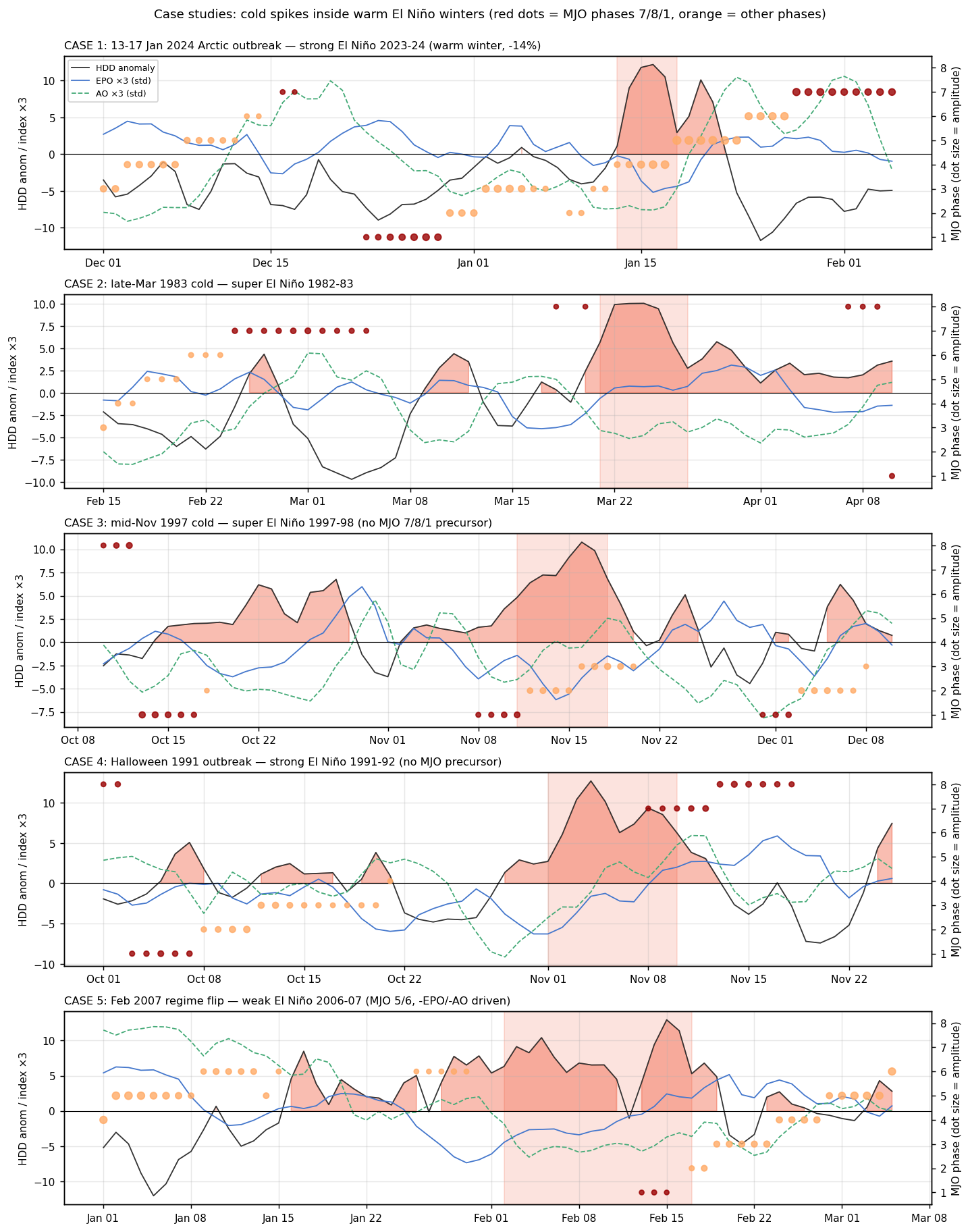
Selected cold-spike case studies showing HDD anomalies, EPO, AO and MJO phase. Some events followed the expected MJO-to-blocking pathway, while others developed primarily through high-latitude circulation changes.
A Practical Trading Framework
Early watch: 15–30 days
Raise awareness when the MJO is coherently moving through phases 6 and 7 during December–February. At this stage, confidence should remain low. The signal is best treated as a reason to examine ensemble changes more closely.
Pattern development: 8–15 days
Look for Alaska and Gulf-of-Alaska ridging, falling EPO forecasts and a negative AO tendency. Determine whether the trough is positioned toward the Midwest, South Central or Northeast rather than remaining in the West.
Trade confirmation: 5–10 days
Confidence rises materially when:
- The EPO becomes strongly negative.
- The AO and possibly NAO are negative.
- Ensemble agreement increases.
- The cold air source is legitimate.
- Regional HDD forecasts rise consistently across multiple model cycles.
- The South Central footprint introduces production risk.
Event management: 0–7 days
Separate a short-lived Arctic shot from a genuine regime change. Historically, many cold spikes inside strong El Niño winters began reversing within approximately one week. A rapid EPO recovery is an important warning against extrapolating one cold week through the remainder of the month.
What Traders Should Not Overweight
MJO amplitude by itself: A strong MJO in the wrong phase, or one that fails to alter North Pacific circulation, has limited value.
One deterministic model run: The high-latitude ridge and downstream trough must survive successive cycles and gain ensemble support.
Sudden stratospheric warming by itself: The study found no meaningful increase in national cold-spike frequency based solely on whether an event occurred within 45 days of a major SSW.
The seasonal El Niño label: It describes the average background but not the week-to-week distribution of demand.
Market Bottom Line
Strong El Niño winters generally reduce seasonal U.S. heating demand, but they do not eliminate short-duration cold risk. Six of the seven strong or very strong El Niño winters in the historical sample contained at least one qualifying national cold spike.
For natural gas and power traders, the hierarchy is clear:
- Negative EPO and Alaska/Gulf-of-Alaska ridging
- Negative AO and, when present, negative NAO blocking
- Coherent MJO progression through phases 6→7→8→1
- Positive PNA and correct ridge–trough placement
- December–February timing and regional model confirmation
The MJO can lengthen the warning window, but the EPO and AO determine whether the atmospheric pathway is actually opening. In a strong El Niño winter, the better strategy is not to assume persistent cold. It is to remain seasonally biased toward warmth while maintaining a disciplined alert system for short, potentially violent reversals in HDDs, power load and South Central gas production.
Published by Amy Hodgson
Key takeaways from the May 2026 review:
Pattern: A +NAO pattern with high pressure dominating much of Europe, with another heatwave event through the second half of the month.
Temps: Above normal temperatures widely across Europe with the greatest anomalies across the west. Hottest June on record across western Europe (Copernicus). Another intense heat wave event through the second half of June across western-central Europe with many temperature records broken.
Hydro: Drier conditions for many areas, with only some wetter conditions across the north of the British Isles and Scandinavia.
Wind: Lower than normal winds for most except for a windier British Isles to far northern France,
Solar: Higher solar for many regions, with lower solar across Scandinavia.
C3S verification: Correctly forecast a higher pressure dominant month across Europe with above normal temperatures. But incorrectly forecast the most anomalous warmth to be across eastern Europe, when in reality the greatest anomalies were across the west.
The observed NAO index is shown below. A generally +NAO month, with a dip to slightly negative values mid month.
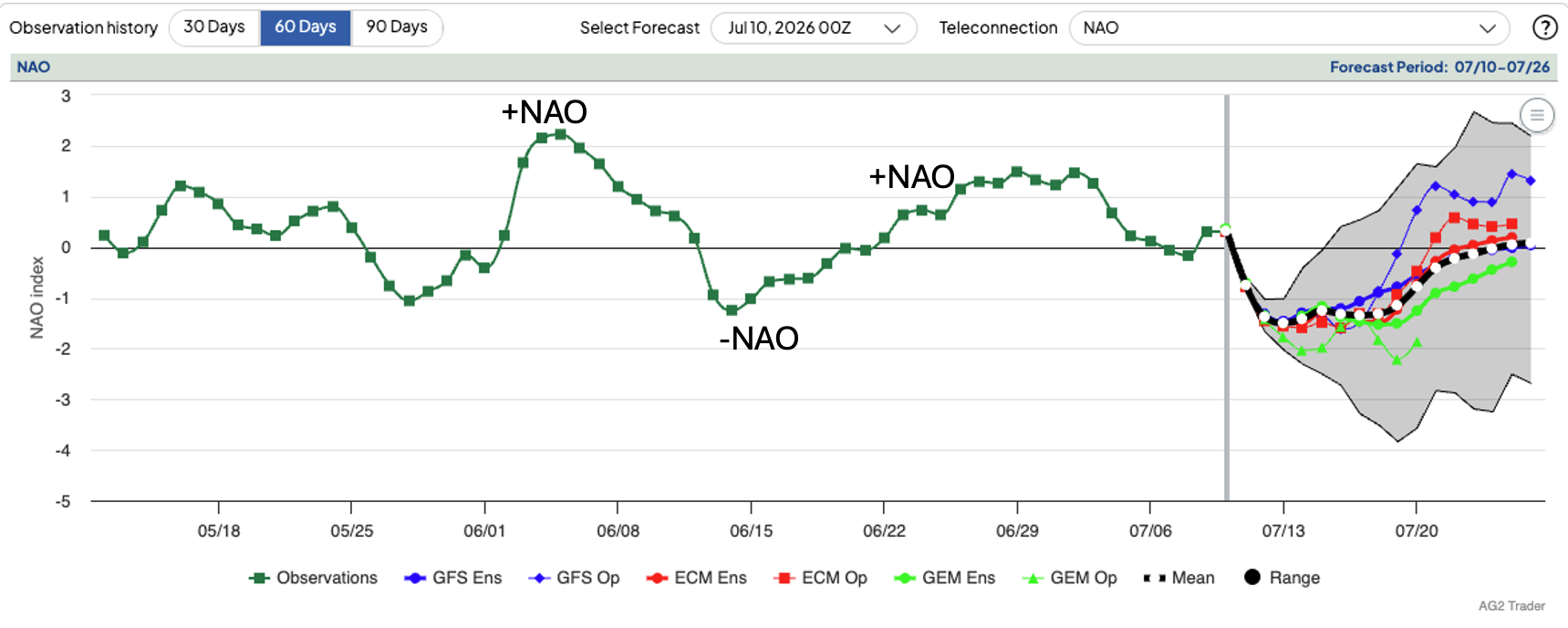
The 500mb geopotential height anomalies and corresponding temperature anomalies for the month of June are shown below. As mentioned earlier, for the month as a whole it was a +NAO month (lower heights across Greenland/Iceland) with higher pressure dominating across Europe. Temperatures were widely above normal, with the greatest anomalies across western and central Europe – well above normal here. Copernicus have stated that is was the hottest June on record across western Europe (https://climate.copernicus.eu/copernicus-record-heatwave-brings-hottest-june-western-europe-during-second-warmest-june-globally) The second half of June saw another intense heatwave across western and central Europe that broke many all time records
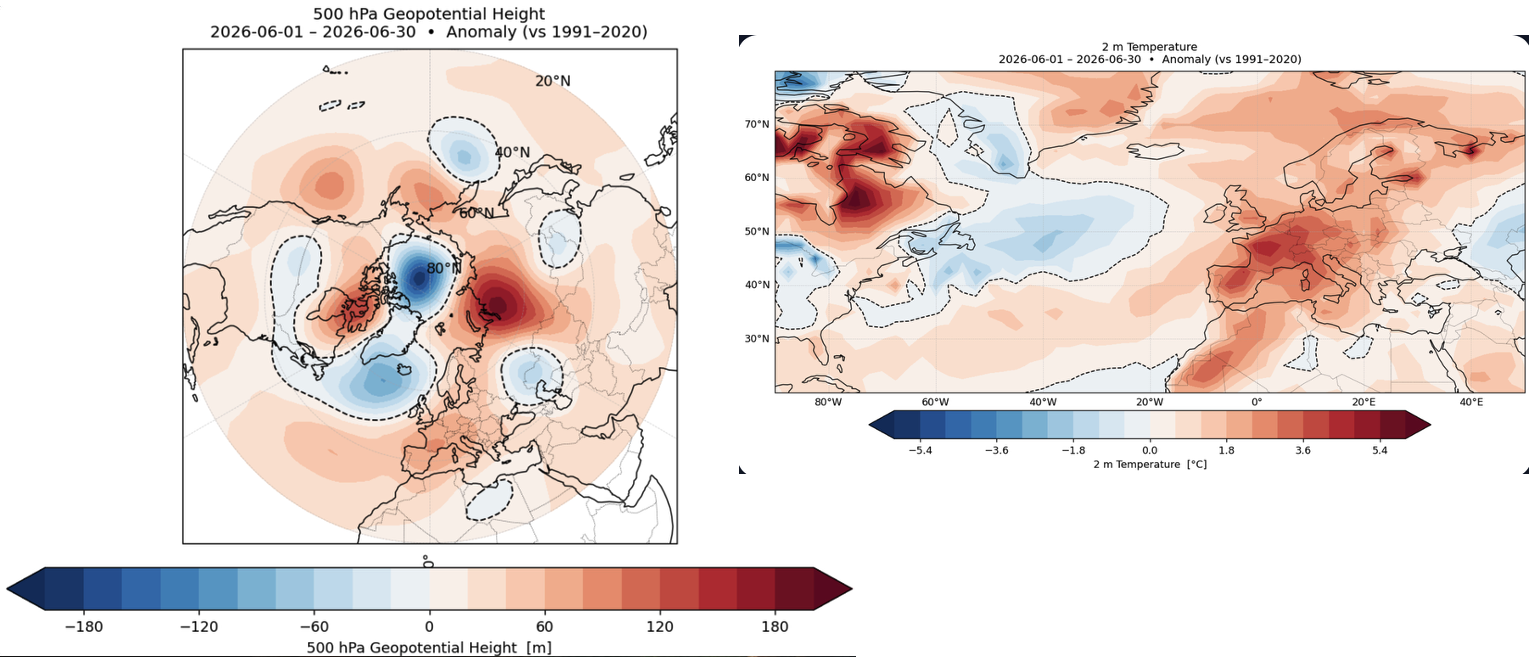
With regards to precipitation, dry conditions were experienced across much of mainland Europe, with the driest conditions across France. While wetter than normal conditions can be seen across the north of the British Isles to Scandinavia.
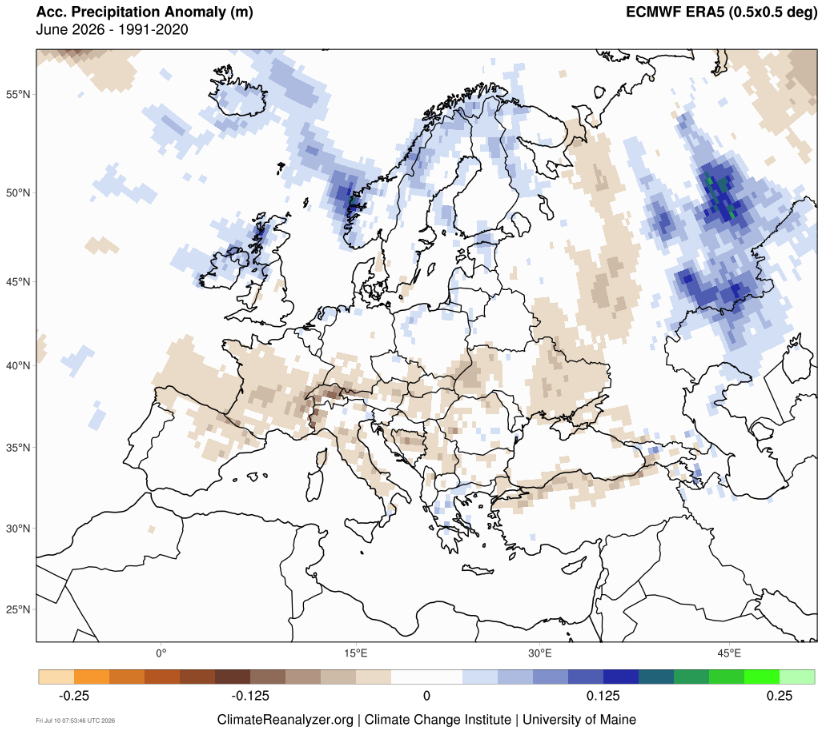
While for winds, the British Isles to far northern France saw above normal winds, otherwise elsewhere across Europe it was a low wind month.
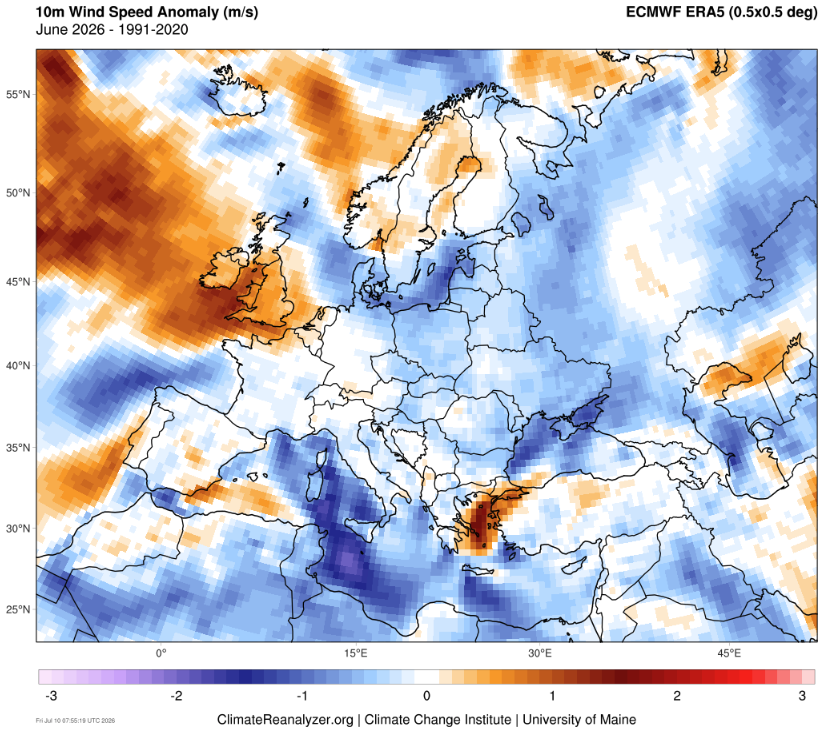
The cloud cover anomalies below show that many areas across Europe saw lower than normal cloud amounts/higher solar. The exception being across Scandinavia with cloud skies/lower solar.
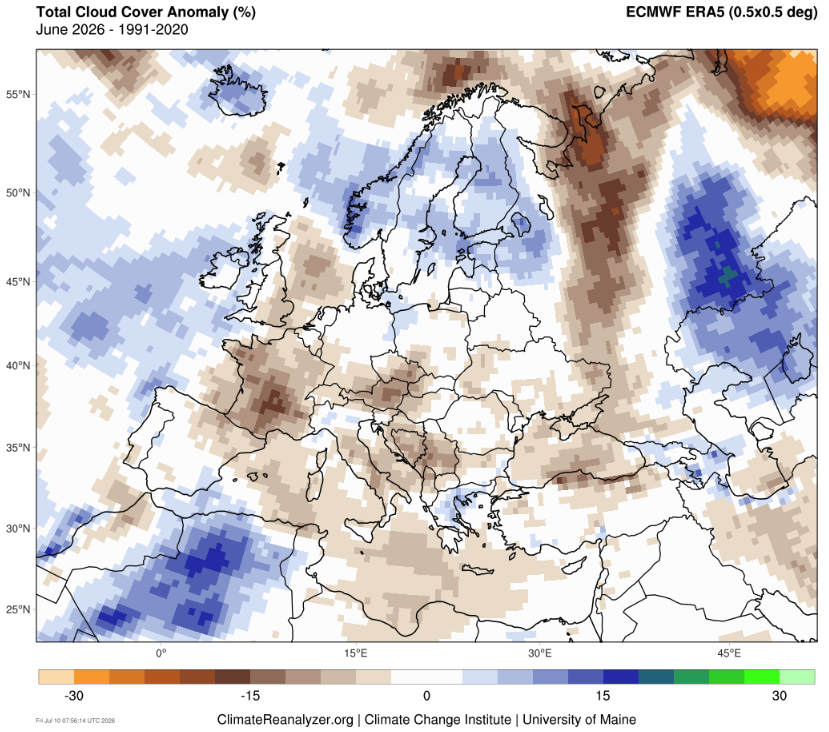
Now looking back at how well the C3S model forecast the month of June. It correctly forecast a widely high pressure dominant pattern across Europe with above normal temperatures. However it incorrectly centred the highest magnitude of the heat across eastern and south-eastern Europe, when in reality the highest anomalies were across western and central Europe.
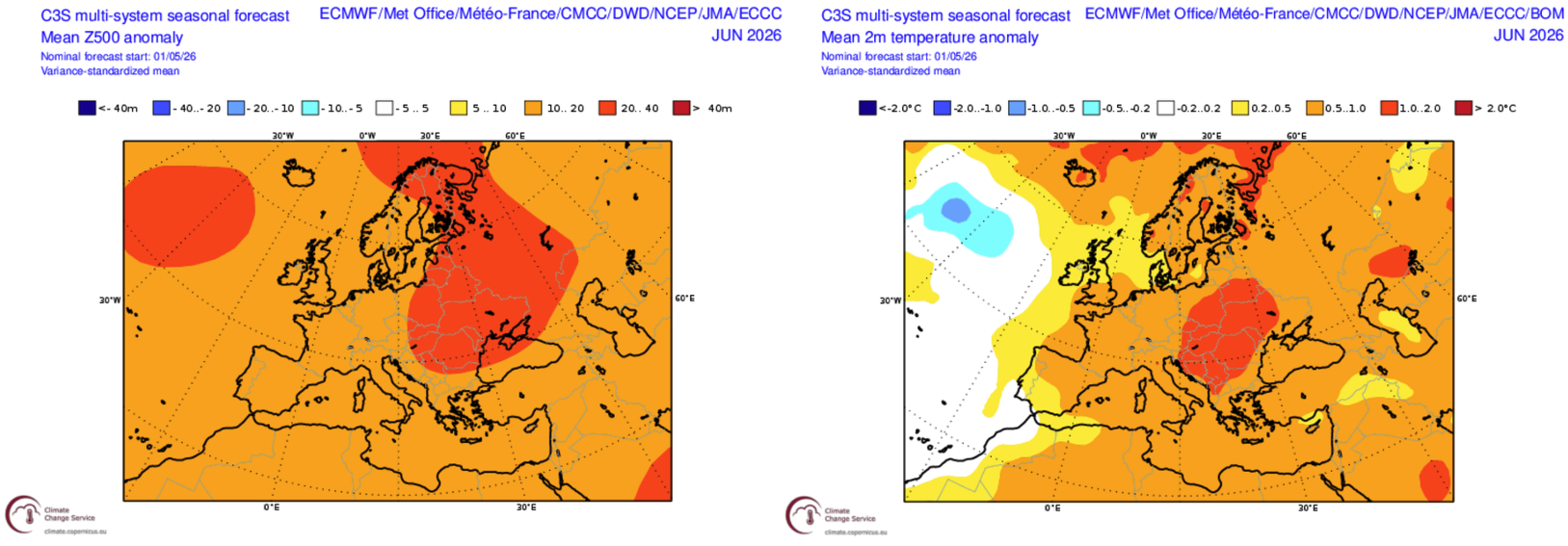
Published by Andrew Pedrini
This is a Northern Hemisphere rundown for the latest ECMWF Seasonal forecast released yesterday covering August through January.
US
A hotter and drier signal is found across the Plains through the Midwest towards the East Coast and Mid-Atlantic in August, with a less hot and wetter West, in a pattern almost diametrically opposed to what has been observed so far this summer. The temperature pattern holds into September, while conditions are projected to turn wetter more widely, except for the far Southeast and Florida. Heading through fall and into winter, anomalous warmth is forecast to lift further north towards Canada, while wetter conditions progressively focus towards the coastal areas. This points to near to somewhat cooler than normal conditions developing towards winter through the southern tier of the country, among nearer normal precipitation for the central and more interior regions.
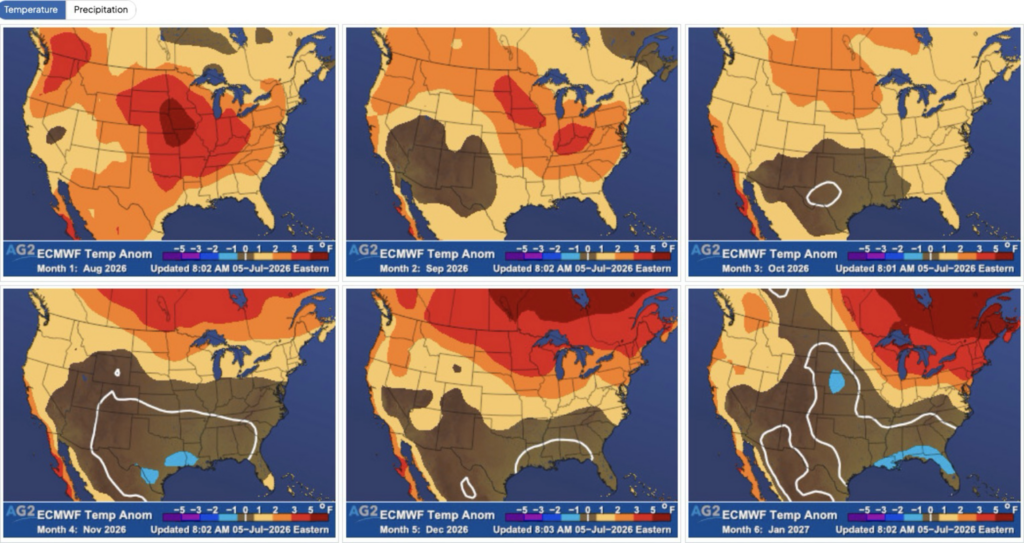
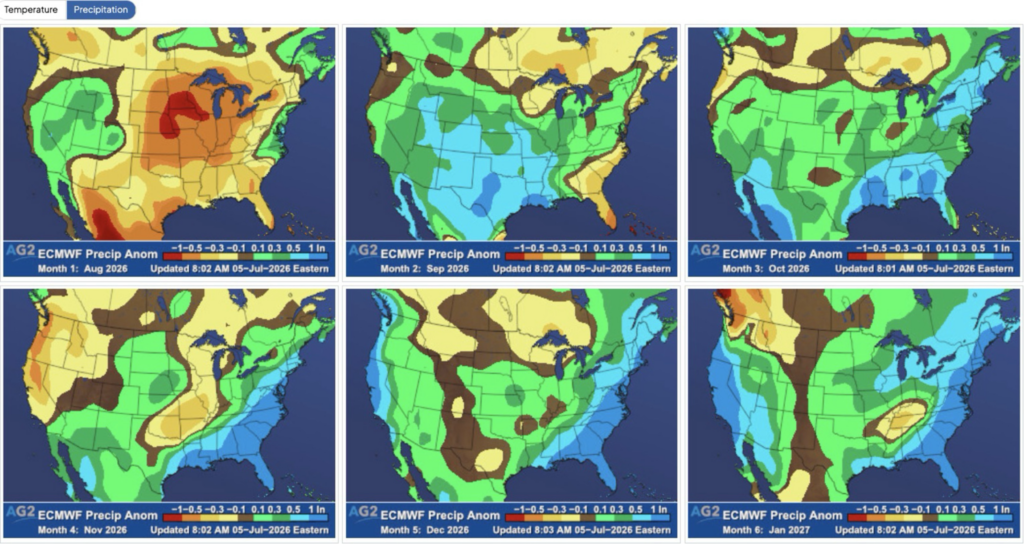
Europe
Fairly hot conditions are forecast for Europe through August, among a drier over wetter signal. Then, warmer and drier conditions are resolved to retreat west-northwest September, ahead of a wetter shift for the west October onwards as anomalous warmth is projected to build back widely, consistent with +NAO trends there. A drier/less warm signal through the north for January should be monitored as a deviation from an otherwise +NAO dominated pattern and the emergence of any colder risks going forward.
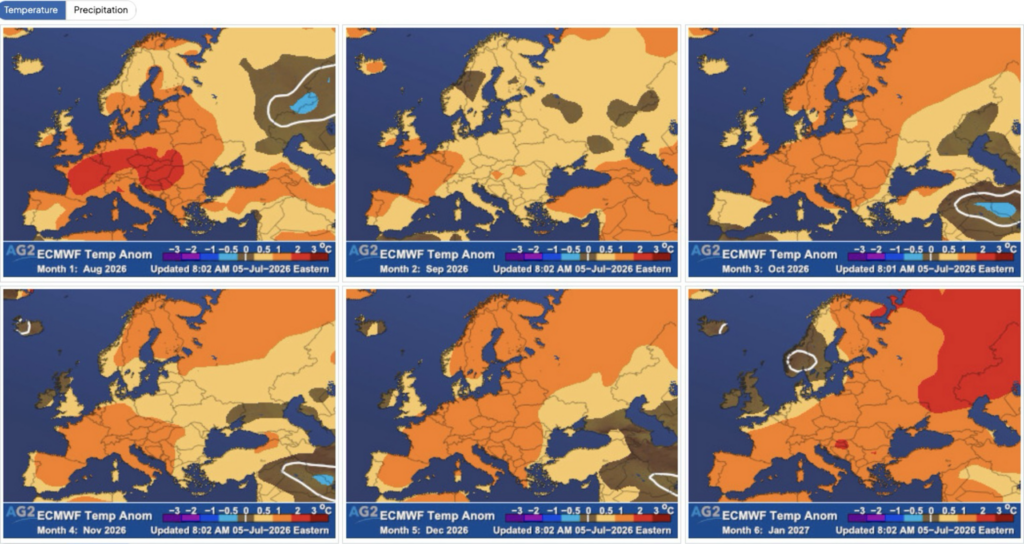
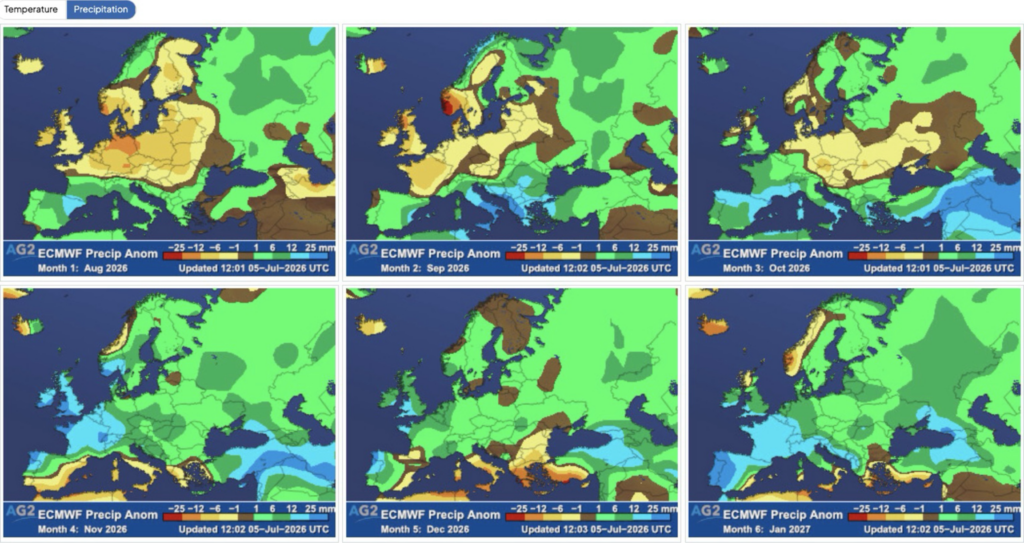
Asia
A less anomalously hot and overall wetter signal is found across East Asia for August compared to other key cooling demand regions of the northern hemisphere. Muted heat is forecast for September, among an overall drier shift across much of East Asia – except for wetter eastern-northeastern Japan and far southeast China. A return of more widespread warmth is then projected from October onward, with a widely wetter shift developing for the mainland first (drier October for Japan) and then much of the region heading towards winter.
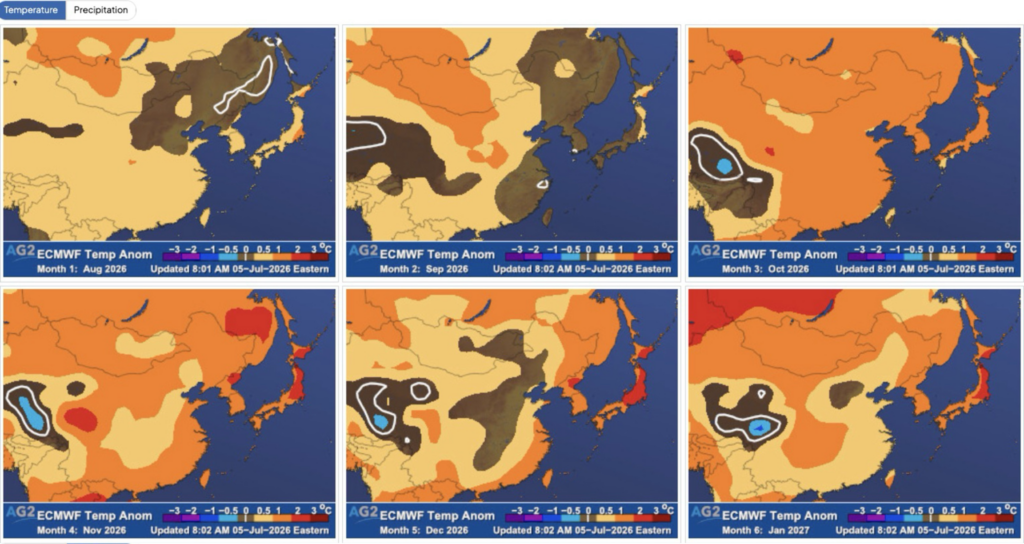
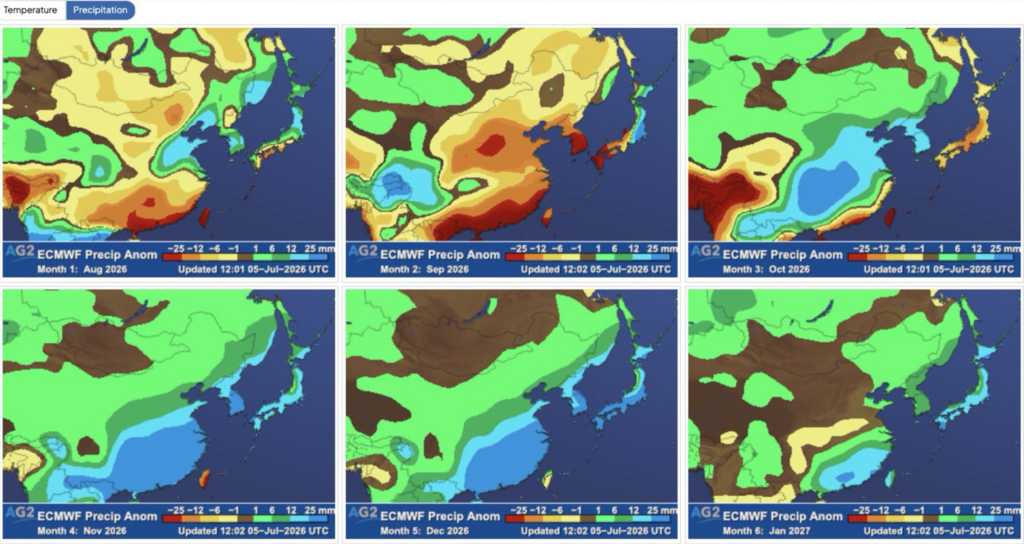
ENSO
The latest ECMWF ENSO projections show a significantly strong El Nino event developing later this year, with the ensemble mean lying between 3.5C and 4C as for NINO3.4 SST anomalies. There are indications that this Nino event could peak around the Nov-Jan timeframe.
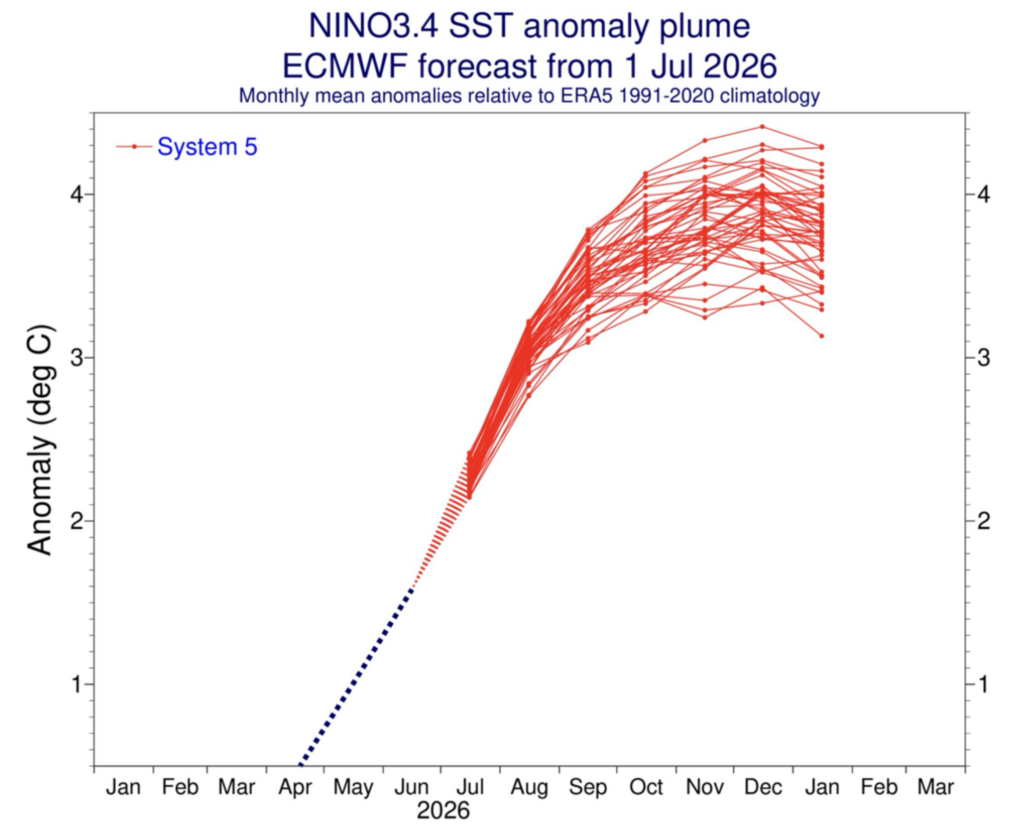
Tropics
For mid-late Northern Hemisphere tropical seasons, the forecast remains largely subdued across the Atlantic basin, while a larger than normal number of storms is forecast across the Pacific, especially central to western sectors, including the northwest Pacific. However, overall lower than normal ACE levels are projected through all basins.
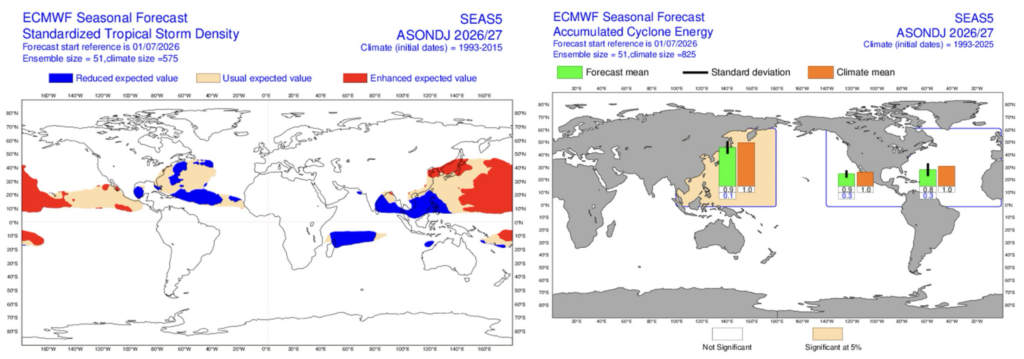
Below is an El Nino schematic as far as its typical impacts go. North America and Asia, where correlations are typically stronger, seem to closely respond to El Nino forcing heading into winter. The strength of El Nino could improve overall forecast confidence later this year into winter there. While in Europe, where correlations to ENSO signals are weaker, we may need to rely more on recent stronger El Nino analogs such as 2015/16 winter.
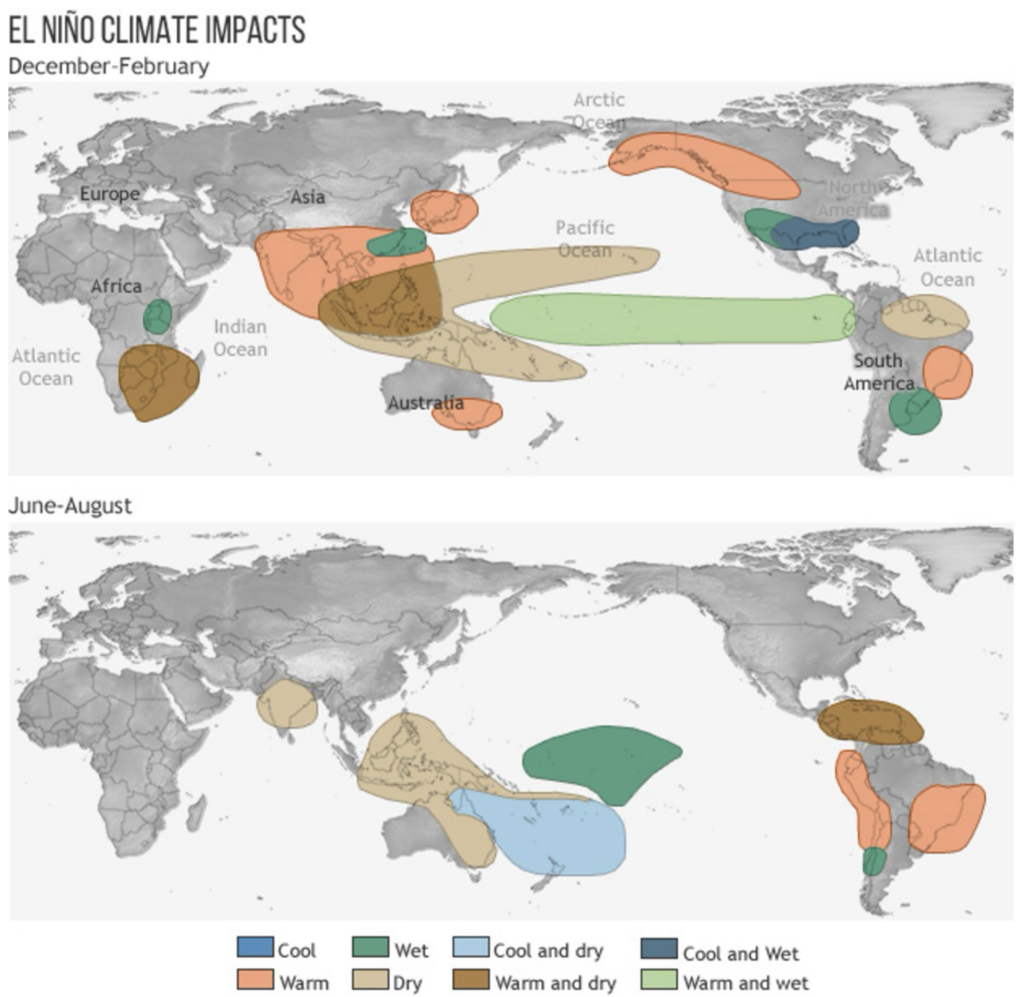
Bottom line: The latest ECMWF seasonal forecast points to a very strong El Niño developing later this year, with clearer impacts signaled across North America and Asia heading into winter, where ENSO correlations are typically stronger. For the US, the outlook highlights a hotter/drier late-summer risks across the Plains, Midwest and East, shifting toward a wetter coastal pattern and cooler southern-tier risks into winter, while East Asia trends less anomalously hot and wetter overall later in the year. Europe remains more uncertain given weaker ENSO teleconnections, though the forecast continues very hot into August before becoming warmer/wetter with +NAO type signals into fall/winter, while any drier/less warm northern deviation by January should be monitored for emerging colder risks. The tropical outlook remains subdued across the Atlantic, consistent with stronger El Niño-related shear, while storm counts lean higher across the Pacific, even though overall ACE values are projected somewhat below normal across all basins.
Published by Amy Hodgson
Here we take a look at the latest hydro situation across Brazil, and the precipitation outlook as we move through Spring and into Summer.
Brazil is one of the largest producers of hydroelectric power in the world, with the largest hydroelectric dam here being the Itaipu Dam. The primary reason for importing LNG into Brazil is to make up for the lack of electricity produced by the Itaipu Dam and other dams across Brazil, especially during times of drought. During times of drought, Brazil relies upon import LNG to meet its power needs. Therefore it’s crucial to monitor Brazilian precipitation.
Over the past 90 days, conditions have been slightly drier than normal across much of Brazil, except locally nearer normal across some western regions. While over the past 30 days, it’s been particularly dry across central-eastern Brazil, with wetter conditions to the south and west.
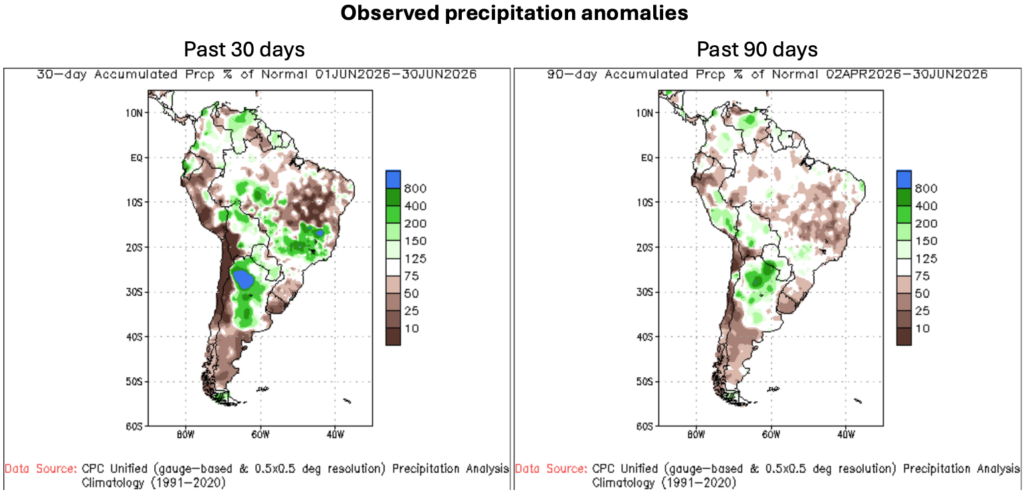
The latest soil moisture data from NASA shows largely dry soils, particularly across the interior regions of Brazil, although there are some localised wetter soils across east, south and west:
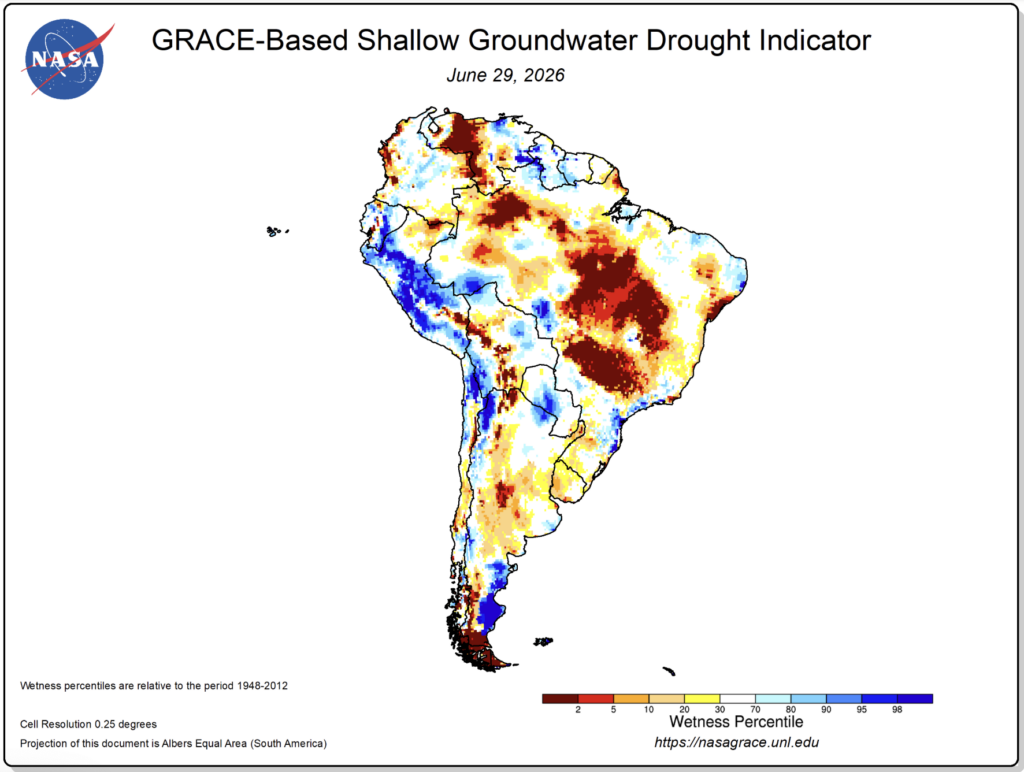
Now looking at the latest hydropower reservoir levels compared to our last update, levels have decreased across all regions, except for increasing for the southern subsystem.
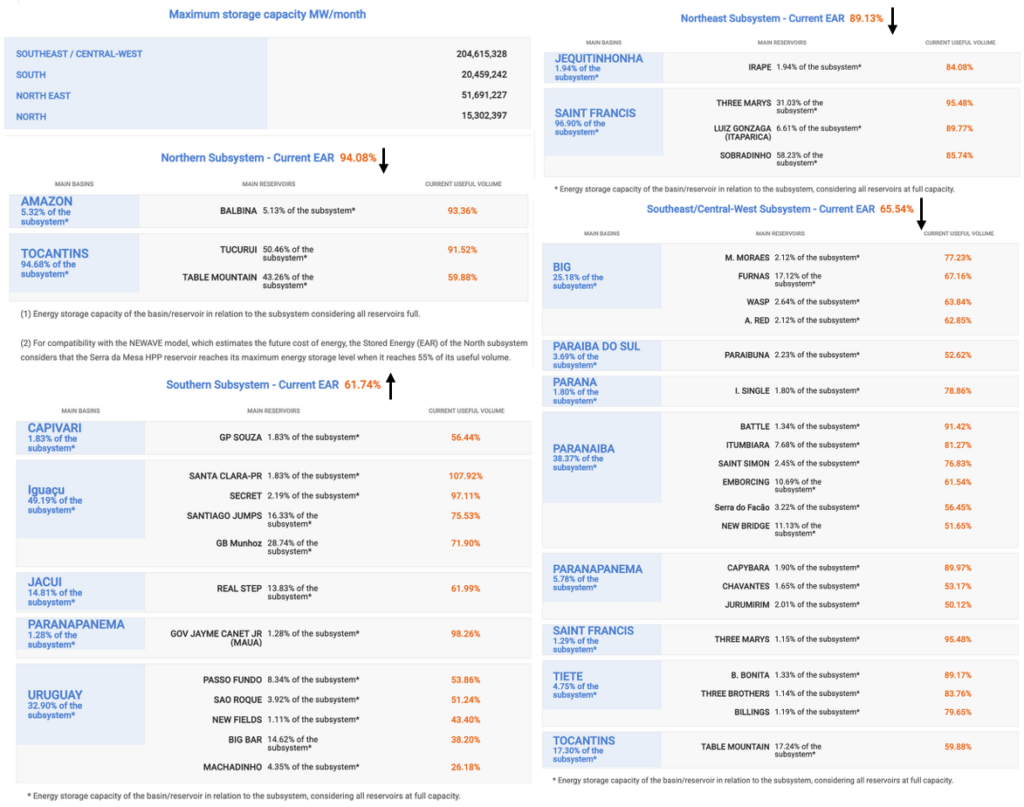
Now looking ahead to the forecast, the precipitation anomalies from the ECMWF and the GFS over the next 15 days are shown below. Generally a wetter outlook across much of Brazil, the exception being drier across the north-west and far south.
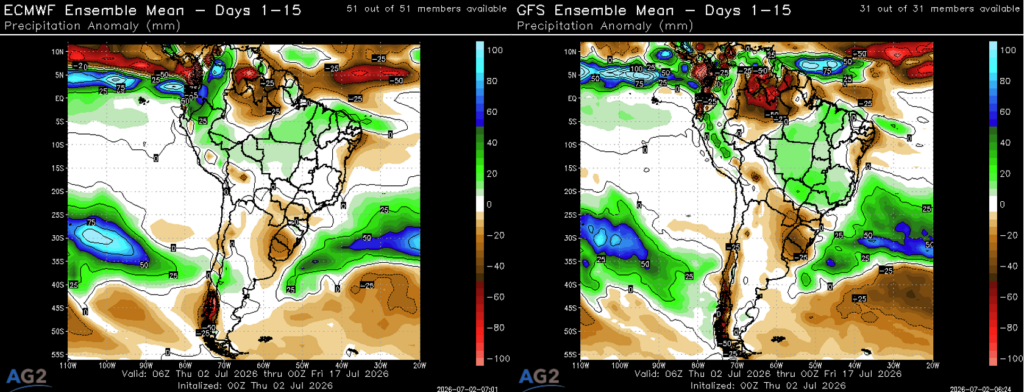
The latest ECMWF weekly for weeks 29 – 32 below shows a broad pattern of generally drier than normal conditions across the far north of Brazil, with wetter than normal conditions elsewhere.
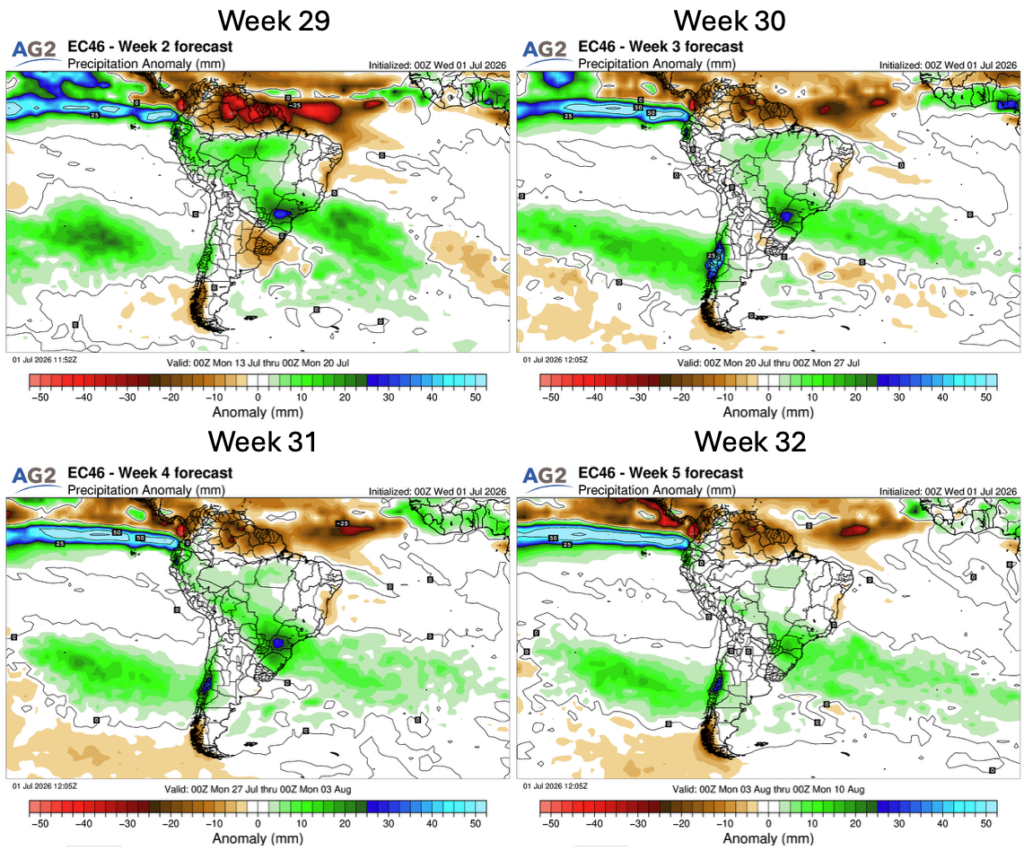
While the C3S seasonal guidance below shows a drier far north, wetter elsewhere pattern through the rest of summer, wettest to the far south. Then into autumn, generally drier than normal conditions across much of Brazil, with wetter conditions restricted to the far south.
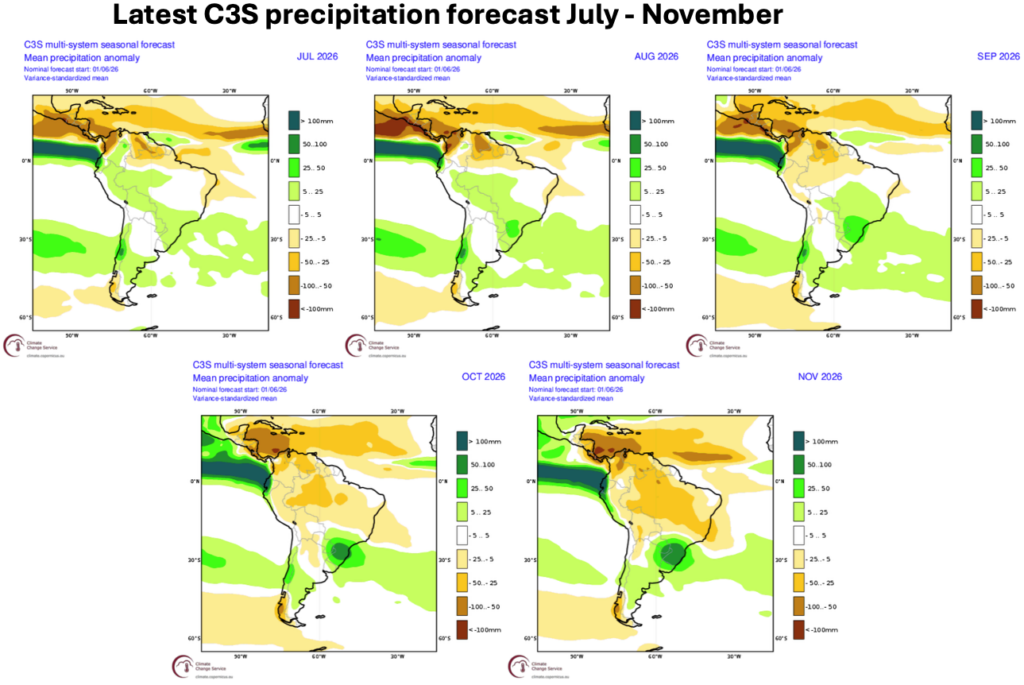
A historically strong El Nino is forecast as we move through the rest of the year. El Nino conditions through summer, generally favor a drier Caribbean and into far northern Brazil as shown in the lower graphic below, which is in agreement with the C3S forecast for summer. Then during El Nino winters, the drier conditions spread across much or northern to central Brazil, with wetter conditions to the far south, which is the broad pattern as per the C3S into autumn.
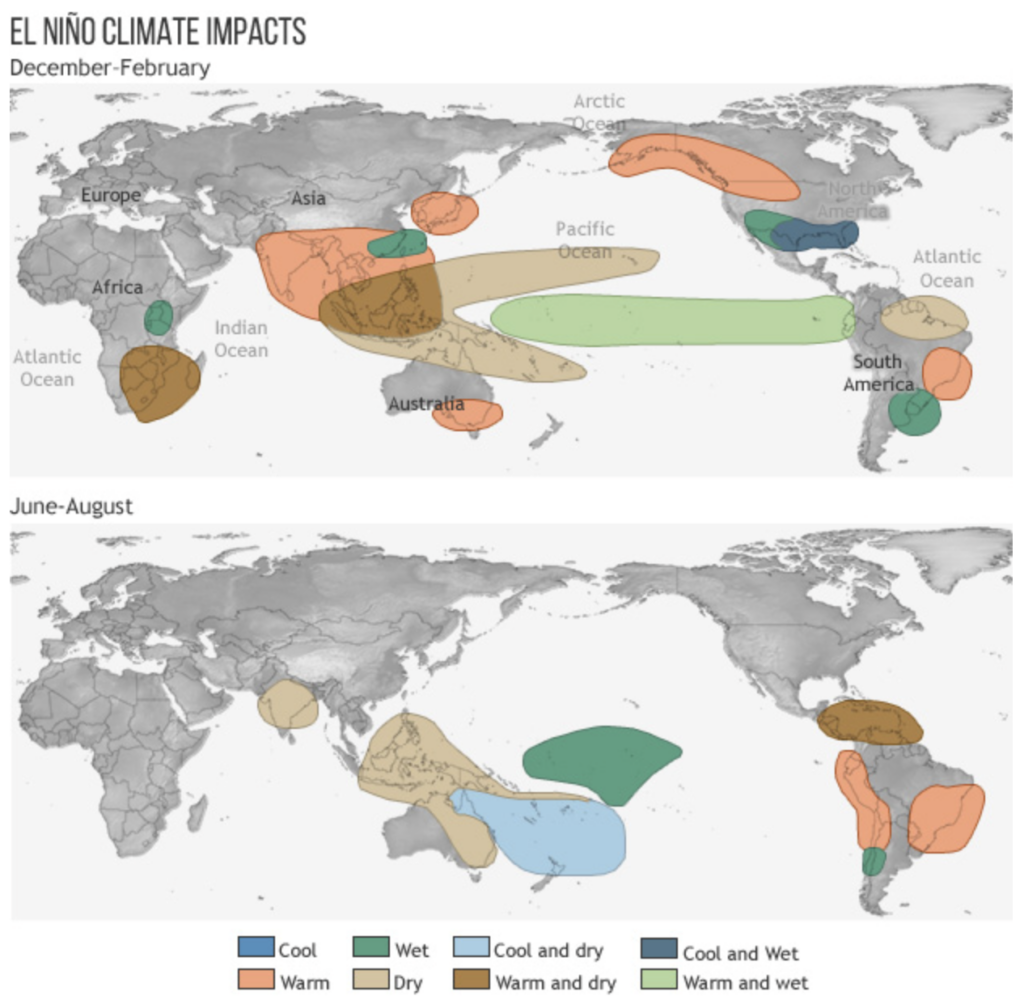
Bottom line: Over the past month reservoir levels across Brazil have decreased for many regions, the exception being an increase in levels across the south. The forecast through the rest of summer is generally for drier than normal conditions across the far north of Brazil, with wettest conditions to the far south – this pattern is typical for El Nino summer. Then moving into autumn, the latest C3S is forecasting generally drier than normal conditions across much of Brazil, with wetter than normal conditions to the far south – which is the broad pattern expected during El Nino winters. Therefore hydro power in Brazil could become limited as we move through the El Nino autumn and winter, thereby impact LNG imports.
Published by Andrew Pedrini
Well above normal temperatures are forecast to return to C-W Europe next week heading towards mid-month.
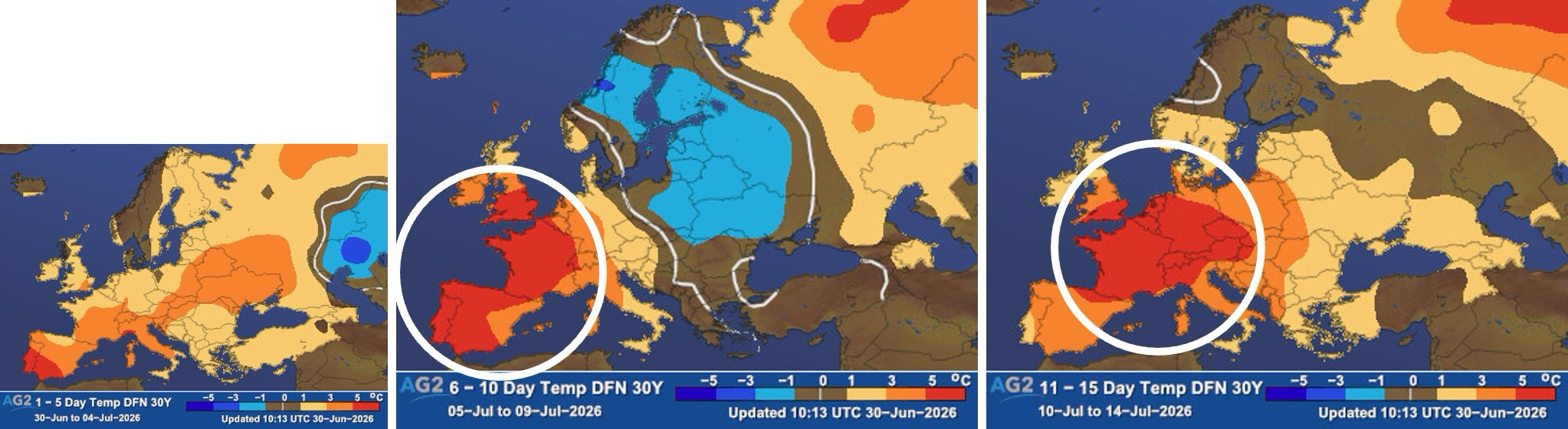
Highs in the order of 30C or above are projected for cities across the British Isles going into next week, while into the mid-30’s and nearing 40C in France and Germany. WE ARE ONCE AGAIN TALKING OF ANOMALIES vs 30-YEAR NORMAL OF AROUND 10C, IF NOT LOCALLY HIGHER!
UK
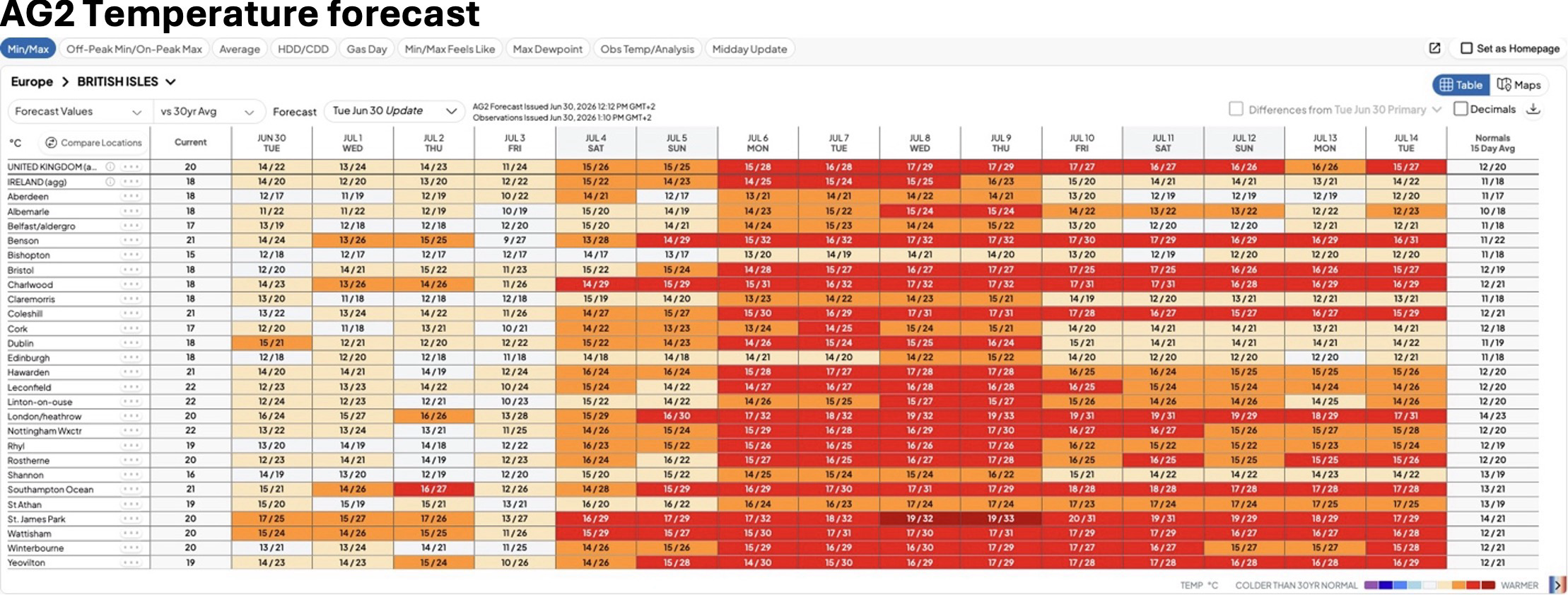
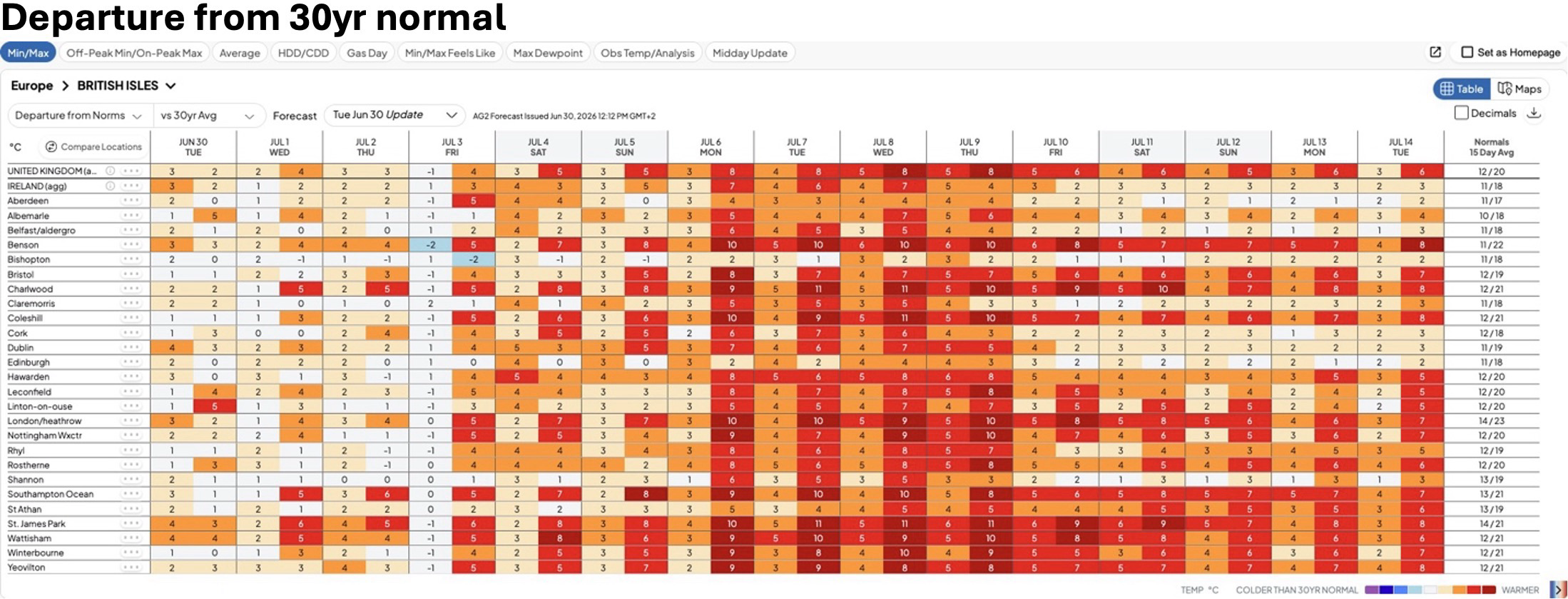
FRANCE

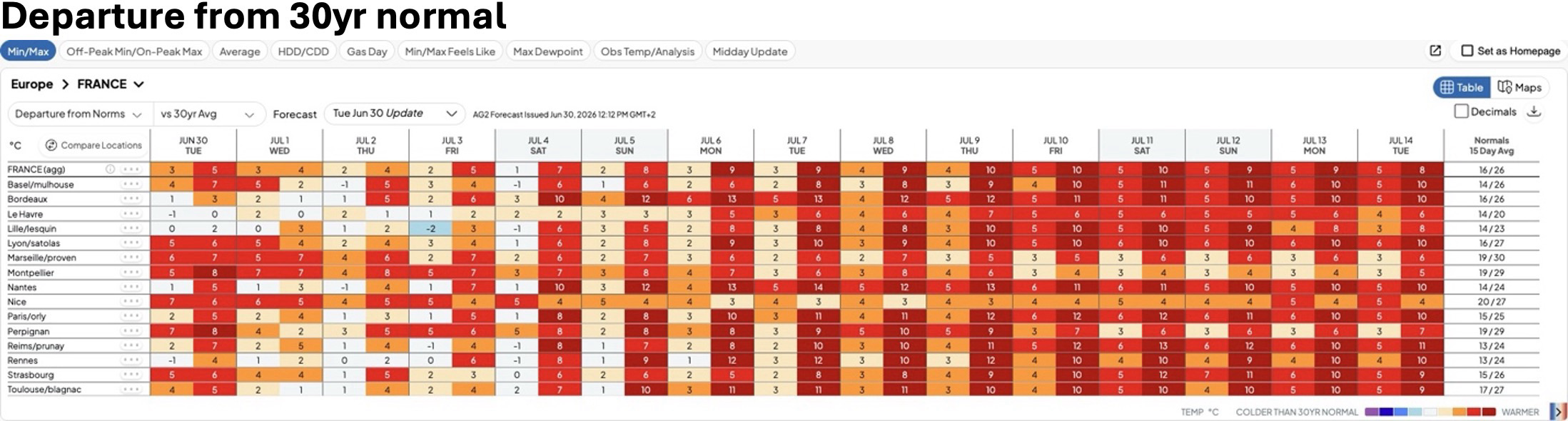
GERMANY
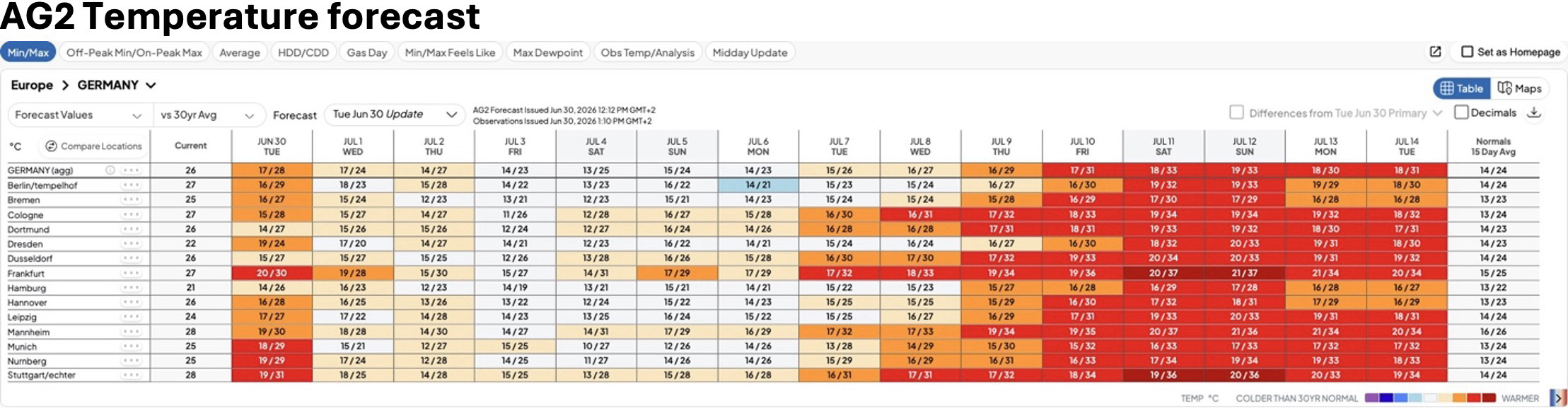
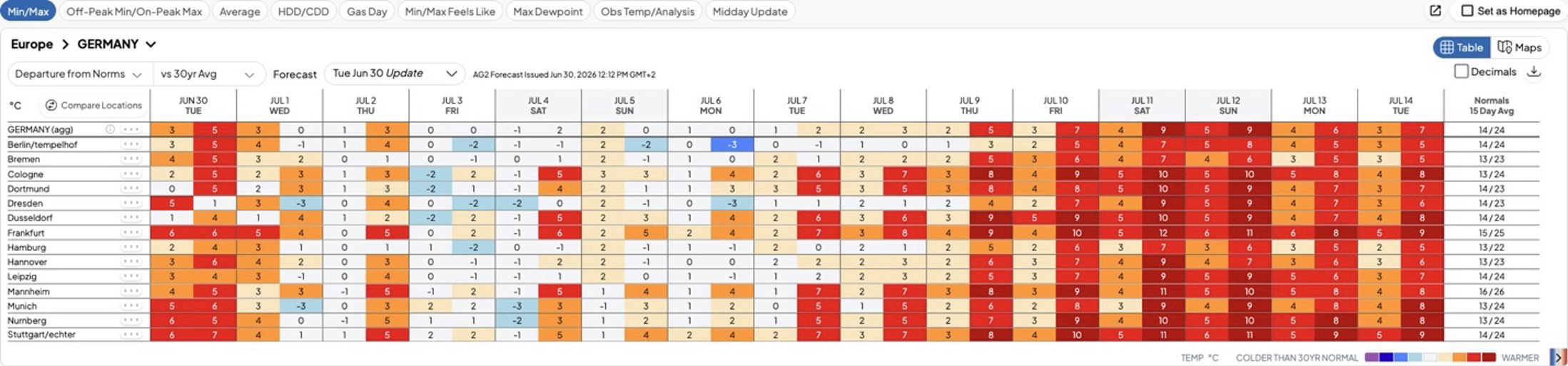
After swinging W’wards for a time this week, higher pressure is forecast to move back in from the W next week towards mid-July. While the preferred EC (and AIFS, not shown here) point to a stronger high returning into Europe, GFS resolves a weaker ridge and less extreme risks for C Europe.
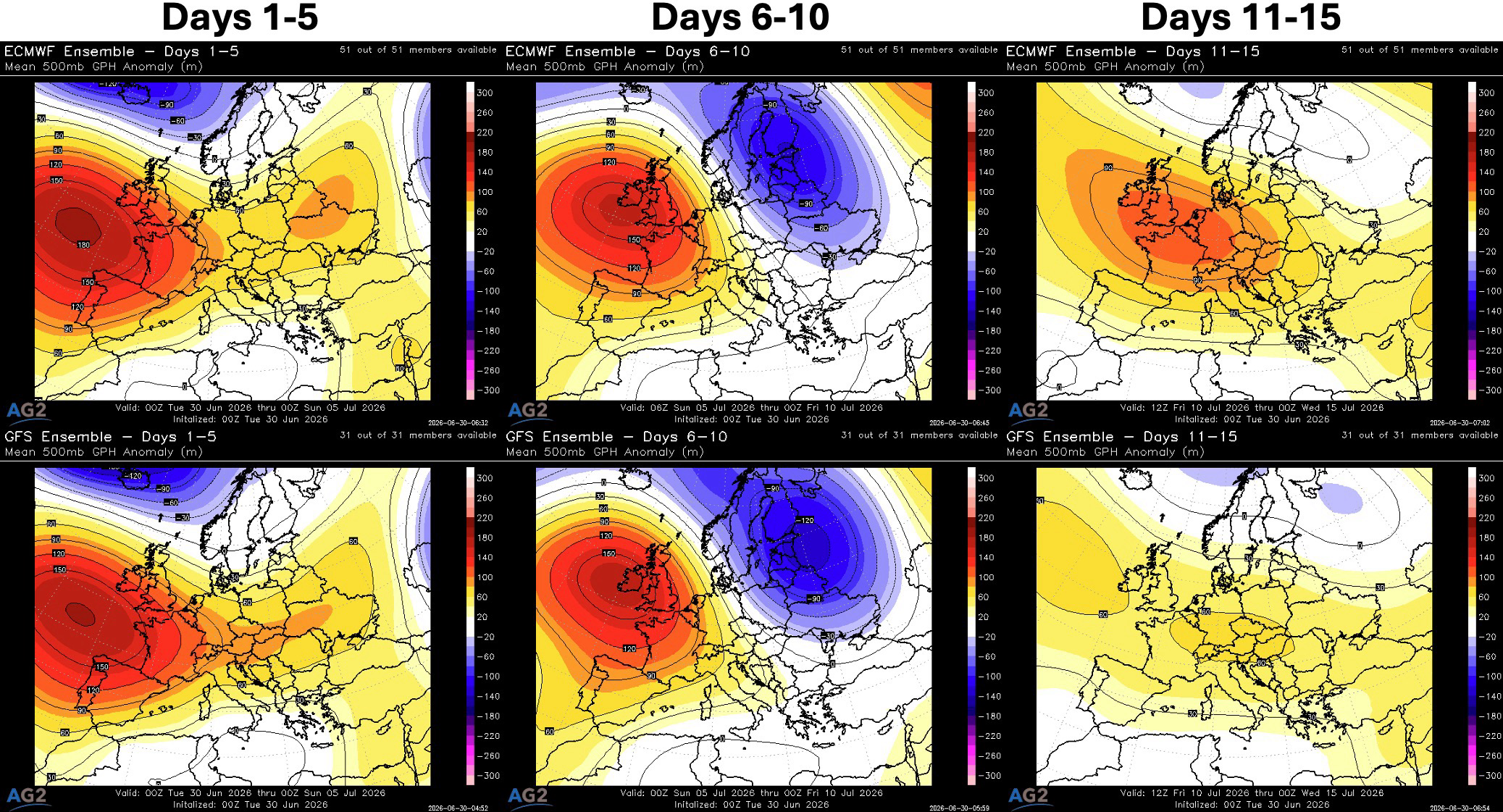
As per our population graphs below, there is overall good consistency in the warmer/hotter trend next week through C-W Europe, but confidence on the exact magnitude of the heat still being lower. ENS guidance tends to pose a less extreme risk to our AG2 forecast, especially GFS through C Europe in the longer range.
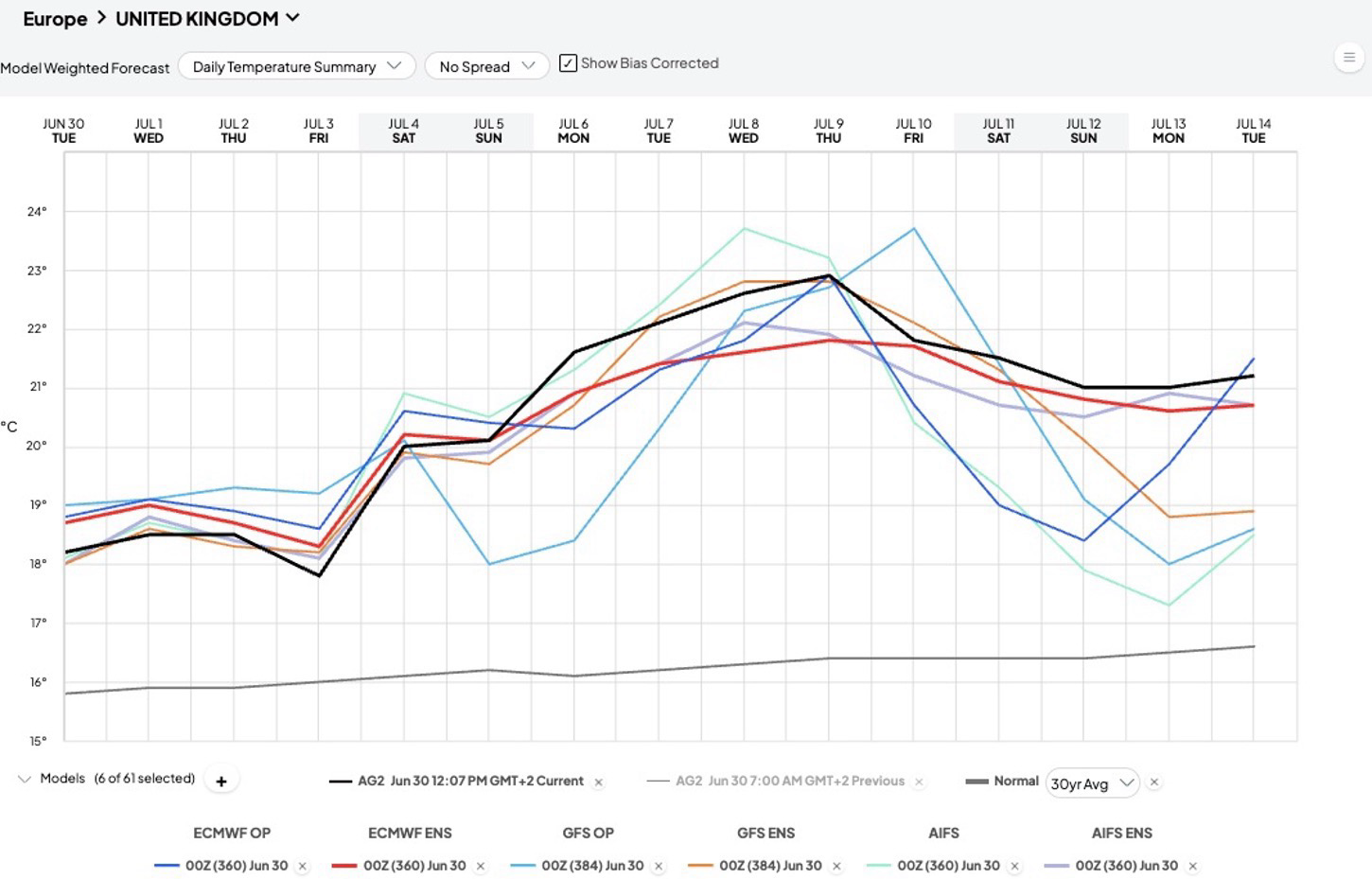
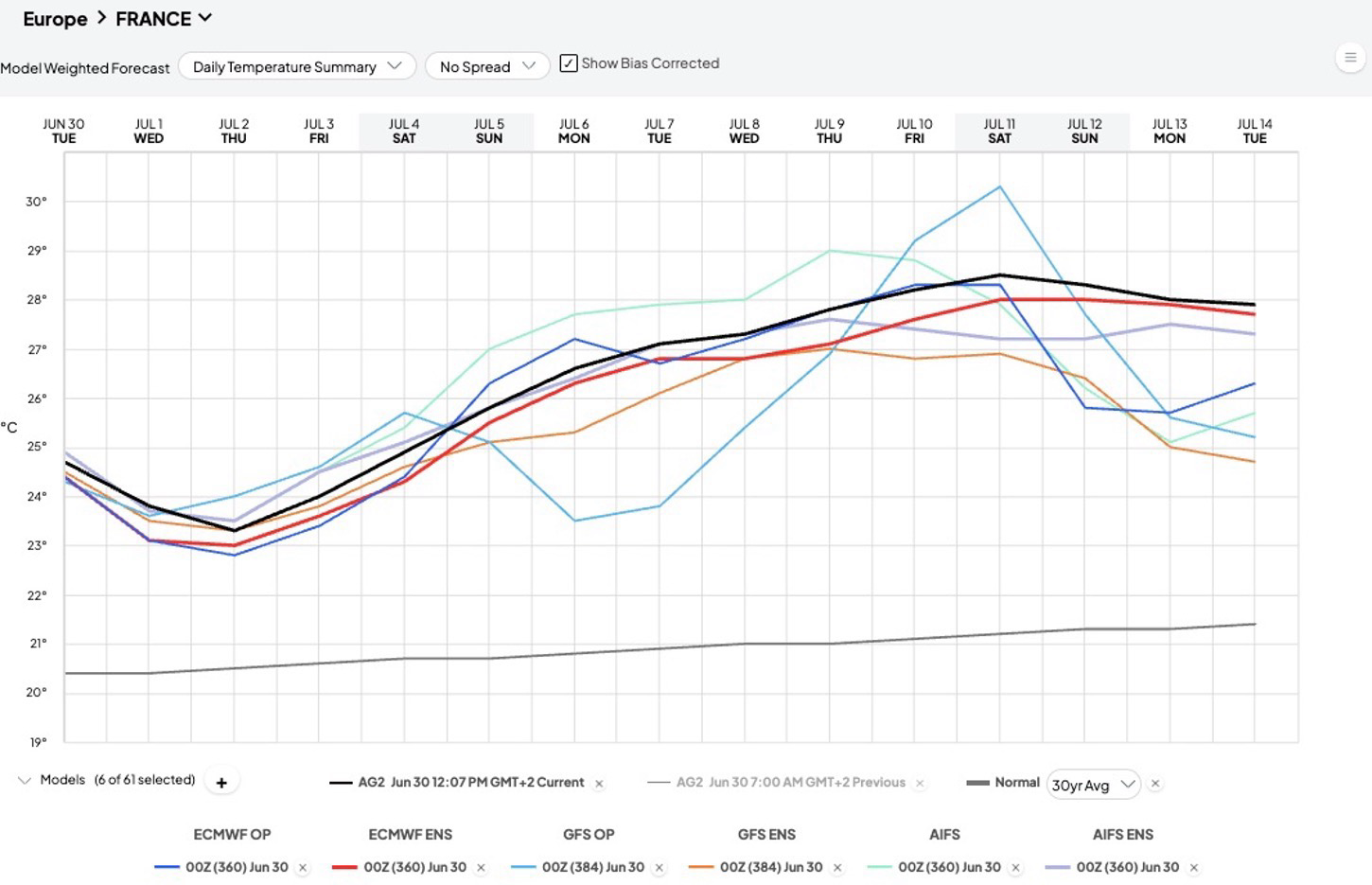
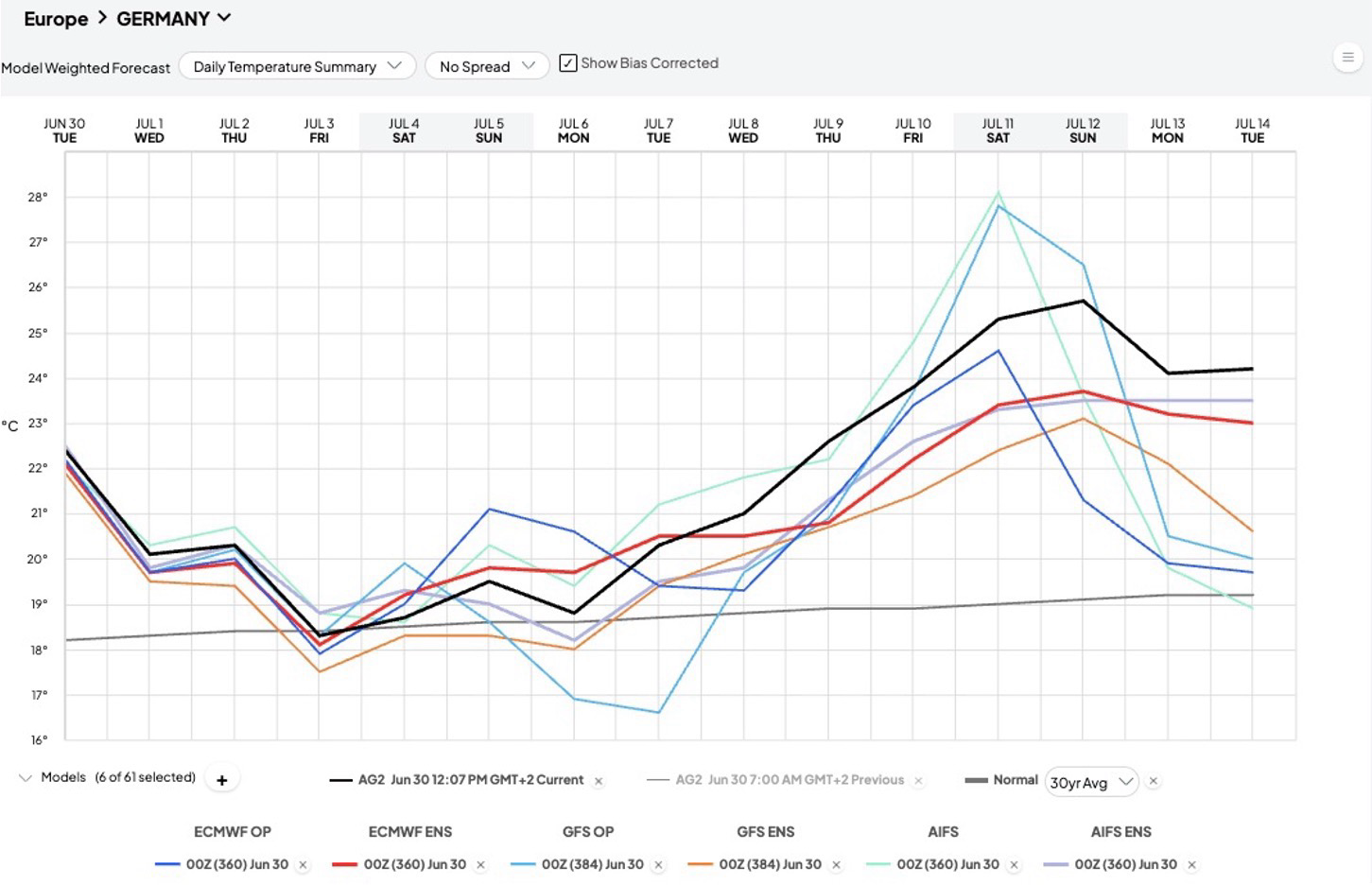
Bottom line: C-W Europe is facing a likely third heatwave of the season next week as higher pressure rebuilds from the W and pushes anomalous heat back into the heart of the continent toward mid-July. Highs are forecast to return to 30°C+ across the British Isles, while France and Germany could climb into the mid-30s to near 40°C, with departures once again around 10°C above 30-year normals, if not locally higher. Confidence is good on the broader warmer/hotter rebound, but lower on the exact magnitude of the heat, with EC/AIFS favoring a stronger and more extreme ridge while GFS offers a less intense risk later in the period at this time.
Published by Amy Hodgson
As Europe is under another extreme heatwave event, here we take a look at how these extremely high temperatures can actually reduce solar panel efficiency.
A counterintuitive but well-established phenomenon is that solar panels actually perform worse during heatwaves despite the abundant sunshine. More sun doesn’t necessarily mean higher solar output as the limiting factor here is the panel temperature.

Why?
Solar panels are semiconductor devices, and like all semiconductors, their efficiency degrades are temperature rises. For most modern silicon panels they lose approximately 0.3 to 0.5% per 1 degree C above 25 DegC. The relevant metric is the temperatures coefficient of power.
Panels absorb a broad spectrum of solar radiation, much of which converts to heat rather than electricity. Dark panel surfaces in full sun with no wind to cool them can run 20–35°C above ambient air temperature. During a heatwave, calm anticyclonic conditions, the same high pressure driving the heat, mean low wind speeds, so convective cooling of the panel surface is minimal. The effect is self-reinforcing: the clearer skies that maximise irradiance are the same conditions that maximise overheating.
A panel sitting in 40°C ambient air during a heatwave can reach a surface temperature of 65–75°C, meaning it may be operating 40–50°C above its rated condition — translating to a power output penalty of around 15–20% relative to its advertised capacity. So a panel that could produce 100 MW under standard conditions may only deliver ~84 MW despite bright sunshine.
The irradiance offset
Heatwaves do bring exceptionally high solar irradiance, which partially compensates for the efficiency loss. A cloudless heatwave day might deliver 10–15% more irradiance than a typical summer day, so the net effect on output is often roughly neutral or modestly positive compared to an average summer day — but substantially below what the same irradiance would produce in cooler conditions. The panel is effectively wasting some of the additional sunshine as heat.
Net effect
In most European heatwaves solar generation is still above average because sunshine is abundant. But output is lower than it would be under cooler sunny conditions. During a major heatwave in Germany for example, if the air temperatures is 35-40C, panel temperatures would likely reach 60-70C meaning an efficiency reduction of 10-18%. Yet solar production often remains near seasonal maxima because cloud cover is minimal and daylight is long.
Energy market implication
During a heatwave this matters for power markets because:
Solar: very high output, but below theoretical maximum
Wind: often suppressed under heat domes
Demand: rises sharply from cooling load
This can create strong midday solar production, steep evening ramps and higher power-price volatility.
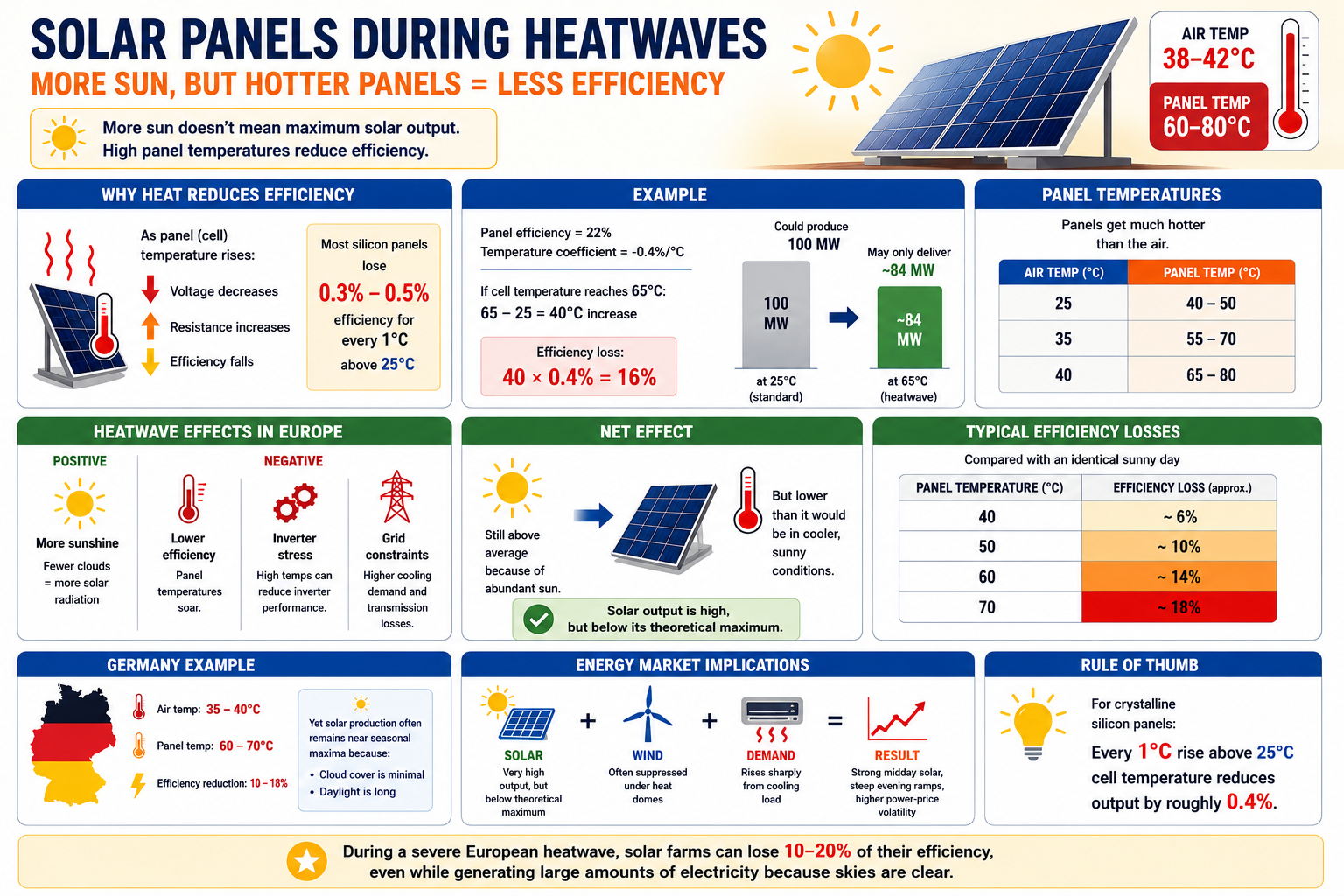
Published by Ed Vallee
This blog takes an updated look at the developing El Nino into Summer and Fall of 2026 through the lens of the newly released IRI seasonal model…
To start, we can see the most recent region 3.4 value in the equatorial Pacific is up to 1.41°C (Nino threshold is 0.50°C). This indicates El Nino is rapidly coming on and we appear to be moving toward a moderate to strong El Nino for later 2026.
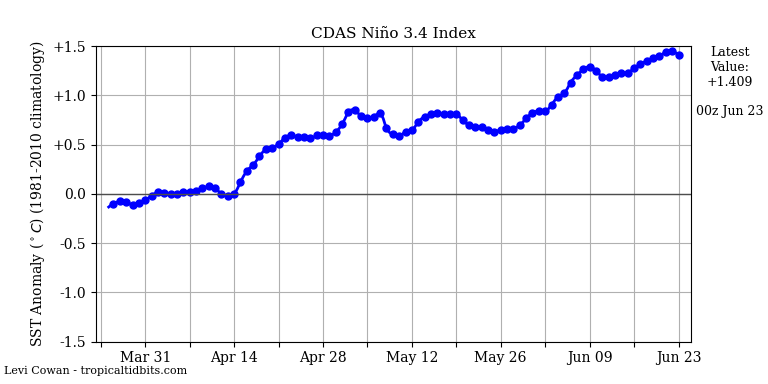
Looking basin-wide as of June 20, we can see all of the equatorial Pacific is warmer than the 1981-2010 normal now, actually…
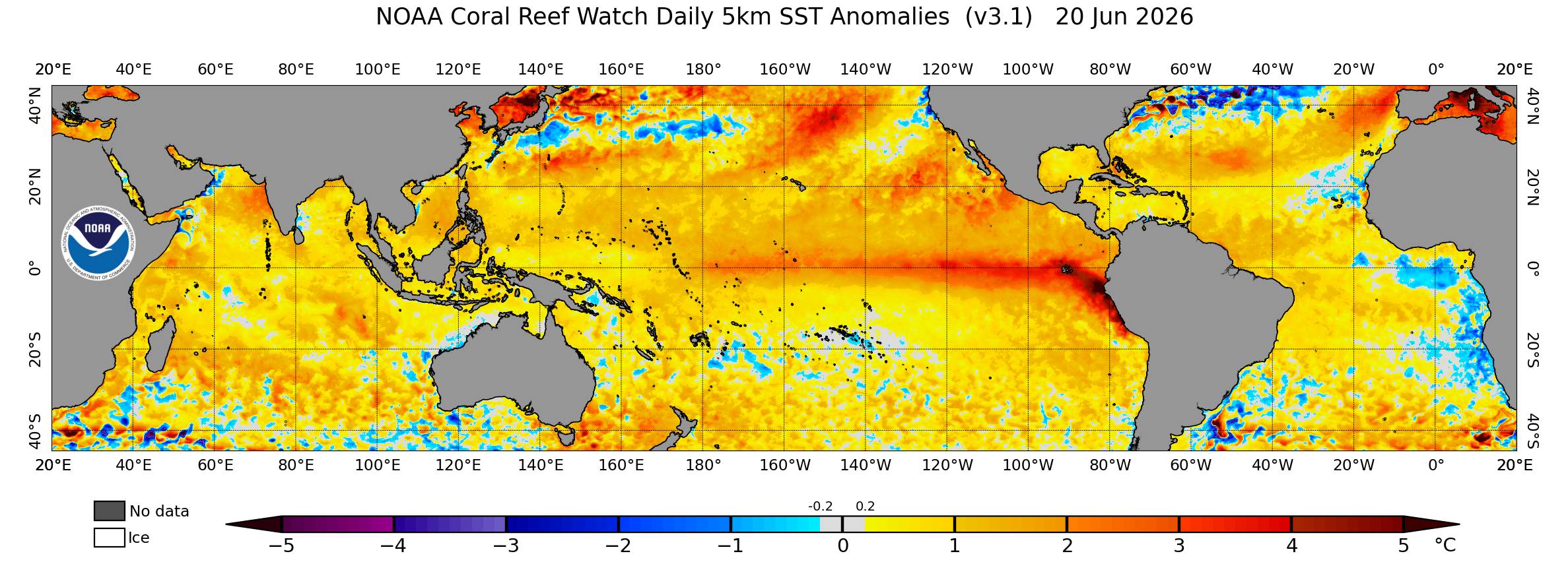
The newest IRI forecast, which plots all seasonal ENSO models, was released yesterday. Model consensus favors a moderate to perhaps a strong El Nino, peaking this Fall at +2.6°C. There are quite a few models stronger, closer to +3°C.
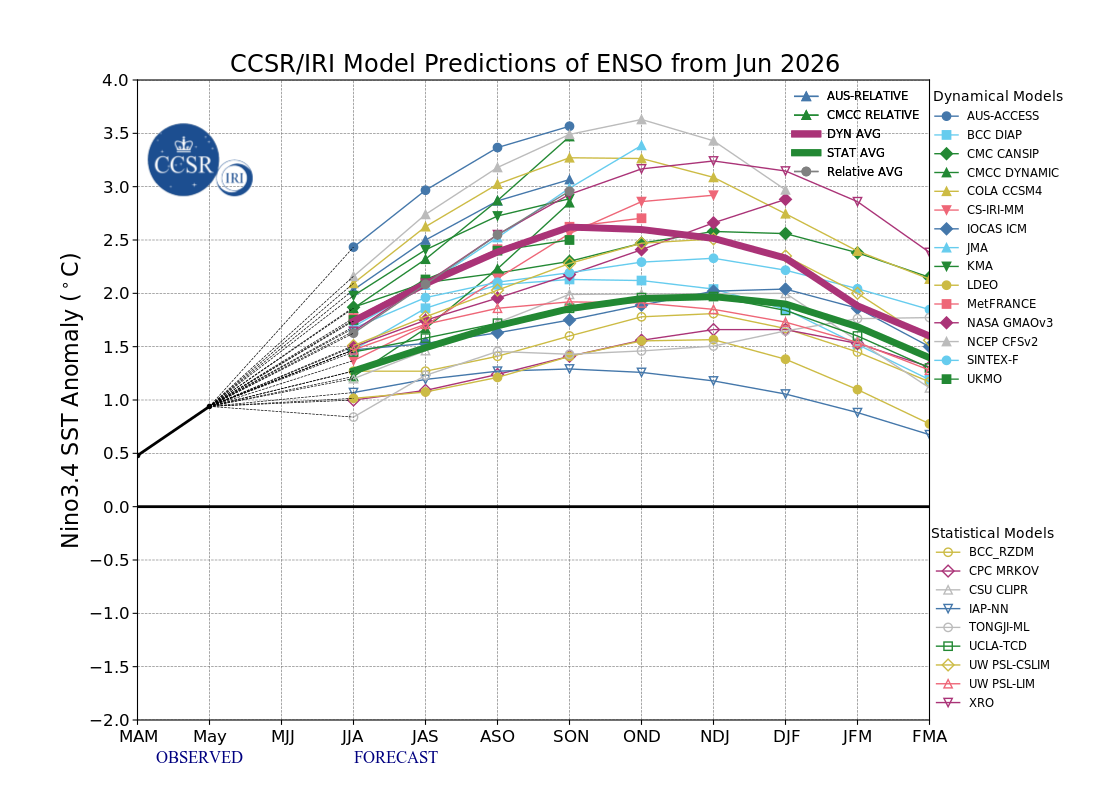
A strong El Nino is becoming likely through the balance of 2026, rivaling the strongest events on record from 1997-1998 and 2015-2016. Keep tabs on this development via our seasonal reports, issued twice monthly for North America, Europe, and Asia.
Published by Takahisa Nishikawa
Summary: Two named tropical cyclones — MEKKALA and HIGOS — are simultaneously active in the western Pacific, with MEKKALA approaching the Nansei Islands on the 25th–26th and HIGOS forecast near Kanto on the morning of the 27th.
The main scenario is a southern coast passage for both systems; a Japan landfall scenario is flagged as sub-scenario at medium confidence, supported by some ECMWF, GFS, and AIFS solutions.
The more immediate market risk is Baiu front enhancement: both systems are supplying abundant moisture to the front, driving above-normal precipitation and suppressed solar irradiance across western and eastern Japan over the next five days.
The western Pacific is currently in an exceptionally active state, with two named tropical cyclones now in existence. MEKKALA and HIGOS — the latter newly named by both the JTWC and JMA — are tracking simultaneously toward the Japan region.
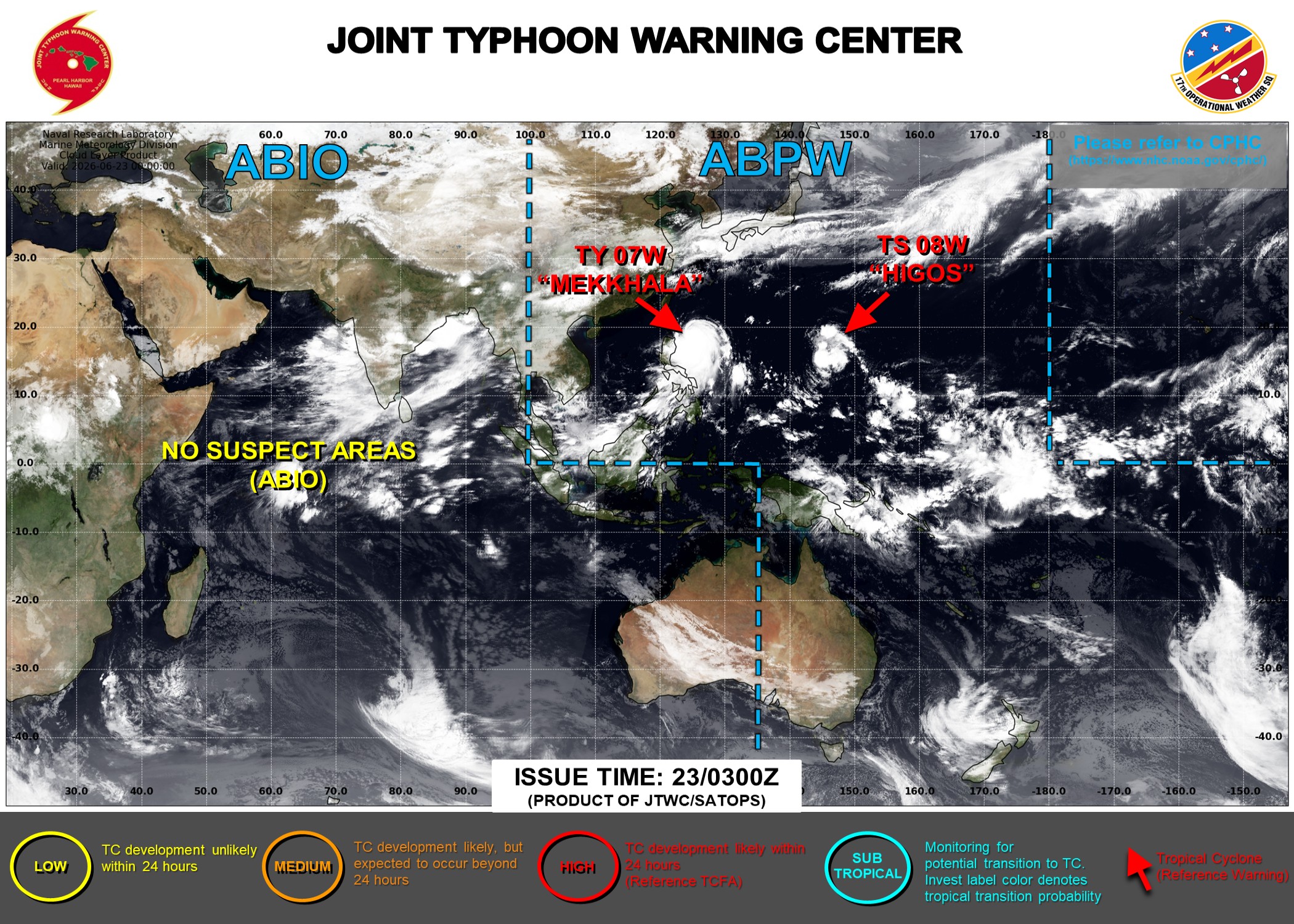
MEKKALA is located east of the Philippines and is expected to gradually weaken. It is forecast to approach the Nansei Islands between the 25th and 26th, raising the risk of heavy rainfall, strong winds, and high seas. The system is then expected to track along Japan’s southern coast.
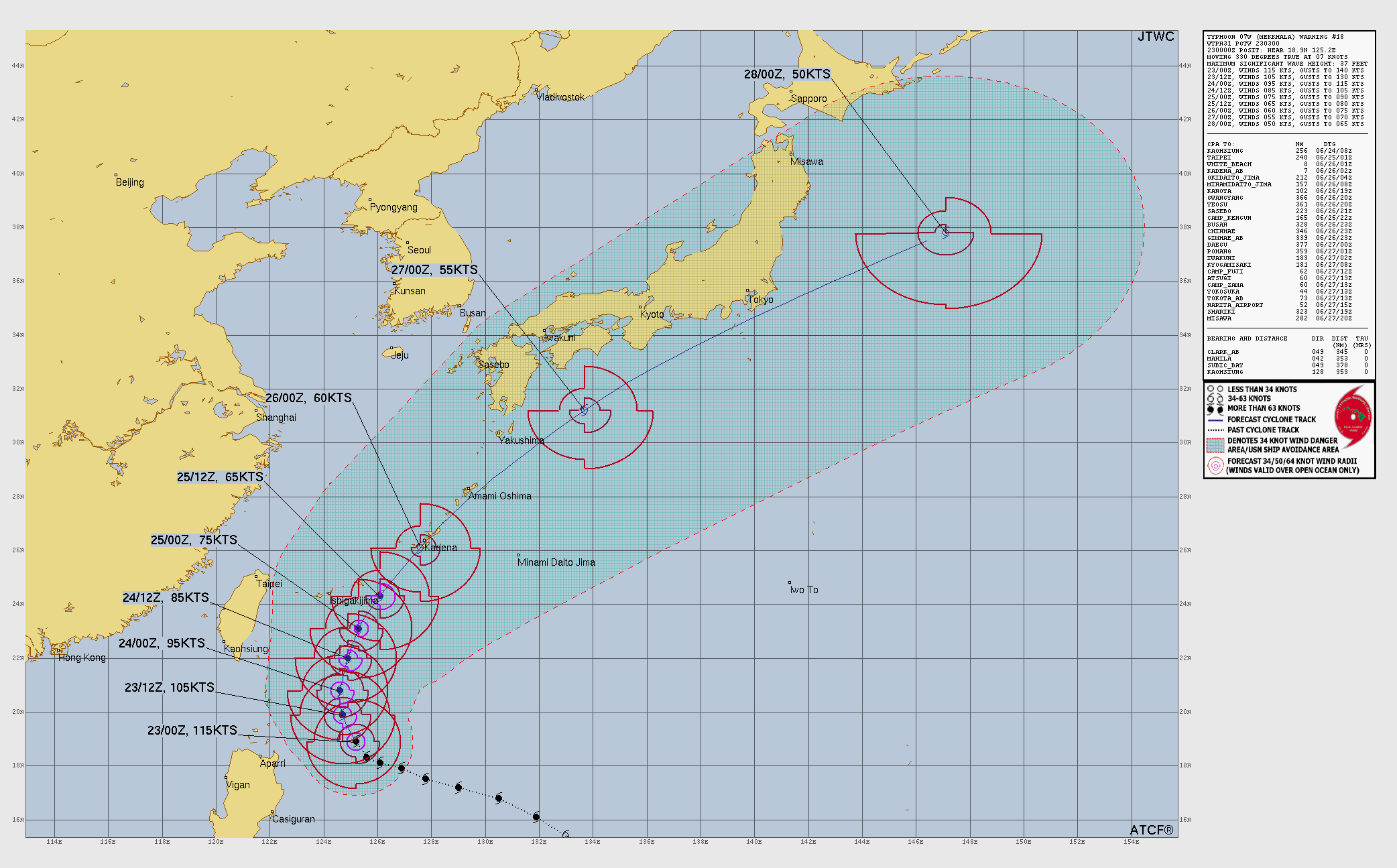
HIGOS is near the Mariana Islands, tracking around the periphery of the Pacific High. While no significant intensification is forecast, the system is expected to approach the Kanto region around the morning of the 27th. At this stage, neither system is forecast to make landfall in Japan.
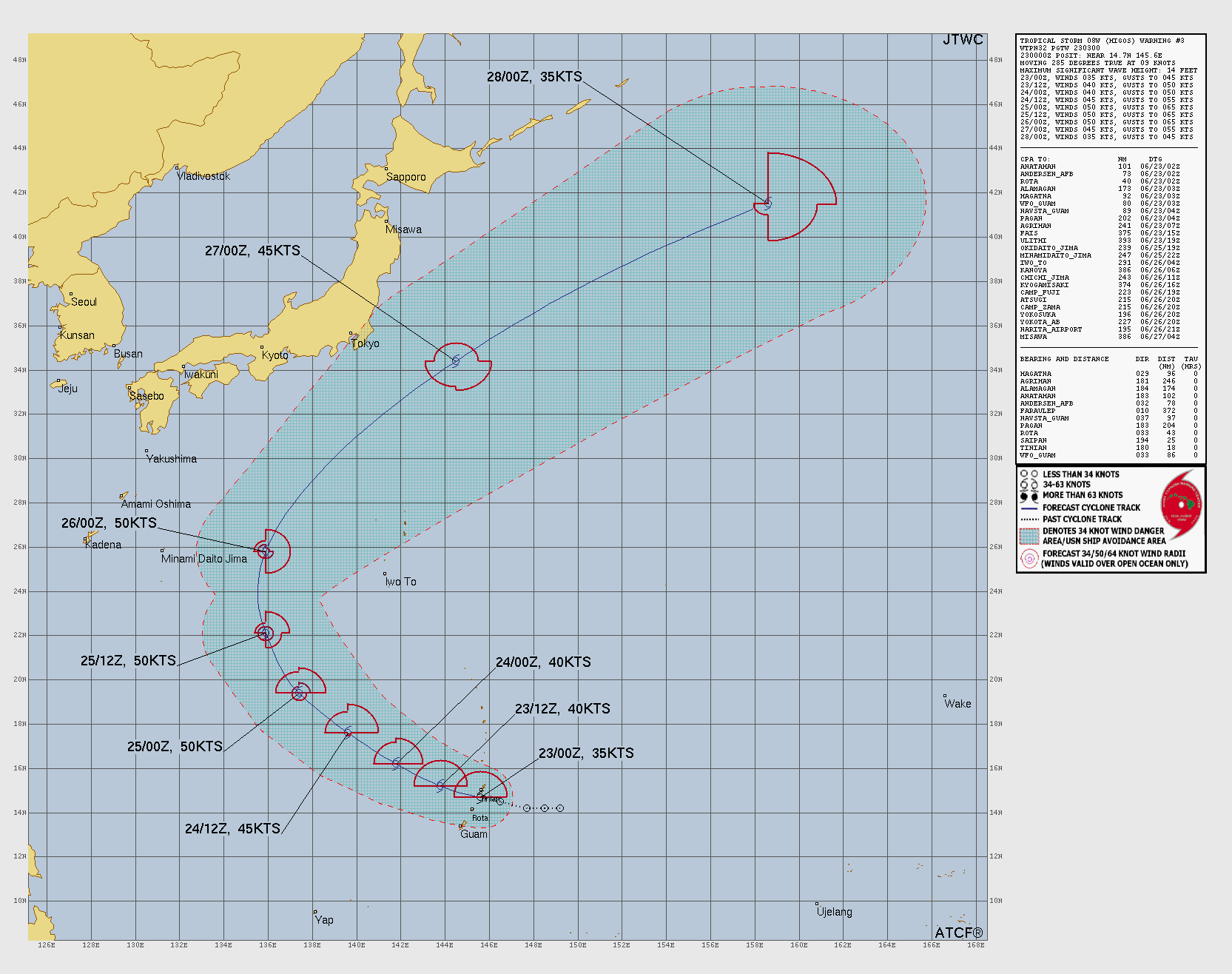
Google DeepMind model guidance broadly aligns with the JTWC track. However, ECMWF, GFS deterministic, and AIFS model runs show landfall scenarios for Japan in some solutions.
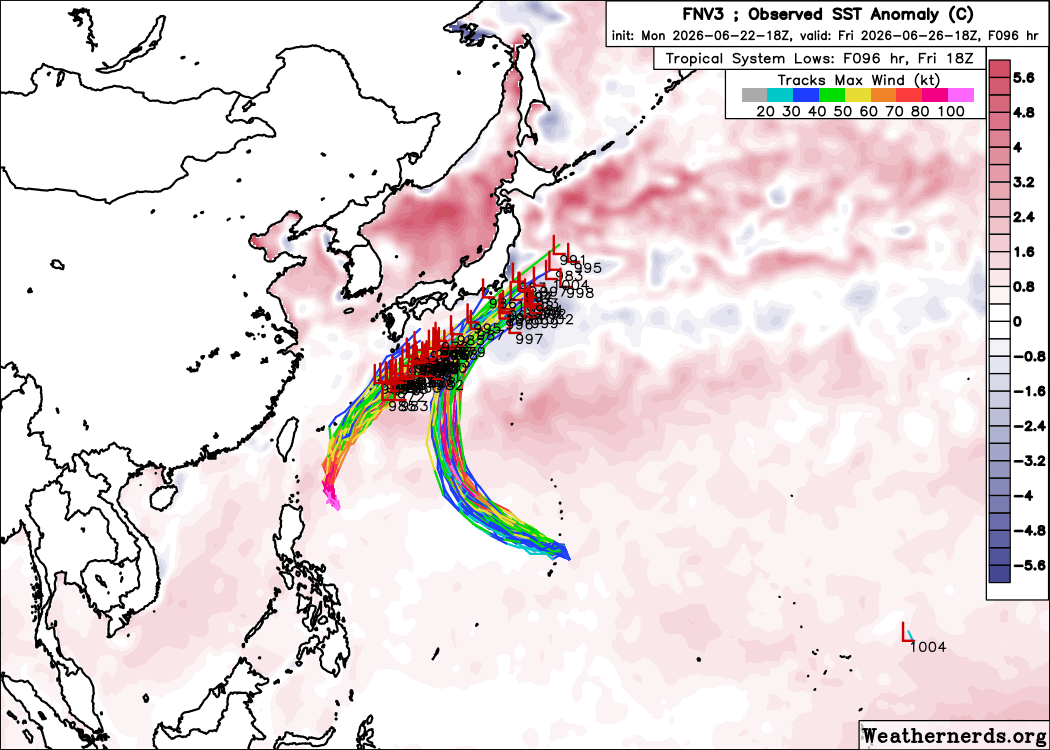
The overall assessment places a southern coast passage as the main scenario and a Japan landfall as the sub-scenario, with medium confidence on the five-day track for both systems.
Current northwestern Pacific SSTs show waters above 27°C — the general threshold for tropical cyclone maintenance — limited to south of 25°N, with SSTs along Japan’s southern coast running below normal. This environment is increasingly unfavorable for intensification as both systems approach Japan.
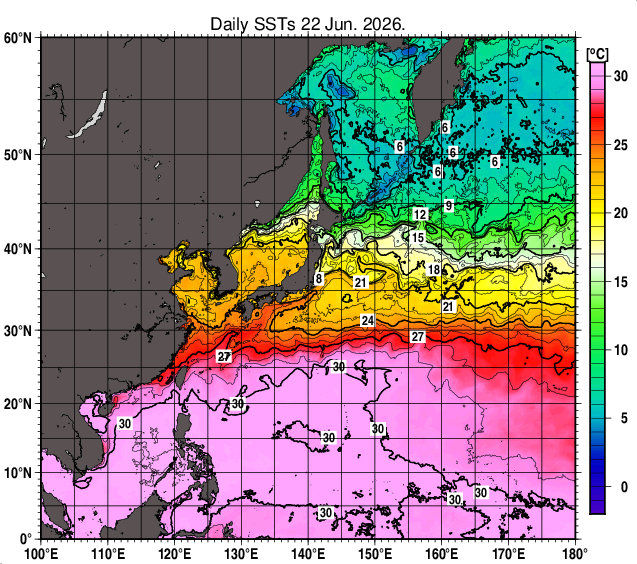
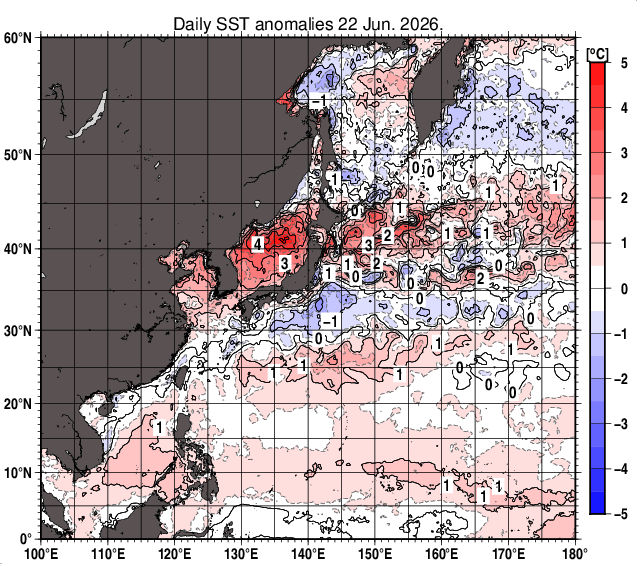
However, the risk that deserves closest attention is not simply the tropical cyclones themselves, but the enhancement of precipitation along the Baiu front extending across the Japanese archipelago. Both systems are currently supplying abundant moisture to the front, creating a period highly conducive to increased rainfall. AG2’s own forecasts project above-normal precipitation along the Pacific coast of western and eastern Japan over the next five days.
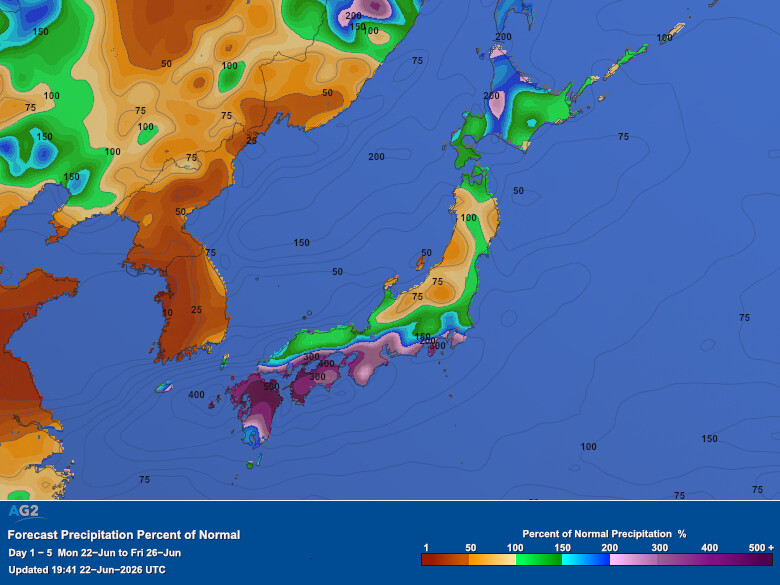
Increased cloud cover will suppress temperatures, but solar irradiance will also fall well below normal. Western and eastern Japan therefore face a compound risk: tropical cyclone landfall, Baiu front activation and heavy rainfall, and suppressed solar generation — all of which require simultaneous monitoring.
Published by Amy Hodgson
Here we take a look at the outlook across Europe today (Friday 19th June) and through the weekend using the high resolution GRAF model.
Firstly the pressure pattern and precipitation forecast below. High pressure will dominate widely across the continent today and through the weekend, with very limited precipitation around. Today, a weak frontal system will bring some rain across north-western regions of the British Isles. There will also be some scattered showers across the Alps, with isolated showers across Iberia, northern France to Germany. Then through Saturday and Sunday, some isolated showers are forecast across parts of central and eastern Europe, and also Iberia, but it will remain dry across the majority of Europe.

Now onto winds, with high pressure dominating, calm conditions with mostly low winds are forecast across the continent. Moderate wind power potential is forecast across the British Isles today, with moderate to high potential for Sweden front weekend, otherwise elsewhere low potential.
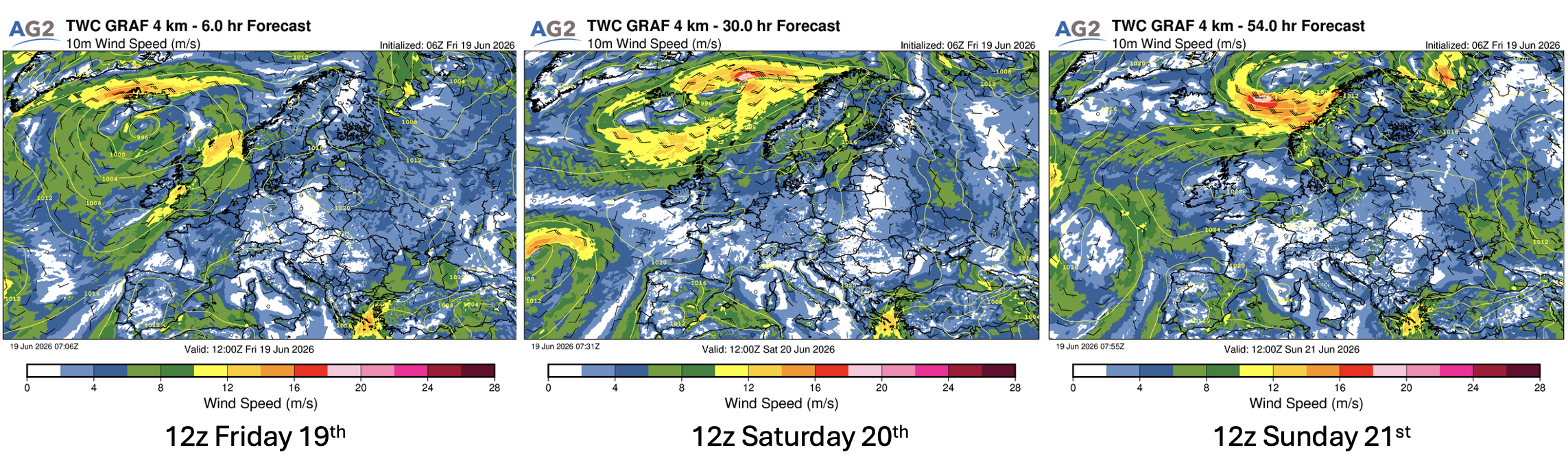
For solar, with many clear sunny skies, solar irradiance will be high for most of Europe.
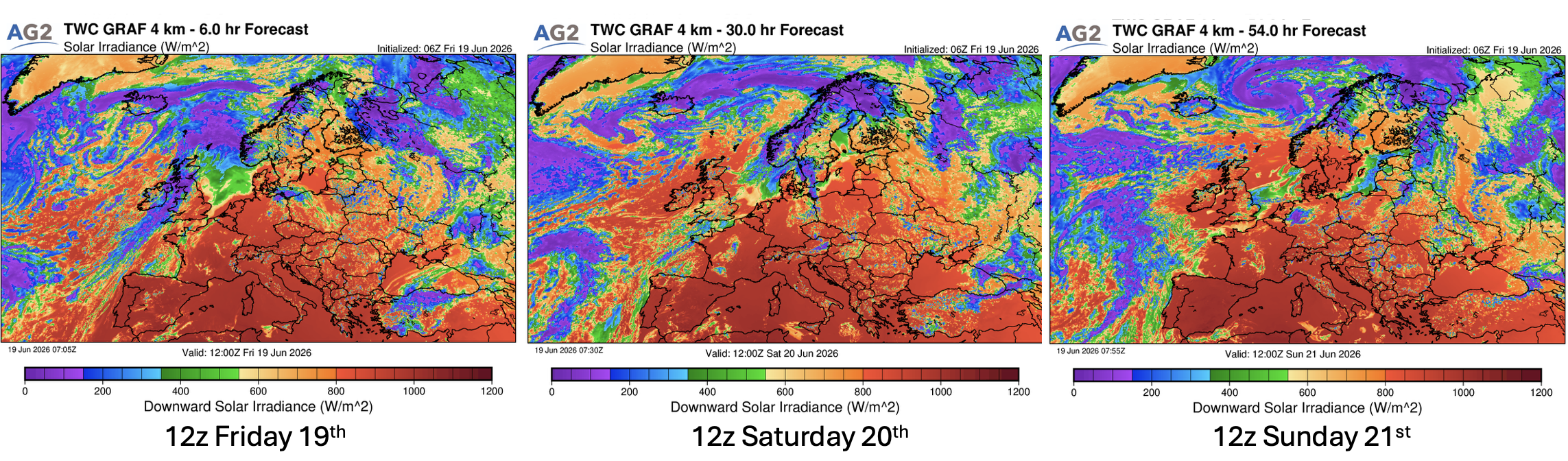
Finally, regarding temperatures, well above normal temperatures are forecast across western-central Europe. The latest AG2 forecast daily maximum temperatures are shown below. French temperatures for example are forecast to reach well into the 30s DegC, potentially reaching into the low 40s across the south-west by Sunday. These high temperatures present a downside risk to solar power potential as solar panels lose efficiency at high temperatures.
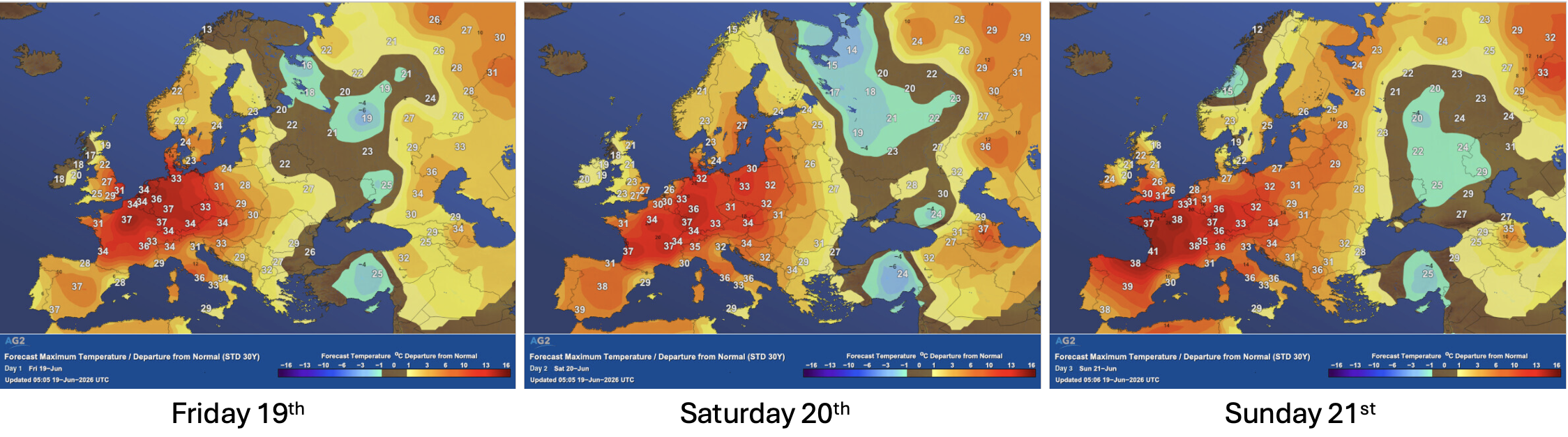
Bottom line: With high pressure in charge for most of Europe today and through front weekend, a dry, sunny and low wind outlook is forecast for the majority. The exception will be some wetter and slightly windier conditions across the north-west of the British today, and then some windier conditions are forecast across Sweden through front weekend. While there will be some isolated showers and thunderstorms across central and eastern Europe.
Published by Takahisa Nishikawa
Summary: A tropical disturbance near Guam is being monitored by the JTWC, with multi-model guidance suggesting tropical storm development and a possible landfall along Japan’s Pacific coast from Kyushu through Kanto on the 26th–27th.
Track, timing, and intensity at landfall remain highly uncertain, with typhoon-category landfall appearing unlikely at this stage.
From around the 23rd, the approaching system is likely to energize the Baiu front, raising precipitation risk across a broad area of Japan ahead of any potential landfall.
The JTWC is currently monitoring a tropical disturbance located approximately 500 NM east-southeast of Guam, with a medium probability of tropical cyclone development within 24 hours. ECMWF and GFS deterministic models are both tracking this signal.
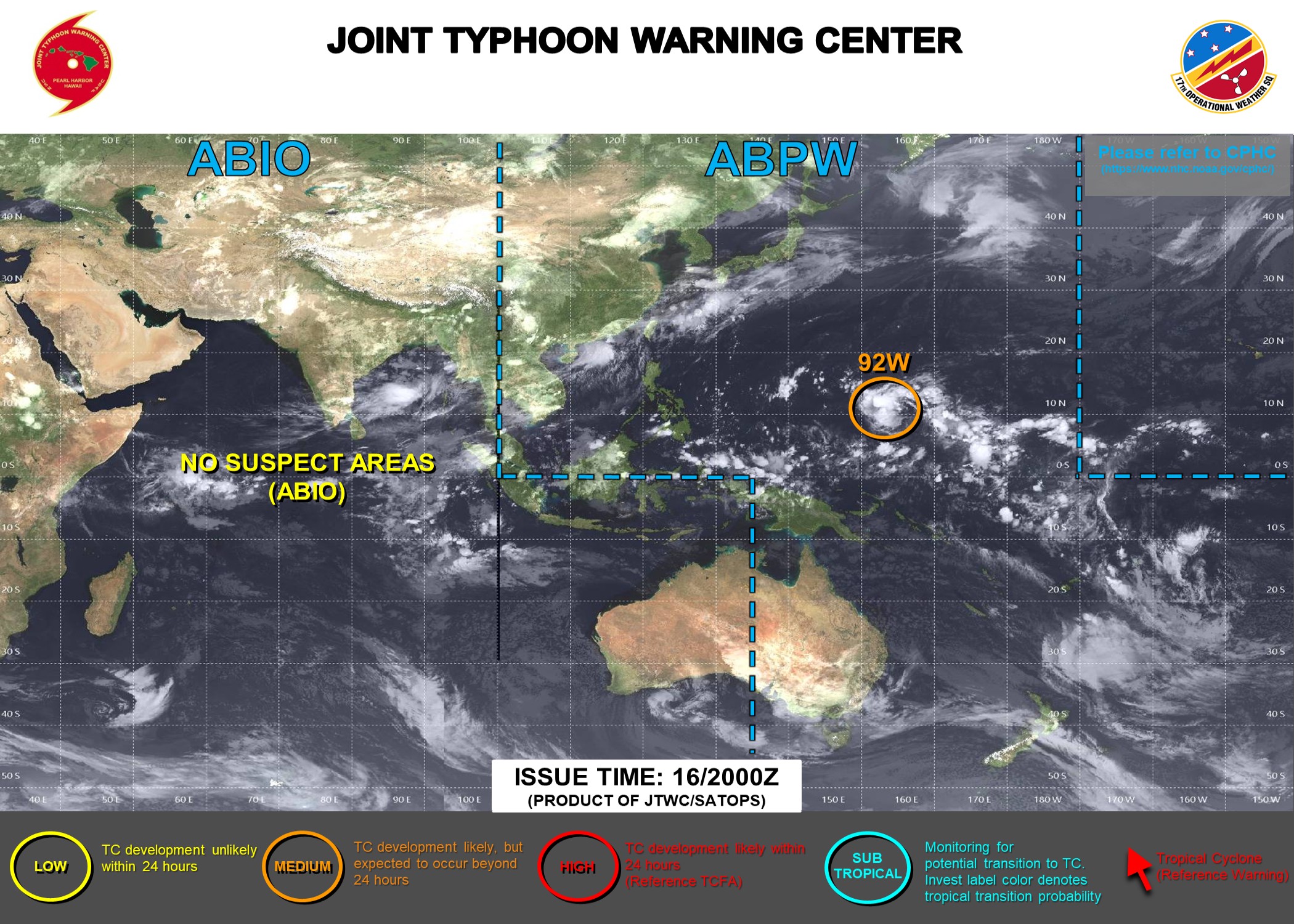
The latest ECMWF and GFS tropical risk maps suggest that a tropical storm could develop and track toward Japan within the next two weeks. At this stage, landfall as a typhoon with maximum sustained winds of 64 knots or above appears unlikely.
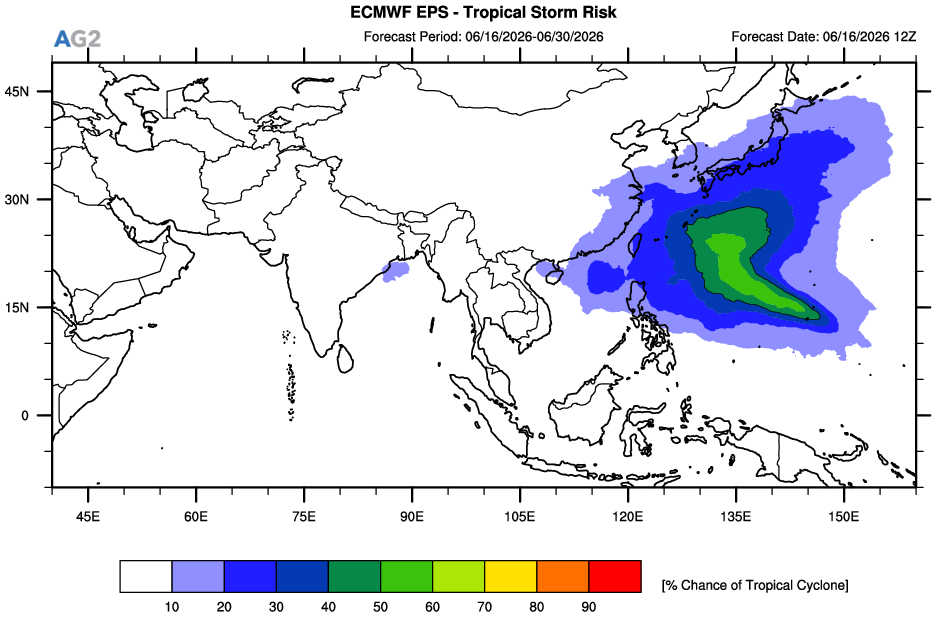
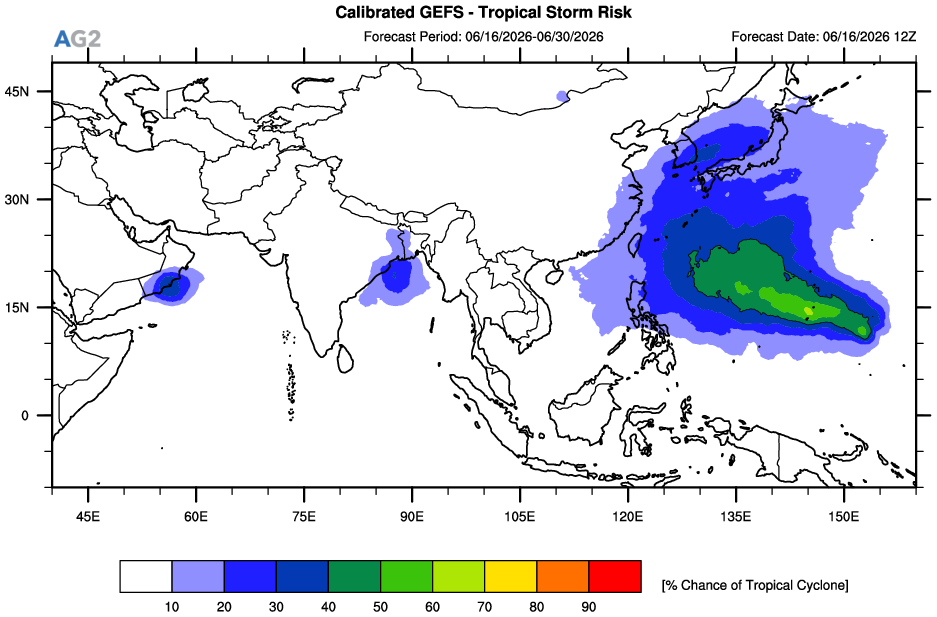
Current sea surface temperatures across the northwestern Pacific show waters near 27°C — the threshold generally associated with tropical cyclone development and maintenance — extending northward to around 25°N, providing a conducive environment for intensification.
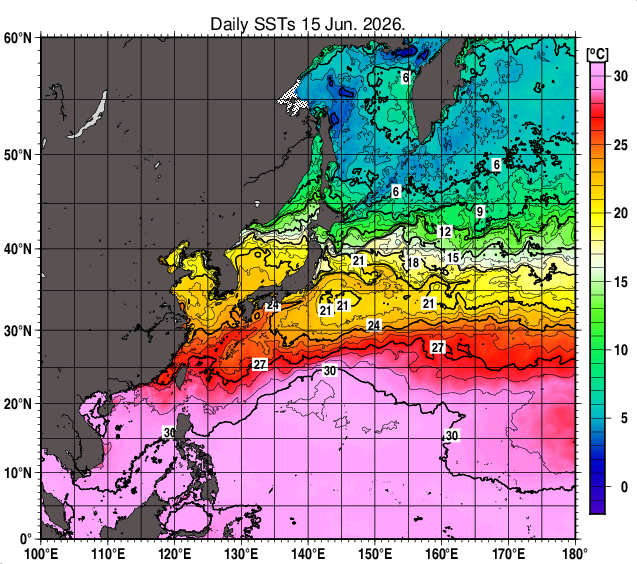
Looking across ECMWF Op, AIFS, GFS Op, and GFS ENS model guidance, all models except GFS ENS suggest the possibility of landfall along the Pacific coast of Japan from Kyushu through Kanto between the 26th and 27th. Model agreement on the track to Japan’s southern waters is relatively high, but track and intensity beyond that point carry significant uncertainty.
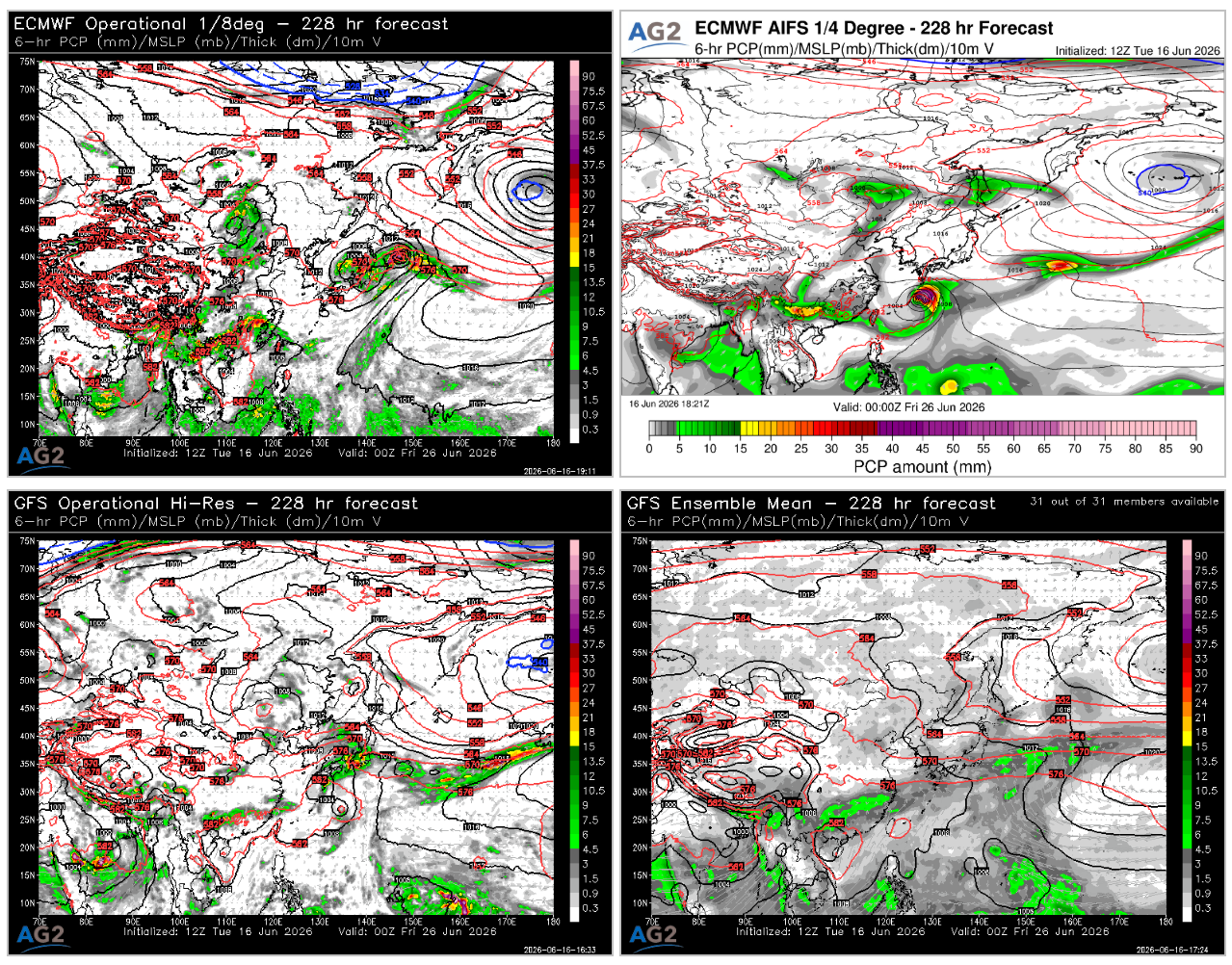
Google DeepMind ensemble guidance shows multiple members indicating landfall from Kyushu through the Kanto region around the 26th, with the majority of those members suggesting tropical storm category at landfall.
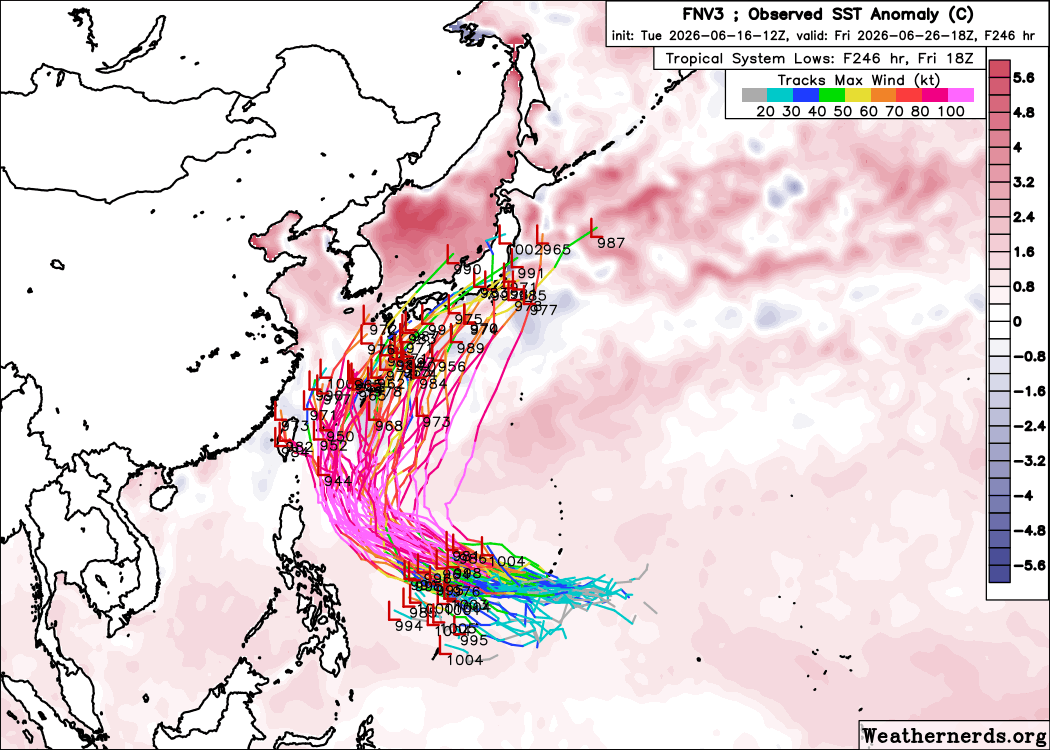
Should a tropical cyclone develop during the Baiu season, it is likely to energize the Baiu front, increasing precipitation, while areas to the south of the front may experience more humid and oppressive conditions as moist flow increases.
Published by Andrew Pedrini
All projections indicate that this next heatwave is going to hit hard. Higher pressure will rebuild over Europe this week bringing back clearer skies, plenty of sunshine (approaching Solstice), and very little gradient wind. Highest concerns should be kept around French nuclear, among all-around central European river stress, rising cooling demand, while risks of blackouts (infrastructure failures) and downside risks to solar through lower PV efficiency in peak heat should also be considered. France and surrounding areas is the most exposed region to sustained hot/dry conditions, impressing both in terms of magnitude and duration. Some mitigation is however expected for NE-E Europe next week, as the high nudges back W for a time.
Fiercely hot and dry conditions are forecast for Europe, especially though its C-W areas over the course of this back half of June.
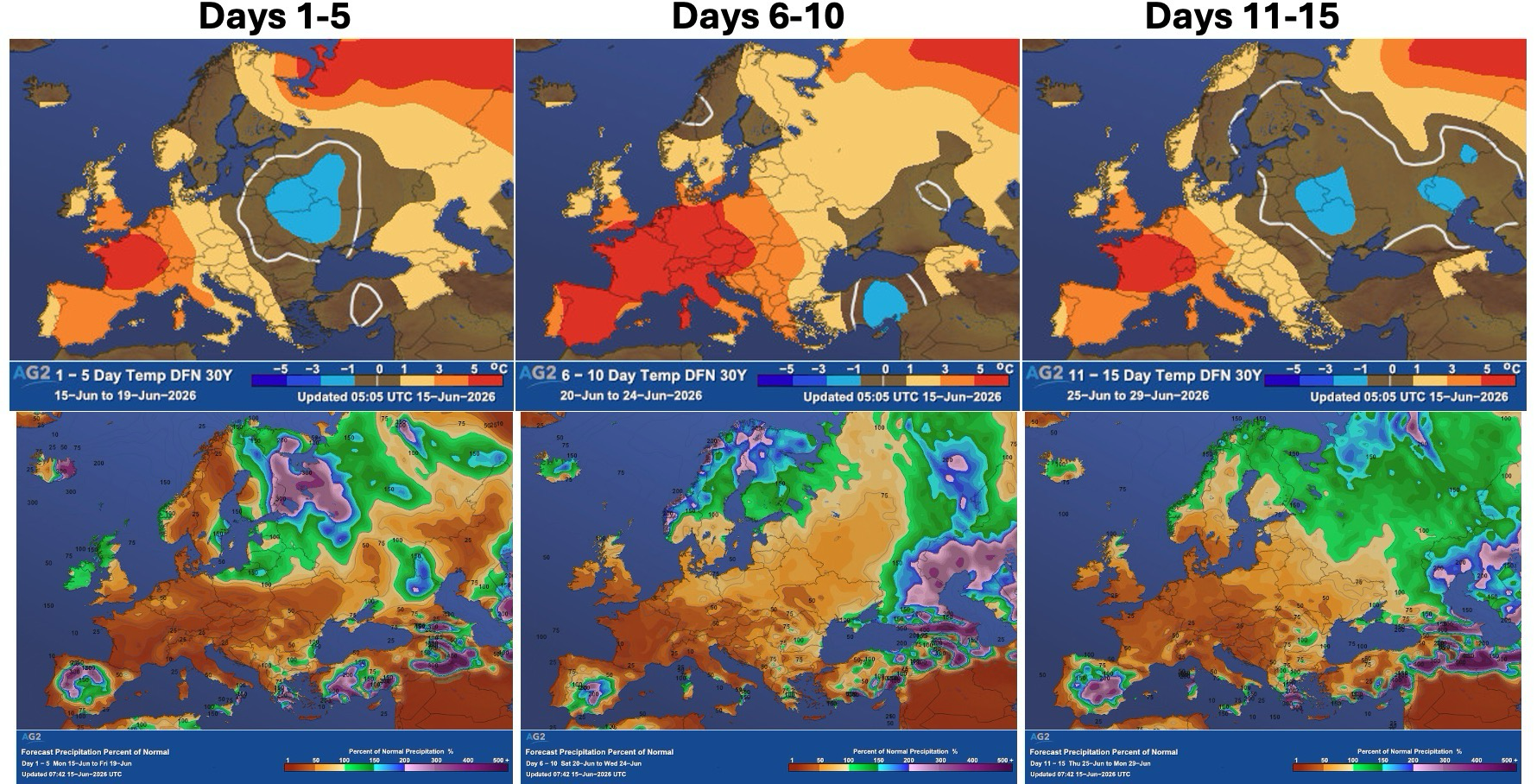
This is due to capping high pressure returning over the continent, where it is expected to become slow moving.
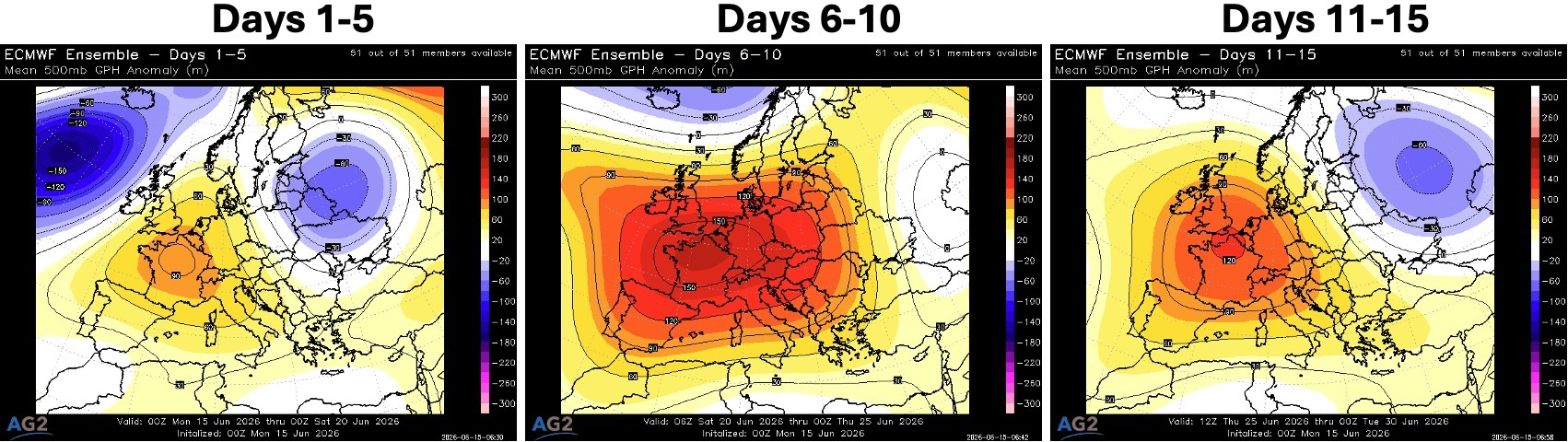
Following up our blogs from last week, discussing upcoming risks of French nuclear curtailment and European river stress, we shall discuss today how the latest forecast updates highlight a concerning 10C+ anomaly signal in max temperatures through many cities in France, for at least a week or son from mid-this week to mid-next week. With limited mitigation to follow, this is a very impressive heatwave in terms of both magnitude and duration.
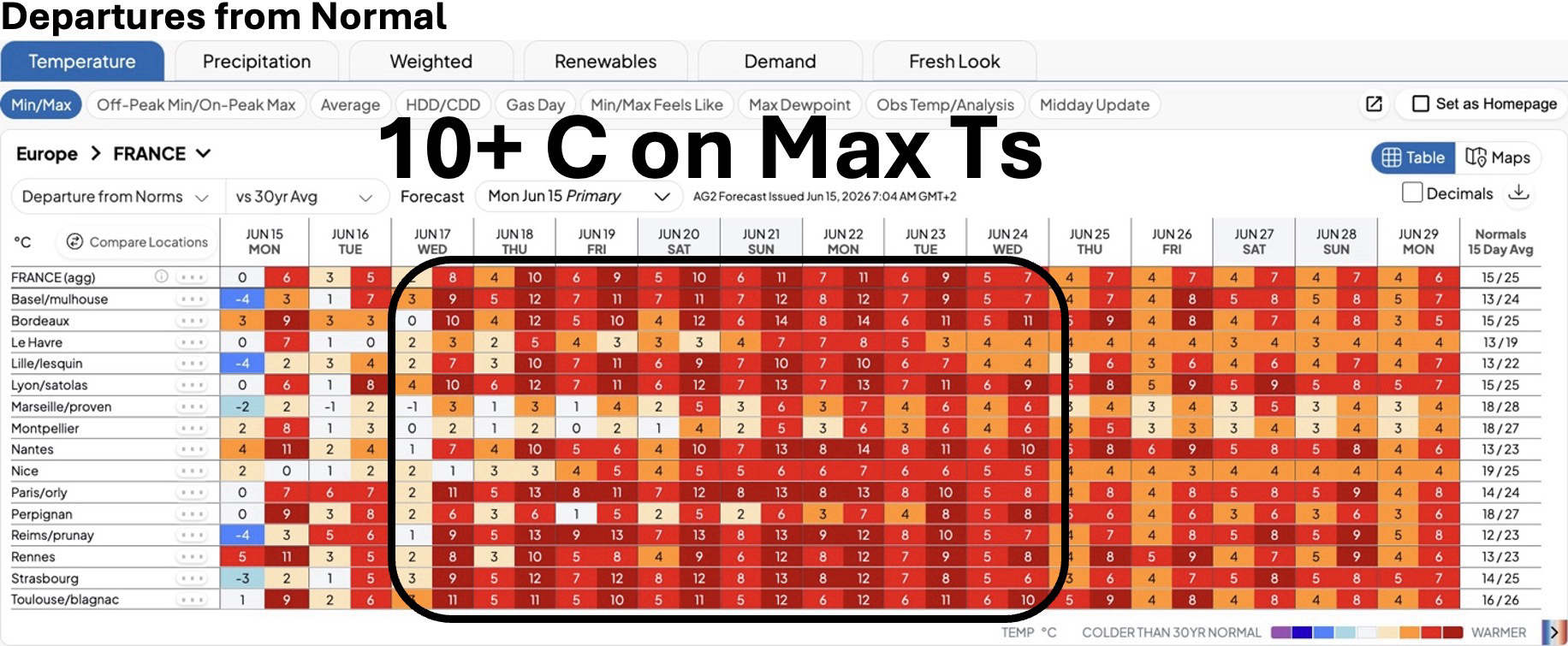
We are talking about max temperatures in the upper 30’s, nearing 40C across much of France later this week through early next week.
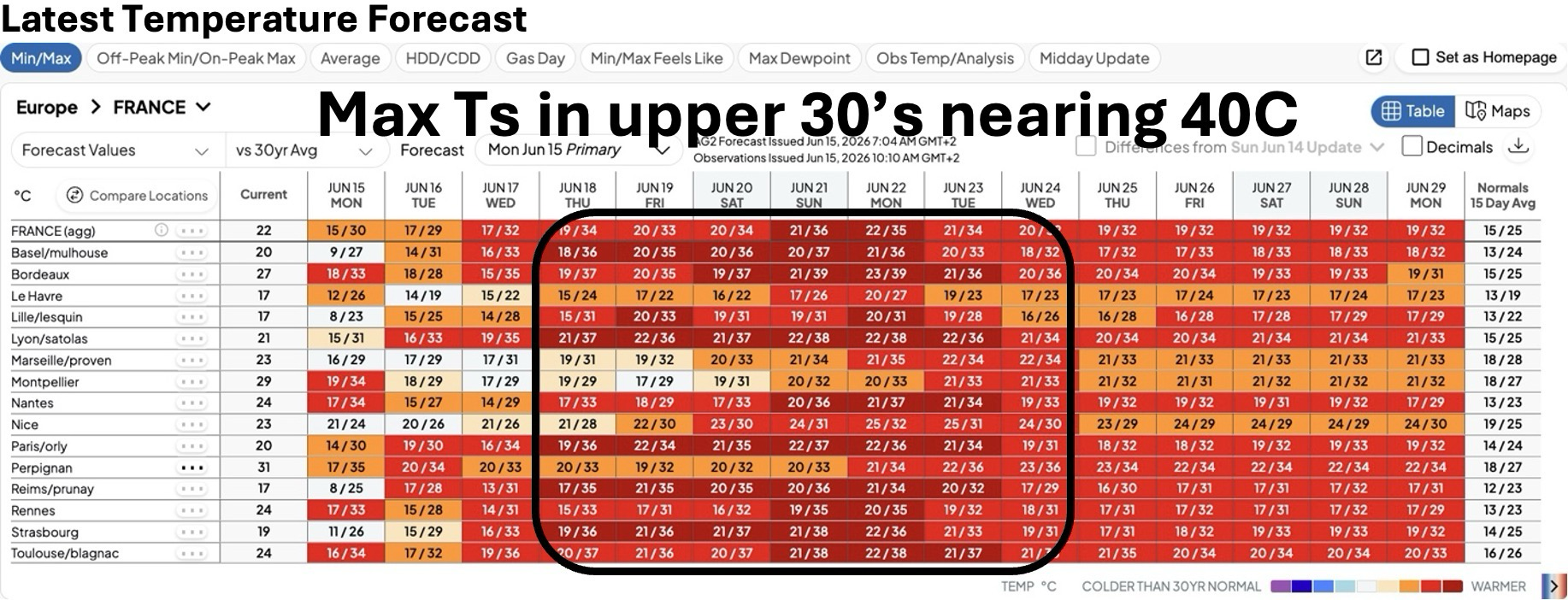
Very limited signs of relief are presently in sight for France through this back half of June.
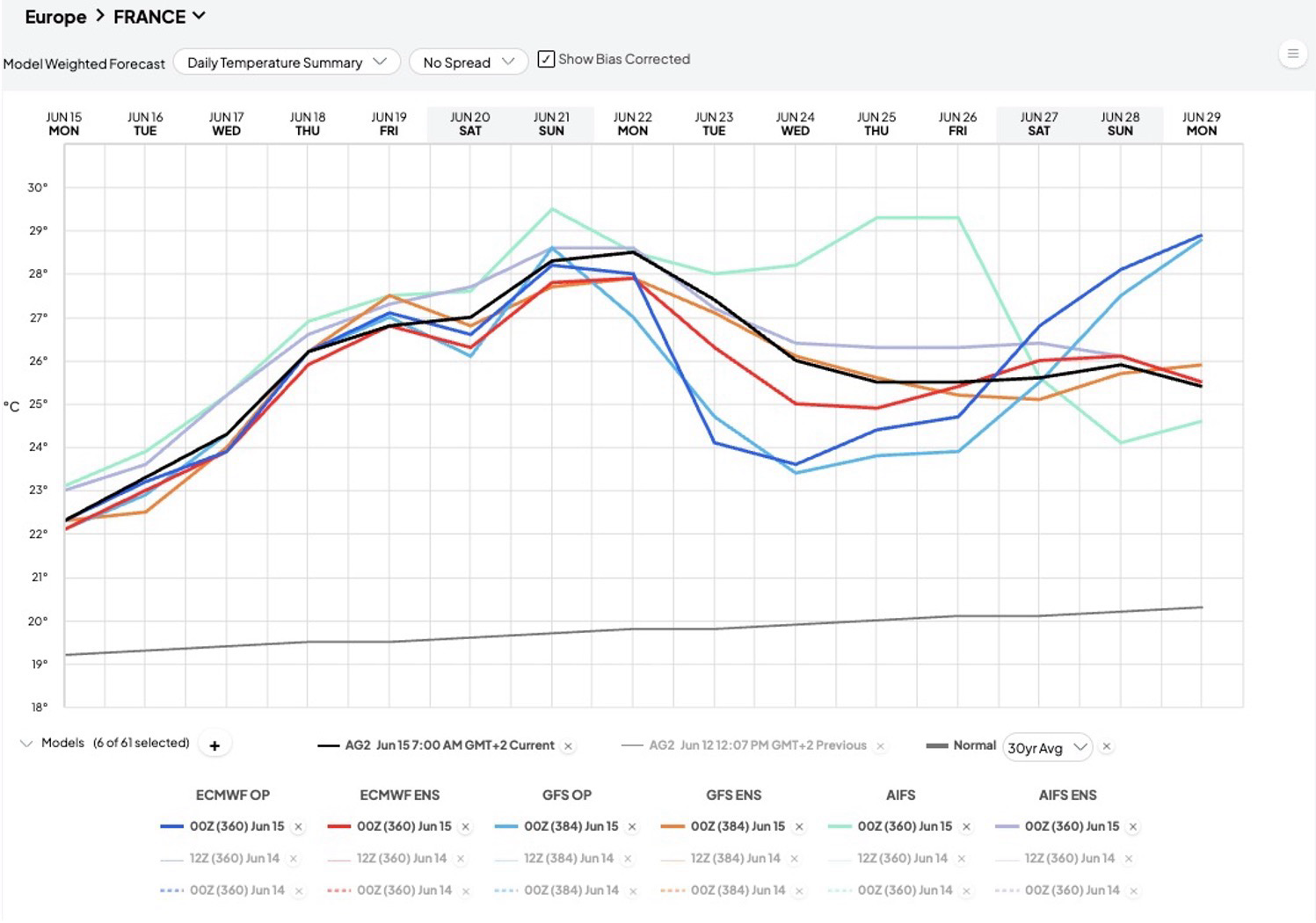
Meanwhile, with peak heat maximum extent expected towards the weekend and opening of W26, there is a cooling signal for C Europe through the course of next week. Latest 00z EC OP and GFS OP suggest risks of dropping back to nearer normal temps next week, while AIFS OP turns the opposite way towards renewed extreme heat. Better confidence lies in ensemble guidance though, with the latest trend showing some hotter rebound in temps once again by the end of the month.
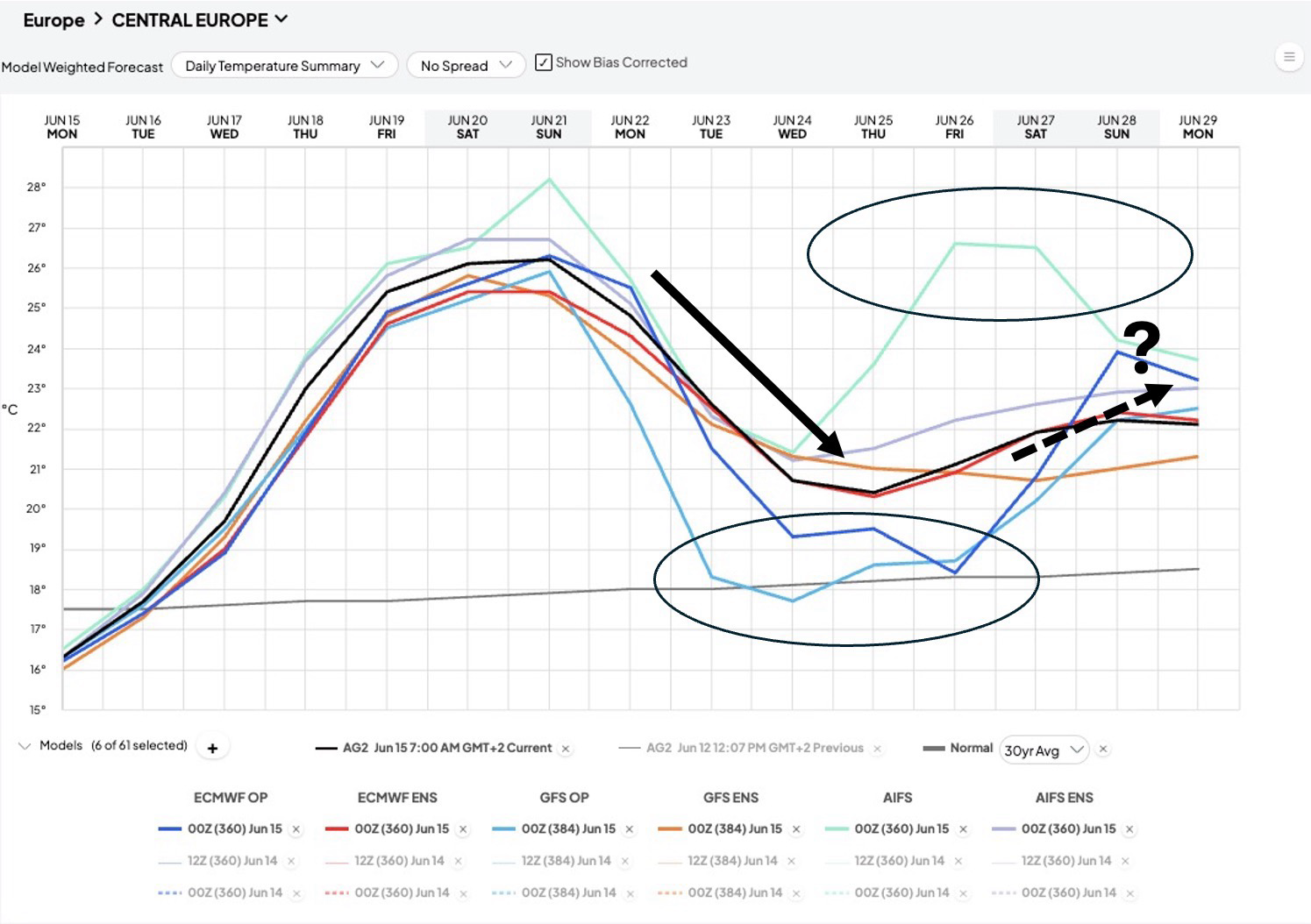
Next week in fact, the heat dome/ridging is forecast to nudge W’ward for a time, as lower heights deepen NE, allowing for come mitigation in the heat through cooler N’ly wind components across NE-E areas of Europe. The heat should however hold across W Europe under the continued protection of the high.

That high that is forecast to draw in once again per the latest EC ENS and AIFS ENS by the end of the month – hence those renewed hot trend towards the end of June per those solutions.
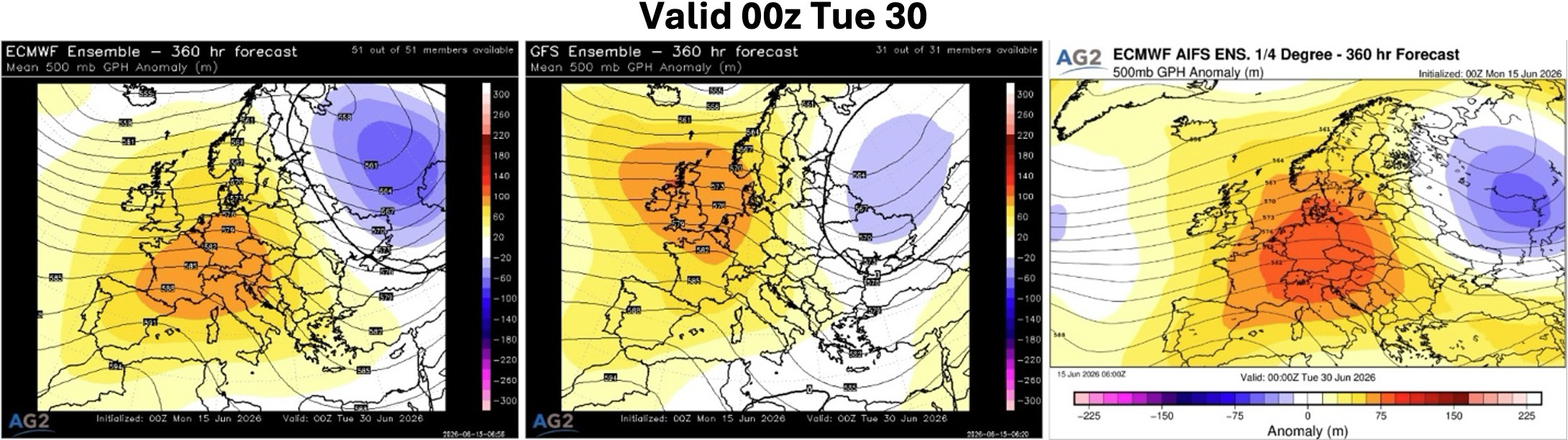
Bottom line: A fierce Solstice heatwave is set to grip much of Europe through the back half of June under a higher pressure regime, bringing very hot, dry, sunny and mostly calmer conditions, with France and surrounding areas most exposed to both impressive magnitude and duration. This maintains risks around French nuclear curtailment and broader central European river stress EXTREMELY HIGH, while also driving a strong surge in cooling demand, and adding (1) upside risks to infrastructure strain/blackouts, (2) downside risks to solar efficiency and in peak heat. Some mitigation is forecast next week for NE-E Europe as the high nudges W for a time, but W Europe should remain under persistent heat, with renewed hotter risks possible again toward the end of the month.
Published by
Summer weather risk in East Asia can move energy markets well before it appears in the short-range weather forecast.
For Japan, South Korea and China, subseasonal shifts in temperature, rainfall, solar radiation, humidity and tropical cyclone activity can affect power demand, solar generation, LNG and coal burn, hydro conditions and fuel logistics. A persistent heat pattern can lift cooling demand. A cloudy and wet regime can suppress daytime temperatures but also reduce solar output. Tropical disturbances can affect demand, generation, transmission, ports and fuel deliveries.
One useful framework for monitoring these risks at the two-to-four-week range is BSISO.
BSISO stands for Boreal Summer Intraseasonal Oscillation. It is a major intraseasonal mode of convection and circulation over the Asian summer monsoon region. In practical terms, it tracks the movement of enhanced tropical convection across the Indian Ocean, Bay of Bengal, South China Sea, Philippine Sea and western North Pacific during the boreal summer.
For energy traders, BSISO is not a deterministic forecast. It does not say, by itself, that Japan will be hot, Korea will be wet, or China will be cloudy. Instead, it provides a structured way to assess whether the subseasonal background is becoming more supportive of heat, rainfall, cloudiness, moisture transport or tropical cyclone activity.
The key point is that BSISO should not be used in isolation. It is most useful when combined with the MJO, subseasonal model guidance, 500 hPa height patterns, low-level moisture transport, the western North Pacific subtropical high, frontal positioning and tropical cyclone genesis conditions.
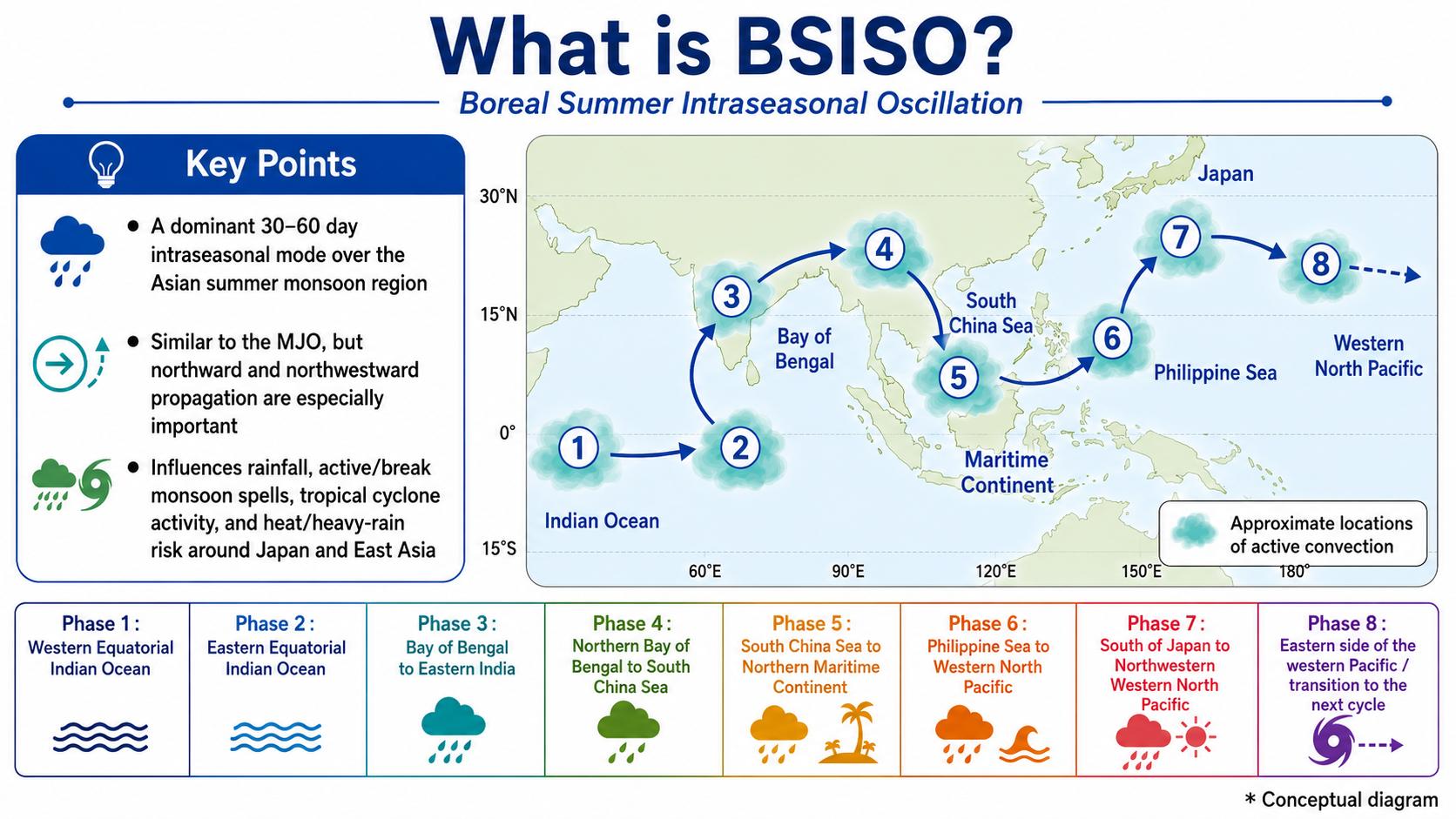
Figure 1. Conceptual BSISO phase geography. The numbered phases indicate the approximate location of enhanced convection as it propagates from the Indian Ocean toward the Bay of Bengal, South China Sea, Philippine Sea and western North Pacific. The map is schematic, not a deterministic forecast map.
What is BSISO?
BSISO is the dominant boreal-summer interseasonal variability over the Asian monsoon region. It operates on a timescale longer than daily weather but shorter than seasonal climate, typically covering the 10-to-60-day range.
During active BSISO events, enhanced convection tends to migrate from the equatorial Indian Ocean toward the Bay of Bengal, South China Sea, Philippine Sea and western North Pacific. This evolution changes low-level winds, upper-level divergence, moisture transport, monsoon rainfall, tropical cyclone environments and the western North Pacific subtropical high.
This matters for energy markets because these circulation changes can influence several tradeable weather risks:
Temperature risk in Japan, South Korea and eastern China.
Rainfall risk associated with the Meiyu, Baiu and Changma frontal systems.
Solar radiation risk caused by persistent cloudiness and rainfall.
Humidity risk, especially where high dew points support stronger cooling demand even if daytime highs are not extreme.
Tropical cyclone risk across the South China Sea, Philippine Sea and western North Pacific.
Fuel demand and generation-mix implications for power, LNG, coal, hydro and renewables.
The practical value of BSISO is that it helps identify the type of weather regime that may become more likely in the subseasonal range. It is a regime-risk tool, not a point forecast.
How is BSISO different from the MJO?
To use BSISO effectively, it is important to distinguish it from the MJO.
The MJO, or Madden–Julian Oscillation, is a 30-to-60-day tropical intraseasonal oscillation. It typically propagates eastward along the equatorial belt from the Indian Ocean toward the Maritime Continent and the western Pacific. It is often particularly clear during boreal winter, but it remains useful in summer as a broad indicator of tropical convection.
BSISO is closely related to this type of tropical intraseasonal variability, but it is more specific to the Asian summer monsoon system. In summer, convection does not simply move eastward along the equator. It also propagates northward and northwestward into the monsoon region. This is the critical difference for East Asian weather risk.
For East Asia, MJO alone may show the broad tropical convection background, but it may not fully capture the northward shift of convection into the Bay of Bengal, South China Sea, Philippine Sea and western North Pacific. BSISO helps track that monsoon-region propagation.
In operational terms, the two should be used together.
Use the MJO to understand the broad tropical convective background across the Indian Ocean, Maritime Continent and western Pacific.
Use BSISO to understand the boreal-summer monsoon-region signal, especially northward and northwestward propagation toward the Bay of Bengal, South China Sea, Philippine Sea and western North Pacific.
For Japan, South Korea and China, this combined view is more useful than using either index alone.
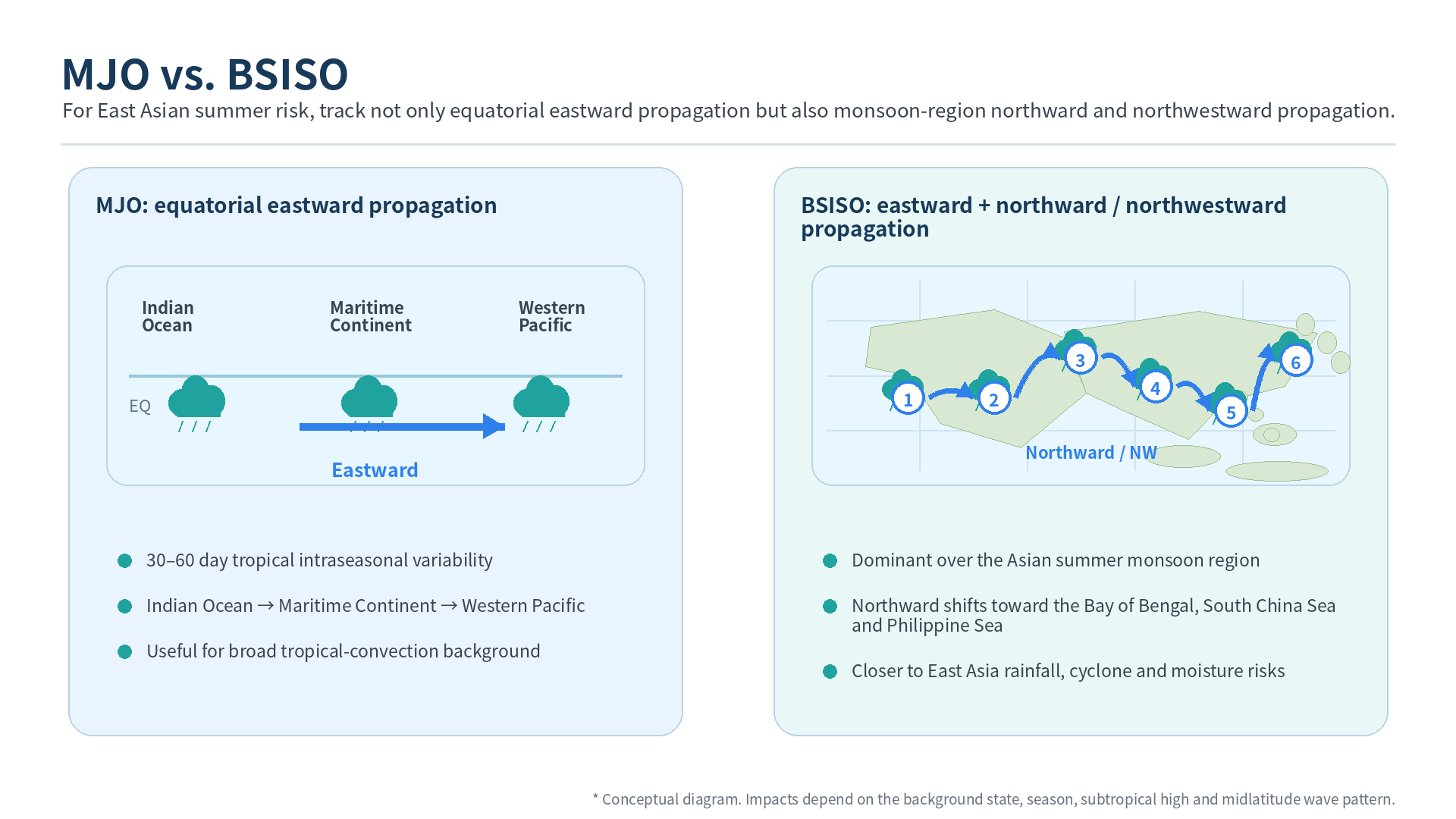
Figure 2. MJO versus BSISO. MJO is often interpreted as an equatorial eastward-propagating convective signal, while BSISO emphasizes the boreal-summer northward and northwestward propagation that is especially relevant for Asian monsoon rainfall, tropical cyclone risk and East Asian moisture transport.
BSISO1 and BSISO2: why traders should care about both
BSISO is commonly monitored through two indices: BSISO1 and BSISO2. They are related but not interchangeable.
BSISO1 mainly captures the lower-frequency, larger-scale component of the summer intraseasonal signal. It is closer to a 30-to-60-day mode and is useful for identifying the broader monsoon background. It can help assess whether the large-scale environment is becoming more supportive of active monsoon conditions, broad moisture transport and sustained circulation anomalies.
BSISO2 captures a higher-frequency component, closer to the 10-to-30-day range. It is often more directly linked to northward and northwestward convective variations over the Bay of Bengal, South China Sea, Philippine Sea and western North Pacific. In practice, BSISO2 can be especially relevant for rainfall, cloudiness, moisture surges, tropical cyclone genesis environments and shorter subseasonal shifts.
A simple way to remember the difference is this:
BSISO1 is the larger-scale background.
BSISO2 is the shorter-period convection, rainfall, moisture and tropical-cyclone-environment signal.
This distinction is important for market interpretation.
If BSISO1 and BSISO2 both point toward phases 5 to 7, confidence tends to increase that convection may become more active across the South China Sea, Philippine Sea and western North Pacific. That would raise attention on East Asian rainfall, tropical disturbance risk and possible humidity-driven demand effects.
If BSISO1 is weak but BSISO2 is active, the signal should be treated more carefully. That pattern may not imply a persistent large-scale heat regime. It may instead indicate shorter-period rainfall, moisture transport, cloudiness and solar-risk episodes.
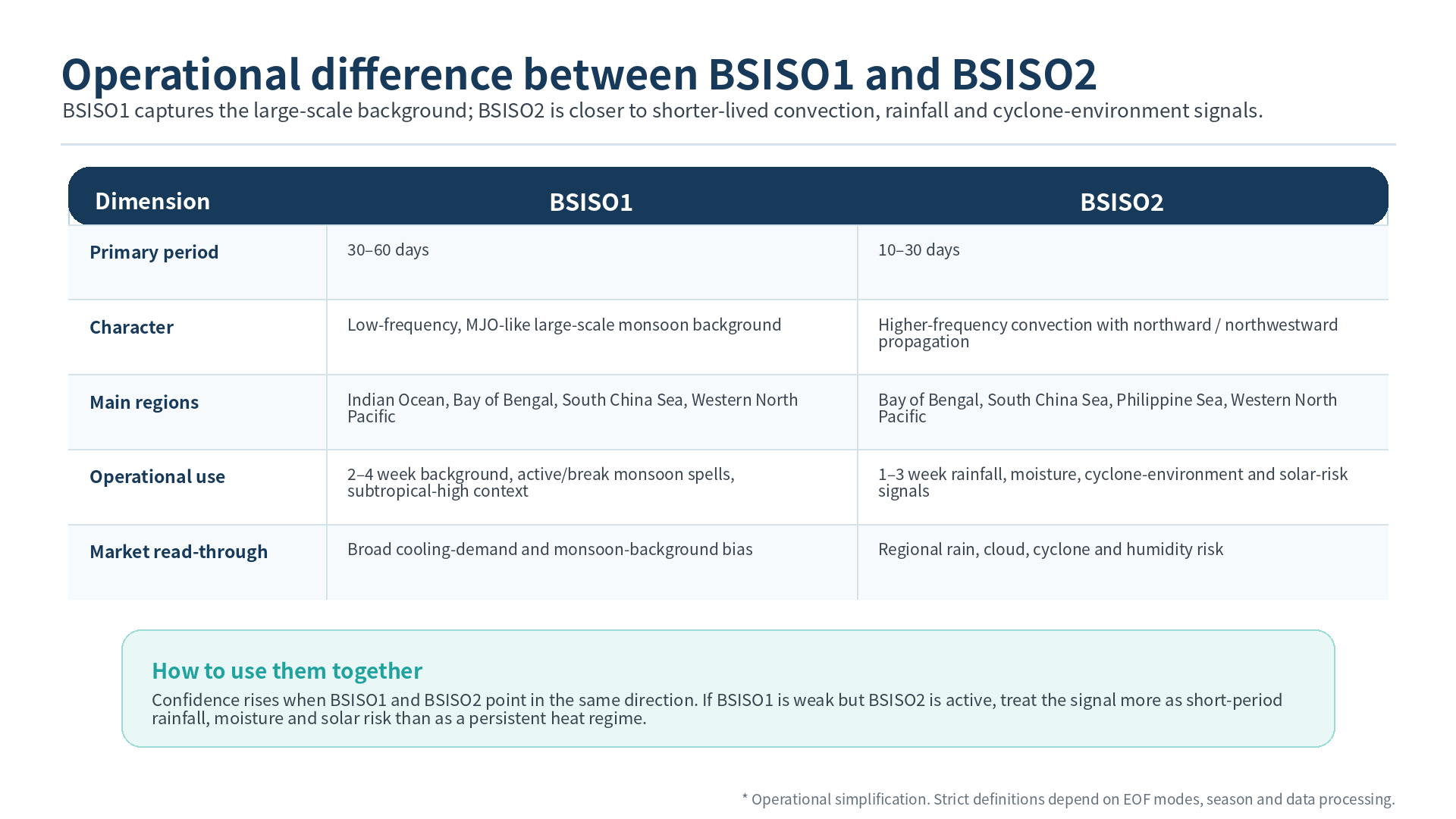
Figure 3. Operational difference between BSISO1 and BSISO2. BSISO1 is more useful for the large-scale monsoon background, while BSISO2 is often more relevant for shorter-period rainfall, moisture, tropical-cyclone-environment and solar-risk signals.
What do phases 1 to 8 mean geographically?
BSISO is usually shown in phase space, with phases 1 through 8 indicating the approximate location of enhanced convection.
A simplified geographic interpretation is:
Phase 1: western equatorial Indian Ocean.
Phase 2: eastern equatorial Indian Ocean.
Phase 3: Bay of Bengal to eastern India.
Phase 4: northern Bay of Bengal to South China Sea.
Phase 5: South China Sea to northern Maritime Continent.
Phase 6: Philippine Sea to western North Pacific.
Phase 7: south of Japan to the northwestern part of the western North Pacific.
Phase 8: eastern side of the western Pacific and transition toward the next cycle.
For East Asian energy markets, phases 4 through 7 are especially important.
Phases 4 and 5 tend to focus attention on the Bay of Bengal, South China Sea and southern China moisture corridor. This can be relevant for rainfall risk in southern China, the Yangtze River basin, Taiwan, the Ryukyu Islands and western Japan, depending on the frontal pattern.
Phases 5 and 6 shift attention toward the South China Sea, Philippine Sea and western North Pacific. This is the stage where tropical disturbance risk and moisture supply toward East Asia often become more relevant.
Phases 6 and 7 bring the signal closer to Japan, South Korea and eastern China. Depending on the western North Pacific subtropical high and frontal positioning, this can support either a hot and humid pattern or a wet, cloudy and frontal-rainfall pattern.
This is why phases 5 to 7 receive particular attention in East Asian summer energy-market monitoring.
How BSISO affects temperature, rainfall and solar radiation
BSISO affects energy markets through multiple weather variables. Temperature is important, but it is not the only variable that matters.
Temperature risk depends heavily on the western North Pacific subtropical high, ridge-trough positioning and cloud cover. If the subtropical high expands northwestward toward Japan, South Korea and eastern China, the region may turn hotter and more humid. This can lift cooling demand, especially where nighttime minimum temperatures remain elevated.
Rainfall risk depends on the interaction between BSISO-related tropical convection and the East Asian frontal zone. If enhanced convection over the South China Sea or Philippine Sea strengthens moisture transport into the Baiu, Meiyu or Changma front, rainfall risk can increase across Japan, Korea and eastern China. This can suppress daytime temperatures but raise flood, logistics and hydro-related risks.
Solar radiation risk is also critical. More cloud cover and rainfall can reduce solar generation. In markets with high solar penetration, a cloudy and wet regime can tighten the supply-demand balance even if cooling demand is not especially strong. This is why rainfall and solar risk should be evaluated together, not separately.
Humidity risk can complicate the signal. A wet pattern may lower daytime maximum temperatures, but high humidity and warm nights can keep power demand resilient. For load forecasting, dew point and nighttime minimum temperature can be as important as daily maximum temperature.
Tropical cyclone risk is another important channel. When BSISO supports enhanced convection across the South China Sea, Philippine Sea and western North Pacific, tropical cyclone genesis environments may become more favorable. Tropical cyclones can affect power demand, transmission infrastructure, generation availability, LNG and coal logistics, port operations and industrial activity.
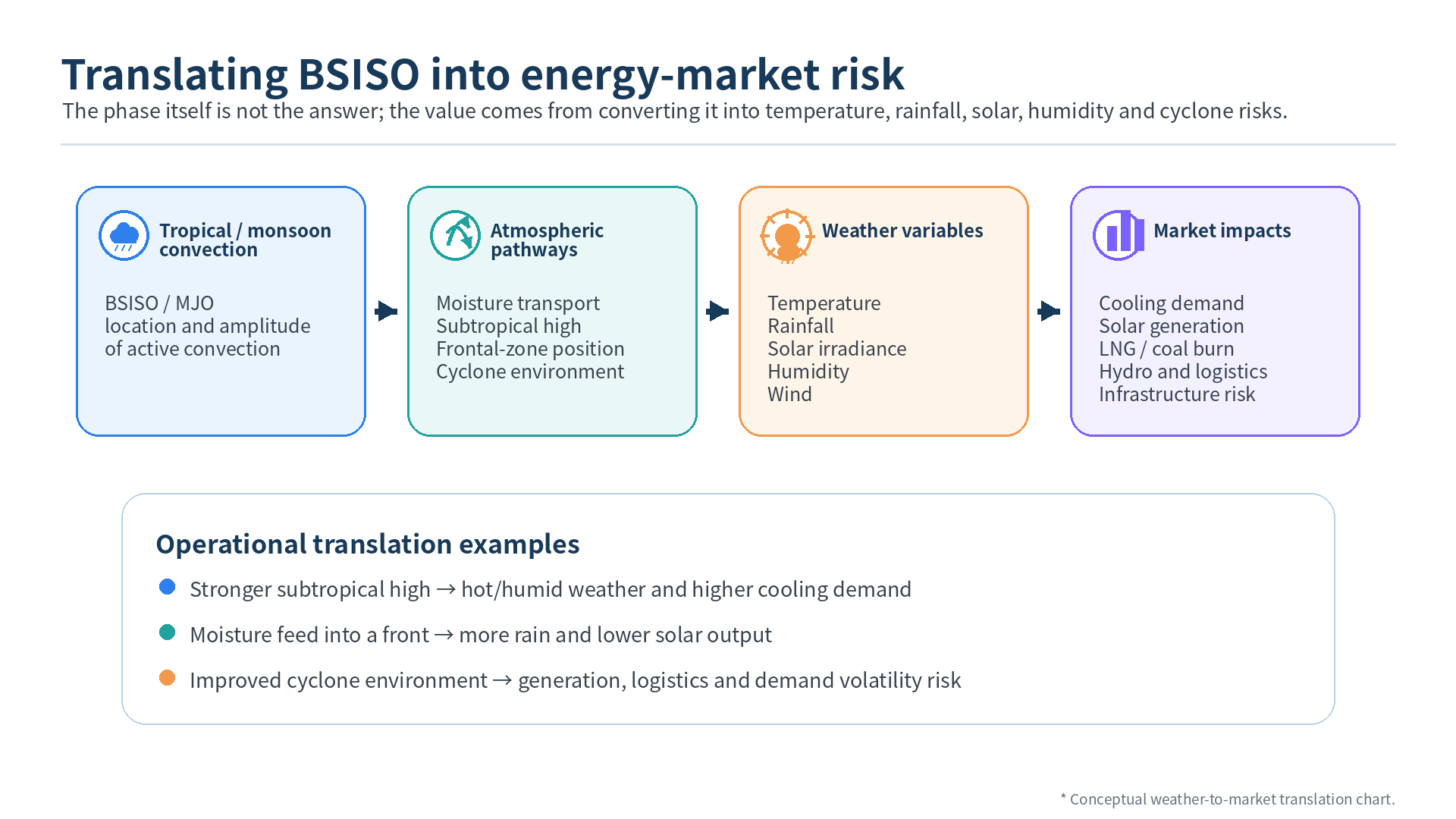
Figure 4. Translating BSISO into energy-market risk. BSISO affects energy markets through convection, moisture transport, subtropical-high positioning, frontal activity, tropical cyclone environments, cloud cover and solar radiation. The market impact depends on how these meteorological drivers translate into demand, generation and logistics.
Model verification: which BSISO forecast should be emphasized?
BSISO forecasts are available from multiple models, but not all models should be given equal weight. Forecast skill varies by model, lead time, index and season. For operational use, model verification matters.
APCC BSISO verification provides a useful reference for comparing model performance. Based on the all-available-period verification chart, ECMWF shows relatively stable skill across BSISO1 and BSISO2. In particular, ECMWF appears comparatively robust for BSISO2 at subseasonal lead times, with relatively slower degradation in correlation, controlled RMSE growth and stronger MSSS compared with several other models.
This matters because BSISO2 is often the more practically relevant signal for short-period convection, rainfall, moisture transport, tropical cyclone environments and solar-risk episodes around East Asia.
GFS and CFS can still provide useful scenario information, especially at shorter lead times, but their skill may degrade more noticeably at longer leads. CFS in particular can become unstable in some BSISO2 verification metrics at longer leads. BOM and CWA can be useful supporting references, but a practical approach is to use ECMWF as the anchor model and compare other models for confirmation or alternative scenarios.
The goal is not to follow one model blindly. The goal is to weight the forecast evidence. If ECMWF and other models agree on BSISO phase progression and amplitude, confidence is higher. If ECMWF suggests a signal but other models diverge, the market conviction should be reduced.
When using APCC verification graphics, one caution is necessary: if the chart does not explicitly state the verification period, the period should not be over-specified. In that case, it is safer to describe the result as an all-available-period verification rather than assigning exact start and end dates.
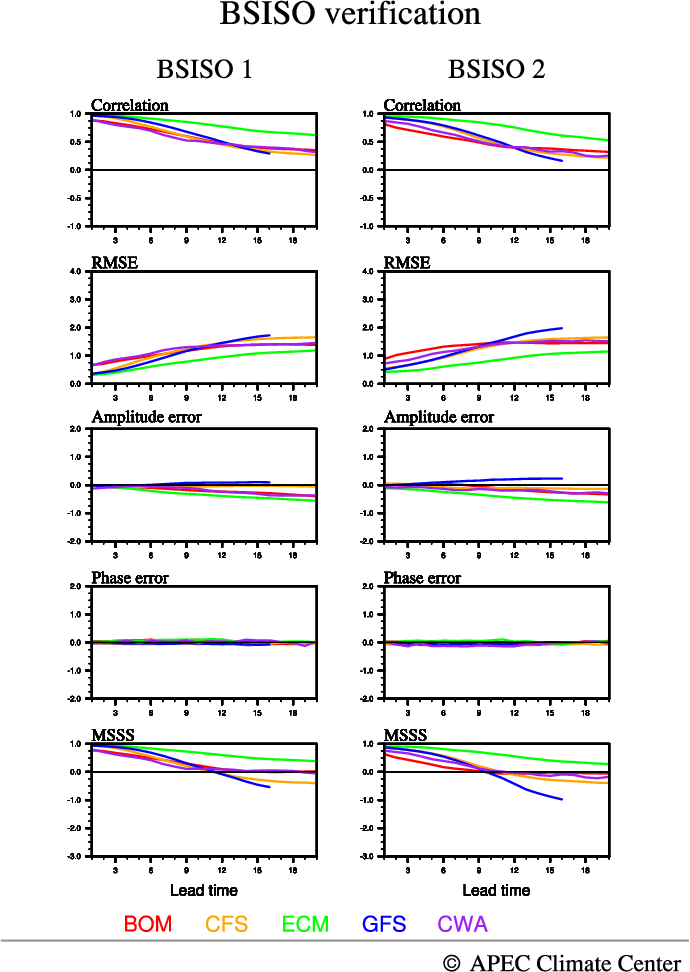
Figure 5. APCC BSISO verification over the all-available-period sample. ECMWF is used as the anchor model in this framework because it shows relatively stable skill across BSISO1 and BSISO2, especially for BSISO2 at subseasonal lead times. The exact verification period should not be over-specified unless the underlying APCC data range is explicitly documented.
A practical monitoring framework for energy traders
BSISO is most useful when integrated into a repeatable workflow.
The first step is to check the MJO. Is there a coherent tropical convective envelope? Is it located over the Indian Ocean, Maritime Continent or western Pacific? Is the amplitude meaningful or weak?
The second step is to check BSISO1 and BSISO2. Is BSISO1 showing a clear large-scale monsoon background? Is BSISO2 moving toward phases 4 to 7? Are the two indices aligned or conflicting?
The third step is to assess model confidence. ECMWF should usually be the anchor model, but the forecast should be compared with BOM, CWA, GFS and CFS where available. Model agreement raises confidence; model divergence lowers it.
The fourth step is to verify the circulation fields. The most important fields include 500 hPa height anomalies, 850 hPa winds and moisture transport, 200 hPa velocity potential, western North Pacific subtropical high position, frontal placement and tropical cyclone genesis conditions.
The fifth step is to translate the weather signal into market variables. This means moving from meteorology to demand, generation and logistics. Temperature, rainfall, solar radiation, humidity, nighttime minimum temperature, tropical cyclone risk, fuel burn and renewable output should be evaluated together.
A practical checklist is:
Is the MJO coherent and active?
Are BSISO1 and BSISO2 aligned?
Is BSISO2 moving into phases 4 to 7?
Does ECMWF agree with other models?
Is the 500 hPa pattern supportive of a ridge or trough over East Asia?
Is 850 hPa moisture transport aimed toward Japan, Korea or eastern China?
Is the western North Pacific subtropical high expanding northwestward?
Where are the Baiu, Meiyu and Changma frontal zones likely to sit?
Are tropical cyclone genesis conditions improving?
Does the final signal imply heat demand, rainfall risk, solar downside, humidity-driven demand or logistics risk?
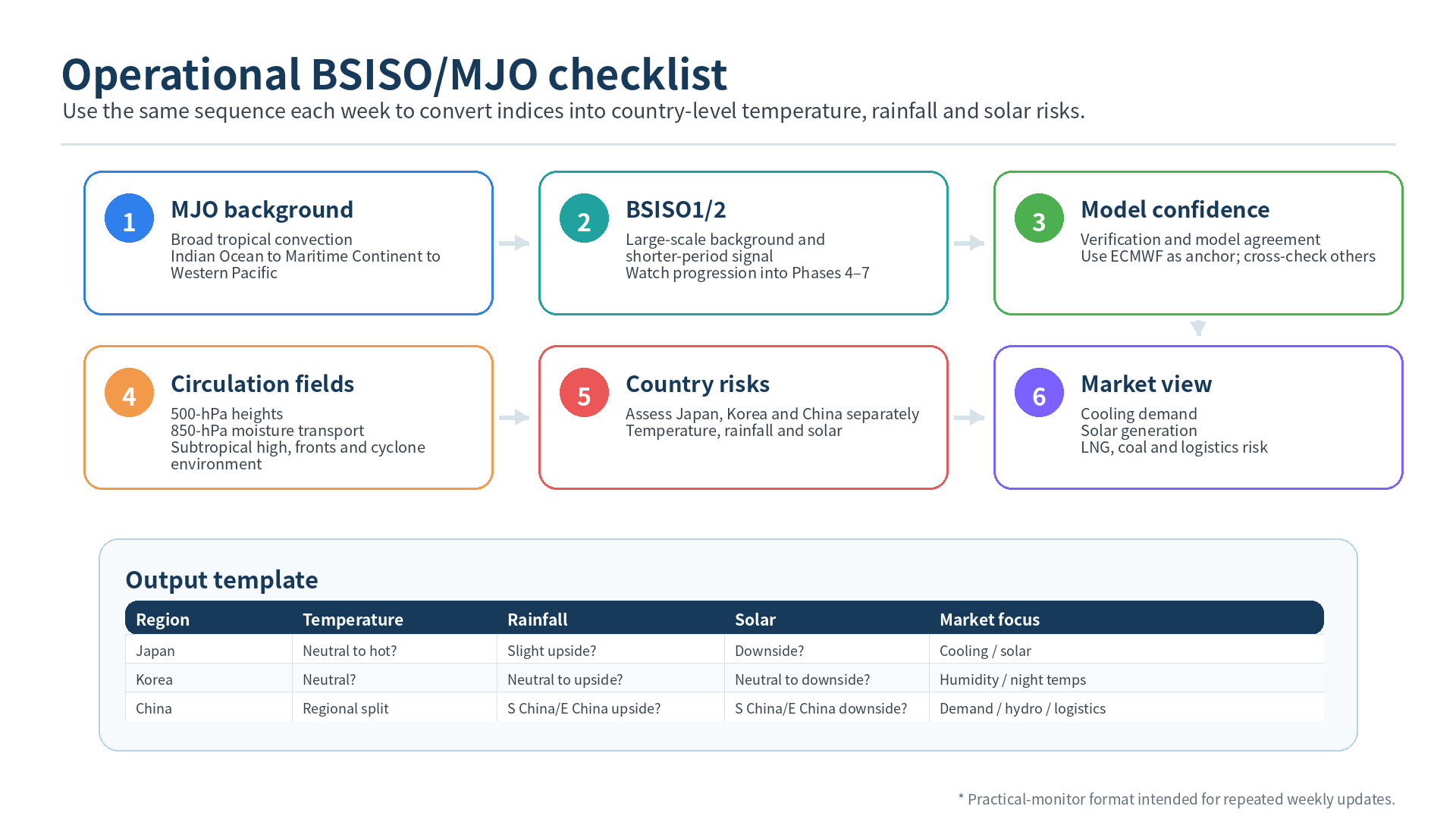
Figure 6. Operational workflow for using MJO and BSISO in energy-market analysis. The index signal should be connected to model confidence, circulation fields, country-level weather risks and market variables.
How to read BSISO for energy-market impact
The value of BSISO is not in naming the phase. The value is in translating phase progression into energy-relevant risks.
For example, if BSISO2 is near phases 4 to 5, the main signal may be enhanced convection from the Bay of Bengal and South China Sea toward the northern Maritime Continent and Philippine Sea. For Japan, South Korea and eastern China, this does not automatically mean a heat-demand bullish pattern. It may first imply greater attention to moisture transport, rainfall, cloud cover, lower solar radiation and tropical disturbance risk.
If BSISO2 advances into phases 5 to 7 while the western North Pacific subtropical high expands northwestward, the interpretation can shift. In that case, hot and humid conditions may become more likely across parts of Japan, Korea and eastern China, lifting cooling demand.
If instead the frontal zone remains over East Asia and tropical moisture feeds into it, the more important risk may be rainfall, cloudiness and lower solar output. Daytime temperatures may be suppressed, but humidity and warm nights can still support power demand.
If tropical disturbances develop, the market impact broadens beyond temperature and solar. Tropical cyclone risk can affect demand, generation, transmission, LNG deliveries, coal logistics, ports and industrial operations.
Therefore, the same BSISO phase can have different market implications depending on the subtropical high, frontal position and midlatitude circulation. BSISO provides the tropical-convective framework, but the market signal comes from the full weather regime.
Conclusion
BSISO is a useful tool for monitoring summer subseasonal weather risk across East Asia. For Japan, South Korea and China, it can help identify shifts in temperature, rainfall, solar radiation, humidity and tropical cyclone risk two to four weeks ahead.
However, BSISO should not be used alone. The most robust approach is to combine MJO for the broad tropical background, BSISO for Asian monsoon-region propagation, ECMWF and other S2S guidance for forecast confidence, and circulation fields for the actual weather pattern.
Model verification supports using ECMWF as the anchor model for BSISO monitoring, particularly for BSISO2 at subseasonal lead times. Other models remain useful as confirmation or alternative scenarios, but the forecast should be weighted by historical skill and current model agreement.
For energy traders, BSISO is not simply a “heat” indicator. It is a framework for monitoring multiple weather-driven market risks: cooling demand, rainfall, cloudiness, solar generation, humidity, tropical cyclones, fuel burn and logistics.
In East Asian summer markets, the most useful question is not only whether it will be hot. It is whether the evolving tropical and monsoon background is setting up a heat-demand regime, a wet-and-cloudy solar-risk regime, a tropical-cyclone-risk regime, or some combination of these. BSISO, used together with MJO and model guidance, helps structure that assessment.
Published by James Caron
The ERCOT forecast has continued to trend in the direction we were watching for, with warmer changes showing up from June 18 onward. This supports the idea that the cooler, wetter pattern across Texas is beginning to break down, while the large-scale upper-air pattern becomes more favorable for heat to expand across the state.
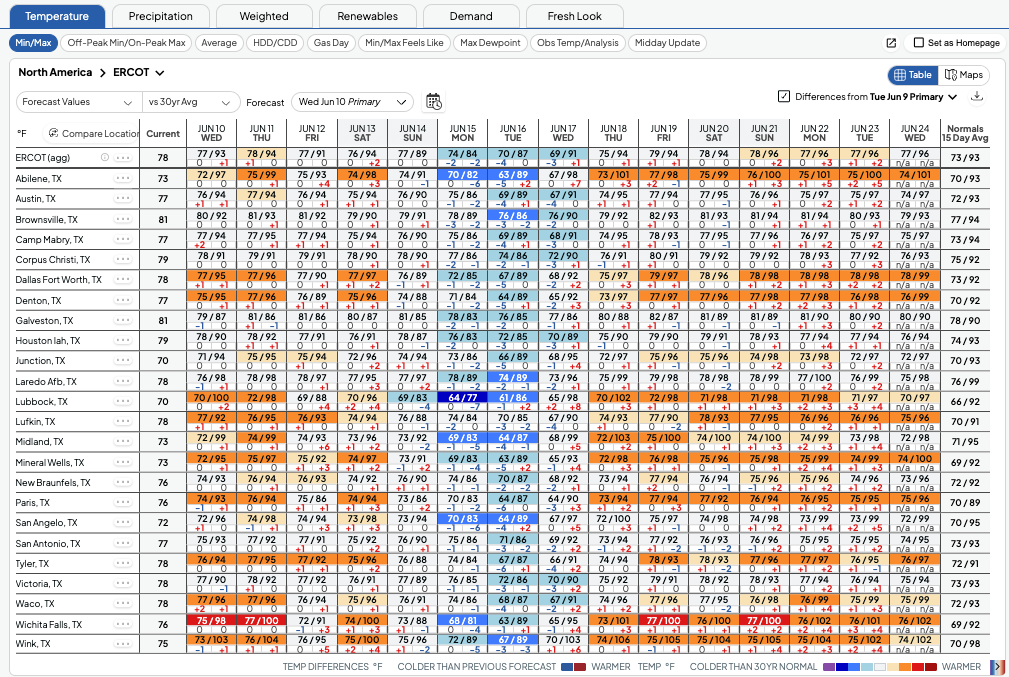
The key driver remains the evolving 500mb setup. A trough over the Midwest and Northeast is expected to compress the ridge southward into Texas and the southern Plains. When that happens, the ridge does not necessarily need to be centered directly over ERCOT to produce heat. The compression itself can help strengthen subsidence, limit cloud cover, and support a hotter, drier surface pattern across Texas.
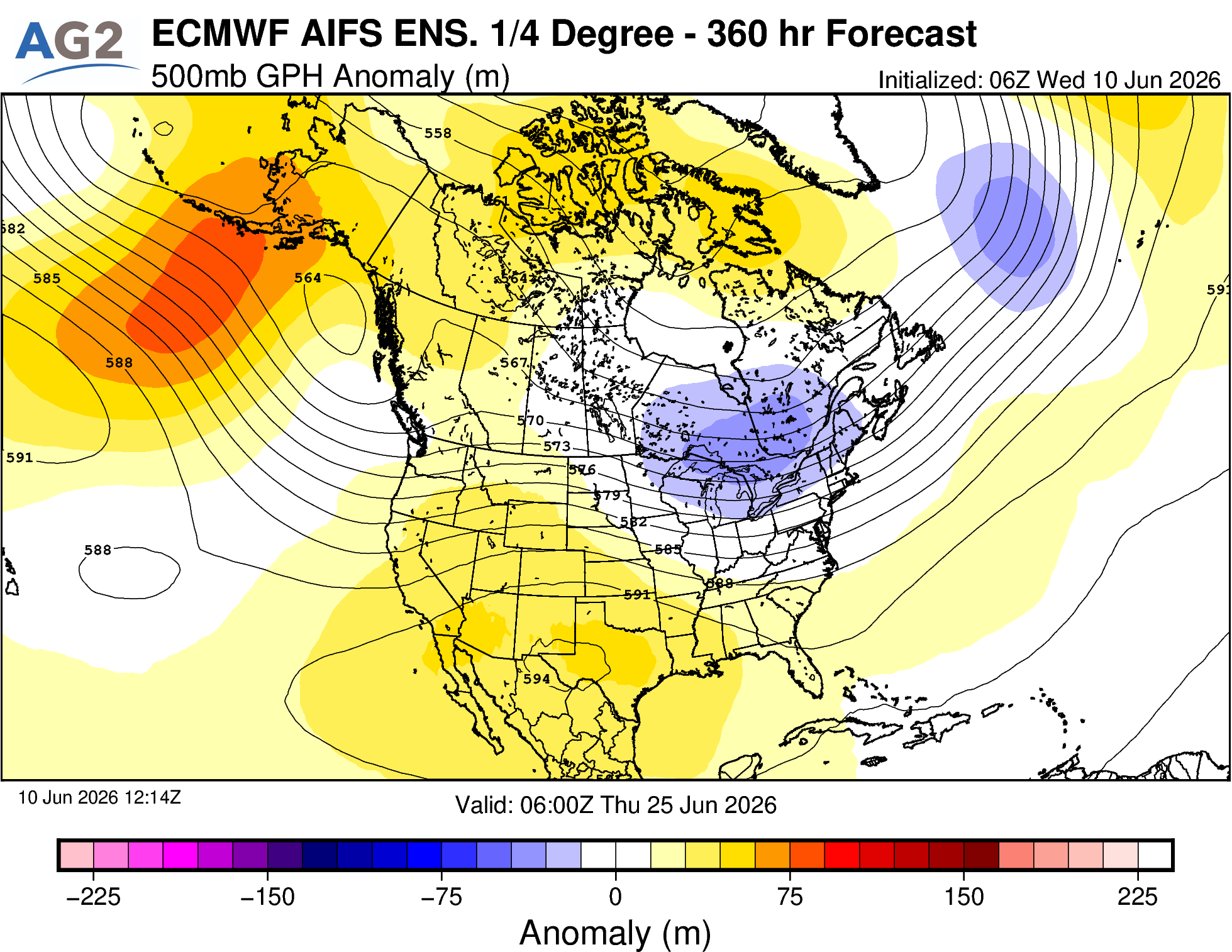
That is important because the temperature forecast is already responding. From roughly June 18 through the week ending Friday, June 26, warmer changes are showing up across the ERCOT cities. The current forecast has moved warmer during this period, but there may still be additional upside risk if the ridge compression verifies or strengthens further.
Another notable change is precipitation. The forecast is finally showing a meaningful decrease in rainfall coverage after the mid-month period. Earlier in the outlook, Texas still has scattered precipitation chances, especially around June 15–18. However, after June 18, rainfall becomes much more limited across the ERCOT footprint. That reduction in precipitation is a key reason the warmer pattern has more room to develop.
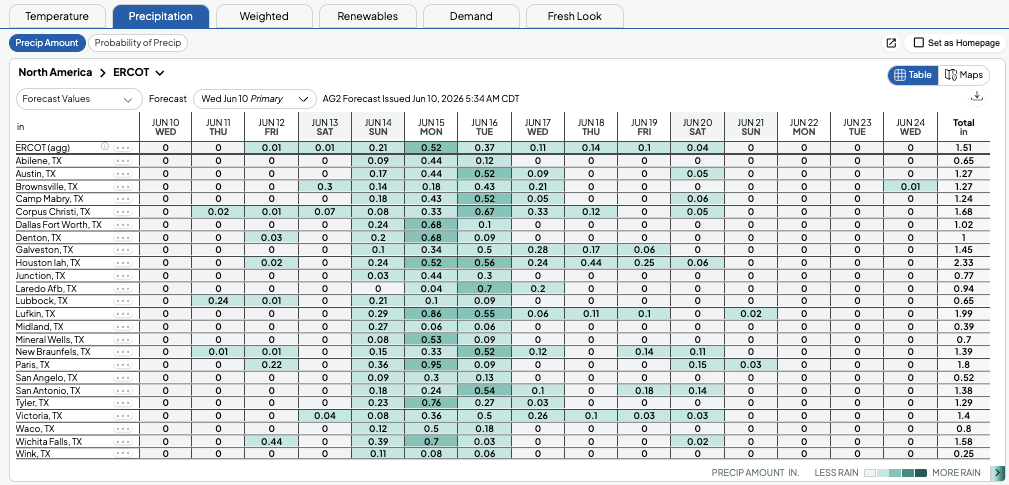
That is important because the temperature forecast is already responding. From roughly June 18 through the week ending Friday, June 26, warmer changes are showing up across the ERCOT cities. The current forecast has moved warmer during this period, but there may still be additional upside risk if the ridge compression verifies or strengthens further.
Another notable change is precipitation. The forecast is finally showing a meaningful decrease in rainfall coverage after the mid-month period. Earlier in the outlook, Texas still has scattered precipitation chances, especially around June 15–18. However, after June 18, rainfall becomes much more limited across the ERCOT footprint. That reduction in precipitation is a key reason the warmer pattern has more room to develop.
Published by James Caron
Days 1–8: Tropical Threat Outlook
The near-term forecast keeps the most focused tropical storm strike probabilities in the western Pacific, with a compact but notable threat signal east of Taiwan and near the southern Ryukyu Islands extending toward the East China Sea. A smaller area of risk is also indicated near Central America, focused around southern Mexico, Guatemala, and nearby Pacific/coastal waters. Elsewhere, only isolated low-probability pockets appear, including near the Bay of Bengal, the central South Pacific, the southwest Indian Ocean, and a small feature in the North Atlantic, suggesting limited organized tropical threat outside the western Pacific and Central America during this first forecast window.
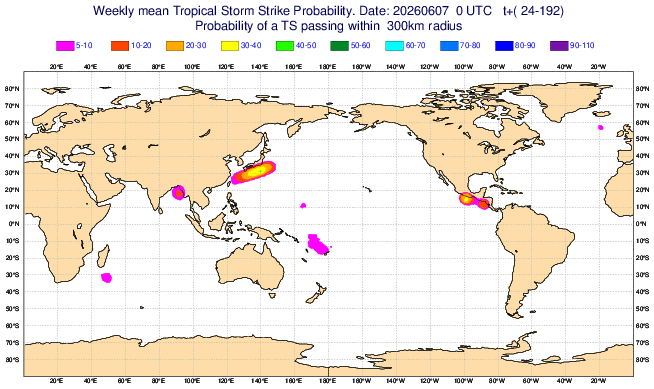
Days 8–15: Tropical Threat Outlook
During the second forecast period, the western Pacific threat expands and becomes more elongated, with strike probabilities stretching from the South China Sea and Philippines eastward across the Philippine Sea and into waters south of Japan. The strongest signal remains in the western North Pacific, suggesting an active basin with potential tracks that could affect the Philippines, Taiwan, the Ryukyus, or nearby shipping lanes depending on storm evolution. A separate low-probability area appears near Central America and southern Mexico, while another tropical signal emerges across the southwest Pacific near Papua New Guinea and island areas east of Australia, indicating broader but generally lower-confidence tropical development potential.
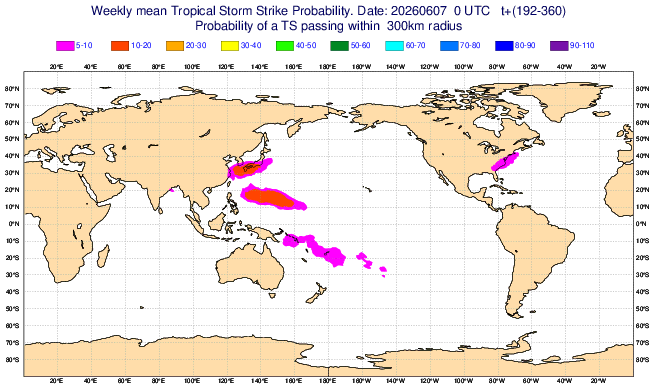
Days 15–22: Tropical Threat Outlook
By the third forecast map, the western Pacific becomes the dominant global tropical concern. Probabilities increase and broaden from the South China Sea through the Philippines and into the Philippine Sea, with the highest concentration of risk near and east of the Philippines, extending northward toward Taiwan, the Ryukyus, and waters south of Japan. This pattern points to a more favorable large-scale environment for tropical cyclones in the western North Pacific, with multiple possible threat corridors for East and Southeast Asia. The eastern Pacific also shows a more defined area of risk west of Central America and southern Mexico, suggesting tropical activity may become better organized there as well.
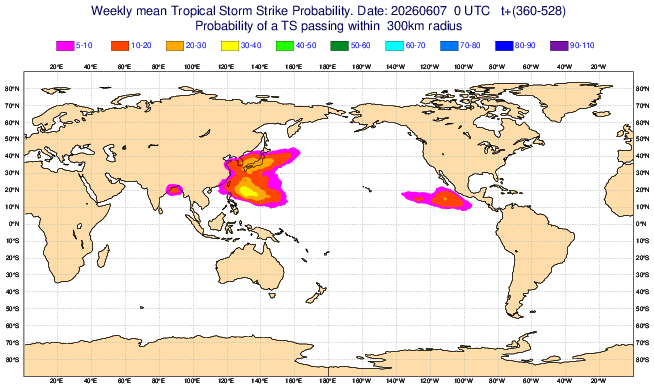
Days 22–29: Tropical Threat Outlook
The final forecast window continues to highlight an active western Pacific, with broad tropical storm strike probabilities covering the South China Sea, the Philippines, the Philippine Sea, Taiwan vicinity, and areas extending northeastward toward Japan. The risk footprint is large, which implies either increased uncertainty in possible tracks or potential for multiple systems across the basin. The eastern Pacific remains another important region to watch, with probabilities concentrated well south and southwest of Mexico and Central America, possibly tied to developing tropical activity moving westward offshore. Additional low-probability areas appear near India and the northern Indian Ocean, but the main tropical threats remain centered on the western Pacific and the eastern Pacific.
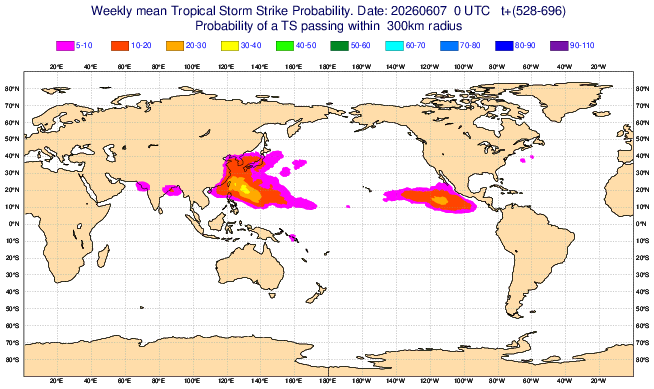
Published by Takahisa Nishikawa
Summary TS Jangmi brought heavy rainfall to Japan’s Pacific coast on June 3 before moving off to the east. A new tropical depression has since developed near Taiwan and warrants close attention. While rapid intensification looks unlikely given below-normal SSTs in Jangmi’s wake, the primary risk is a scenario where the system continuously feeds warm, moist air into a stalled front near southern Kyushu, triggering potentially severe rainfall around June 7. For energy markets, the focus is on the impact to large-scale solar installations in Kyushu and the region’s renewable generation and supply-demand balance.
Jangmi Has Cleared — But a New System Is Developing
TS Jangmi brought heavy rain to Japan’s Pacific coast on June 3 before tracking east. Attention now shifts to a new tropical depression that has developed near Taiwan. The latest ECMWF ensemble guidance suggests this system will track northeast, potentially following a path similar to Jangmi’s.
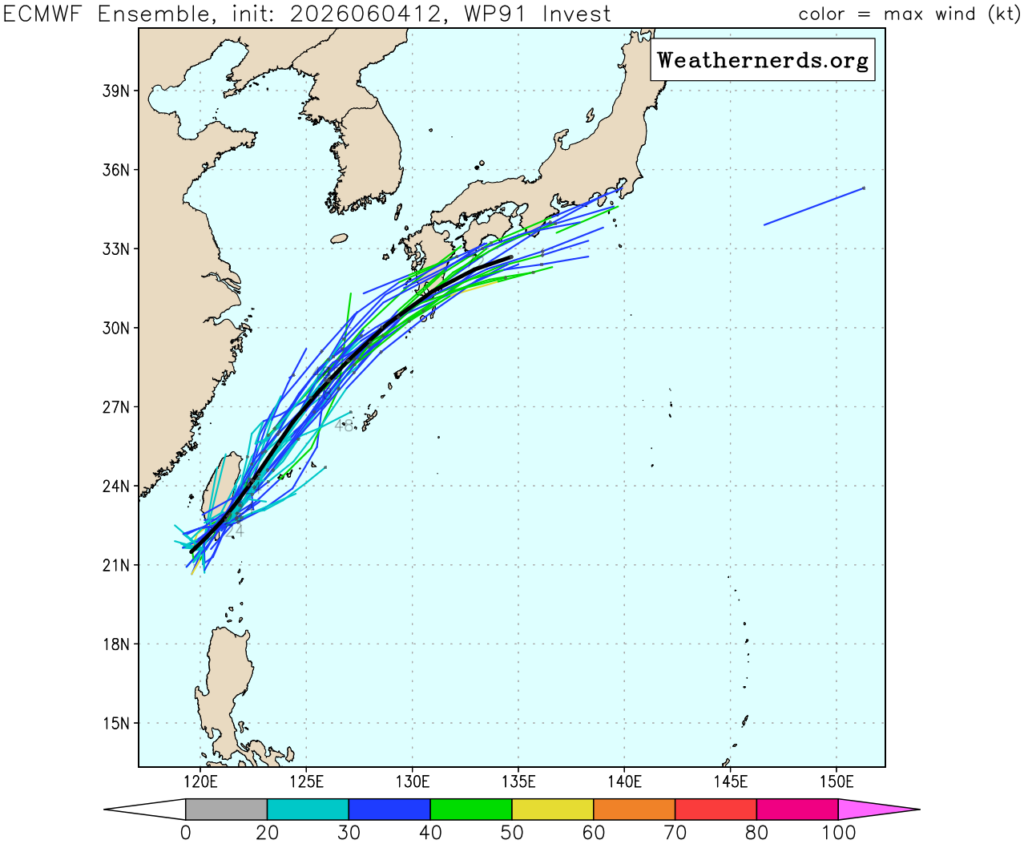
Rapid Intensification Unlikely
Significant intensification looks unlikely at this stage. Sea surface temperatures in the waters Jangmi passed through are running below normal, and the area with SSTs above 26.5°C — the threshold generally considered necessary for tropical cyclone development and maintenance — is limited. A rapid intensification scenario is therefore assessed as low probability.
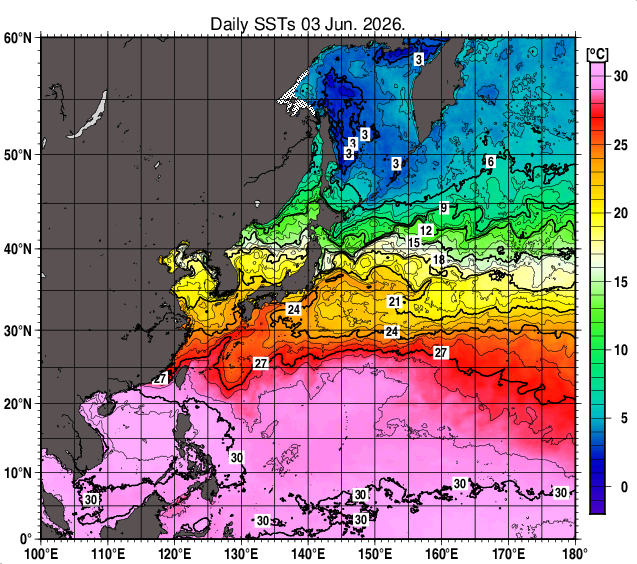
The Primary Risk: Frontal Rainfall Enhanced by Moist Tropical Inflow
The scenario that warrants the most attention is not a direct typhoon strike, but rather the continuous injection of warm, moist air from the south that could activate a stalled front near southern Kyushu. Current guidance points to the risk of very heavy rainfall across southern Kyushu and the Pacific side of Shikoku, centered around June 7. Localized totals could be significant, raising the risk of landslides, flooding in low-lying areas, and river level rises. It is worth recalling that Jangmi triggered river flooding in parts of Wakayama Prefecture — a similar risk could materialize depending on rainfall totals this time.
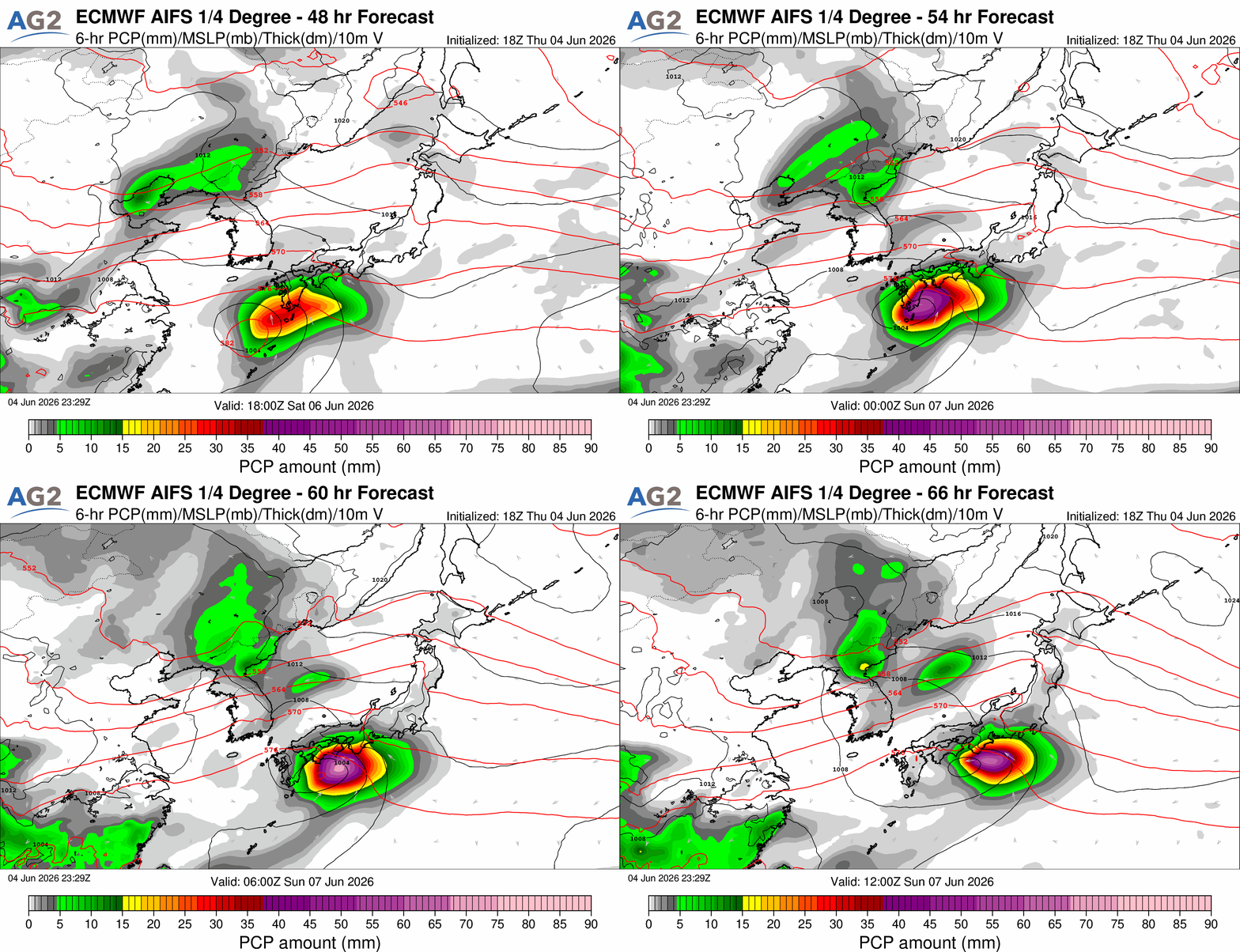
Energy Market Implications: Kyushu Solar in Focus
From an energy market perspective, the key area to watch is Kyushu. Southern Kyushu and Miyazaki Prefecture host a large number of utility-scale solar installations, and heavy rainfall raises the risk of slope failures, sediment intrusion, and road closures that could directly or indirectly affect generating capacity.
Persistent thick cloud cover is also expected to suppress solar output significantly, with implications for Kyushu’s renewable generation outlook and regional supply-demand balance. Continuous monitoring will be essential through the weekend.
In short, the primary risk scenario here is not a powerful typhoon making landfall — it is frontal rainfall enhanced by tropical moisture inflow. The rainfall forecast and any track shifts in the tropical depression deserve close attention as the weekend approaches.
Published by Ed Vallee
This piece discusses the month of June in a historical context with respect to pop weighted CDDs and how 2026 stacks up against other years dating back to 1960.
To start, let’s get a quick look at how the month of June is likely to start out – it will start out warmer than normal for the northern tier with “coolest” risks in the South and East.
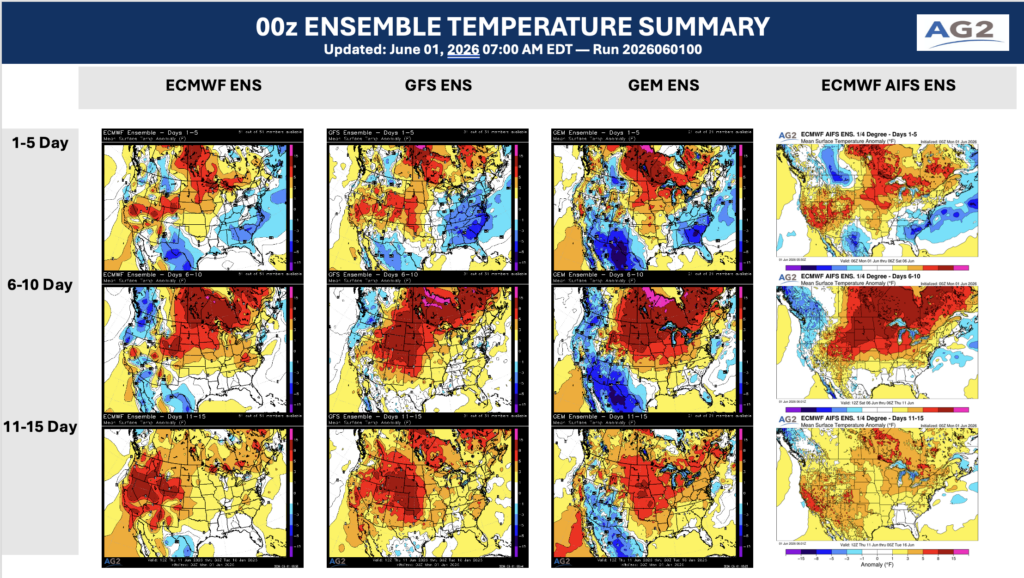
With our 15 day forecast covering much of the front half of the month, the June 1-15 forecast yields 126.1 CDDs, 19.5 CDDs above the 30 year normal for that same period. The 16-30 day likely will feature a CDD regime near 10 and 30 year normals given the warmth settling in the West. Our official current June CDD value is 274.
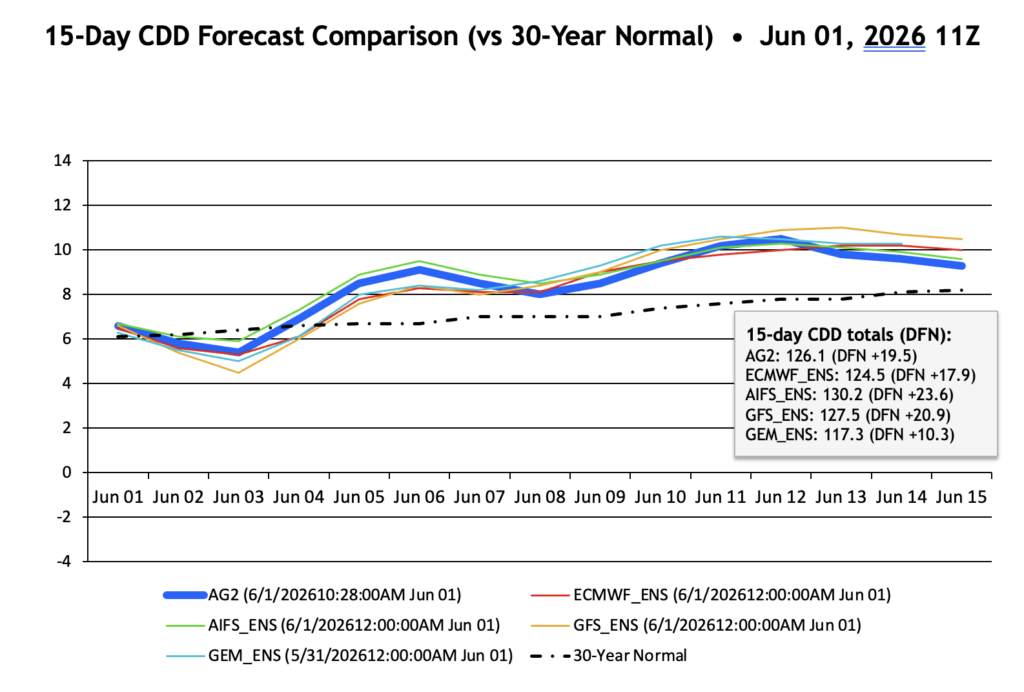
Our June 2026 CDD forecast stands at 274 CDDs. This would be the 9th warmest since 1960. 2025 yielded 276 CDDs. Notice Texas is coolest relative to the 2016-2025 rolling 10 year normals.
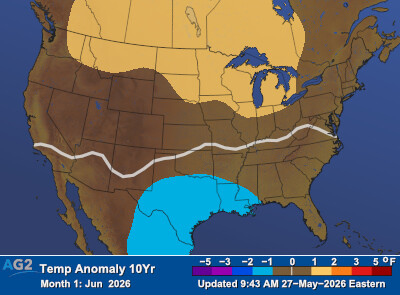
Based on observations since 1960, we can see our 2026 forecast of 274 CDDs would be good for the 9th warmest June.
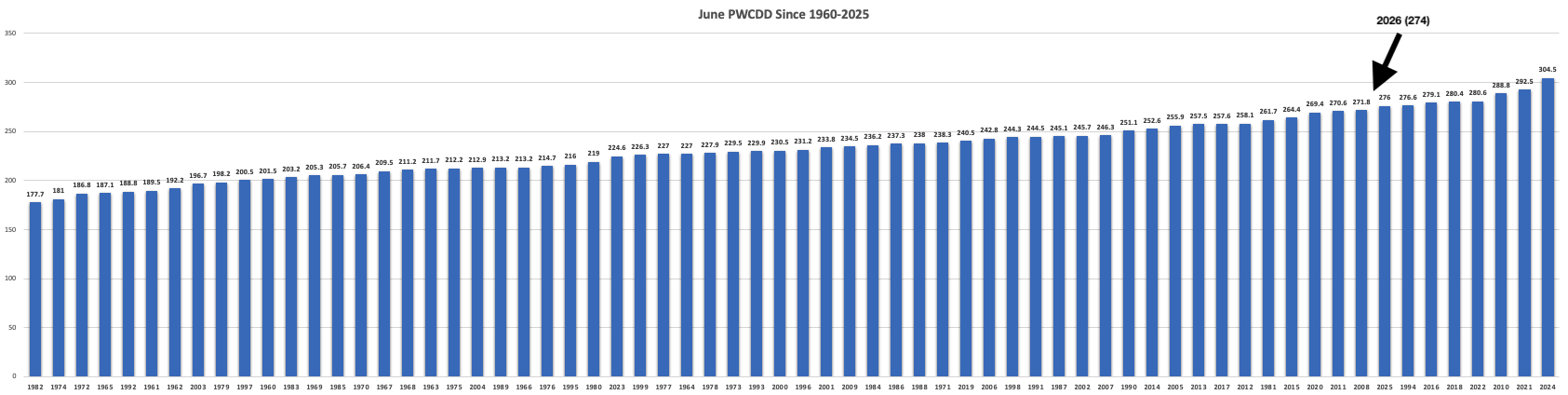
By the numbers, we can see that our current projection of 274 CDD is not in the top 5 coldest or warmest June’s since 1960, but we are not far off from the 5th warmest spot…
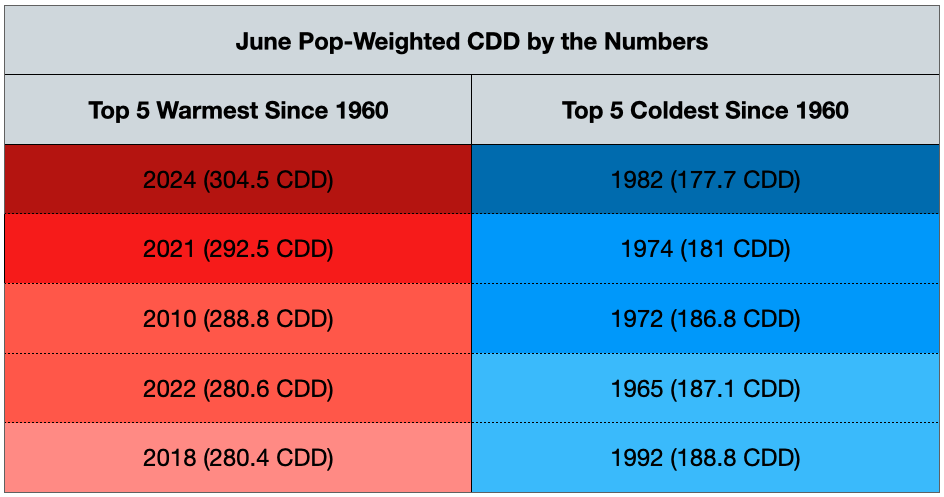
Bottom line: a warmer than normal June is expected in terms of pop-weighted CDDs, falling above the 10 and 30 year normals, with warmest risks generally focused in the north-central U.S.
Published by Takahisa Nishikawa
Summary Analysis of weekly 500 hPa geopotential height forecasts suggests that the rainy season onset across much of Honshu may arrive slightly later than normal this year. By contrast, the end of the rainy season in southern Kyushu could come slightly earlier than normal. This stands in sharp contrast to last year’s exceptionally early rainy season, which concluded across most of the country — except Tohoku — by the end of June.
Background: Normal Timing and Last Year’s Contrast
The rainy season typically begins across most of Honshu between early and mid-June, with the end arriving between mid- and late July. Last year was a notable exception — the rainy season onset was exceptionally early across most regions (excluding Tohoku), and the end of the rainy season was similarly advanced, wrapping up by late June almost everywhere outside of Tohoku. This year’s pattern looks set to be quite different.

Methodology: Reading the Baiu Front and Pacific High From 500 hPa Heights
A well-established framework links the 500 hPa geopotential height field to the rainy season pattern: the Baiu front typically corresponds to the 5820 m contour, while the western Pacific subtropical high is associated with the 5880 m contour. The following analysis uses weekly 500 hPa GPH anomaly forecasts to assess the likely timing of rainy season onset and end by region.
Week 2 (June 8–15): Southern Kyushu May See Rainy Season Onset
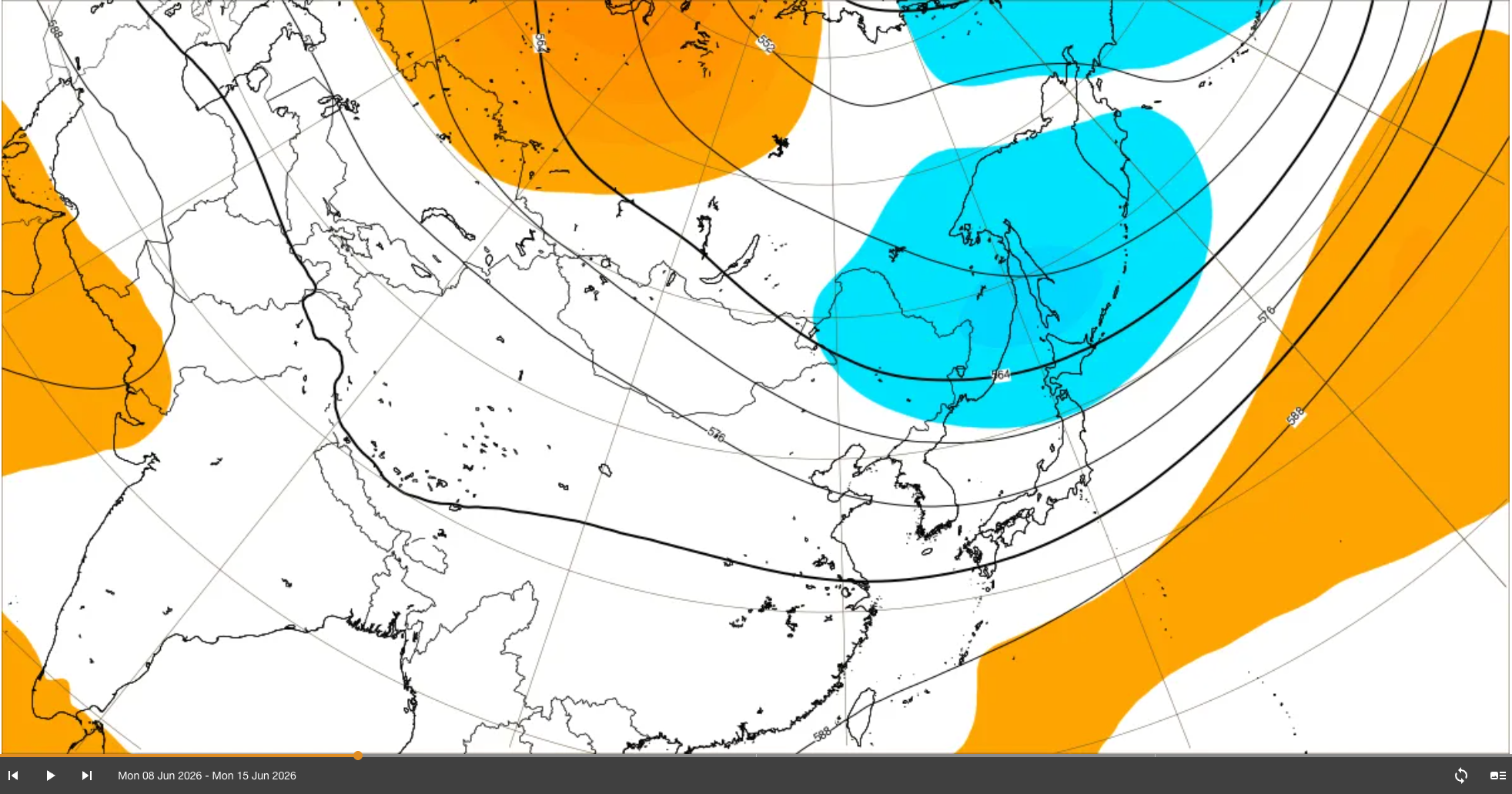
The 5820 m contour is forecast to sit over southern Kyushu during this period, but does not extend to other regions. The 5880 m contour remains south of Okinawa. The rainy season onset looks possible for southern Kyushu during this window, but most of Honshu remains too early.
Week 3 (June 15–22): Rainy Season Onset Likely for Much of Honshu

The 5820 m contour advances northward to cover northern Kyushu, Shikoku, southern Kansai, Tokai, and Kanto. The 5880 m contour moves to near Okinawa. The rainy season onset is possible across northern Kyushu, Shikoku, Kansai, Tokai, and Kanto during this period. Okinawa may also see the end of its rainy season around this time.
Week 4 (June 22–29): Front Reaches Tohoku; Amami May See Rainy Season End

The 5820 m contour continues northward to southern Tohoku, while the 5880 m contour nudges slightly north of Okinawa. The rainy season onset is possible across the Chugoku region, Hokuriku, and Tohoku by the end of this period. The Amami Islands may also see the end of their rainy season around this time.
Week 5 (June 29 – July 5): Southern Kyushu May See Rainy Season End
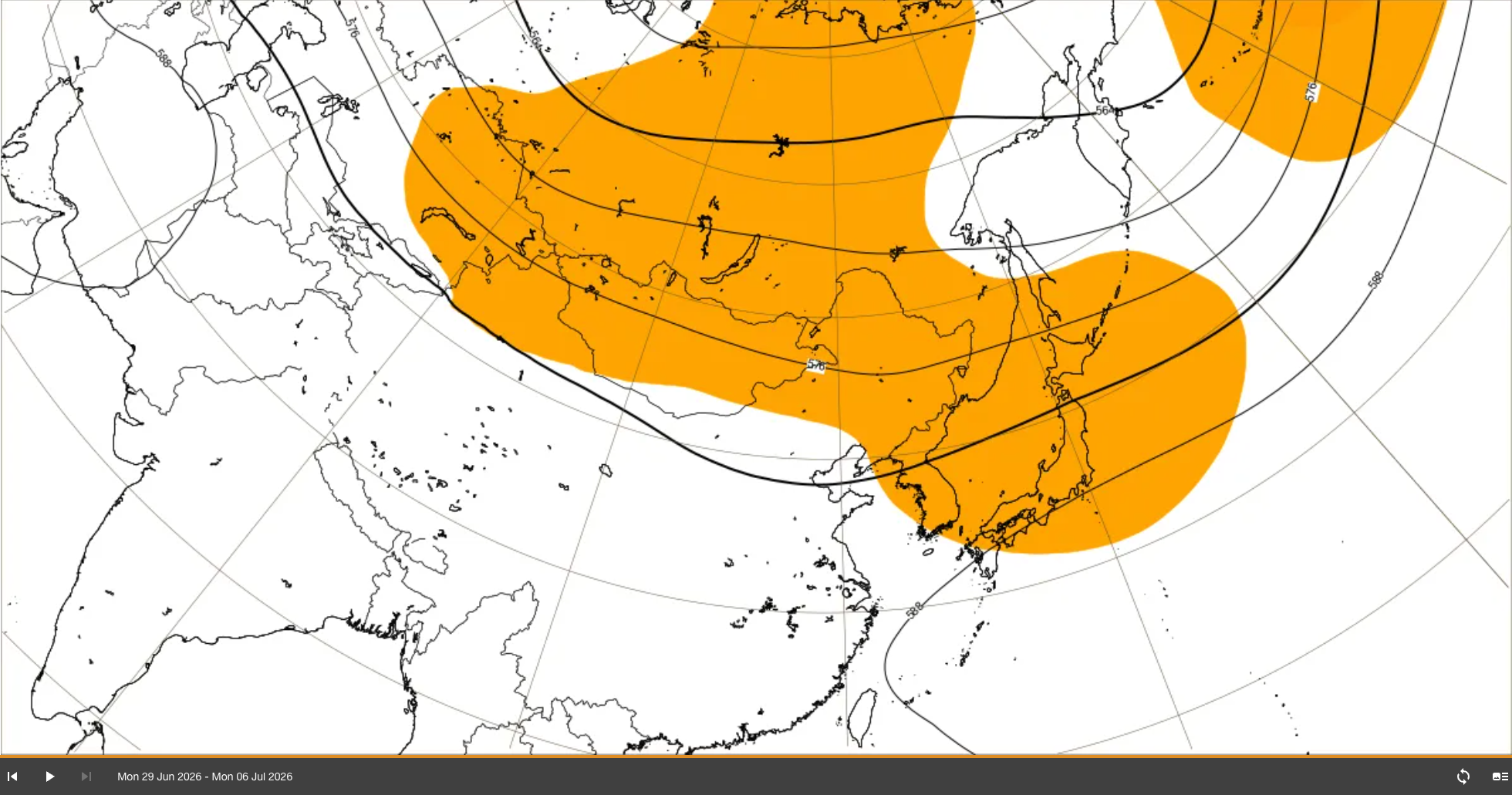
The 5820 m contour advances to northern Tohoku, and the 5880 m contour moves northward to southern Kyushu. This suggests the end of the rainy season in southern Kyushu could arrive during this window. Note that Week 5 forecasts carry significant uncertainty and should be treated as indicative rather than definitive.
Bottom line: Taken together, the 500 hPa height analysis points to a rainy season onset that is slightly later than normal across much of Japan this year, while the end of the rainy season in southern Kyushu may arrive slightly earlier than normal. Week 5 uncertainty limits confidence at that range, but the overall picture contrasts clearly with last year’s exceptionally early rainy season. Further updates will be provided as the sub-seasonal forecast evolves.
Published by Takahisa Nishikawa
Summary The IMD’s May 15 press release placed the monsoon onset over Kerala at May 26 ± 4 days, but current conditions and the near-term forecast pattern suggest a slight delay is possible. The Northern Limit of Monsoon line has stalled near the Andaman & Nicobar Islands over the past few days, and the 850 hPa Zonal Wind Anomaly map indicates that sufficiently moist low-level westerlies are unlikely to reach the Kerala area through the end of May. From June onward, strengthening low-level westerlies should bring the onset back within the normal range. With El Niño expected to suppress convective activity and push total monsoon rainfall below normal this year, an early onset — or at least one that doesn’t slip too far — is particularly important for limiting the dry season risk.
Northern Limit of Monsoon: Progress Has Stalled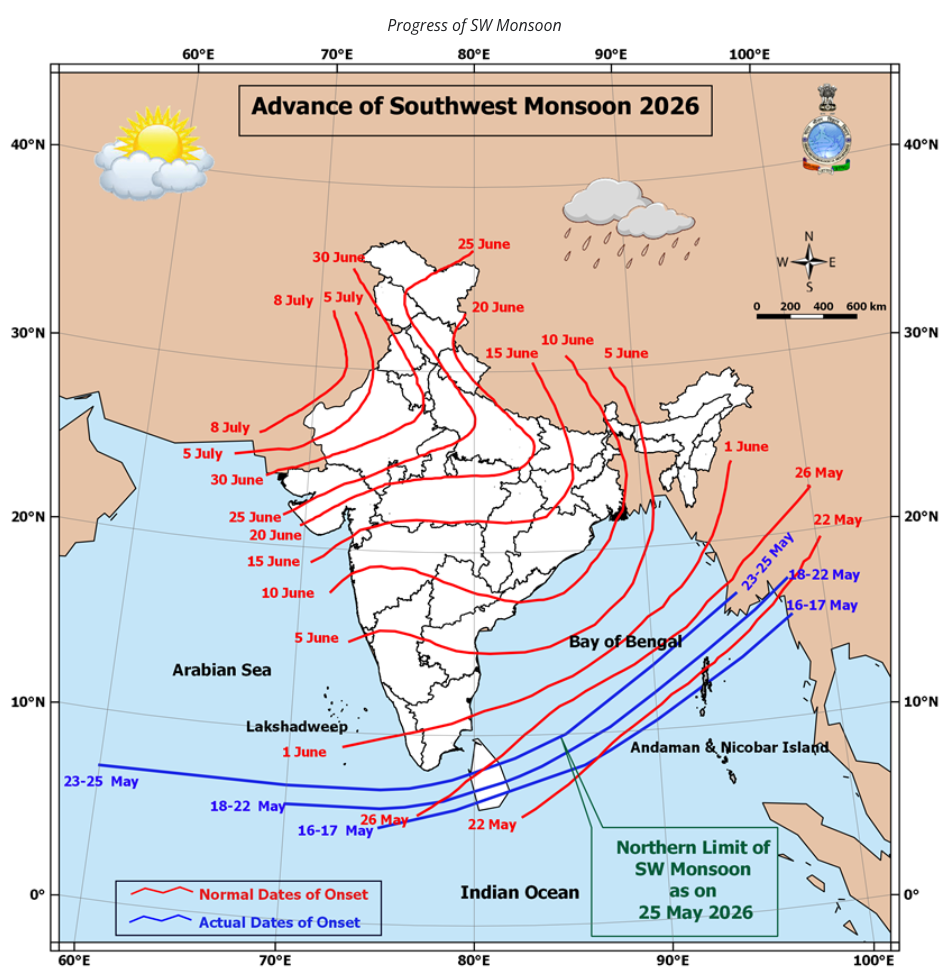
The latest monsoon onset map for India shows the Northern Limit of Monsoon (NLM) line covering the Andaman & Nicobar Islands, but forward progress has effectively stalled over the past few days.
The IMD’s May 15 press release forecast the monsoon onset over Kerala for May 26 ± 4 days. Based on current weather maps and near-term guidance, however, a slight delay beyond that window cannot be ruled out.
Why the Delay? Low-Level Westerlies Are Tracking Too Far South
Precipitation forecasts out to ten days show a drier-than-normal tendency over Kerala and southern India. One key factor is that the low-level zonal wind flow is meandering slightly southward over southern India, limiting the delivery of sufficient moisture to the Kerala region.
The 850 hPa Zonal Wind Anomaly map supports this assessment, indicating that the moist low-level westerlies needed for a monsoon onset are unlikely to reach the Kerala area in meaningful strength through the end of May.
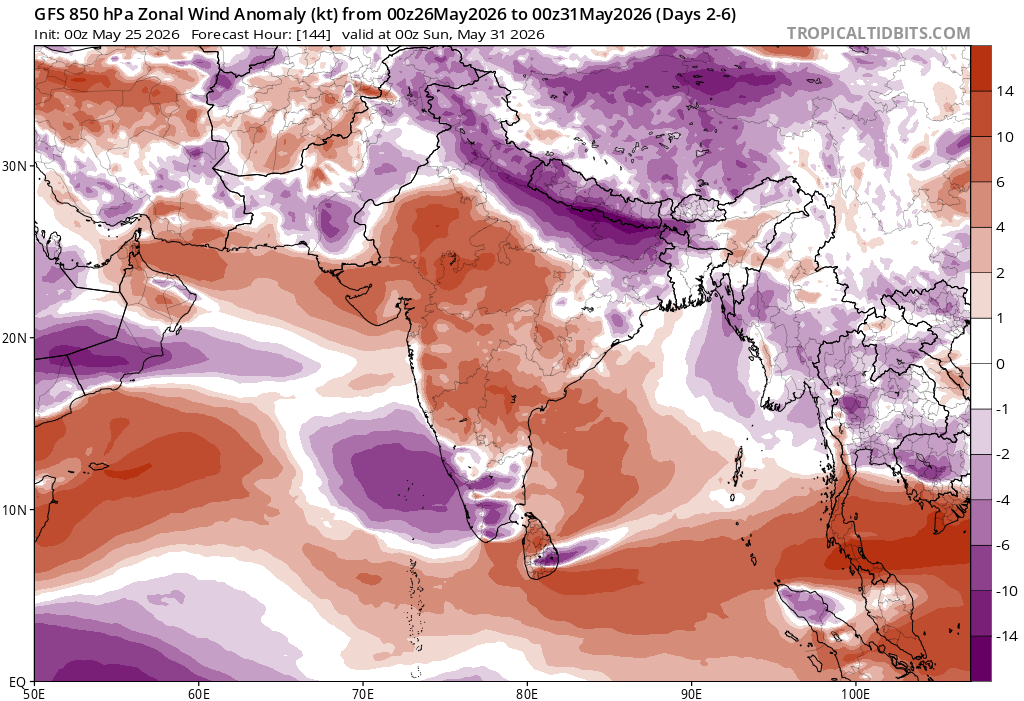
From June: Westerlies Strengthen, Onset Expected Within Normal Range
From June onward, low-level westerlies are expected to strengthen, bringing the monsoon onset back within the climatologically normal range. The current delay appears likely to be temporary, but continued monitoring of model updates will be important as the situation evolves.

El Niño Influence: Below-Normal Rainfall Risk This Season
El Niño is expected to suppress convective activity across India this year, with total monsoon season rainfall forecast to run below normal. In this context, the timing of the onset matters more than usual — every day the monsoon arrives earlier helps reduce the cumulative rainfall deficit for the season. The onset date will be closely watched by agricultural, water resource, and energy sector stakeholders alike.

Published by Takahisa Nishikawa
Summary The next 15 days split into two distinct risk periods: multiple low-pressure systems through late May, followed by tropical storm risk from June 2 onward. Track and intensity uncertainty for the potential tropical system is extremely high, but some models suggest a possible approach toward the Kanto region in early June. On the sub-seasonal scale, a ridge-dominant pattern near Japan is expected from early June through early July, keeping temperatures near to slightly above normal. The rainy season onset looks on schedule or slightly early, with an earlier-than-normal end to the rainy season possible for eastern Japan.
First Half (Through May 29): Multiple Low-Pressure Systems
The low that brought cloudy and rainy conditions through today has moved off to the east. A new low developing over the waters south of Japan is expected to pass along the southern coast on May 23–24, raising the risk of below-forecast solar output on the Pacific side of eastern and western Japan.
May 25 brings a brief respite, with a mobile high bringing broadly clear skies across Japan.
From May 26, however, a new low approaching from the Chinese mainland will bring cloudy and rainy conditions to western Japan on May 27, spreading to eastern and northern Japan from May 28.
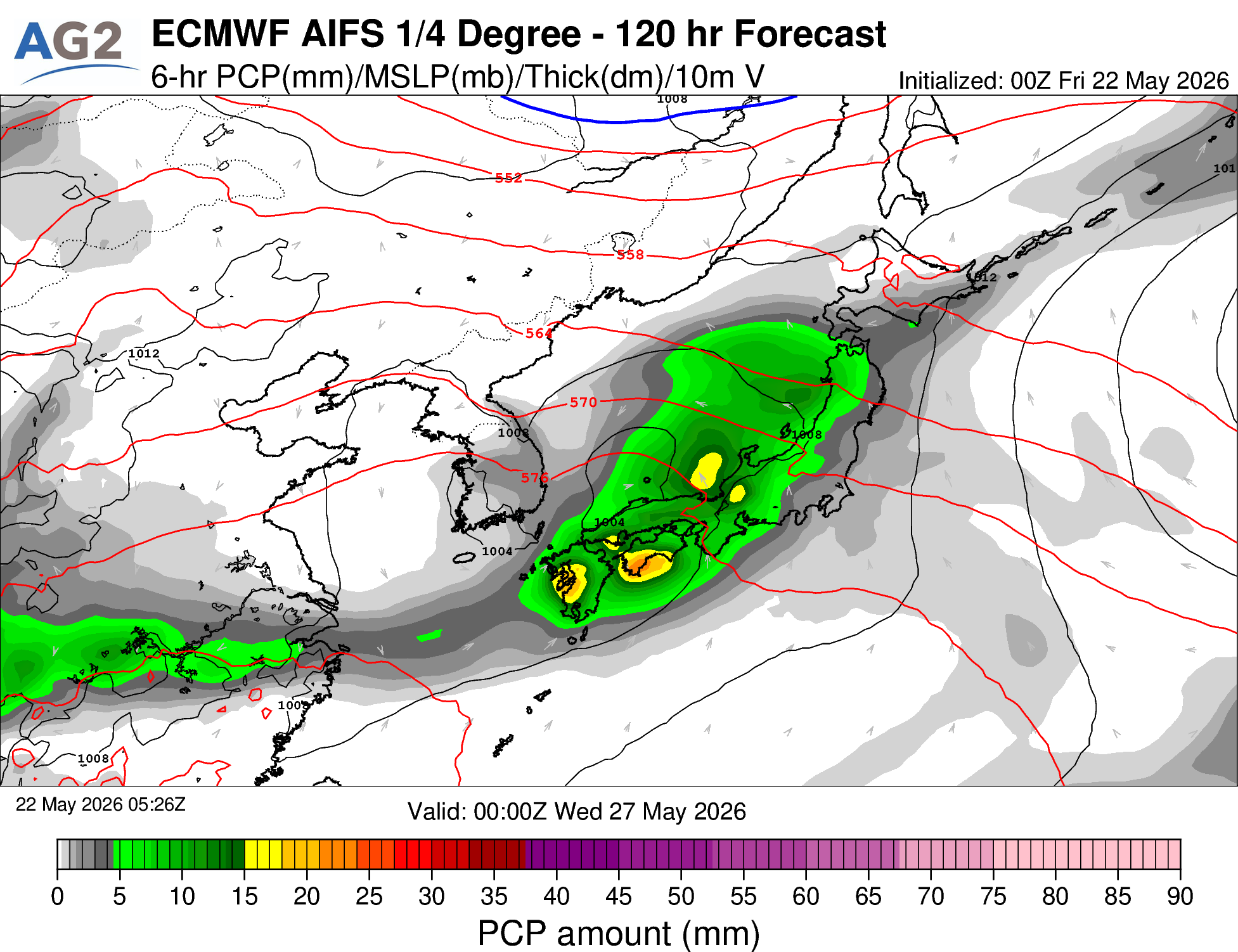
From May 29, a deepening low tracking east across the northern Sea of Japan will bring strong winds, particularly for eastern Japan, with widespread cloud and rain across northern Japan on the same day. May 30–31 and June 1 see high pressure return, with broadly clear and settled conditions expected across Japan.
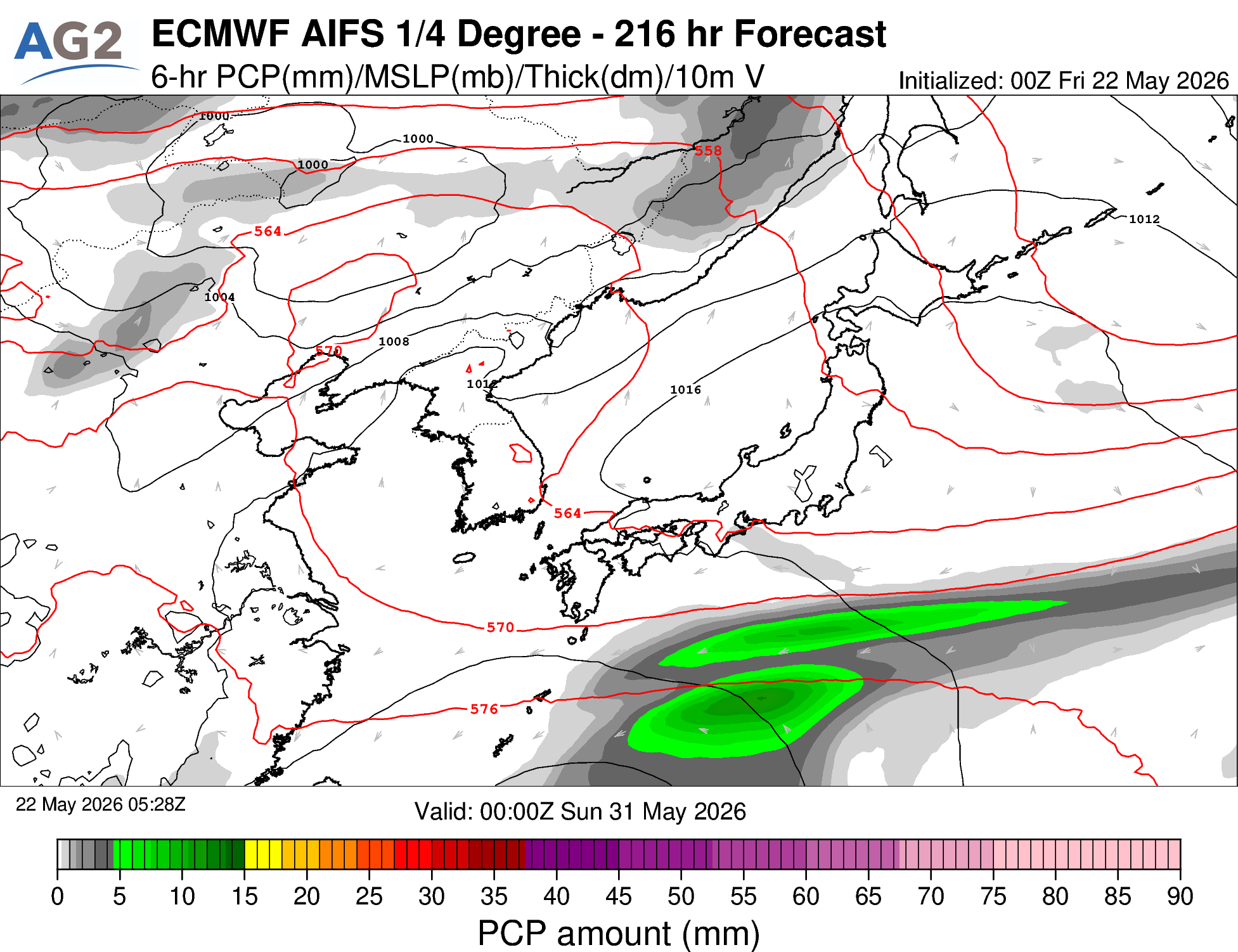
Second Half (From June 2): Tropical Storm Risk Emerges
No tropical storms are currently being monitored by the JTWC. However, from late May, several global models are suggesting the possibility of tropical cyclone development east of the Philippines. Track and intensity uncertainty is extremely high, but some models point to a possible approach toward the Kanto region in early June. Updates will be provided frequently as the situation develops.
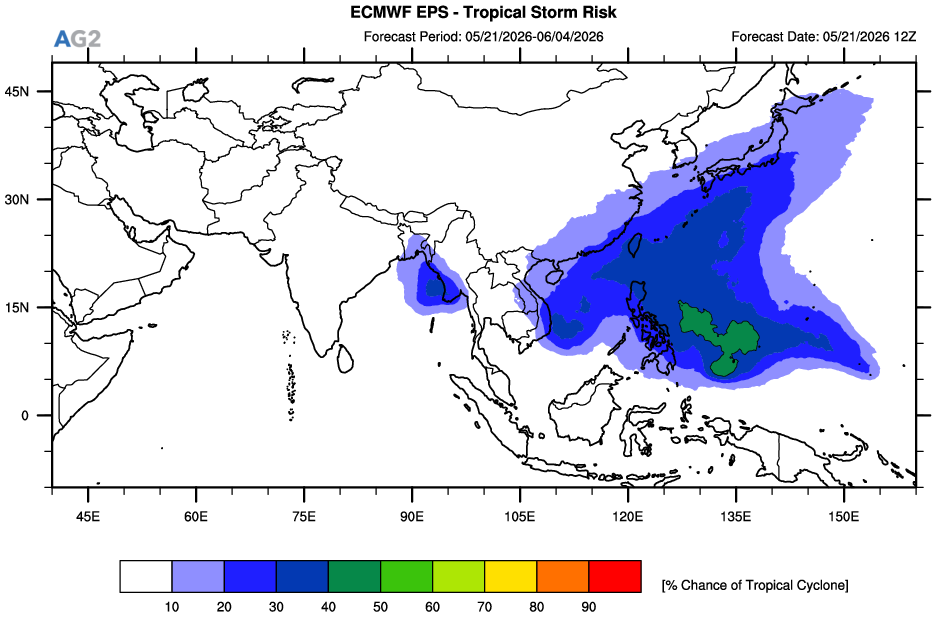

Temperature
Temperatures in eastern Japan will run slightly below normal through May 24, before recovering to near- or slightly above-normal from May 25 onward. May 25 stands out as a potential midsummer-like day, with parts of the Kansai region possibly reaching 30°C under the influence of the high. The above-normal temperature tendency is expected to continue thereafter, though tropical storm uncertainty introduces meaningful variability risk to the temperature outlook from June onward.
Precipitation

Above-normal precipitation is expected across northern and eastern Japan through the period, with slightly above-normal totals also possible along the coast of western Japan. While no extreme dry risk is apparent, a low-pressure system around May 27 carries the risk of heavy rainfall in Kyushu. Precipitation forecasts for the latter half of the period are highly sensitive to the tropical storm track.
Solar
Solar output will be disrupted at times during the first half of the period due to frequent low-pressure passages, but May 25, 30, and 31 stand out as favorable days under high-pressure influence. Output looks modestly above normal from June 1, but remains highly sensitive to the tropical storm track.
Sub-Seasonal Outlook (Early June Through Early July)
A ridge-dominant pattern is expected near Japan from early June through early July, with positive height anomalies centered on eastern and northern Japan. A trough is consistently forecast near northern China and the Korean Peninsula through this period. Temperatures are expected to run near to slightly above normal, with medium confidence in this outlook.

A low-pressure anomaly is expected through mid-June, bringing slightly above-normal precipitation in the first half of June. From Week 4 onward, a high-pressure anomaly begins to emerge over eastern Japan, shifting eastern Japan toward near- to slightly below-normal precipitation, while western Japan remains prone to above-normal rainfall from moist southerly flow around the ridge.

Solar output will be slightly below normal for eastern Japan in the first half of the sub-seasonal period, shifting to below normal for western Japan around Week 5 (late June). In Week 6 (late June through early July), a scenario where high pressure covers all of Japan emerges, which could bring a favorable period for solar power generation.
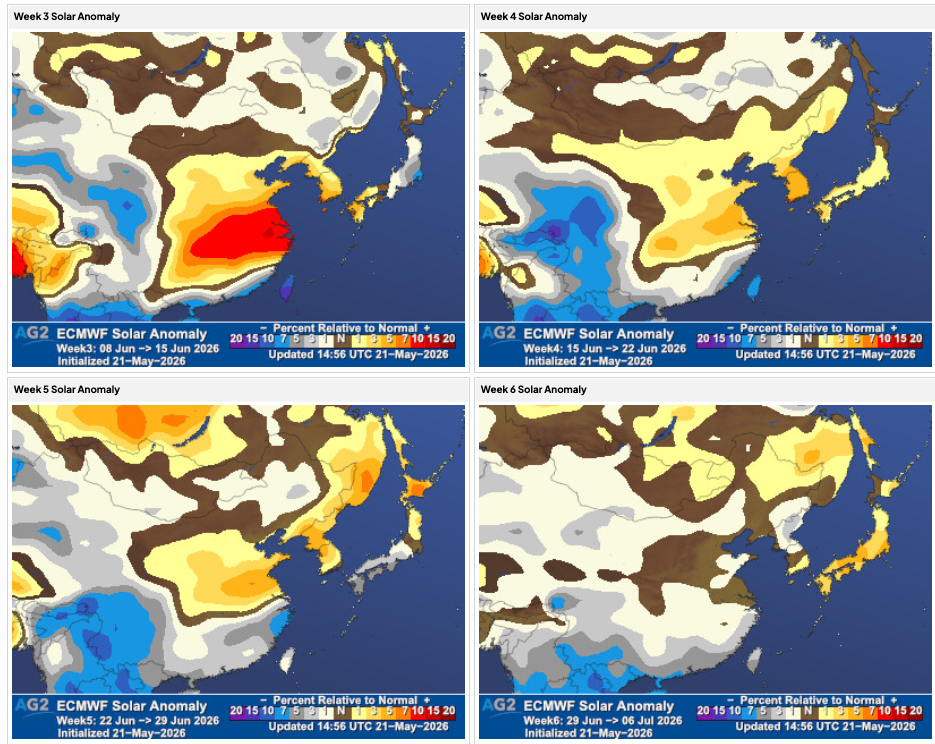
The rainy season onset is expected near normal or slightly early. The end of the rainy season in eastern Japan may also arrive slightly ahead of schedule.
Tropical Storm Strike Risk
ECMWF Tropical Storm Strike Probability guidance shows elevated approach risk for eastern and western Japan through June. While tropical cyclone formation probability in the Philippine Sea and northwest Pacific from mid-June onward is not particularly high, there is also the possibility of extratropical low-pressure development near Japan. Either way, the guidance points to elevated heavy rainfall risk, and the track of any tropical or low-pressure disturbance warrants close monitoring.
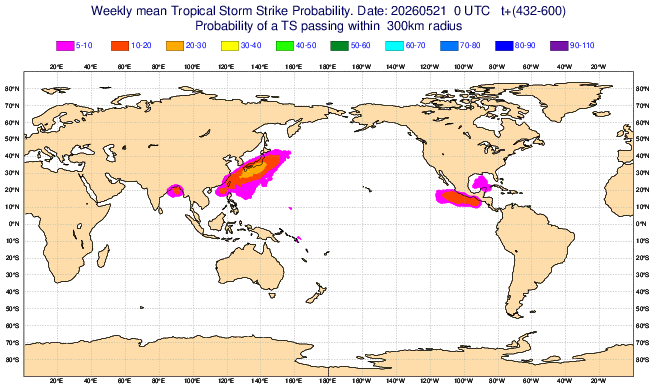
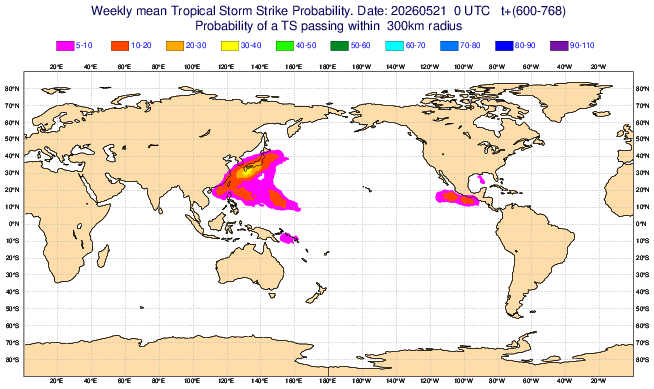
Published by Ed Vallee
The 14 day national demand change since yesterday is +1.2 CDDs…
Modeled temperatures next 15 days: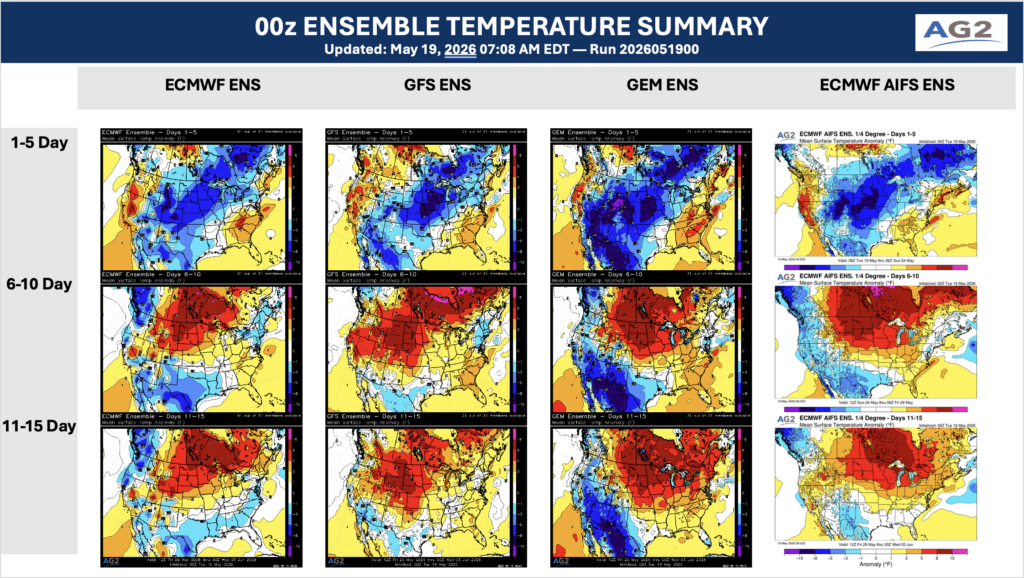
Our forecast in terms CDDs with changes since yesterday:
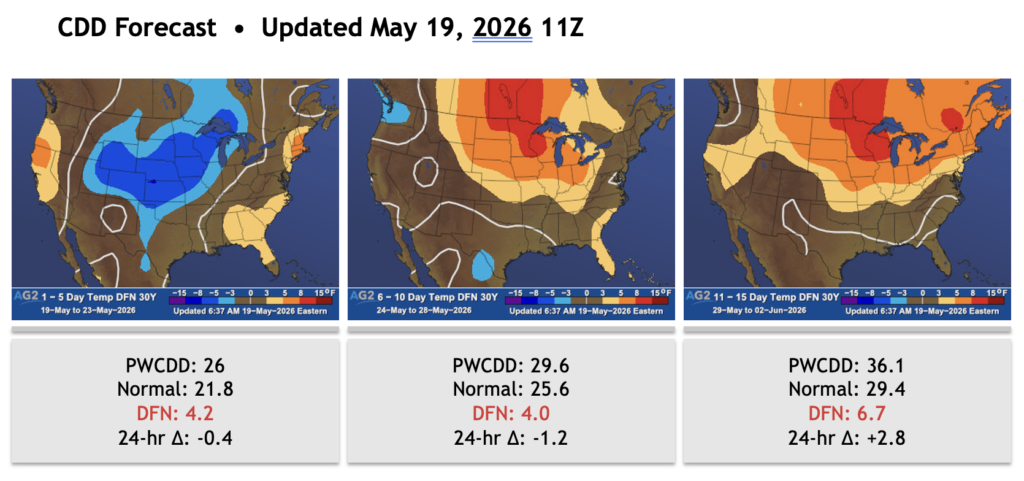
Degree day info, noting we continue to be on the warmer side of guidance throughout the period.
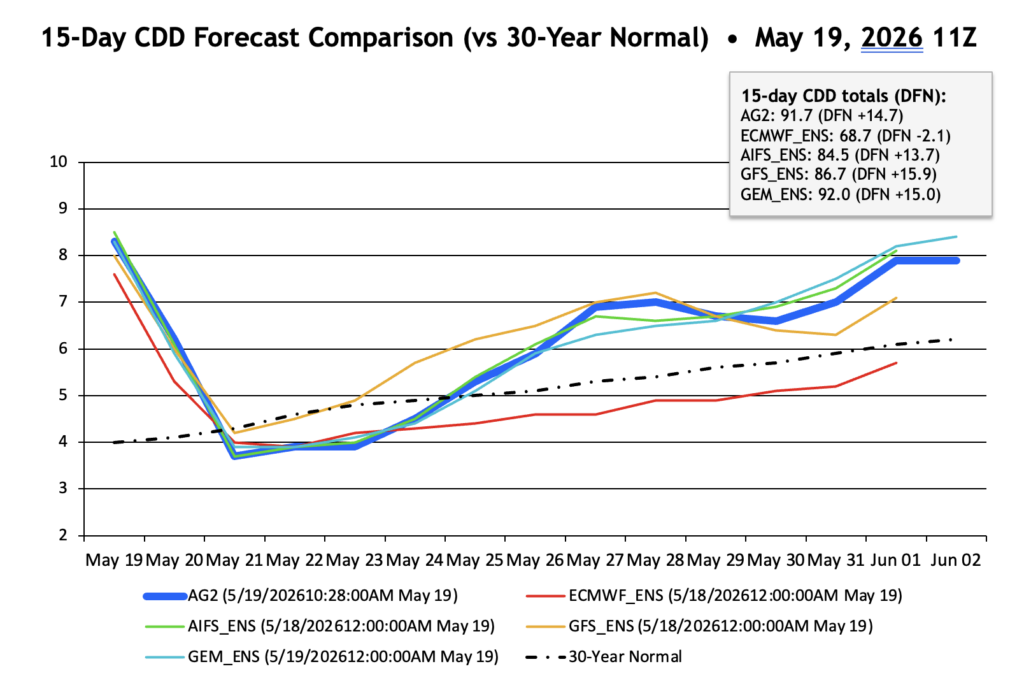

Looking at day 15, June 2nd, ridging remains focused across the northern tier, but extreme heat is hard to come by: lots of 80s across MISO and PJM.
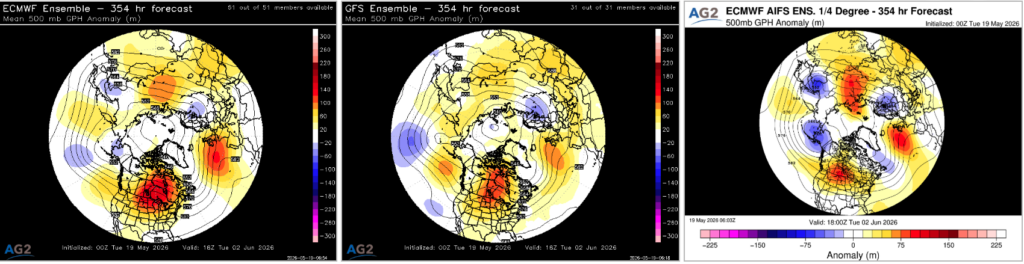
The 15 day precipitation forecast is starting to resemble El Nino, with precipitation focused across the southern tier, including Texas:
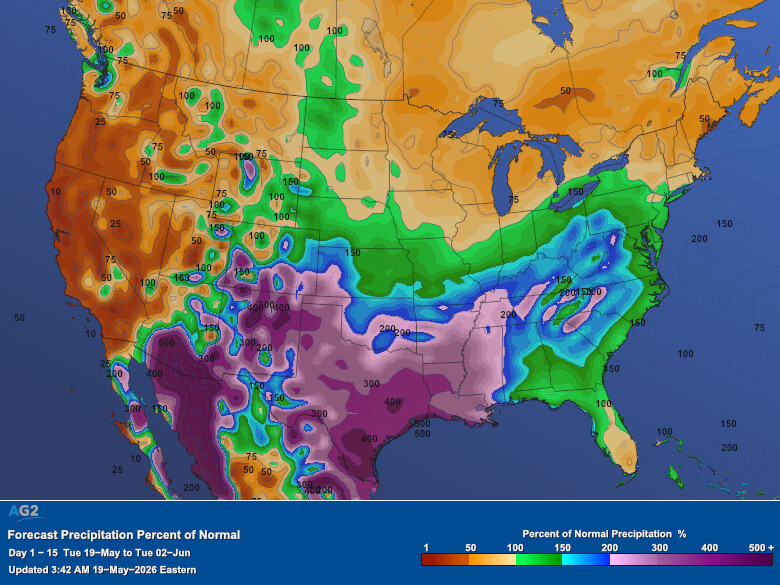
Published by Takahisa Nishikawa
This article summarizes the factors behind the cool conditions in late May last year, the warming trend from mid-June onward, and the outlook through the end of June this year.
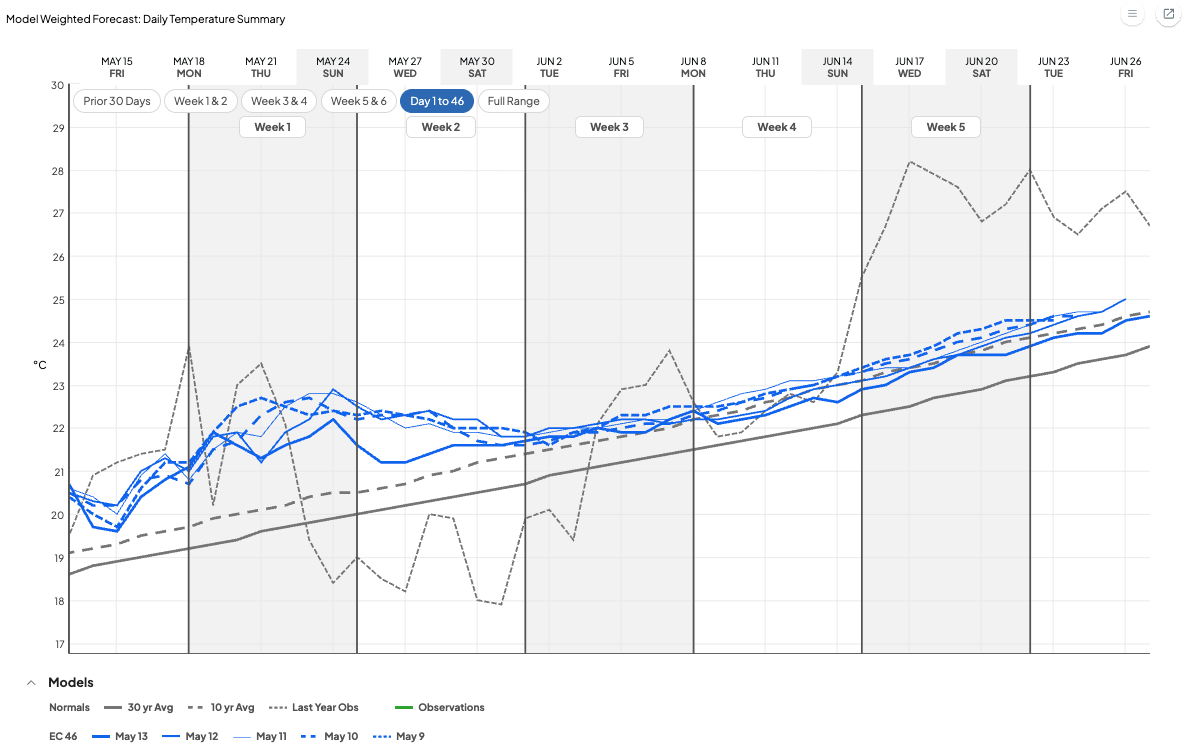
In summary, we currently assess the risk of a significant cool spell in late May this year, similar to last year, as relatively low. On the other hand, for the latter half of June, while a prolonged period of strong heat like last year is not the base-case scenario at this stage, short-lived heat events may still require attention depending on the timing of any break in the rainy season.
Late May to Early June
Last year: Cool conditions in late May due to the influence of a trough and frequent rainfall
The main reason for the cool conditions in late May last year was that an upper-level trough, or a low-pressure trough, tended to remain near Japan, allowing cold air to flow into the region.
In particular, the 500 hPa height field showed that western Japan was prone to the influence of the trough. In the lower levels, moist air also flowed in easily, and the rainy season began early, leading to above-normal precipitation in late May.
As a result, the combined effects of cold air, frequent rainfall, and reduced sunshine made it difficult for temperatures to rise, leading to below-normal temperatures.
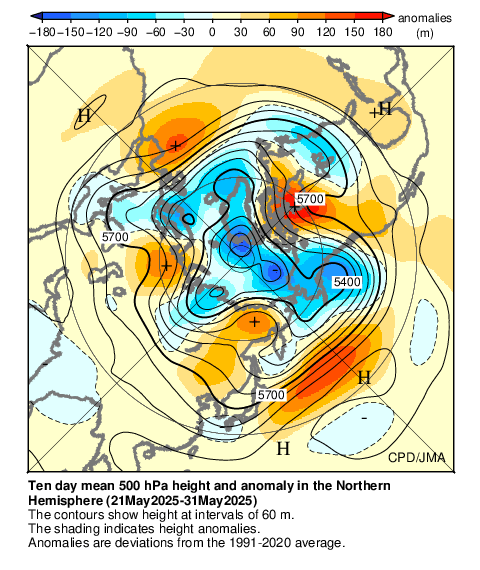
This year: A dominant ridge pattern makes a sustained cool spell like last year unlikely
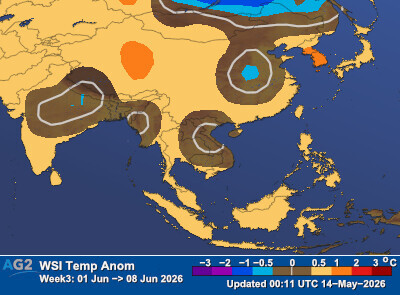
By contrast, for late May to early June this year, the current forecasts have been relatively consistent in indicating a dominant ridge pattern, suggesting a tendency for temperatures to be above normal.
The ECMWF ensemble forecasts do not currently show a clear signal of a long-lasting trough near Japan, as was observed last year.
Therefore, at this stage, we consider the likelihood of a sustained period of significantly below-normal temperatures, similar to last year, to be low. That said, there may still be short periods when temperatures are near normal or slightly below normal.
Late June
Last year: Heat in late June driven by a ridge pattern and surface high pressure
From mid- to late June last year, a ridge pattern, or anticyclonic pattern, persisted in the upper levels near Japan.
In addition, surface high pressure frequently covered the region, creating conditions that were unusually favorable for temperatures to rise during the rainy season. As a result, Japan was covered by very warm air, leading to intense heat from mid- to late June.
This heat event was one of the key characteristics of last June.
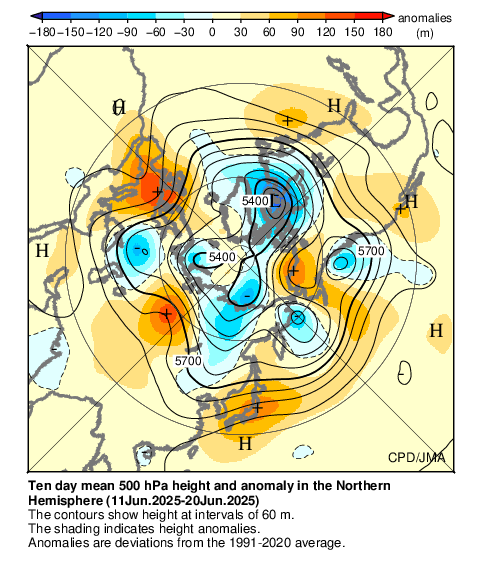
This year: A ridge as strong as last year is unlikely at this stage, but short-lived heat events remain possible
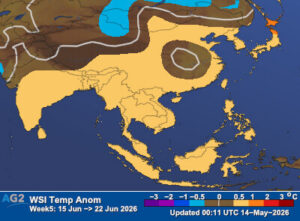
For the latter half of June this year, current forecasts do not indicate a ridge pattern as strong as the one observed last year.
Therefore, a prolonged period of extreme heat similar to last June is not considered highly likely as the base-case scenario at this point.
However, if a break in the rainy season allows high pressure to cover Japan while the upper-level ridge strengthens at the same time, there is still a meaningful possibility that heat comparable to last year could persist for around two to three days.
Summary
Taking these points together, we currently assess that a sustained cool period similar to last year is unlikely from late May to early June this year. For the latter half of June, however, the main risk to monitor is not necessarily a prolonged extreme heat event, but rather short-lived periods of intense heat.
As the forecast may change with future updates, it will be important to continue monitoring the latest ensemble forecasts and cluster analysis and update the outlook accordingly.
Published by Amy Hodgson
The Panama Canal is a major global shipping route, shortening transit times between the east and west coasts of the Americas. Severe drought in 2023 and into 2024 reduced Panama Canal transits by around 30% as low water levels limited canal operations. The main reservoir feeding the canal is Gatun Lake which has strong seasonal variability. The plot below shows the monthly average water levels over the past five years:
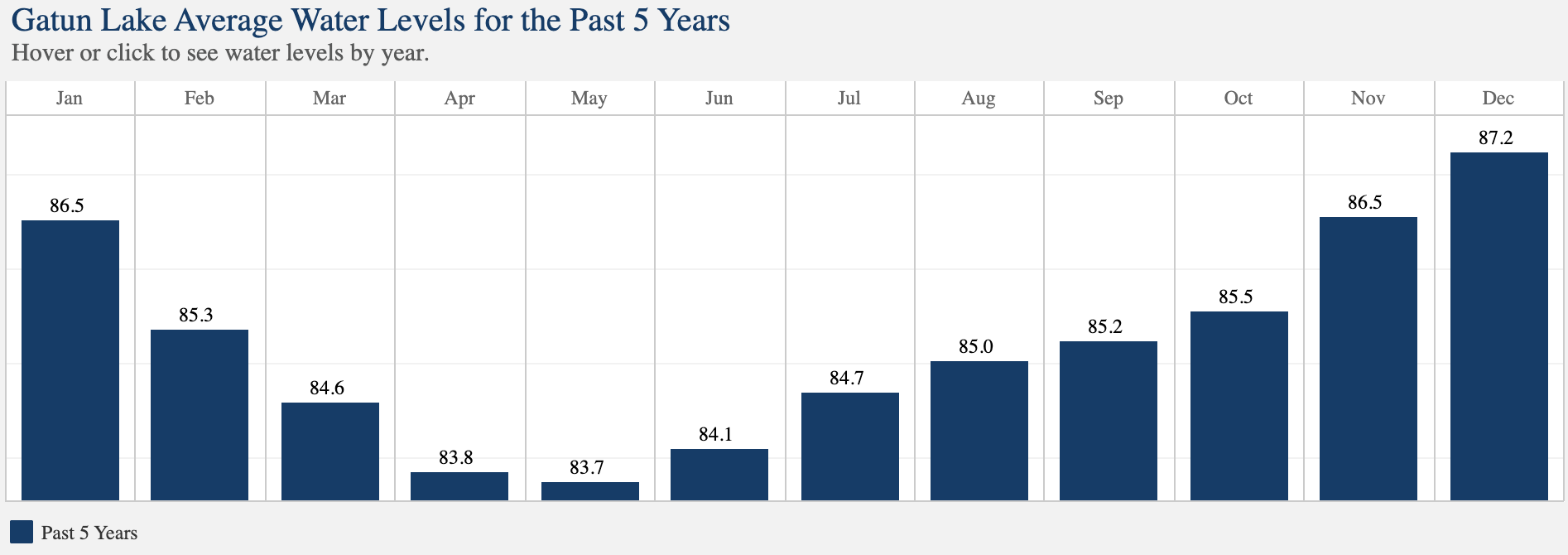
Taking a closer look at the yearly levels for May and August below, clearly shows the extremely low levels during the El Nino of 2023 and to begin 2024.
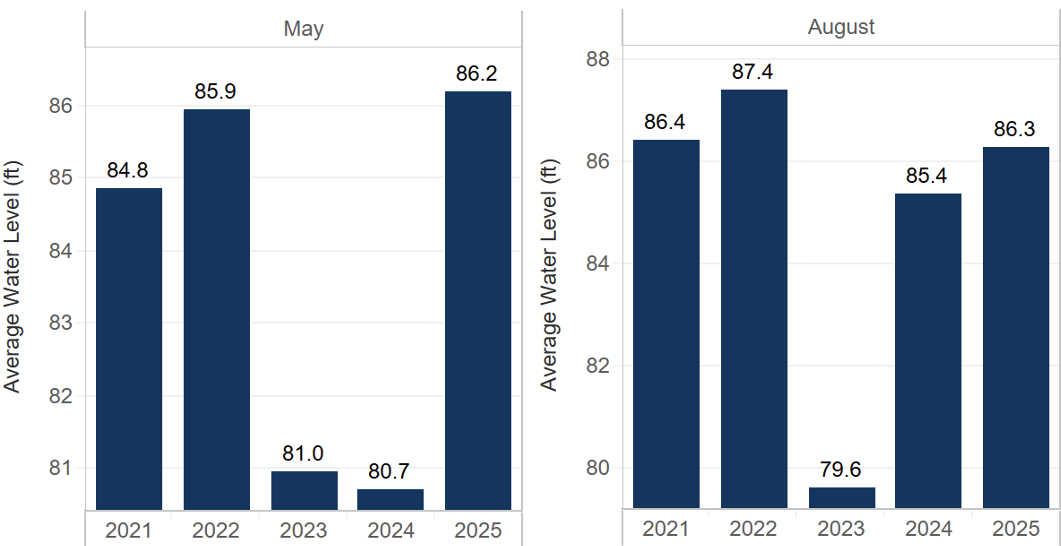
The strong El Nino through 2023-2024 is considered to have played a significant role in these drought conditions leading to the canal operating well below capacity. Daily transits dropped to as low as 24 vessels and maximum drafts fell below 44 feet. By later 2024 and through 2025, a change to La Nina conditions led to an increase in rains across the region and hence the canal returned to normal operations.
So, what is the current situation and the outlook through 2026?
Local observations show water levels in Gatun Lake ranging between 85.7ft to 86.2ft over the past week.
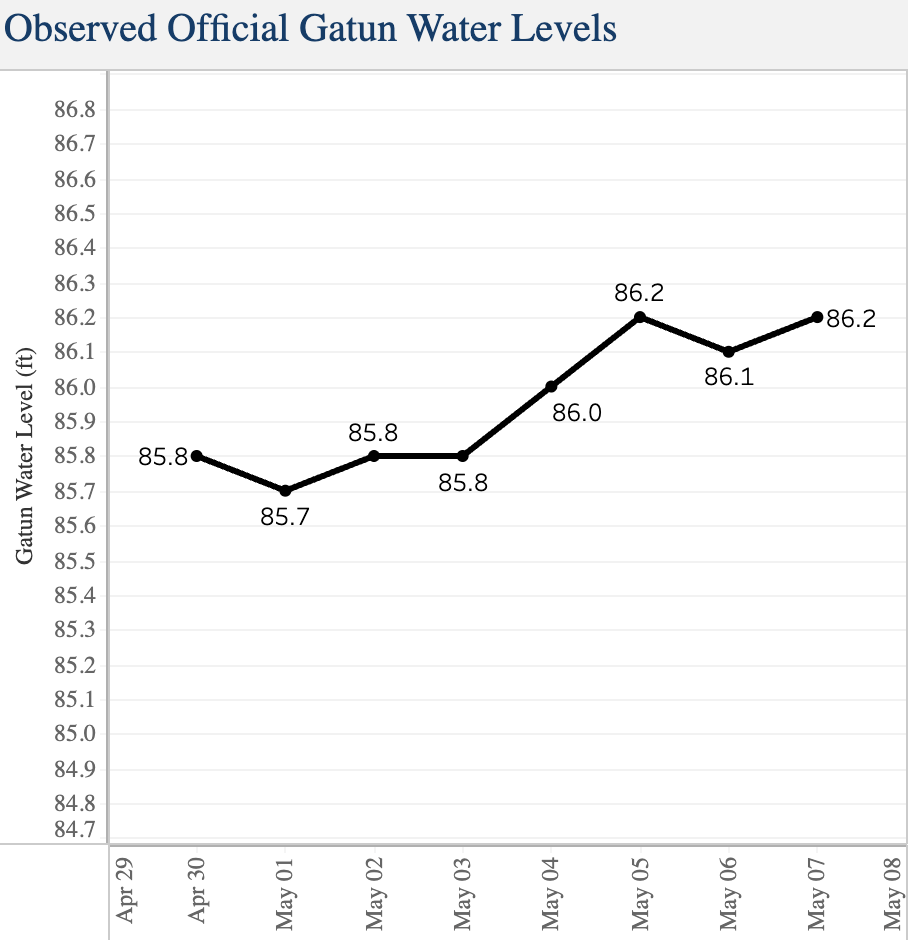
The water level projection plot below does forecast an increase in levels over the next month as expected due to strong precipitation seasonally across the region.
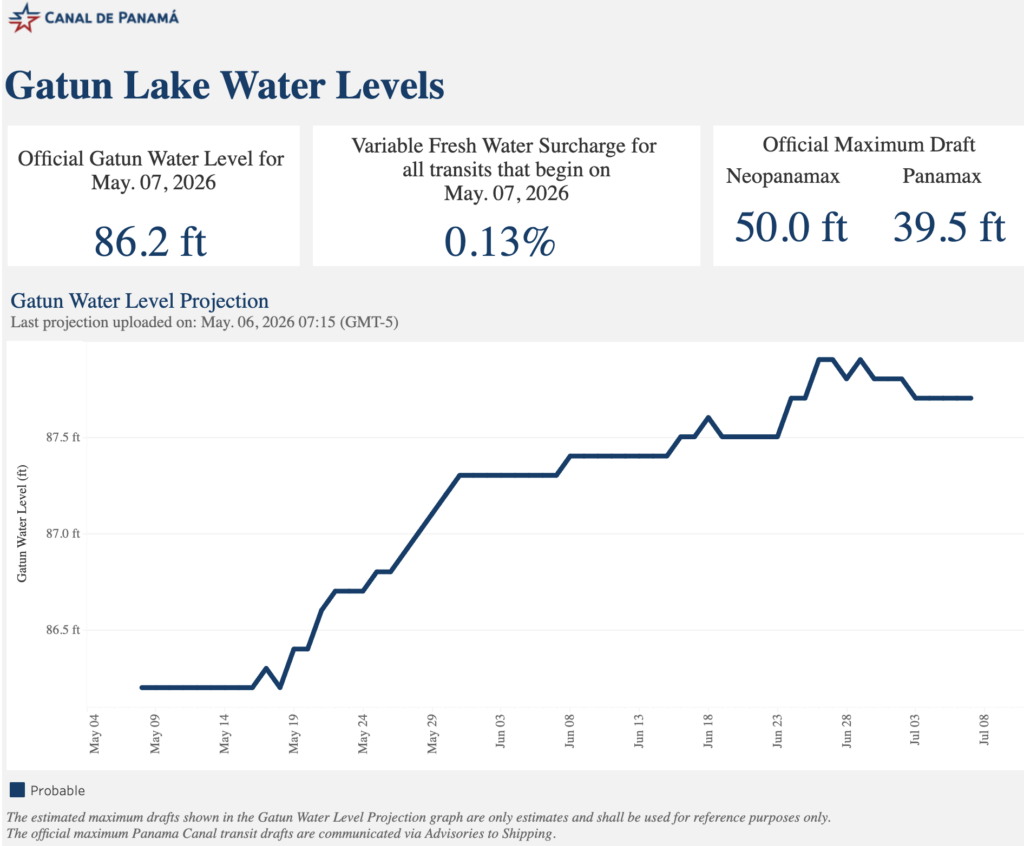
The latest ENSO guidance from the ECMWF below forecasts a strong El Nino developing as we move through the summer and into autumn. A reminder that the 2023-2024 drought occurred during El Nino conditions.
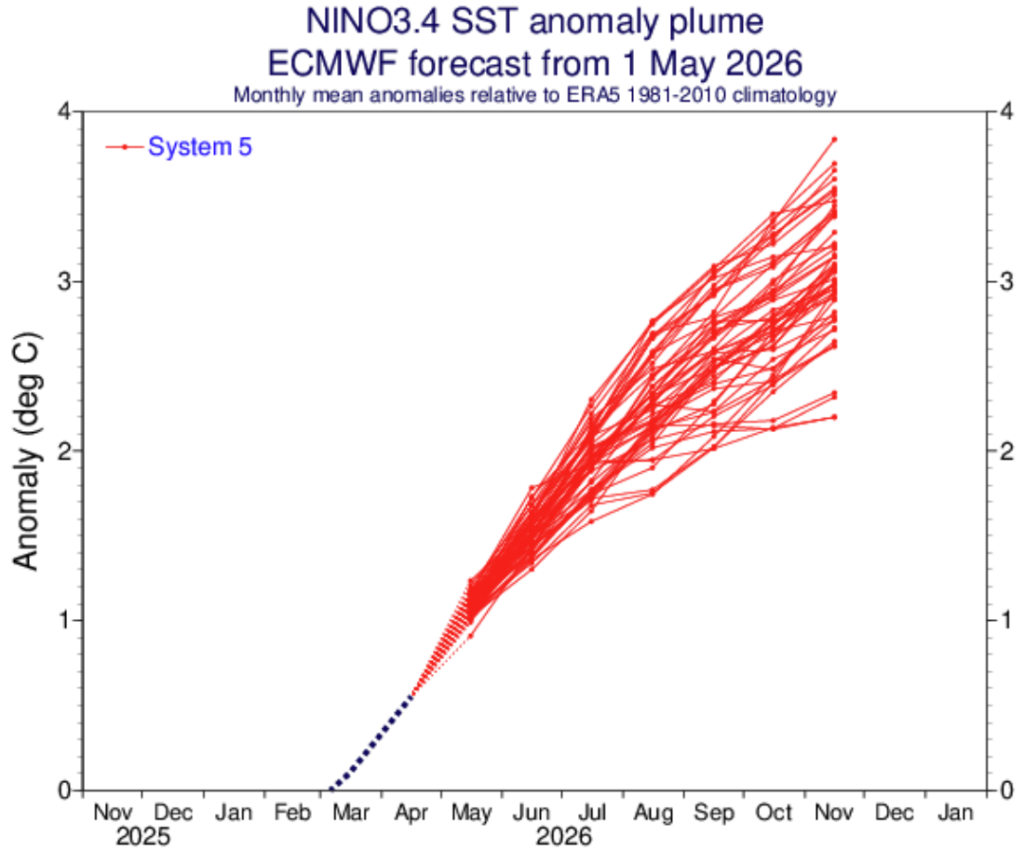
El Nino generally brings drier conditions across the Caribbean, including the Panama Canal region through summer, therefore a close eye needs to be kept on the forecast heading through the year.
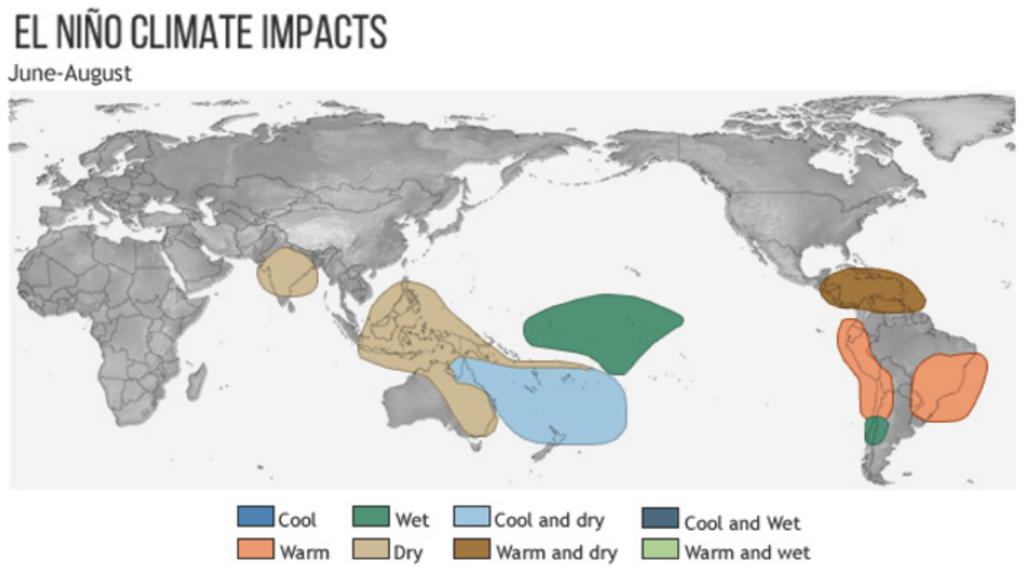
The C3S seasonal guidance shows generally shows near normal precipitation amounts in June, before then drier than normal conditions through the rest of summer and into autumn. This would therefore limit precipitation input into Lake Gatun and have implications on water levels in the Panama Canal through the summer and into autumn. There is the increasing risk that this summer could have vessel restrictions if the expected drought conditions come to fruition.

Bottom line: There is the increasing risk of drier than normal conditions returning across the Panama Canal region moving through 2026 as we transition to a possible strong El Nino state. Drier than normal conditions would limit precipitation input into Lake Gatun which is the main reservoir feeding into the canal. This would therefore have a knock on effect on canal levels which if water levels drop low enough, could potentially lead to vessel restrictions moving through the year.
Published by Amy Hodgson
Here we take a look at the latest hydro situation across Brazil, and the precipitation outlook as we move through Spring and into Summer. The previous Brazil hydro blog issued late March can be found here https://www.ag2trader.com/1-15days/?blogPostID=190361
Brazil is one of the largest producers of hydroelectric power in the world, with the largest hydroelectric dam here being the Itaipu Dam. The primary reason for importing LNG into Brazil is to make up for the lack of electricity produced by the Itaipu Dam and other dams across Brazil, especially during times of drought. During times of drought, Brazil relies upon import LNG to meet its power needs. Therefore it’s crucial to monitor Brazilian precipitation.
Over the past 90 days, conditions have been slightly drier than normal across much of Brazil, except nearer normal across the far east. While over the past 30 days, it’s been particularly dry across south-eastern Brazil.

The latest soil moisture data from NASA shows largely dry soils, particularly across the interior regions of Brazil, although there are some localised wetter soils across the north-east:
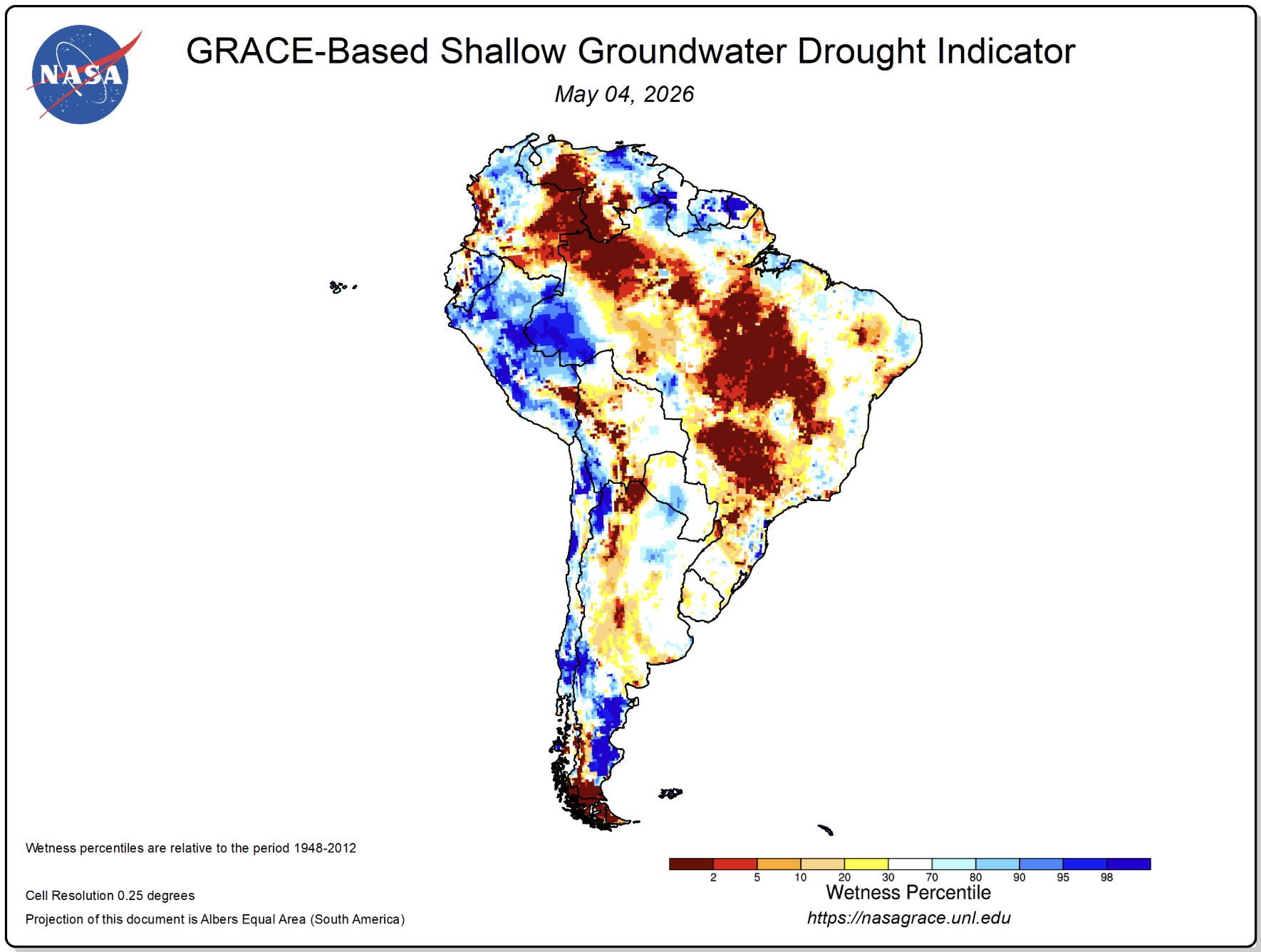
Now looking at the latest hydropower reservoir levels (https://www.ons.org.br/paginas/energia-agora/reservatorios). Compared to our last update https://www.ag2trader.com/1-15days/?blogPostID=190361, levels have increased across all regions. However, southern regions still remain low.
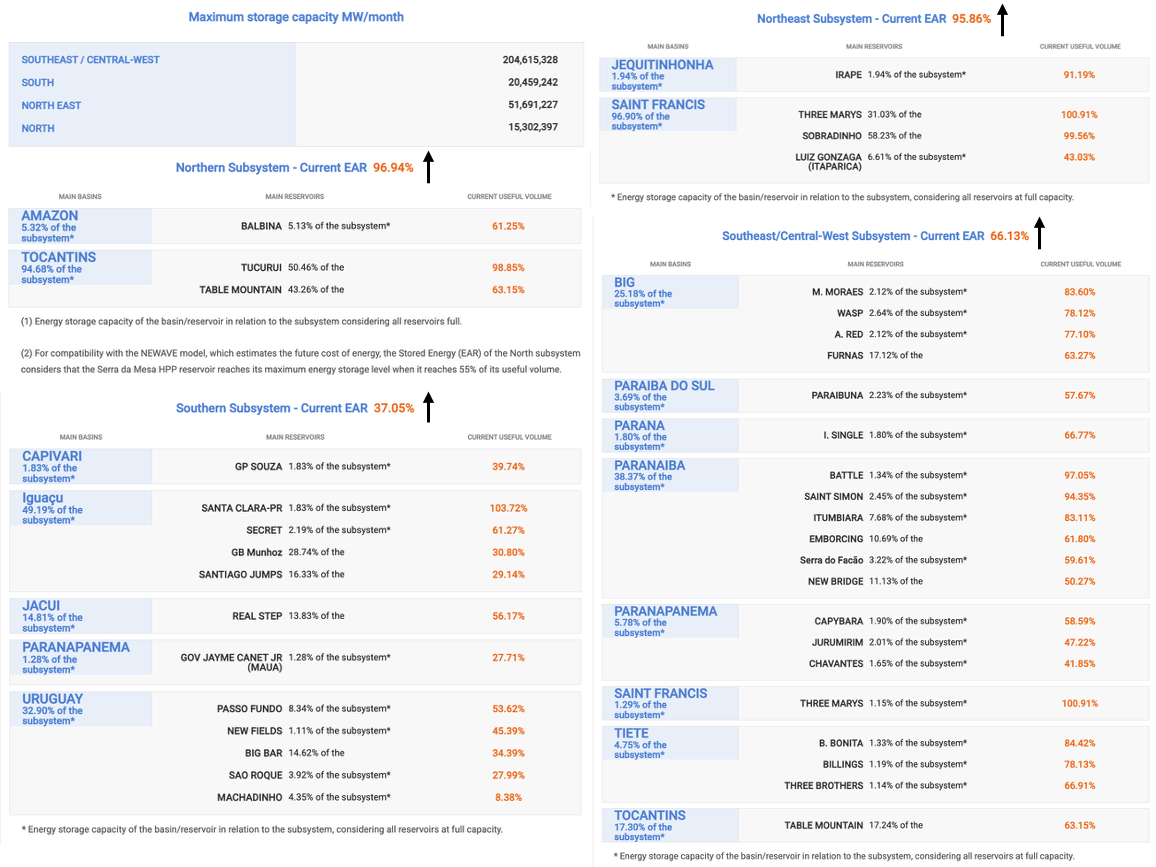
Now looking ahead to the forecast, the precipitation anomalies from the ECMWF and the GFS over the next 15 days are shown below. Generally a dry outlook continuing across much of Brazil, the exception being wetter across the far south, and across the far north.
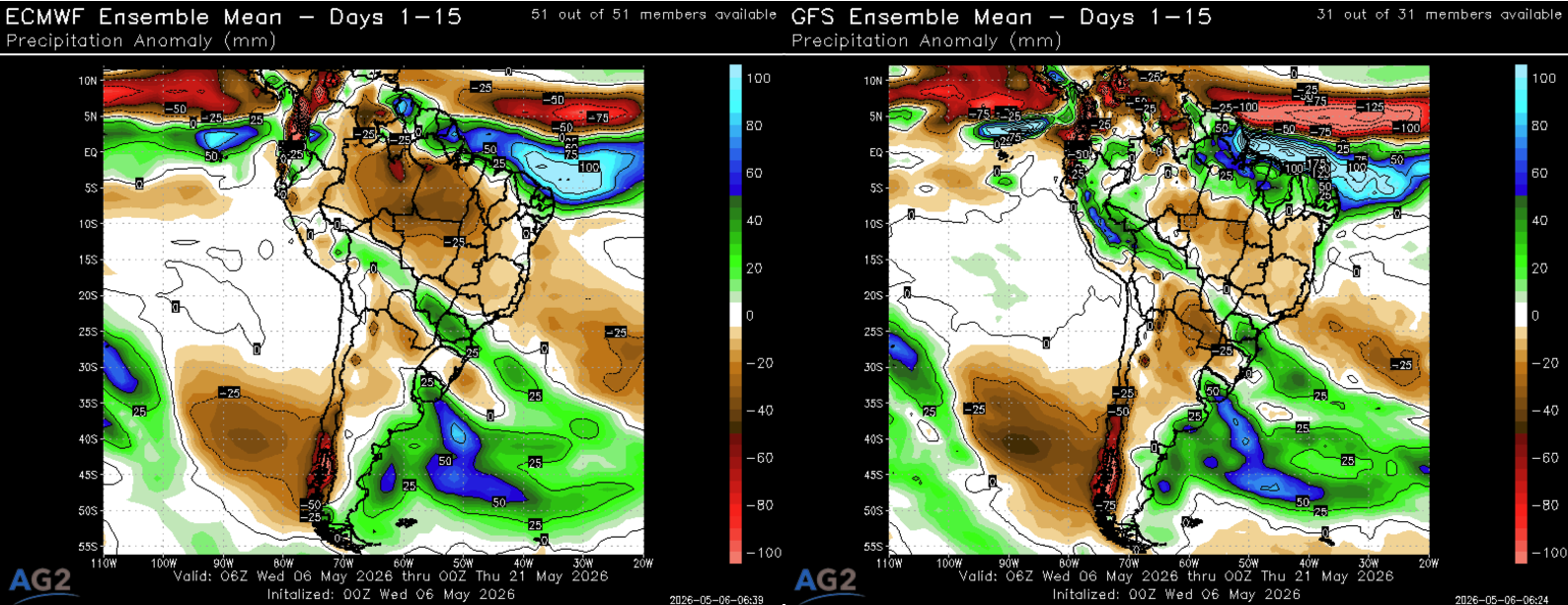
The latest ECMWF weekly below shows wetter conditions across the far north of Brazil weeks 21 and 22, with near normal to drier than normal across much of Brazil. Weeks 23 and 24, generally near normal precipitation across much of Brazil.

The C3S seasonal guidance below shows near normal precipitation forecast through the summer across central Brazil, with a generally drier far north and wetter south pattern.
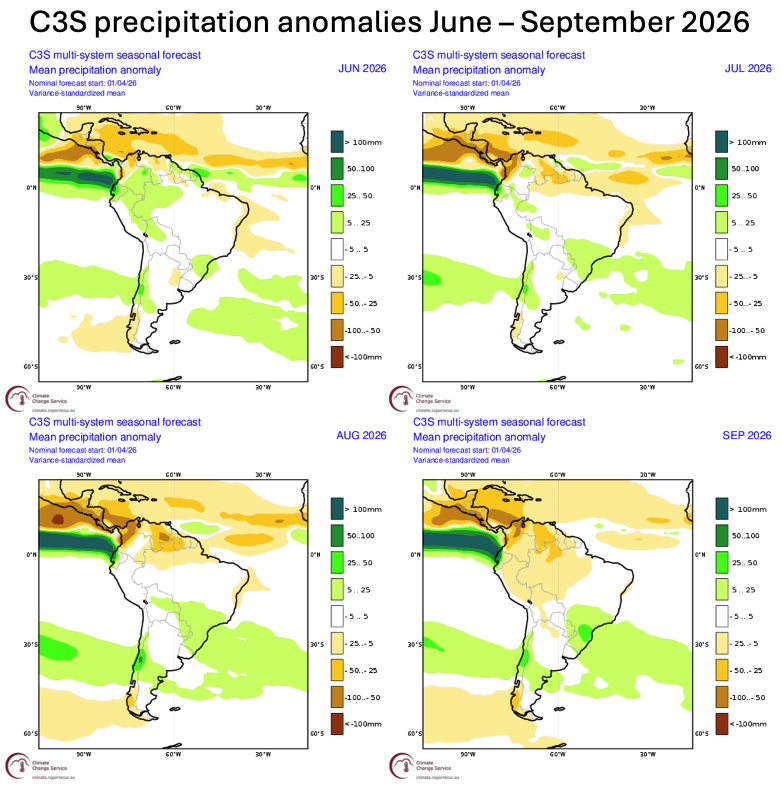
El Nino conditions are forecast as we move through summer, possibly reaching strong levels. El Nino conditions through summer, generally favor a drier Caribbean and into northern Brazil as shown in the graphic below, which is in agreement with the C3S forecast for summer.
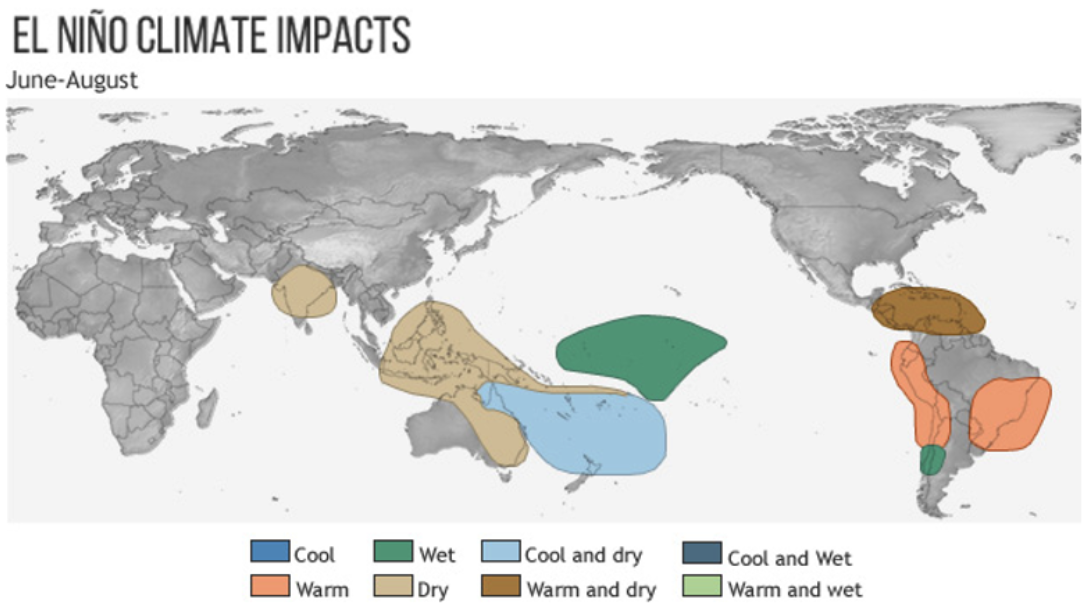
Bottom line: Over the past month reservoir levels across Brazil have increased slightly, however levels across the south remain low. The forecast over the 2 weeks is for generally a dry outlook continuing across much of Brazil, the exception being wetter across the far south, and across the far north. Then through the summer, the C3S seasonal guidance shows near normal precipitation forecast across central Brazil, with a generally drier far north and wetter south pattern. This drier north pattern is typical of an El Nino pattern which is forecast as we move through 2026.
Published by Ed Vallee
Changes:
Week 1-3: Cooler West, Warmer Central
Week 4: Cooler Northeast, Warmer Rockies
Week 5: Cooler PNW
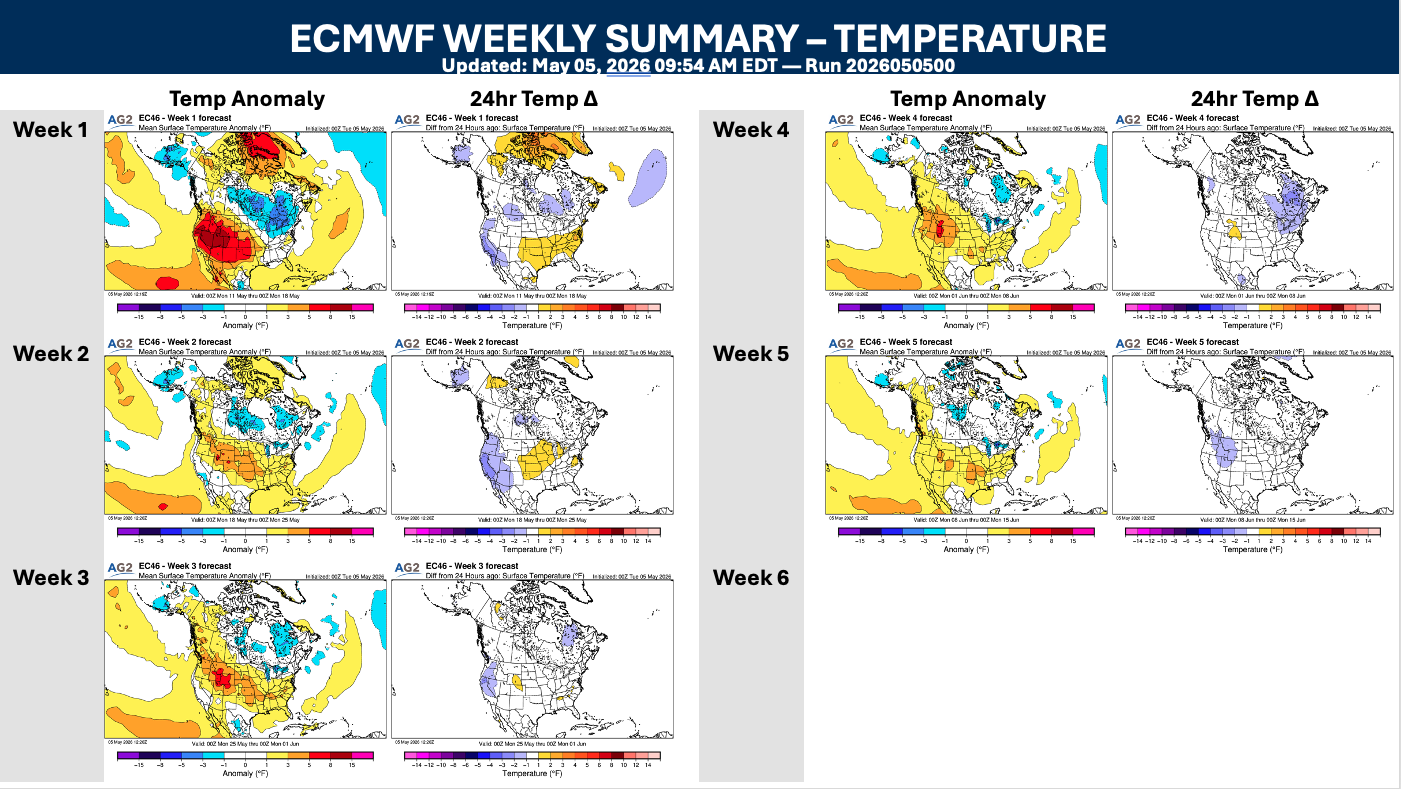
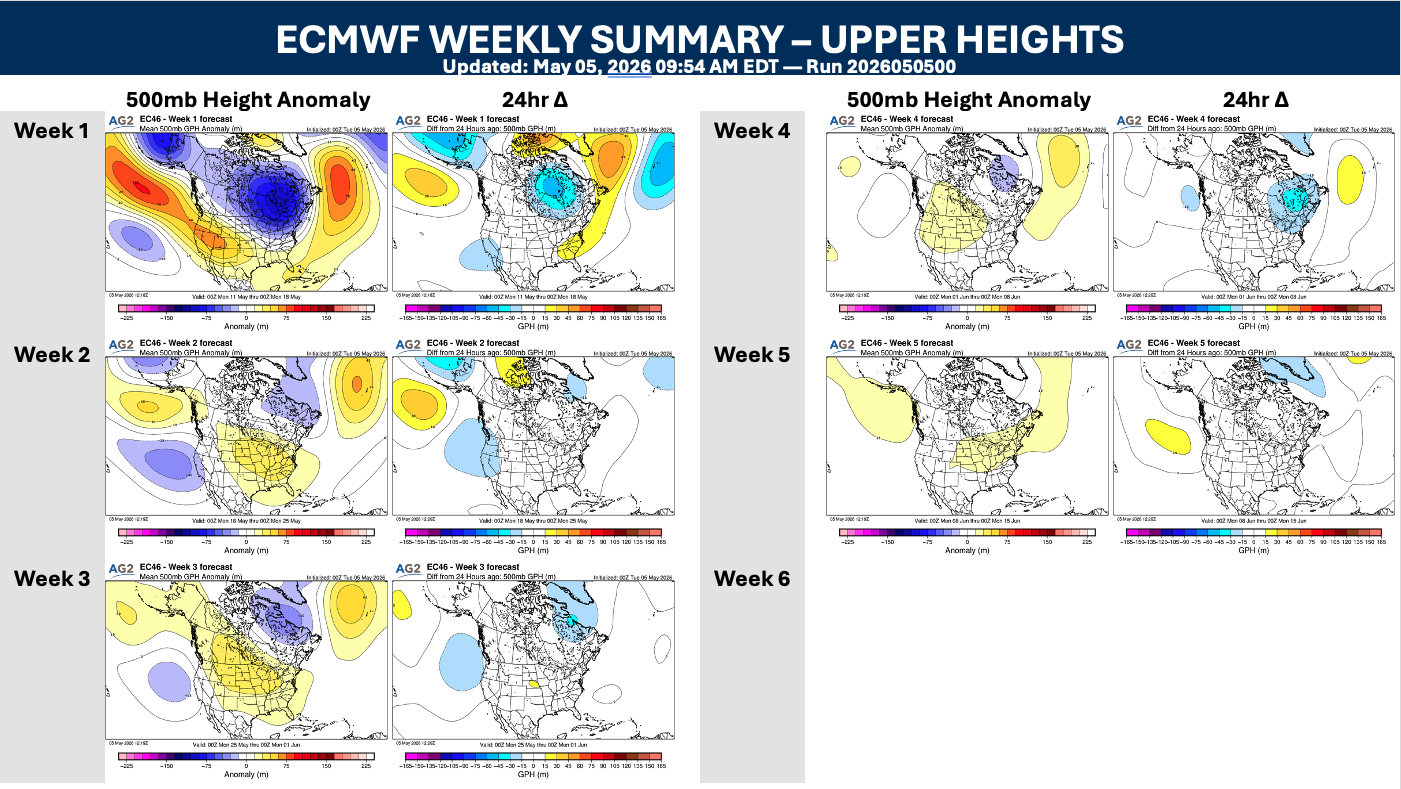
CDD Info noting 10 CDDs gained versus yesterday’s forecast.
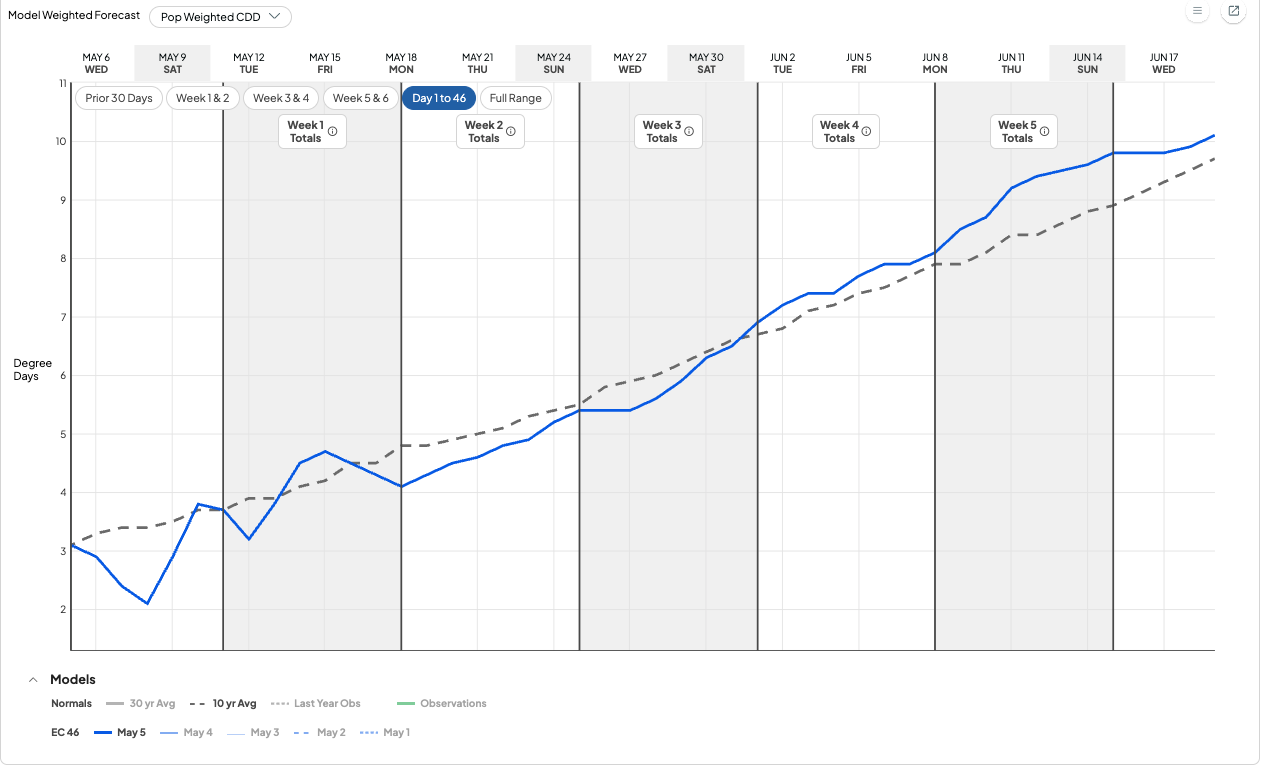

Published by Ed Vallee
Today’s 12z overview for the next 15 days is shown below.

Degree Day Info:
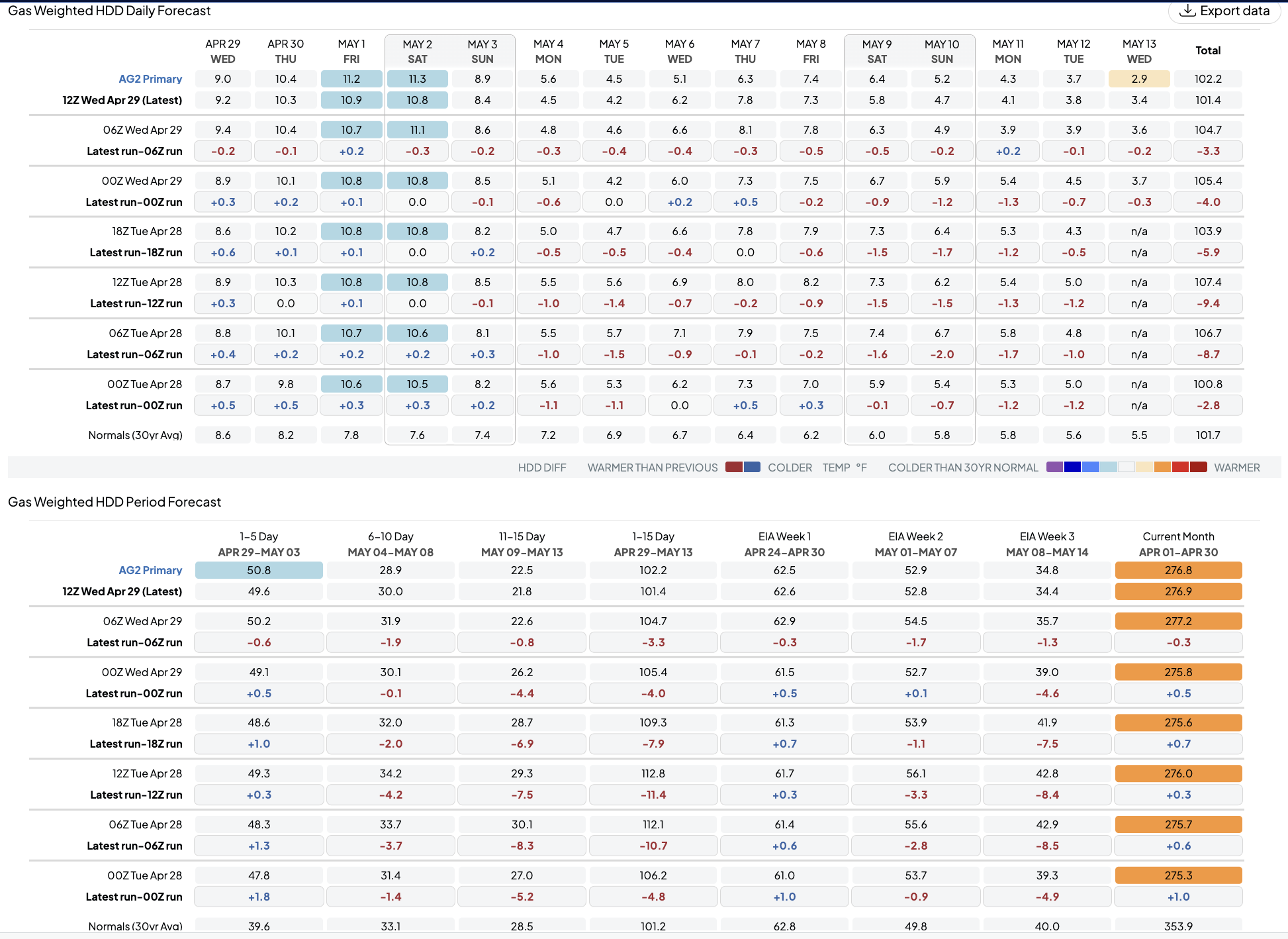
Published by Takahisa Nishikawa
May 1: Cold Air Advection Drives Sharp Temperature Drop
Today’s AG2 forecast brings a meaningful downward revision to temperatures across Japan from April 29 through May 7. The most striking change is in Tokyo, where the daytime high on April 30 has been revised down by 4°C from yesterday’s forecast.

The main driver is cold air advection following a low-pressure system passage. Models are broadly aligned on the depth and position of the associated trough, lending relatively high confidence to this near-term forecast.

From April 29 to May 1, minimum temperatures are expected to fall to single digits across a wide area of northern and eastern Japan. This raises the prospect of an uptick in morning and evening heating demand that warrants attention from power and gas market participants.
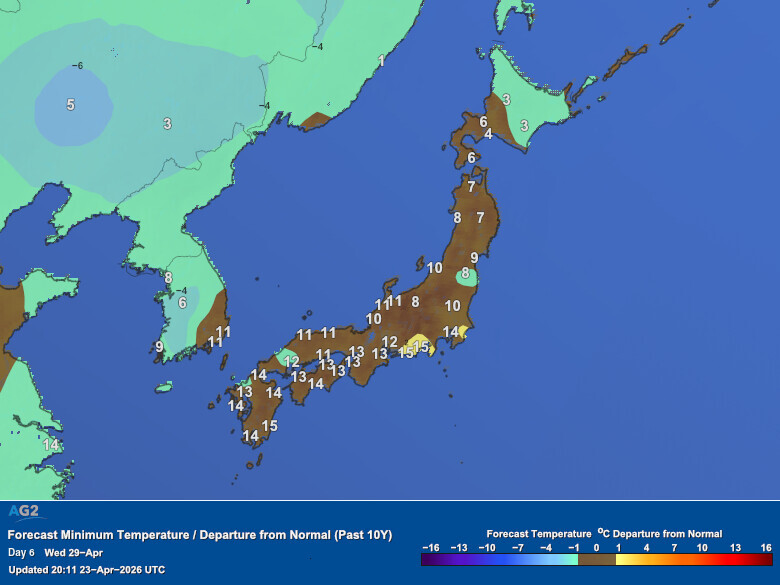
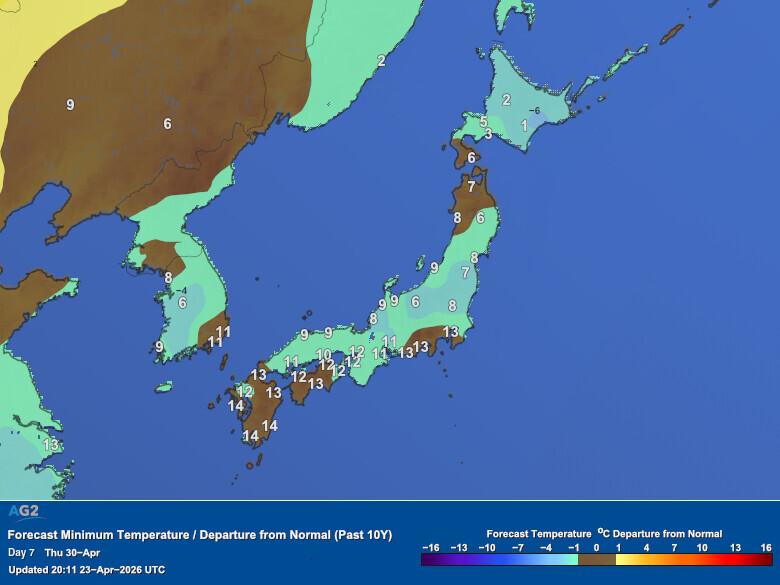
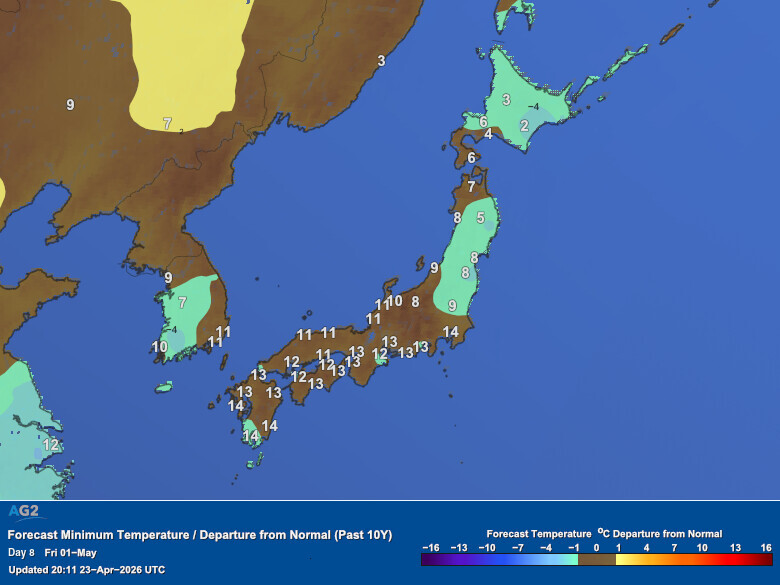
From May 2: Ridge Returns, Temperatures Recover
Will this cold spell last? The answer is no.
From May 2, a ridge pattern is expected to establish itself over Japan, bringing a return to near- to slightly above-normal temperatures.
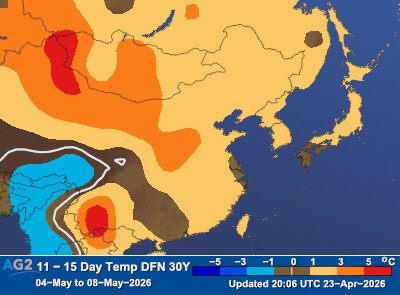
This cold episode should be seen as a short-term fluctuation rather than a signal of any sustained seasonal shift.
Published by Amy Hodgson
Here we take a look at the large scale atmospheric pattern through days 6-10 and 11-15.
The graphics below show the latest ensembles for mid week 16, Wednesday 15th April. The models are in close agreement of a Nordic high, with higher pressure extending across much of Europe.

Then by late week 17, the ensembles below show the high retrogressing to Greenland, with the NAO dropping to negative territory. There’s overall good model agreement in the broad pattern trend to a reduction in the NAO index.

This NAO drop late April has been highlighted for a while now, as the MJO moves across the western Hemisphere:
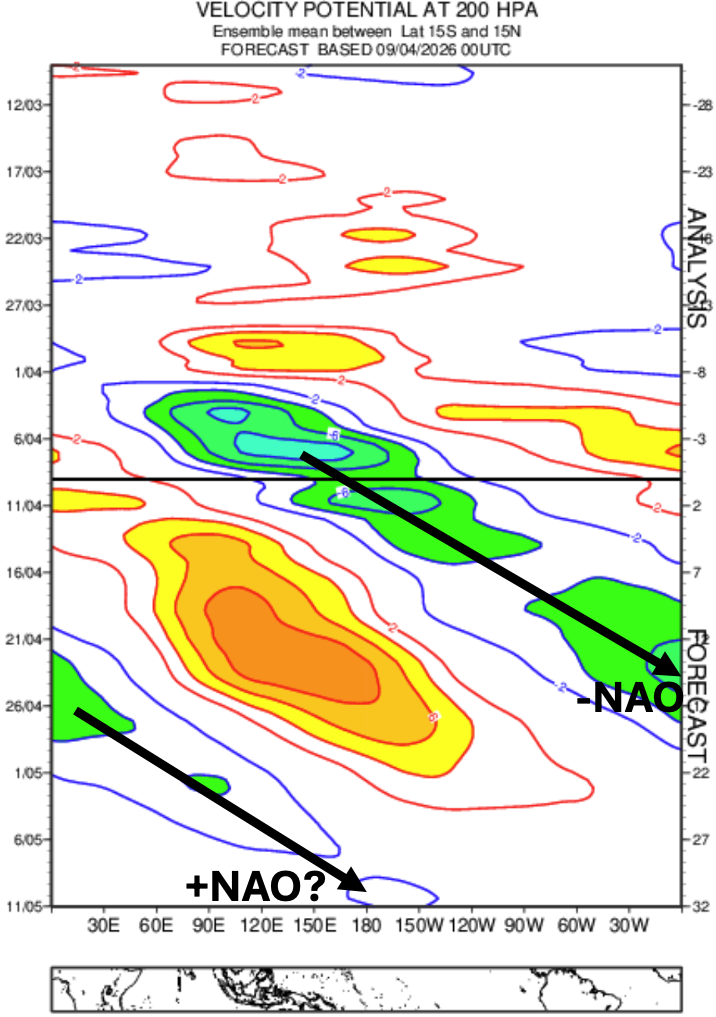
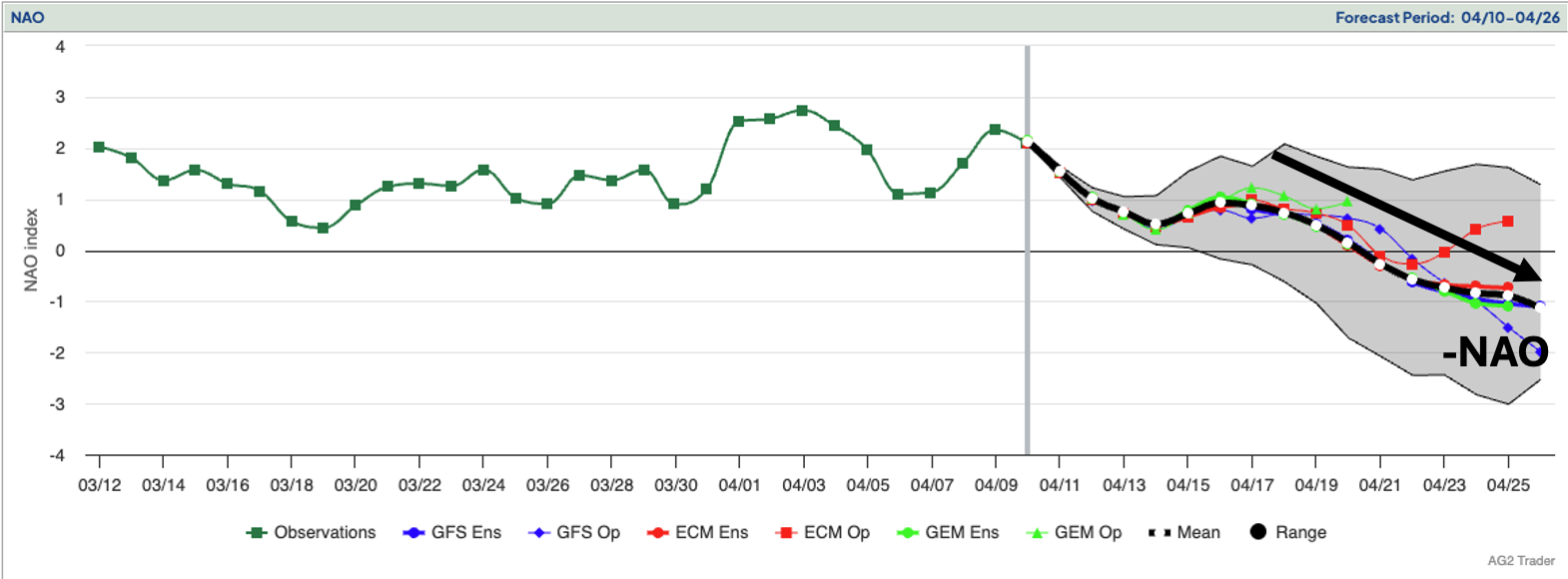
A quick look at the FRisk graphics below actually shows plenty of green across Europe from day 7 onwards indicating lower than normal forecast risk, or that there is higher than normal forecast confidence.

Expectations as the NAO drops to negative week 17?
The latest AG2 temperature forecast for the 11-15 day timeframe is shown below with northern-central to north-eastern Europe highlighted as the area where there is greatest cooler risk to the forecast. Conditions are also forecast to be drier than normal across northern and central Europe, with low winds and high solar here. While to the far south of Europe, slightly below normal to near normal precipitation, mostly low winds and below normal solar potential.

Published by Amy Hodgson
Here, we present the latest Saharan dust outlook across Europe through the rest of this week.
With lower pressure in the vicinity of Iberia, this is resulting in a southerly airflow around it’s western flank, transporting Saharan dust northwards across Iberia:
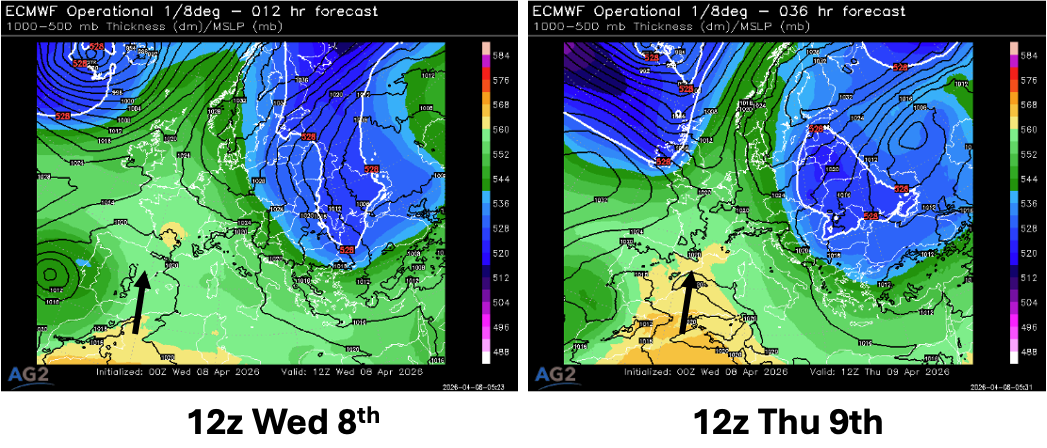
The latest dust load forecast from the University of Athens below shows the highest dust load currently across Iberia to western France. Then by Saturday, elevated levels are forecast across much of western Europe edging into central Europe and across Germany on Sunday which gives the downside risk to solar generation.

The Barcelona Dust Regional Centre dust load forecast below shows a similar pattern of higher levels across Iberia, with lower levels spreading to north-western and central Europe over the next few days.

So why Saharan dust important?
Saharan dust can have an impact on solar power generation both directly and indirectly. Directly, dust in the atmosphere blocks and scatters solar radiation from the sun, hence less incoming radiation hitting solar panels, thereby reducing generation. Dry deposition of the dust directly settling and building up on the panels will also reduce the power generation. Wet deposition, the process of removal of dust from the atmosphere by precipitation can also lead to dust build up on panels and reduced generation. Finally indirectly, Saharan dust in the atmosphere can act as cloud condensation nuclei (CCN), which is needed for clouds to form. Therefore dust in the atmosphere acting as CCN can lead to an increase in cloudiness, thereby reducing incoming solar radiation leading to a reduction in solar generation.
Risks are therefore to the downside for solar across Iberia through the rest of this week, with lower dust levels also reaching across France and then Germany by front weekend.
Published by
Summary: NOAA puts the probability of El Niño this summer above 60%. However, spring forecasts are inherently uncertain. Past cases show that early signals often fail to materialize. Markets may price in El Niño risk, but overconfidence is risky. Treat forecasts as probabilities, not certainties.

Figure 1: ENSO Probabilities by NOAA as of March, 2026
Risks in Spring El Niño Forecasts
NOAA’s latest outlook may have led traders to price in El Niño trend. But building positions based on spring forecasts alone can be risky.
This is due to the “spring predictability barrier,” when forecast skill is structurally lower.
What History Tells Us
2014: Strong signal that failed
- Forecast pointed to a very strong El Niño
- Actual warming was limited
- Strong signals can lead to market overreaction

Figure 2: July SST analysis values (left), forecast (center), and error (right) by JMA with initial values in April 2014
2012: Event declaration reversed
- JMA initially declared an event
- Later revised to no event
- Even “declared” events may not hold

Figure 3: July SST analysis values (left), forecast (center), and error (right) by JMA with initial values in April 2012
Why Spring Forecasts Struggle
From March to May, trade winds and ocean temperatures fluctuate more. This makes initial conditions unstable in models. Forecast skill improves after June as ocean-atmosphere feedback stabilizes.
Trading Implications
1. Keep alternative scenarios
Even if an El Niño is forecast, the underlying warming trend means localized extreme heat cannot be ruled out.
Traders should therefore keep hedges for a “La Niña-like” hot scenario if the forecast fails.
In Japan, this risk is especially important. Under La Niña or neutral conditions, sea surface temperatures east of the Philippines tend to rise. This enhances convection, which strengthens the Pacific High (PJ pattern). As a result, the risk of extreme heat in Japan increases.
In short, even without El Niño, the risk of a hot summer remains significant.
2. Avoid full commitment until forecast convergence in June
Forecast skill tends to improve after June, once the spring predictability barrier passes.
JMA data shows that forecasts issued in April lose accuracy beyond a three-month horizon, while forecasts from June maintain relatively better skill up to six months ahead.
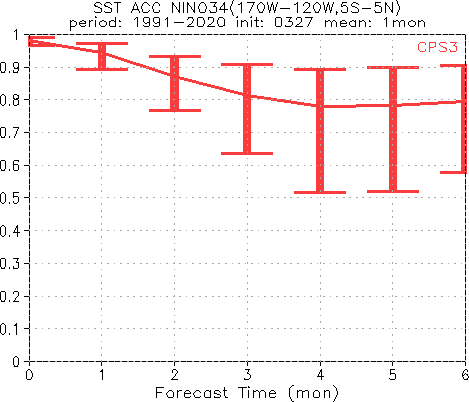
Figure 4: SST accuracy evaluation of the Niño 3.4 area with initial values in April

Figure 5: SST accuracy evaluation of the Niño 3.4 area with initial values in June
This highlights the high uncertainty in spring forecasts.
Until then, it is prudent to keep positions smaller and manage volatility using options or similar tools.
3. Watch the Pacific High directly
Japanese demand depends more on the Pacific High than ENSO itself. Monitoring its strength can help detect forecast errors early.
Bottom line: El Niño forecasts are probabilistic, not certain. History shows that forecasts can fail. Flexible scenario planning remains essential for energy markets.
Published by Ed Vallee
This blog takes a look at the latest drought monitor, which was issued on April 2nd.
The latest drought monitor is below, noting drought coverage is up to 80.01 % (up from 77.14% last week).
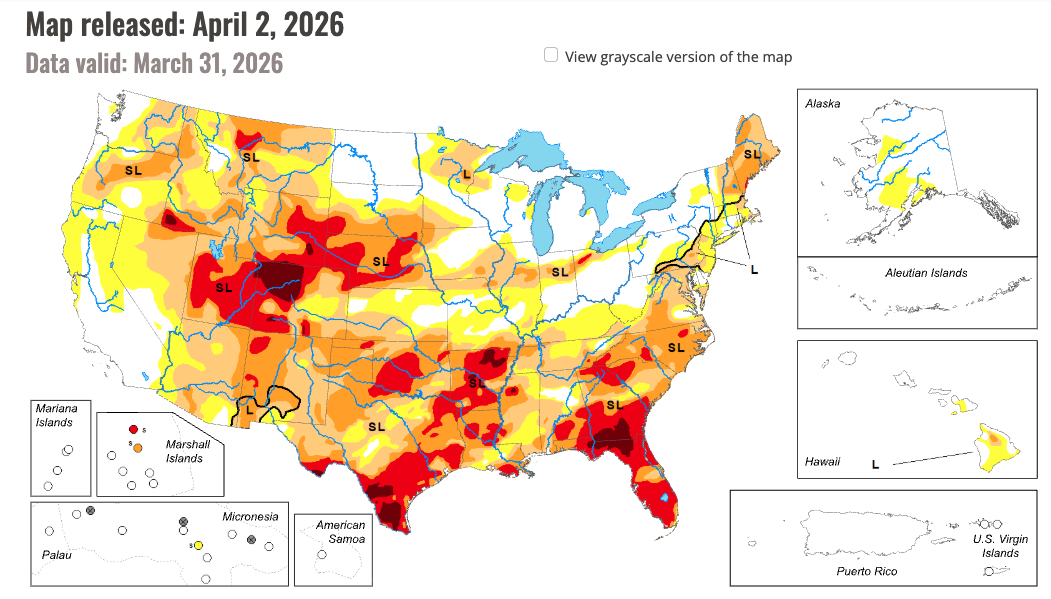
Month over month change maps are below. The most notable trends in the last month are wetter in parts of the Ohio River Valley and Northeast, but drier in parts of the Rockies, Plains, South, and West.

The forecast over the next 15 days is fairly dry across the West and Southeast, but the Central U.S. looks active!